
Real Estate Fund Manager: The Architect’s Path to Institutional Scale in 2026
If you're still raising capital on a deal-by-deal basis, you aren't building a legacy; you're just managing a high-stress job. The era of the frantic operator is over, and the era of the institutional architect has arrived. To break the seven-figure ceiling and command the $172 billion in private real estate capital that flooded the market in 2025, you must transition into the role of a professional real estate fund manager. This isn't just a title change. It's a fundamental shift in your business operating system that replaces capital raising fatigue with absolute discretionary control.
You know the exhaustion of seeing a prime asset slip away because your syndication timeline couldn't keep pace with the market's velocity. We understand that operational bottlenecks are the primary barriers standing between your current portfolio and institutional-grade scale. This article details exactly how to evolve from a deal-driven operator into the CEO of a private equity firm. We'll explore the impact of the June 29, 2026, SEC threshold increases to $1.4 million in assets under management and provide the strategic framework you need to secure an unrivaled advantage in the 2026 landscape.
Key Takeaways
- Learn the critical distinction between tactical asset management and strategic wealth architecture to evolve into a visionary CEO of capital.
- Master the structural shift from deal-by-deal syndication to becoming a professional real estate fund manager to unlock the power of discretionary capital control.
- Discover how to eliminate the investor-by-investor approval bottleneck, enabling your firm to close institutional-grade assets with unrivaled speed.
- Identify the infrastructure requirements and compliance standards necessary to transition from selling individual deals to managing high-level investor relationships.
- Implement a standardized business operating system that transforms your current hustle into a predictable, scalable private equity firm.
Defining the Real Estate Fund Manager: The CEO of Capital Architecture
The role of a real estate fund manager is the ultimate evolution for the elite operator. It represents the transition from a deal-driven "hustler" to the CEO of a sophisticated financial engine. While the average syndicator spends their days in a state of perpetual capital raising fatigue, the fund manager operates from a position of strength. They don't just find buildings; they architect wealth. This distinction is critical for those who have outgrown the noise of entry-level flipping and are ready to command institutional-grade capital.
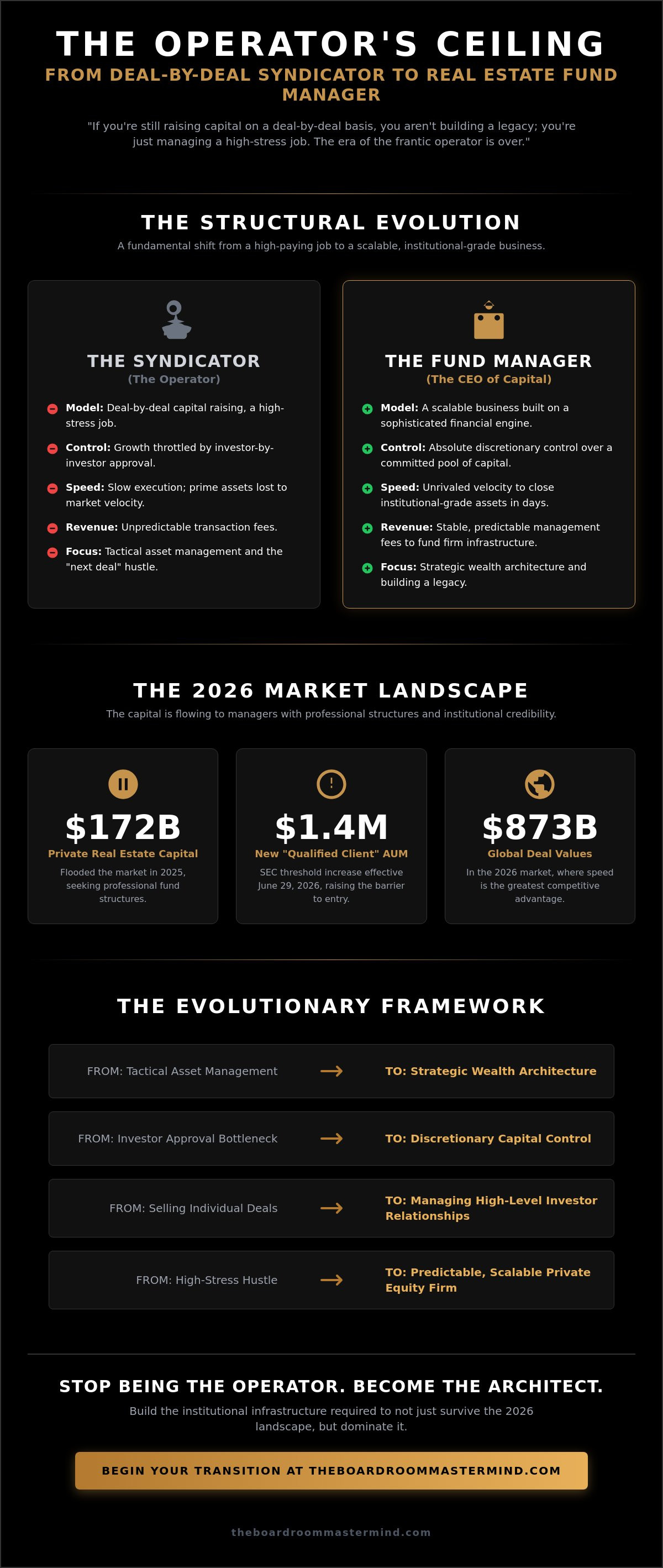
Asset management is tactical. It's the grind of property-level execution, lease-ups, and renovations. Fund management, however, is strategic wealth architecture. It involves the high-level deployment of discretionary capital across a diversified portfolio. This distinction is why the world's leading real estate investment firms focus on the fund model rather than individual syndications. In the 2026 market, where global deal values climbed to $873 billion, the ability to move with speed is your greatest competitive advantage. With the SEC increasing the "qualified client" AUM threshold to $1.4 million on June 29, 2026, the barrier to entry for professional management has never been clearer or more rewarding for those who qualify.
The Shift from Deal-Finder to Wealth Architect
Operators who have outgrown the cycle of individual deals often hit a ceiling. They have the skill, but they lack the structure. Transitioning to a real estate fund manager role allows you to replace the frantic energy of deal-by-deal chasing with the calm of institutional credibility. You're no longer selling a single property to a nervous investor. You're inviting partners into a vision. It's a fundamental pivot from "finding the next deal" to constructing a portfolio that leverages collective intelligence to mitigate risk.
If you want to scale to nine figures, you must stop being the person who does the work and start being the person who owns the system. This path is the logical conclusion for those seeking an unrivaled legacy. You can explore how this transition looks for the industry's top 1% through The Boardroom experience. By standardizing your business operating system, you ensure that your investment outcomes are repeatable and predictable. This is how you build a firm that doesn't just survive the 2026 landscape but dominates it.
The Structural Evolution: Syndication vs. Professional Fund Management
Syndication is a high-paying job. Fund management is a scalable business. If you're operating on a deal-by-deal basis, you're trapped on a treadmill of perpetual capital raising where your growth is throttled by investor-by-investor approval. A professional real estate fund manager breaks this cycle by securing discretionary capital. This shift allows you to close on institutional-grade assets in days rather than months. While the average syndicator is still circulating a pitch deck, the fund manager has already executed the purchase agreement, leveraging a pool of capital that is ready for immediate deployment.
Institutional credibility is the primary currency of the 2026 market. Family offices and sovereign wealth funds rarely participate in one-off syndications; they seek the sophisticated reporting and diversified risk profiles that only a fund can provide. In 2025, private real estate fundraising reached $172 billion because capital flowed toward managers who offered professional structures. A real estate fund structure is the blueprint for institutional scale. By moving to this model, you replace unpredictable transaction fees with stable, predictable management fees that fund your firm's infrastructure and long-term legacy.
Managing the Capital Stack at Scale
Scaling to nine figures requires a mastery of complex financial engineering. You aren't just looking for equity; you're integrating senior debt, mezzanine financing, and preferred equity into a cohesive strategy. This level of sophistication is what separates the "hustler" from the architect. Understanding the Real Estate Capital Stack: The Architecture of Institutional-Grade Deals is essential for optimizing your returns and protecting your downside in a selective recovery environment.
The GP/LP Dynamic in 2026
The relationship between the General Partner (GP) and Limited Partner (LP) has evolved. To attract high-net-worth individuals in a landscape where 57% of institutional investors intend to increase commitments, your promote and waterfall distributions must be flawlessly structured. This alignment ensures that as you achieve eight-figure growth, your investors see the unrivaled value of your collective intelligence. You can refine these high-stakes structures by consulting our guide on Real Estate Fund Structure. For those ready to move from operator to owner, The Boardroom Mastermind Membership provides the inner circle access needed to execute these strategies without the stress of trial and error.
Core Competencies of Elite Real Estate Fund Managers
Commanding institutional capital requires more than a track record. It demands a total transformation of your operational identity. As a real estate fund manager, your primary product is no longer the property; it is the certainty of your execution. This certainty is built on four pillars of elite competency that separate the market leaders from the noise. If you cannot provide institutional-grade transparency, you will remain relegated to the frantic world of retail syndication.
Mastering fiduciary responsibility is the first hurdle. With the SEC increasing the "qualified client" net worth test to $2.7 million on June 29, 2026, your compliance and reporting systems must be bulletproof. Institutional investors do not tolerate ambiguity. They demand transparent, data-driven reporting that protects their capital and your legacy. Simultaneously, your approach to investor relations must shift from a sales function to a relationship architecture. You aren't selling a deal; you're managing a high-stakes partnership. This requires a level of strategic proximity to other nine-figure founders who understand the pressures of scaling. Success at this level is a result of collective intelligence, not isolated effort.
Leadership and the A-Player Team
Your capacity to scale is limited by the talent you can attract. A fund manager is only as strong as their executive leadership. You must build a team of A-players who handle the tactical execution so you can focus on high-level capital deployment. If you are still the smartest person in every meeting, you haven't built a business; you've built a cage. Learn how to construct this engine in our guide on Building a Leadership Team: The CEO’s Blueprint for 8-Figure Scale.
The CEO Mindset Shift
The most difficult transition isn't financial; it's psychological. You must stop being the person who does the deals and start being the person who builds the business that does the deals. This shift from operator to owner is the only way to achieve scaling without the stress. This mental pivot allows you to focus on portfolio construction rather than individual property fires. Explore the Operator to CEO Mindset Shift to understand the mental framework of the world's most successful managers. If you are ready to stop the hustle and start the legacy, apply for the inner circle at The Boardroom.
Building the Infrastructure for Discretionary Capital
Infrastructure isn't just software; it's the standard for how you deploy capital. If your business model still relies on your personal presence for every decision, you haven't built a fund; you've built a trap. To operate as an elite real estate fund manager, you must first audit your current operations to identify the bottlenecks preventing institutional-grade scale. This means standardizing your "Business Operating System" to ensure that every investment outcome is repeatable and every reporting cycle is flawless. By May 2026, the gap between the "mega-managers" who captured 40% of the total capital raised in 2025 and the fragmented operators has widened. You close that gap through systems, not effort.
Your 2026 roadmap starts with a clear trajectory. A $10 million first fund is the proof of concept. A $100 million portfolio is the legacy. To bridge this gap, you need the "unfair advantage" of collective intelligence. Accessing off-market deal flow and high-level capital partners isn't a matter of luck. It's a matter of proximity. When you align your firm with the right peer network, you bypass the learning curves that stall your competitors. You don't have time for trial and error when the global deal value is hitting $873 billion.
Leveraging Institutional Capital
Attracting family office investment requires a shift in positioning. These entities aren't looking for a "deal"; they're looking for a professional steward of wealth who understands the nuances of the 2026 tax landscape, including the California market-based sourcing regulations effective January 1, 2026. You must demonstrate that your fund can handle the complexity of domicile-based fee sourcing. Learn how to tailor your approach in our guide on Family Office Real Estate Investing.
The Boardroom Advantage
The highest-level fund managers don't operate in a vacuum. They thrive in environments where eight and nine-figure strategies are the baseline. If you're ready to stop the deal-by-deal grind and start architecting a firm that commands institutional respect, you need the right inner circle. You can't achieve peak performance while sacrificing your personal freedom to the hustle. Discover the Boardroom Experience and scale your fund without the stress.
Architecting Your Nine-Figure Legacy
The transition from operator to owner is the only logical move for those who refuse to be throttled by the limitations of deal-by-deal syndication. By evolving into a professional real estate fund manager, you secure the discretionary control required to dominate a market where global deal values reached $873 billion in 2025. We've established that institutional scale is built on bulletproof fiduciary systems and a leadership team of A-players who can navigate the June 29, 2026, SEC threshold increases with precision.
Success at this level isn't achieved in a vacuum; it's the result of being inside the right room. Apply to Join the Boardroom Inner Circle to gain access to an exclusive network of seven, eight, and nine-figure real estate entrepreneurs. Through our quarterly in-person intensives, we'll audit your fund structure and provide the battle-tested frameworks needed for scaling without the stress. Your ascent to a nine-figure legacy is the inevitable conclusion of the right strategic framework. The path is clear for those ready to lead.
Frequently Asked Questions
What is the primary difference between a real estate fund manager and a syndicator?
A real estate fund manager maintains total discretionary control over a pool of capital, while a syndicator must seek investor approval for every specific deal. This structural shift allows fund managers to act with institutional speed, closing assets in days rather than months. While syndication is a transaction-heavy job, fund management is a scalable business model built on predictable management fees and strategic portfolio architecture.
How much capital do I need to manage to be considered an institutional-grade fund manager?
While the SEC qualified client threshold for performance fees sits at $1.4 million in assets under management as of June 29, 2026, true institutional status generally requires a portfolio exceeding $50 million. Family offices and sovereign wealth funds typically look for managers who can deploy significant tranches of capital without representing the entirety of the fund's assets. In 2025, capital concentration favored those who could demonstrate this level of operational depth and scalability.
Is a real estate fund manager responsible for day-to-day property management?
No, the fund manager focuses on capital architecture and portfolio-level risk rather than fixing toilets or managing tenants. Day-to-day operations are delegated to third-party property managers or internal asset management teams. This separation ensures the CEO remains focused on high-level deployment and investor relations, maintaining the clarity needed to scale to nine figures without the stress of tactical execution.
Can I transition from wholesaling or flipping to fund management directly?
Transitioning from active flipping to the role of a real estate fund manager is possible, but it requires abandoning the "hustler" mindset in favor of a CEO framework. Wholesalers move individual contracts; fund managers move institutional capital. This shift demands a standardized business operating system and an A-player leadership team to handle the high-stakes compliance and reporting required to attract sophisticated high-net-worth individuals.
What are the typical fees a real estate fund manager charges?
The traditional two-and-twenty model has shifted toward a more selective structure for emerging managers in 2026. You'll frequently see management fees ranging from 1% to 1.5% and performance fees between 10% and 15% as managers align their interests with institutional partners. These fees provide the stable cash flow necessary to fund your firm's infrastructure while rewarding the unrivaled performance you deliver to your inner circle of investors.


