
Family Office Real Estate Investing: The Architect’s Guide to Institutional Capital
The relentless hustle of $50,000 syndication checks is the silent killer of true scale. You're likely running on a capital-raising treadmill that prioritizes volume over velocity, leaving you trapped in the weeds of retail investor relations. It's a common bottleneck for high-performers who've mastered the deal but haven't yet mastered the machine. If you want to dominate family office real estate investing, you must stop thinking like a deal-finder and start operating like an architect.
You already know that managing a roster of 200 individual personalities isn't a sustainable path to a nine-figure legacy. It's frustrating to lack the institutional-grade reporting systems that the world's $6 trillion family office sector demands for entry. This guide provides the strategic framework to transition from a frantic operator to a sophisticated investment architect. We'll explore the specific systems, structural optimizations, and Inner Circle access points required to secure 8-figure checks from single sources and build a portfolio that compounds for generations.
Key Takeaways
- Navigate the shifting landscape of family office real estate investing by moving beyond blind-pool funds into high-conviction, direct opportunistic deals.
- Engineer an institutional-grade investment architecture that centralizes property data and optimizes the capital stack for sophisticated wealth partners.
- Align your acquisition strategy with the "Legacy Play" to attract capital from families focused on generational compounding rather than short-term exits.
- Execute the critical mindset shift from operator to CEO, leveraging an A-Player leadership team to manage the expectations of the world’s most discerning investors.
The Landscape of Family Office Real Estate Investing in 2026
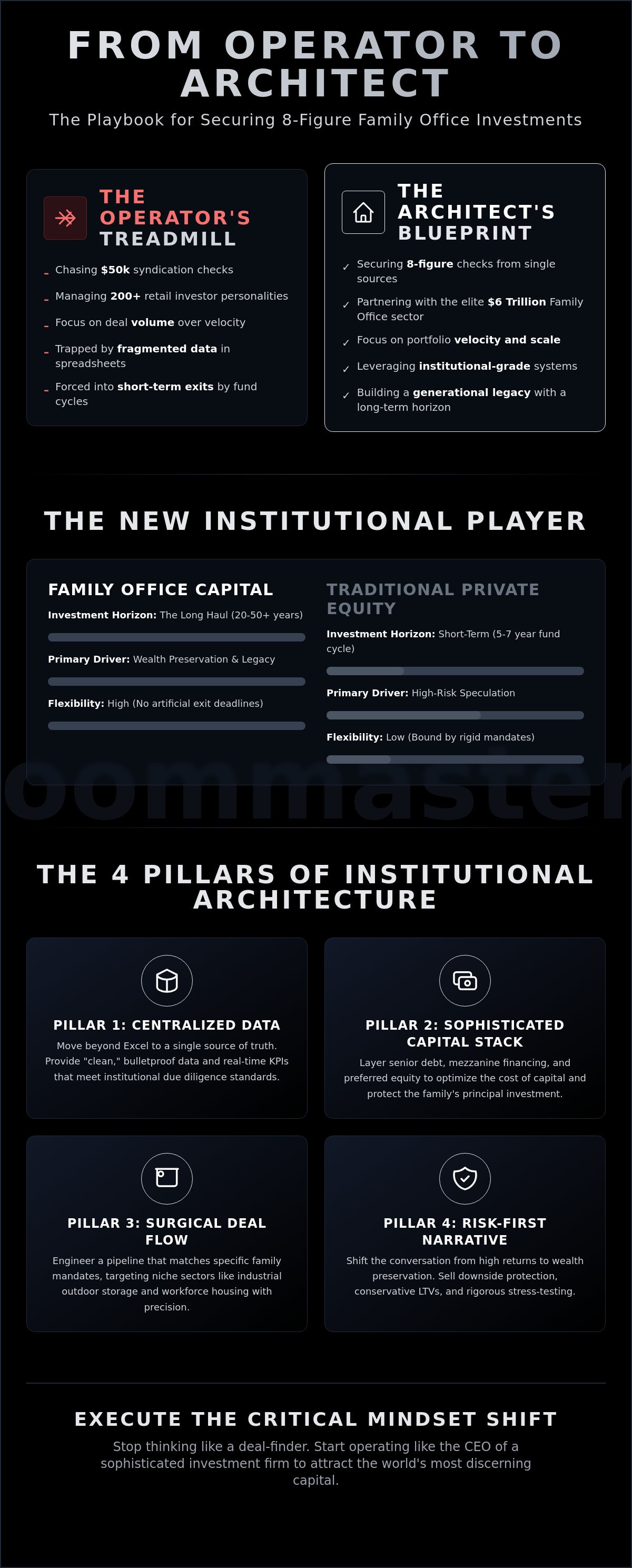
Family office real estate investing has transitioned from a quiet side-allocation into a dominant, direct market force. By 2026, private wealth vehicles are projected to manage over $5.4 trillion in assets globally. This isn't just passive capital; it's a strategic takeover of the capital stack. To understand the shift, one must first grasp what a family office is and how it functions as a private wealth management firm for the ultra-high-net-worth (UHNW) elite. These entities have moved beyond the blind-pool fund model. They now demand direct, non-institutional partnerships that offer transparency and control. In the current cycle, family office real estate investing represents the gold standard for architects of long-term wealth.
The 2026 market dictates a new hierarchy. Family offices are now the new institutional players, often outbidding traditional firms on prime assets. Their primary driver isn't the frantic chase for high-risk speculation. It's wealth preservation. They seek assets that anchor a 100-year legacy. They value the compounding power of high-quality real estate over the volatile returns of the equity markets. This is strategic architecture at the highest level. If you aren't positioned to speak their language, you're already behind.
Direct Investing vs. Traditional Private Equity
The contrast between family capital and traditional private equity is stark. Private equity is bound by rigid mandates and arbitrary fund cycles. Most funds operate on a 5-7 year exit timeline. They're forced to sell when the clock runs out, often leaving significant value on the table. Family offices don't play by these rules. Their investment horizon is the long-haul. They can hold an asset for 20 years or 50 years if the cash flow supports the family's multi-generational goals. This flexibility is their unfair advantage. It allows for scaling without the stress of artificial deadlines. While institutional funds are scrambling to meet quarterly benchmarks, family offices are busy building empires that last.
Engineering an Institutional-Grade Investment Architecture
Scaling to 8-figure capital raises isn't about working harder; it's about the architecture of your data. If your property management metrics are fragmented across three different softwares and a dozen local operators, you're a liability. Family offices demand "clean" data. This means centralizing every line item, from utility slippage to fee oversight, into a single source of truth. A spreadsheet is a static snapshot of a dynamic problem; it's the enemy of the elite sponsor. Moving beyond Excel into a dedicated platform ensures that your reporting is bulletproof when the due diligence team arrives.
Sophisticated family office real estate investing requires a capital stack that mirrors institutional complexity. You're no longer just balancing debt and equity. You're layering senior debt, mezzanine financing, and preferred equity to optimize the cost of capital while protecting the family’s position. A 2023 analysis of family office investment trends shows a distinct pivot toward niche sectors like industrial outdoor storage and workforce housing. Your deal-flow engine must be engineered to match these specific mandates with surgical precision. If your pipeline doesn't produce 5 to 10 qualified opportunities for every one deal you close, your engine isn't built for scale.
Transparency and Reporting Standards
The "Institutional Standard" is defined by quarterly reporting that includes full business audits and real-time performance tracking. You can't rely on manual updates. Implementing a business operating system provides the visibility required to maintain trust. This system ensures that every stakeholder has access to the same KPIs at the same time, eliminating the information asymmetry that kills deals. If you want to see how elite operators structure these systems, you should explore our case studies for real-world frameworks.
Risk Mitigation as a Value Proposition
Stop selling high returns. The wealthiest families prioritize wealth preservation over speculative upside. You must shift the narrative to risk-adjusted growth. Downside protection in commercial multifamily is the structural insulation of principal through conservative LTV ratios, rigorous stress-testing of exit cap rates, and preferred return hurdles that prioritize investor distributions over sponsor promotes. By focusing on the "floor" of the investment, you demonstrate the calculated confidence that characterizes the inner circle of global wealth managers.
Strategic Alignment: Matching Deal Flow to Family Mandates
Legacy is the primary currency of institutional family capital. While the typical retail investor fixates on the next 90 days, family office real estate investing operates on a 90-year horizon. You aren't just selling a property; you're proposing a pillar for a multi-generational estate. This fundamental shift in perspective changes how you underwrite and present every deal. If your model relies on a quick flip, you're speaking the wrong language.
Success requires identifying opportunistic gaps where others see only risk. In San Francisco, for instance, commercial office vacancy rates climbed to a staggering 36.6% in early 2024. While institutional REITs fled, sophisticated families viewed this as a once-in-a-generation window to acquire core assets at a significant discount to replacement cost. To win this capital, you must demonstrate niche expertise in specific, resilient verticals:
- Medical Office: Leveraging the "sticky" nature of healthcare tenants who rarely relocate due to high build-out costs.
- Industrial and Cold Storage: Capitalizing on the essential nature of e-commerce logistics and food supply chains.
- Class B Multifamily: Providing a hedge against inflation through consistent rental demand in supply-constrained markets.
Position your firm as a tactical asset, not a middleman. Families don't need more "deal-finders." They need operational partners who can navigate local zoning, manage complex renovations, and protect their principal through volatile market cycles. Your value isn't the transaction; it's the execution.
The Power of Proximity and Elite Networks
The highest-tier deals never reach a public listing. They're negotiated in private rooms where trust is the only valid passport. Industry data suggests that over 80% of private wealth real estate transactions are completed through "quiet" networks. If you're relying on public portals, you're competing for scraps. Real leverage comes from being in the room where decisions are made before the market even knows a deal exists. This is exactly what we facilitate through The Boardroom Mastermind Experience, where the world's most sophisticated operators consolidate their collective intelligence.
Ready to move from operator to owner? Apply for the Inner Circle today.
The CEO Mindset Shift: From Operator to Institutional Partner
The hustler phase is a bottleneck. It's the primary reason most operators never secure nine-figure checks. Family offices don't invest in the "one-man show" because it represents a single point of failure. To succeed in family office real estate investing, you must build a business that functions as an institutional partner. This requires moving away from the frantic energy of the daily grind and into the calculated confidence of the boardroom.
Institutional capital demands an A-Player leadership team. These investors expect a level of sophistication that a solo founder cannot provide. You need specialists in acquisitions, asset management, and investor relations who can manage UHNW expectations with precision. When you leverage collective intelligence, you solve complex scaling problems that would otherwise paralyze a smaller firm. Your ascent to institutional scale requires a structural shift. You can find the blueprint for this transition in our Real Estate Private Equity: The Architect’s Guide.
- Systems over Sweat: Replace your personal involvement with repeatable, documented processes.
- Talent Density: Hire people who are more experienced in their specific verticals than you are.
- Risk Mitigation: Demonstrate that the business thrives even if the founder is absent for 30 days.
Scaling Without the Stress
True freedom comes from a business that runs without your daily intervention. Transitioning to a Board of Advisors structure is a critical move for increasing institutional credibility. This isn't just a vanity play. It provides a layer of oversight that satisfies the most discerning family office real estate investing groups. When external experts with decades of experience vet your strategy, your risk profile drops significantly. You stop being an operator and start being an owner who architects legacy wealth. This shift allows you to focus on high-level strategy while your team handles the tactical execution. It's the ultimate unfair advantage in a competitive marketplace.
Architecting Your Legacy in the Institutional Era
The window for transition is narrowing. To dominate the 2026 landscape, you must move beyond the frantic energy of an operator and embrace the surgical precision of an institutional partner. Success in family office real estate investing requires more than just deal flow; it demands an architectural overhaul of your entire business model. You're no longer just buying assets. You're engineering a legacy that aligns with the rigid mandates of the world's most sophisticated capital. High-level growth becomes a logical conclusion when you secure access to the right collective intelligence.
At The Boardroom Mastermind, we provide the proven frameworks required to scale from a seven-figure operator to a nine-figure owner. Our members undergo quarterly in-person intensives for rigorous business auditing, ensuring every system is optimized for maximum leverage. You don't have to navigate this complexity alone. By surrounding yourself with a peer network of 9-figure investors, you transform your business from a job into a strategic asset that operates independently of your daily presence.
Apply to Join the Inner Circle of 8-Figure Real Estate CEOs and secure your seat at the table where the future of wealth is decided. Your ascent to the next level of wealth architecture is well within reach.
Frequently Asked Questions
What is the typical minimum check size for family office real estate investing?
Single family offices typically deploy a minimum check size of $5 million to $25 million per transaction, while multi-family offices often participate at the $1 million to $10 million level. This capital entry point ensures that the administrative burden of the deal doesn't erode the family's net returns. If you're targeting institutional-grade family office real estate investing, your project must support this scale. Elite offices prioritize efficiency over high-volume, low-impact management to protect their most valuable asset: time.
How do family offices differ from traditional real estate private equity funds?
Family offices differ from private equity by prioritizing permanent capital and multi-generational hold periods over the standard seven to ten year fund lifecycle. Unlike PE firms that face pressure to liquidate assets to return capital to limited partners, family offices focus on compounding wealth indefinitely. They operate with a lean decision-making structure, often bypassing the rigid investment committees that slow down traditional institutional funds. You're dealing directly with the principal's capital, which allows for creative structures and faster execution.
What are the most important metrics family offices look for in a real estate partner?
Family offices prioritize the Equity Multiple and a GP co-investment of at least 10% to ensure a total alignment of interests. While a target Internal Rate of Return of 15% to 20% is standard for value-add plays, these investors value the preservation of principal above all else. They examine your track record for realized returns rather than projected pro-forma numbers. Trust is the ultimate currency in this inner circle; they want to see that you've navigated market cycles successfully.
Can a real estate syndicator transition to working with family offices?
A syndicator can transition to family office capital by institutionalizing their reporting standards and moving away from the retail investor model. This shift requires a robust back-office infrastructure and a track record of at least five full-cycle exits to prove your system works. Family offices look for partners who have evolved from simple operators to sophisticated asset managers. It's a move from a deal-by-deal hustle to a scalable investment platform that protects a nine-figure legacy.
Is a family office looking for cash flow or long-term appreciation?
Most family offices seek a balance of 6% to 9% annual cash-on-cash returns paired with long-term capital appreciation to hedge against inflation. They view family office real estate investing as a vehicle for tax-efficient wealth preservation rather than high-risk speculation. The goal is predictable yield that funds the family's lifestyle while the underlying asset value grows over decades. They'll often sacrifice a few points of IRR for the stability of a core-plus asset in a Tier 1 market.


