
Building a Leadership Team: The CEO’s Blueprint for 8-Figure Scale
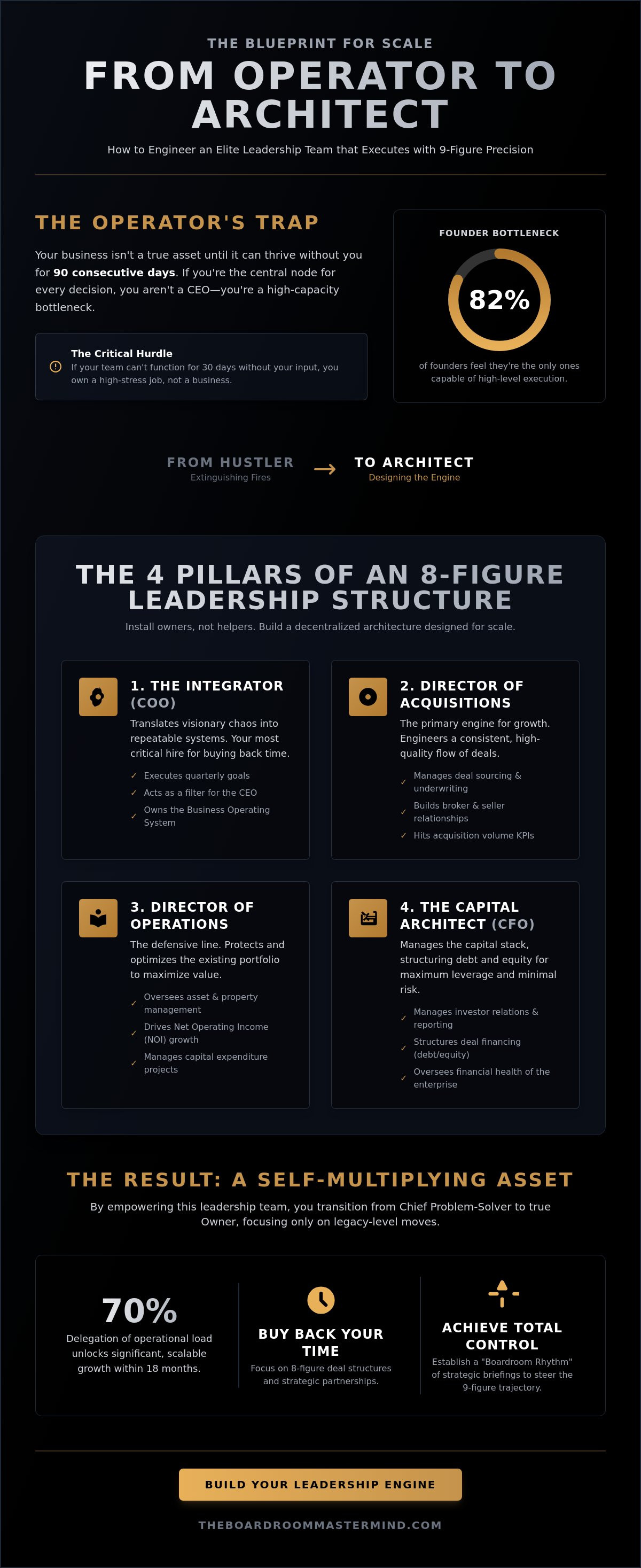
Your business isn't an asset until it can thrive without your direct intervention for 90 consecutive days. You've likely spent the last 1,000 days believing that if you don't touch every decision, the quality will drop and the vision will blur. It's a common trap; industry data shows that 82% of founders feel they're the only ones capable of high-level execution. This is the primary hurdle when building a leadership team that actually performs. If you're still the "everything" person, you aren't scaling; you're just surviving at a higher price point.
We agree that your vision is too important to be throttled by your own calendar. This blueprint will teach you the strategic art of architecting an elite executive layer that buys back your time and executes with 9-figure precision. You'll learn how to install a team that operates with total autonomy, turning your business into a self-multiplying asset that compounds while you focus on legacy. We're going to examine the specific hiring sequences, delegation frameworks, and cultural pillars required to transition from a frantic operator to a true owner.
Key Takeaways
- Break the "Founder Bottleneck" by evolving from a hands-on operator into a visionary architect of a high-performance human operating system.
- Identify the critical executive pillars required to transform visionary chaos into a repeatable, 8-figure engine for consistent deal flow.
- Master the high-stakes strategy for building a leadership team of elite A-players by leveraging exclusive networks over generic job boards.
- Establish a "Boardroom Rhythm" of strategic briefings to buy back your time while maintaining total control over your firm’s 9-figure trajectory.
The Operator’s Trap: Why Your Leadership Team is the Ceiling of Your Scale
Success is often a double-edged sword for the high-achieving founder. The same grit that propelled you to seven figures now acts as a chokehold on your ascent to eight. When you are the central node for every decision, you aren't a CEO; you're a high-capacity bottleneck. Building a leadership team is the process of installing your Business Operating System in human form. It's the only way to move from the chaos of the hustle to the precision of an enterprise.
Most entrepreneurs treat their business as a series of fires to be extinguished. This "Hustler" mentality works in the early stages, but it creates a ceiling that no amount of hard work can break. You must shift to the role of "Architect," where your primary output is the design of the organization itself. This means moving beyond hiring for "tasks" and instead hiring for "ownership" of entire departments. If you're still dictating the "how," you've failed to find the right "who."
Are You Leading or Just Managing?
If your team can't function for 30 days without your direct input, you don't own a business; you own a high-stress job. Identifying the components of an effective team is critical for this transition. You must stop being the chief problem-solver. The Operator to CEO mindset shift requires you to stop asking how to fix a problem and start asking who is responsible for ensuring the problem never recurs. It's the difference between managing a process and leading a person.
The True Cost of Stagnation
The opportunity cost of a CEO performing $20 per hour tasks is staggering. While you're buried in the minutiae of daily operations, you're missing the 8-figure deal structures and strategic partnerships that define legacy-level wealth. Data from high-growth firms suggests that founders who delegate 70% of their operational load see a significant increase in scalable growth within 18 months. Your business will only grow to the level of the leaders you are willing to empower.
When building a leadership team, you aren't just filling seats. You're buying back your time to focus on high-leverage activities that move the needle. Without this core group of owners, your business remains a fragile entity dependent on your personal energy. With them, it becomes an indestructible asset designed for the long game.
The 4 Critical Pillars of an 8-Figure Real Estate Leadership Structure
Building a leadership team at the 8-figure level isn't about hiring helpers; it's about installing owners. You're no longer looking for people to do the work. You're looking for high-level operators to own the outcomes. Scaling a real estate enterprise beyond the $10 million mark requires a shift from a hub-and-spoke model to a decentralized architecture supported by four distinct pillars.
The first pillar is the Integrator (COO). This individual acts as the steady hand that translates visionary chaos into repeatable systems. While you're dreaming of the next 500-unit acquisition, they're ensuring the current 200 units are operating at peak efficiency. Second, the Director of Acquisitions serves as your primary engine. They don't just find deals; they engineer a consistent, high-quality flow that survives market volatility. Third, the Director of Operations/Asset Management protects the existing portfolio. They're the defensive line, optimizing the back of the house to squeeze every basis point of value from your holdings. Finally, the CFO or Capital Architect manages the capital stack. They're responsible for the architecture of scale, ensuring that debt and equity are structured for maximum leverage and minimal risk.
The Integrator: Your Most Critical Hire
Every visionary CEO eventually hits a ceiling. You can't scale if you're the one answering every Slack message or putting out every fire. The Integrator is the person who executes the goals set during your quarterly intensives. They act as a filter. If a problem doesn't need your specific genius, it never reaches your desk. This hire is the first step toward true freedom. It's how you leverage elite talent to regain your time and focus on legacy-level moves.
Structuring Departmental Ownership
Accountability dies in the gray areas. To maintain a high-growth trajectory, every leader must have a clear Scorecard with no more than three to five primary KPIs. This method ensures performance is measured by data, not feelings. It's critical to attract and retain top executive talent by giving them total ownership of their domain. When building a leadership team, remember the rule of five: you should never have more than five direct reports. Beyond that, communication breaks down and your effectiveness as a CEO dilutes. This structure creates a sophisticated "inner circle" environment where elite performance is the only standard.
Engineering the Hire: How to Attract and Retain A-Player Executives
Building a leadership team is an exercise in precision engineering. If you settle for a "B-Player" to fill a gap, you aren't just hiring a person; you're importing mediocrity into your executive suite. Research suggests the cost of a mis-hire at this level can exceed 15 times the individual’s base salary. Elite talent doesn't scan job boards. They operate within high-level networks and private circles. To attract them, you must offer more than a role; you must offer a mission that resonates with their ambition.
The Architecture of Executive Compensation
Sophisticated CEOs understand that cash is a commodity. To secure long-term loyalty, you must design Executive Compensation Models that align their personal wealth with your company’s 8-figure trajectory. This includes performance-based equity, profit-sharing milestones, and phantom stock options. A-players don't work for a salary; they work for a seat at the table and a stake in the vision.
The $1,000,000 Mistake: Avoiding the Bad Executive Hire
A single bad hire can derail 24 months of momentum and burn through significant capital. When you factor in wasted training, lost revenue, and the impact on team morale, you are looking at The $1,000,000 Mistake. Elite teams follow the "Hire Slow, Fire Fast" rule. If an executive doesn't align with your high-performance culture within the first 90 days, they never will. Retention is achieved by creating an environment where A-players are challenged and surrounded by peers of equal caliber. This prevents competitors from poaching your best talent with simple salary increases.
Stop gambling on talent and start scaling with certainty. Join the Inner Circle to access the frameworks used by 8-figure CEOs.
From Micro-Manager to Visionary: Leading Your Leadership Team for Scale
The final stage of building a leadership team requires you to stop being the smartest person in the room. You've recruited the talent. Now, you must lead it. This transition is where many 7-figure founders stall. They possess the vision but lack the discipline to establish a Boardroom Rhythm that functions without their constant intervention. To reach 8-figure scale and beyond, you must shift from solving every problem to architecting the environment where problems are solved by others.
The CEO’s primary responsibility is to delegate the "What" and the "How" while fiercely protecting the "Why." You define the destination; your team builds the road. This dynamic thrives on the power of proximity. When your leadership team sees you operating in elite, high-stakes environments, your authority compounds. It signals that you are focused on the future, not the minutiae of daily tasks. This is the path to scaling without the stress, moving you from a frantic operator to a true legacy-driven Owner.
The Weekly Strategic Briefing
Efficiency is the currency of the elite. Your weekly briefing isn't a social hour. It's a 60-minute surgical strike designed to drive 7 days of relentless execution. Stop wasting time on status updates that could have been an email. Instead, focus 80% of the meeting on "Issues." Identify the bottleneck, debate the solution, and assign the owner. This high-level cadence ensures your team remains aligned with the principles found in our guide on How to Build a High-Performance Culture: The CEO’s Blueprint for 8-Figure Scale.
Auditing Your Leadership Team
The individuals who helped you cross the $1 million mark are rarely the ones who will take you to $100 million. Scale introduces complexity that breaks mediocre leaders. You must conduct an annual audit to determine if your current team possesses the capacity for 9-figure operations. If a leader cannot manage a $10 million department with the same precision they managed a $1 million one, they've reached their ceiling. You can experience a business audit at our next Boardroom Intensive to identify where your current structure is leaking profit and prepare for the next level of growth.
Architect Your Exit From the Day-to-Day
The transition from a high-earning operator to an 8-figure visionary is not a matter of effort; it's a matter of architecture. You've identified the operational bottlenecks and recognized that building a leadership team is the singular lever that transforms a job into a scalable enterprise. By implementing the 4 critical pillars of structure and engineering hires that attract A-player executives, you move from managing tasks to leading leaders. This is how you reclaim your time while ensuring your business operates with or without your physical presence.
Elite performance requires elite proximity. You can continue to navigate these complexities alone, or you can leverage proven frameworks for scaling from 7 to 9 figures alongside a peer network managing billions in assets. Through quarterly in-person business audits with elite CEOs, we strip away the noise and focus on the strategic optimization of your executive suite. If you want to dominate your market, you must surround yourself with those who have already conquered it. Your legacy is waiting for the leader you're becoming.
Apply to Join The Boardroom Mastermind and Audit Your Leadership Strategy
Frequently Asked Questions
How do I know when it's time to hire my first leadership team member?
You must initiate building a leadership team when your personal output hits a ceiling and prevents the company from scaling past the $2 million to $5 million revenue mark. If you're spending more than 30 hours a week managing tactical tasks instead of architecting the future, you've become the bottleneck. High-level talent allows you to shift from operator to owner, ensuring the business compounds without your constant presence.
What is the difference between a manager and a leadership team executive?
Managers execute existing processes to hit targets, while executives design the systems and strategies that define those targets. A manager ensures the 10-person sales team hits its monthly quota; an executive builds the entire revenue engine and identifies new market opportunities. Executives own the results and the risks, operating with a level of autonomy that requires zero hand-holding. They don't just follow the blueprint; they're the architects responsible for your 8-figure legacy.
How much should I expect to pay for a top-tier COO in real estate?
According to 2023 compensation data from platforms like Glassdoor and Payscale, a high-performing COO in the real estate sector commands a base salary between $150,000 and $250,000. Expect to offer a total package that includes performance-based bonuses or equity to attract elite talent. In high-growth markets, total compensation often exceeds $300,000 when incentives are tied to 20% year-over-year profit increases. You aren't buying a worker; you're investing in a strategic asset that protects your time.
How can I trust someone else to make high-stakes decisions for my business?
You build trust through a rigorous 90-day onboarding framework that uses decision guardrails to limit risk while testing their judgment. Start by delegating decisions with a financial impact under $10,000 and gradually increase this threshold as they demonstrate alignment with your core values. If they consistently produce a 3x return on their decisions, you expand their territory. Trust isn't a feeling; it's a calculated result of verified performance and shared logic within your inner circle.
What happens if a member of my leadership team leaves with my trade secrets?
You mitigate this risk by enforcing ironclad non-compete and non-solicitation agreements that specify liquidated damages for 24 months post-employment. Protecting your intellectual property requires a multi-layered defense including restricted data access and legal contracts drafted by specialists. If a breach occurs, these documents provide the leverage needed to seek immediate injunctive relief in court. Building a leadership team involves high stakes, so you must treat your proprietary systems as the crown jewels they are.


