
Real Estate Capital Stack: The Architecture of Institutional-Grade Deals
Your ability to scale isn't limited by your deal flow; it's limited by your architecture. While the average operator is busy hunting for the next property, the top 1% of investors are busy engineering the capital that funds it. If you're still relying on a simple mix of personal cash and a local bank loan, you've likely hit a ceiling that no amount of hustle can break through. You recognize that giving away 50% of your equity just to close a deal is a strategy for survival, not for building a legacy. This realization is what separates the exhausted middle-market player from the elite sovereign of the real estate capital stack.
This briefing provides the blueprint to master these strategic layers so you can compete for institutional-grade assets without sacrificing your upside. You'll learn how to deploy mezzanine debt and preferred equity to create an unfair advantage in a crowded market. We'll examine the precise priority of repayment and the sophisticated financing structures that allow you to transition from a high-stakes operator to a CEO-level architect of 8-figure wealth. It's time to stop playing by the bank's rules and start designing your own.
Key Takeaways
- Transition from a deal-by-deal operator to a sophisticated architect by mastering the strategic language of institutional private equity.
- Learn to manipulate the real estate capital stack to balance risk and priority, ensuring your repayment hierarchy protects your most valuable assets.
- Optimize your Weighted Average Cost of Capital (WACC) to maximize leverage and profitability across diverse asset types and exit strategies.
- Shift from the frantic energy of single-deal syndication to a scalable fund model that functions as a high-output capital-raising machine.
- Secure your eight-figure legacy by applying the frameworks used to architect institutional-grade wealth and predictable growth.
Beyond the Simple Loan: Why Sophisticated Investors View the Capital Stack as a Strategic Blueprint
Novice operators focus on the loan; elite owners focus on the architecture. In the high-stakes world of institutional real estate, the real estate capital stack represents the total financial structure of a deal. It's the primary language of private equity. It dictates exactly how risk is partitioned and how cash flow is distributed among various stakeholders. By the end of 2022, global institutional real estate assets under management reached $4.1 trillion, a figure driven by leaders who understand that capital is a tool for design, not just a means of survival.
Moving from a "finding money" mindset to "architecting capital" is the hallmark of the transition from operator to owner. You aren't just looking for a lender. You're constructing a multi-layered engine designed for maximum scalability. This blueprint ensures that every dollar has a specific job and a specific rank in the hierarchy. If a deal encounters headwinds, the stack determines the order of protection. The real estate capital stack provides a clear map of who holds the senior position and who carries the speculative weight.
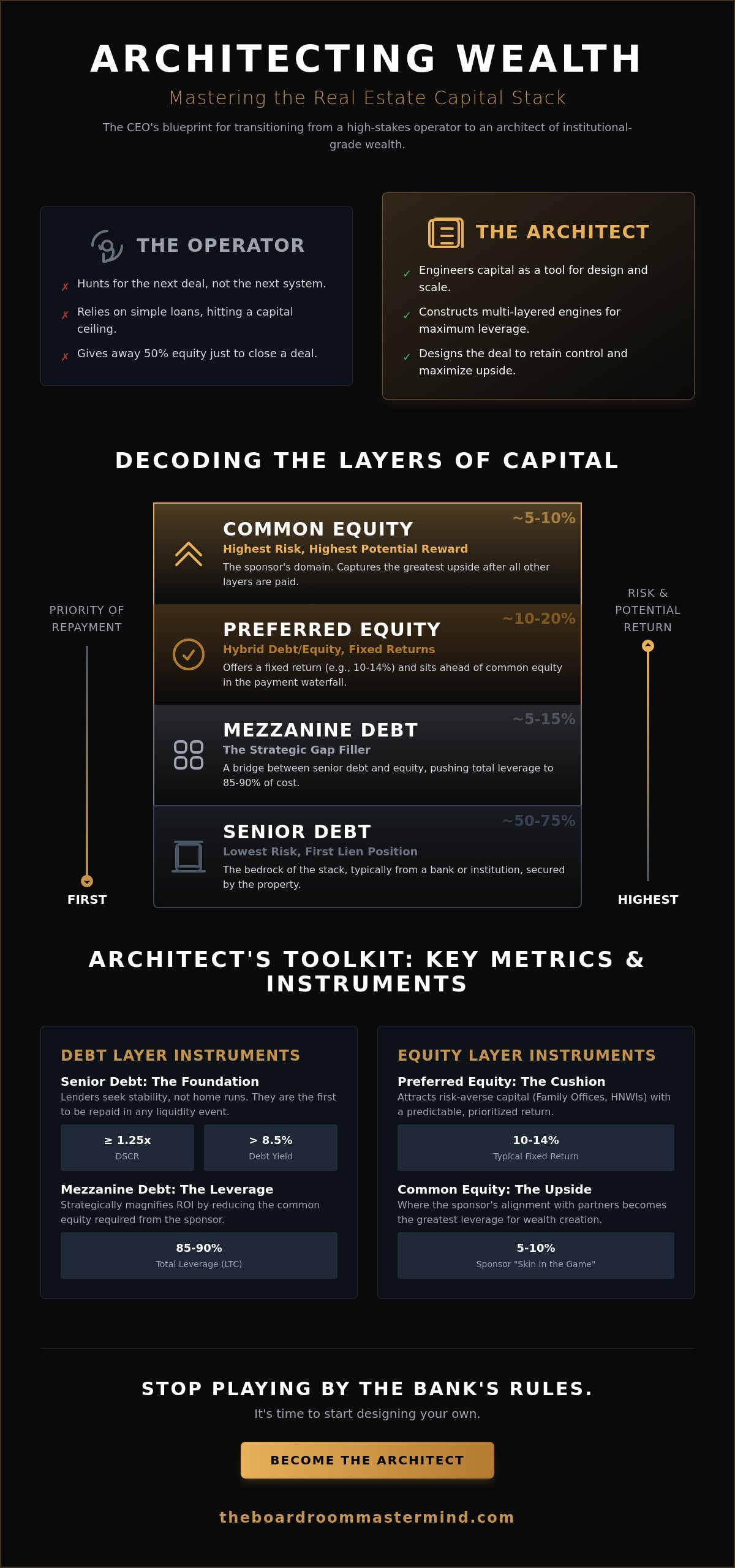
- Senior Debt: The foundation, typically covering 50% to 75% of the cost, holding the first lien position.
- Mezzanine Debt: The bridge that fills the gap between senior debt and equity, offering higher returns for higher risk.
- Preferred Equity: A hybrid layer that sits behind debt but ahead of common equity in the payment waterfall.
- Common Equity: The highest risk layer where the sponsor and partners capture the greatest upside.
The Anatomy of a High-Level Deal Structure
A sophisticated structure often begins with the Loan-to-Cost (LTC) ratio. While a standard 65% LTC covers the base, the remaining 35% is where the real strategy happens. This is where you layer mezzanine debt or preferred equity to optimize your internal rate of return. Your role as the sponsor shifts based on where your skin in the game sits within this hierarchy. If you're co-investing 5% to 10% of the total equity, your alignment with limited partners becomes your greatest leverage. For those ready to join the inner circle of high-level execution, mastering these layers is non-negotiable. The capital stack is the structural foundation of institutional wealth.
Decoding the Layers: Priority, Risk, and the Hierarchy of Repayment
The real estate capital stack serves as the definitive legal blueprint for cash flow distribution. It dictates exactly who gets paid, when they get paid, and how much risk they shoulder. For the elite operator, mastering this hierarchy is the difference between a one-off project and a scalable enterprise. The structure is rigid; the higher you climb, the greater the potential for wealth creation, but the thinner the safety net becomes. You aren't just raising money; you're architecting a repayment waterfall that protects your interests while incentivizing your partners.
The Debt Layers: Senior vs. Mezzanine
Senior debt forms the bedrock of the stack. These lenders demand a first lien position, ensuring they're the first to be repaid in any liquidity event. They aren't looking for home runs; they're looking for stability. Most institutional senior lenders require a Debt Service Coverage Ratio (DSCR) of at least 1.25x and a Debt Yield above 8.5% to mitigate downside. By contrast, mezzanine debt acts as the strategic bridge within the real estate capital stack. It allows a CEO to push total leverage to 85% or 90% of the total project cost. This reduces the amount of common equity required, effectively magnifying the sponsor's return on investment while maintaining total operational control.
The Equity Layers: Preferred vs. Common
Preferred equity is the instrument of choice for attracting family offices and high-net-worth individuals who demand a hybrid of safety and yield. It offers a fixed return, typically between 10% and 14%, and sits in a privileged position ahead of the sponsor's profit. This layer provides a "cushion" for the common equity holders while offering the investor a predictable payout. Common equity is the final layer. It's the highest risk tier, but it's where the inner circle captures the true upside. As a sponsor, your ability to structure this layer determines your legacy. To dominate this space, you must learn more about institutional scale to ensure your deals are attractive to the world's most sophisticated capital partners.
Success at this level requires moving beyond simple arithmetic. It's about engineering a structure where every dollar of risk is precisely calculated. If you're ready to transition from a project manager to a true architect of wealth, you should explore how our exclusive experience can refine your approach to institutional-grade deal flow.
Architecting for Scale: How to Optimize Your Stack for Maximum Leverage
Your real estate capital stack isn't just a funding mechanism; it's the structural engineering of your wealth. To scale toward a nine-figure legacy, you must evaluate the Weighted Average Cost of Capital (WACC) with clinical precision. If your projected internal rate of return (IRR) doesn't exceed your WACC by at least 500 basis points, the deal's risk profile likely outweighs its rewards. Optimal stacks vary by asset class. A stabilized multifamily asset might thrive on 75% senior debt, while a complex industrial redevelopment requires a thicker equity base or preferred equity to weather construction delays.
The "hustler" mindset, which prioritizes maximum leverage at any cost, often leads to catastrophic collapses when the market shifts. True CEOs understand that over-leveraging creates a fragile foundation. Implementing a robust business operating system ensures that capital is managed with institutional-grade discipline. This systematic approach prevents the cash-flow bottlenecks that frequently paralyze growing firms during mid-cycle shifts. A sophisticated real estate capital stack allows for growth without the constant threat of a margin call.
Strategic Leverage vs. Reckless Risk
Every deal requires a "CEO check" to ensure the debt alignment matches your 10-year legacy goals. Don't sign terms that trap you. Negotiate for flexibility, such as 12-month extension options or the ability to recapitalize without predatory prepayment penalties. High-level operators prioritize the ability to pivot during market corrections over the vanity of a zero-down deal. If the debt service coverage ratio (DSCR) dips below 1.25, you've lost your margin of safety.
Attracting Institutional Partners
Moving up the stack to lower your cost of capital requires more than just a good property. Family offices and institutional partners look for sponsor credibility and operational transparency. When you demonstrate a track record of 20% or higher realized returns and professional reporting, you earn the right to access institutional debt. This transition from high-interest private money to lower-cost institutional capital is the fastest way to compound your net worth. Ready to build your inner circle of elite partners? Apply for the Boardroom Mastermind today.
From Syndicator to Architect: The CEO’s Path to Institutional-Level Management
Scaling past the $10 million mark requires a fundamental shift in how you view your balance sheet. Single-deal syndication is often a treadmill of high-effort, one-off capital raises. To reach the next level, you must stop doing deals and start building a capital-raising machine. This transition demands a deep mastery of the real estate capital stack to ensure every layer of funding works in your favor. When you graduate to a fund model, you aren't just buying property; you're selling a sophisticated investment vehicle designed for predictable, scalable growth.
Proximity is your greatest multiplier. Accessing institutional-grade capital isn't about cold calling; it's about being in the room where those conversations happen. Joining exclusive mastermind groups places you among peers who have already secured $50 million credit lines and nine-figure equity partners. This collective intelligence provides the blueprint for positioning your firm as the partner of choice for family offices and institutional funds that demand rigorous structure over raw hustle.
The Boardroom Perspective on Capital
Elite CEOs don't scramble for private lenders at the eleventh hour. They engineer an unfair advantage by pre-structuring their real estate capital stack long before a Letter of Intent is signed. This involves moving away from the frantic energy of the solo operator and toward systematic capital flow. By utilizing 80% loan-to-cost debt and layering in programmatic equity, you shift from a borrower to a strategic architect of wealth. It's the difference between working for your capital and making your capital work for your legacy.
Next Steps for 8-Figure Growth
Growth stops where your current deal structure fails. Audit your current projects to identify bottlenecks in your equity waterfall or debt coverage ratios. If your cost of capital is 150 basis points higher than your competitors, you have already lost the advantage. It's time to refine your architecture and join the inner circle of high-performers. Experience the Boardroom Mastermind and scale your capital architecture to the institutional level.
Mastering the Architecture of the Nine-Figure Deal
The real estate capital stack is the definitive blueprint for your legacy. Transitioning from a transactional syndicator to an institutional architect requires a fundamental shift in how you deploy leverage. You've seen how the strategic layering of senior debt and mezzanine financing dictates your risk profile. High-level execution means moving beyond standard 70 percent LTV loans to architect structures that facilitate rapid scale.
Scaling to a 9-figure portfolio is the logical outcome of superior strategy. Most operators hit a ceiling because they lack the collective intelligence of those who've already cleared the path. The Boardroom Mastermind provides that unfair advantage through a network of 7, 8, and 9-figure real estate entrepreneurs. Our quarterly in-person business intensives and strategic auditing processes are designed specifically for institutional scalability.
Stop operating at the retail level. It's time to enter the inner circle where elite achievers refine their wealth architecture. Apply to Join the Elite: The Boardroom Mastermind Application
Your ascent to the next level of institutional dominance is the logical conclusion of your professional evolution.
Frequently Asked Questions
What is the order of priority in a real estate capital stack?
Senior debt holds the first priority position in the real estate capital stack, followed by mezzanine debt, preferred equity, and common equity. In any liquidation event, the senior lender receives 100 percent of their principal and interest before any junior capital receives a dime. This rigid hierarchy ensures that risk increases as you move down the stack, while the potential for outsized returns grows for those at the bottom.
How does mezzanine debt differ from preferred equity in a deal structure?
Mezzanine debt is a loan secured by a pledge of ownership interests, whereas preferred equity represents an actual ownership stake with preferential payment rights. If a default occurs, a mezzanine lender uses a UCC foreclosure to seize control of the entity in as little as 30 days. Preferred equity holders must rely on specific forced sale or removal of manager clauses within the operating agreement to protect their capital.
Is common equity or preferred equity more risky for a real estate investor?
Common equity is significantly more risky than preferred equity because it occupies the first loss position at the bottom of the stack. Preferred investors typically secure a fixed 7 to 11 percent return that must be paid before common partners receive any distributions. While common holders face the highest probability of total loss, they also retain the exclusive right to all residual profits once the fixed hurdles are cleared.
What is a typical capital stack structure for a commercial real estate project in 2026?
An institutional real estate capital stack in 2026 generally consists of 60 percent senior debt, 15 percent mezzanine financing, and 25 percent equity. This 75 percent total leverage threshold aligns with the stricter 1.30x debt service coverage requirements seen in the current credit environment. Elite CEOs utilize this structure to balance the safety of senior debt with the high-octane growth potential of concentrated equity positions.
How can a real estate CEO use the capital stack to increase their Internal Rate of Return (IRR)?
A CEO maximizes Internal Rate of Return by utilizing positive leverage to reduce the amount of expensive common equity required for a deal. When the asset's yield is 200 basis points higher than the cost of debt, increasing leverage from 50 to 70 percent significantly compounds the returns for the ownership group. It's a strategic move that turns a stable 9 percent cash-on-cash return into a 19 percent legacy-building IRR.


