
The CEO’s Annual Business Audit: A Strategic Template for 8-Figure Scale
Over 70% of 8-figure real estate firms don't fail because they lack deal flow; they collapse because their infrastructure was built for a 7-figure reality. You've likely reached a point where more volume no longer feels like progress. It feels like a liability. When every new acquisition adds more weight to your schedule than to your net worth, you're no longer the CEO; you're the bottleneck. To break this cycle, you must move beyond tactical fixes and conduct a rigorous annual business audit that treats your company as a strategic asset, not a high-paying job.
You deserve an operation that compounds wealth without demanding your presence in every minor decision. This guide provides the elite auditing framework used by the inner circle of investors to identify the single system holding back your next level of scale. We'll outline a 12-month roadmap that aligns your personal legacy goals with your executive hiring strategy, ensuring your business finally provides the freedom you've already earned. We will examine the specific leverage points that transform a chaotic operator into a quiet professional who dominates the market.
Key Takeaways
- Distinguish between standard compliance checks and a strategic annual business audit designed to engineer elite wealth architecture and 8-figure growth.
- Identify and eliminate friction points within your business operating system to ensure your infrastructure supports rapid, predictable scaling.
- Evaluate the true ROI of your leadership team to facilitate the critical transition from a tactical operator to a visionary owner.
- Master the "Boardroom Review" process to analyze performance data with the strategic clarity required for high-stakes decision-making.
- Convert diagnostic insights into immediate momentum using a 90-day sprint framework that prevents stagnation and ensures high-level execution.
What is a Strategic Annual Business Audit for Elite Entrepreneurs?
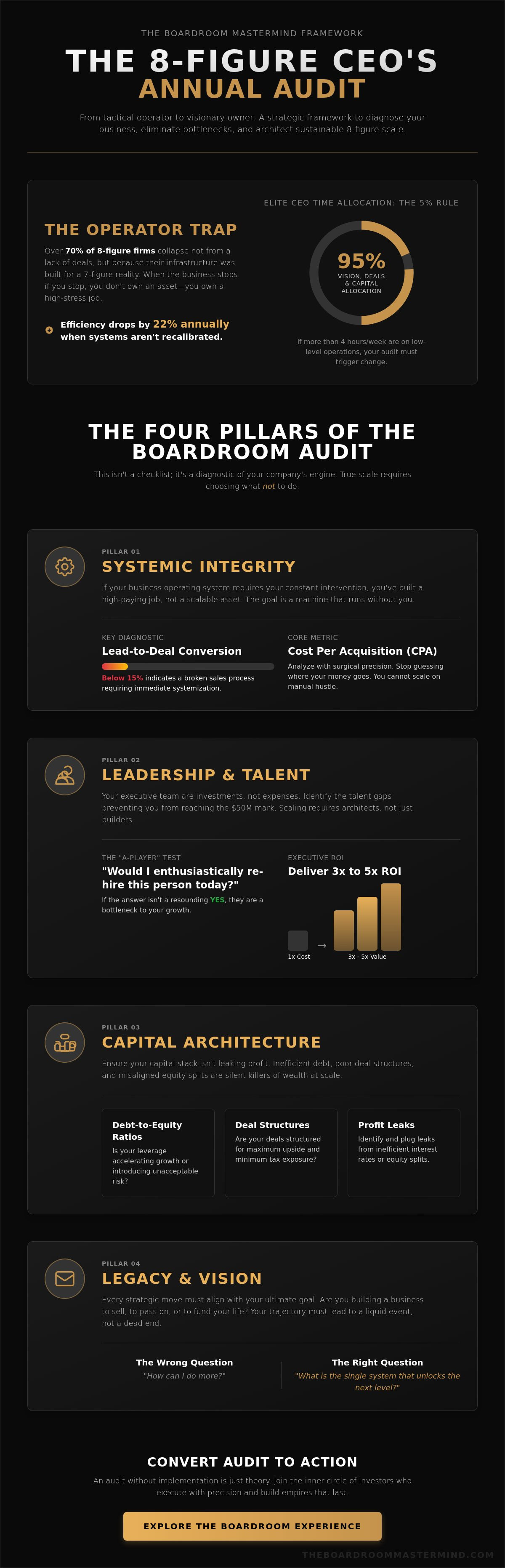
Most founders mistake a tax review for a strategy session. A compliance audit keeps you out of legal jeopardy; a growth-focused annual business audit keeps you in the top 1% of earners. This process is a comprehensive diagnostic of your systems, team, and capital allocation. It's the difference between surviving a fiscal year and architecting an 8-figure exit. Seven-figure founders hit a ceiling because they rely on intuition rather than data-driven diagnostics. Without a formal auditing process, operational drift sets in. Efficiency often drops by 22% annually when systems aren't recalibrated to match new scale. Conduct this audit at least once every twelve months to ensure your machine remains optimized for leverage.
The Difference Between Accounting and Architecture
Your CPA is trained to look at the past. They focus on historical data to satisfy the IRS. A strategic audit requires a Business performance management framework that prioritizes the future. You must shift focus from historical results to leading and lagging indicators to predict your next 24 months of growth. The strategic audit is the CEO's health check for their business operating system.
Identifying the 'Operator Trap' in Your Audit
The annual business audit reveals where you have become the primary bottleneck. If the business stops when you stop, you don't own an asset; you own a high-stress job. Elite CEOs apply the 5% rule. They audit their time to ensure 95% of their energy is spent on vision, high-level deal-making, and capital allocation. Everything else is a system to be delegated or deleted. If you're spending more than 4 hours a week on low-level operations, your audit should trigger an immediate hiring or automation sequence. The transition from operator to owner is a mathematical necessity for 8-figure scale.
The Four Pillars of the Boardroom Audit Framework
The annual business audit isn't a checklist; it's a diagnostic of your company's engine. At the 8-figure level, growth is no longer about working harder. It's about optimizing the four pillars that support a legacy scale. Michael E. Porter, who defines strategy as the creation of a unique and valuable position, reminds us that true scale requires choosing what not to do. This annual business audit forces that clarity.
First, examine your Systemic Integrity. If your business operating system requires your constant intervention, you've built a high-paying job, not a company. Second, scrutinize Leadership & Talent. Your executive team must deliver a 3x to 5x ROI on their total compensation package. Third, evaluate Capital Architecture. Review your debt-to-equity ratios and deal structures to ensure your capital stack isn't leaking profit through inefficient interest rates or equity splits. Finally, assess Legacy & Vision. Every move must align with your eventual exit, ensuring your trajectory leads to a liquid event rather than a dead end.
Auditing Your Systems for Predictable Deal Flow
Stop guessing where your money goes. Analyze your Cost Per Acquisition (CPA) with surgical precision. If your lead-to-deal conversion ratio is below 15 percent, your sales process is broken. You can't scale on manual hustle; it's a recipe for burnout. Move toward full systemization to ensure your pipeline remains full without your direct oversight. Efficiency here is the difference between a struggling 7-figure firm and a dominant 8-figure enterprise.
The Talent Audit: Is Your Team Built for the Next Level?
Apply the "A-Player" test to every seat in your boardroom. Ask yourself: "If I were hiring today, knowing what I know now, would I enthusiastically re-hire this person?" If the answer isn't a resounding yes, they're a bottleneck to your growth. Identify the gaps in your leadership team that prevent you from reaching the $50M mark. Scaling requires architects, not just builders. To see how elite founders structure these audits, explore The Boardroom experience.
Step-by-Step: Executing Your Annual Business Audit Template
Execution is where the amateur and the architect diverge. You don't perform an annual business audit while managing Slack notifications or fire-fighting in the warehouse. High-level execution requires 12 months of clean performance metrics and the discipline to step back. Conduct your review away from the day-to-day noise of the office. This isolation allows you to analyze executive reports with the cold objectivity of a shareholder rather than the emotional attachment of an operator. It's about wealth architecture; it's not about task management.
Step 1: The Quantitative Deep Dive
Analyze your P&L, balance sheet, and cash flow with a singular focus on margin expansion. In 2023, data from high-growth sectors indicated that even a 5% leak in overhead can compound into a 15% loss in enterprise value over a three-year period. A successful audit requires 100% transparency in financial reporting to identify hidden leaks. If your margins aren't expanding as you scale, you're building a liability. Review every line item to ensure capital is being deployed as a tool for leverage, not just a cost of doing business.
Step 2: The Qualitative Reality Check
Numbers tell the story, but your department heads reveal the friction. Gather feedback to identify where operational rot is setting in. Your SWOT analysis must be ruthless, focusing on external market threats, such as the 30% rise in customer acquisition costs seen in digital markets, and internal scaling weaknesses like talent bottlenecks. If your systems can't handle a 2x increase in volume tomorrow, they're already broken. This reality check ensures your infrastructure matches your ambition.
The final phase is the gap analysis. Compare your current trajectory against your 3-year vision. If the delta between your current revenue and your goal is more than 25%, your strategy requires a fundamental pivot. Distill your findings into three key initiatives for the coming year. Focus is your greatest leverage. By selecting only three pillars, you ensure that your resources are concentrated for maximum impact rather than diluted across a dozen mediocre goals.
From Audit to Action: Implementing the 8-Figure Roadmap
An annual business audit is only as valuable as the execution that follows it. Most CEOs fall into the trap of the "Shelf Audit," where high-level insights are buried under the weight of daily operations. Research indicates that 67% of well-formulated strategies fail due to poor execution; you cannot afford to be part of that metric. To bridge the gap between diagnosis and results, you must translate your findings into a 90-day sprint. This compressed timeline creates a sense of urgency that forces your team to prioritize high-leverage activities over low-value busy work.
True scale requires an external perspective to dismantle your blind spots. Relying solely on internal data is a recipe for stagnation. This is where building a board of advisors becomes your competitive advantage. They provide the objective friction necessary to sharpen your strategy and hold you to a higher standard of performance. Proximity to elite peers who have already conquered your current revenue plateaus is the ultimate shortcut. It moves you from guessing to knowing, saving you years of trial and error.
Building the Accountability Loop
Execution requires a closed-loop system. Use quarterly intensives to pressure-test your progress against the goals set during your annual business audit. If you aren't hitting your key performance indicators by the 45-day mark, your Inner Circle should be there to challenge your assumptions. This level of radical transparency ensures that small deviations don't turn into catastrophic failures by year-end. Accountability isn't about micromanagement; it's about maintaining the integrity of your vision.
Scaling Without the Stress
The final objective of any audit is to buy back your time. You are shifting from the role of the primary operator to the visionary owner. When you optimize your systems based on hard data, you reduce the friction of scaling. This allows you to focus on legacy-level decisions while your business grows predictably and profitably. Ready to audit your business with the world's elite? Apply for The Boardroom Mastermind and secure your seat at the table.
Secure Your 8-Figure Legacy
An annual business audit serves as the definitive boundary between a stagnant seven-figure operation and a scalable eight-figure enterprise. By implementing the four pillars of the Boardroom Audit Framework, you've established the strategic blueprint to identify operational friction and reclaim your time. True leverage happens when you stop acting as the primary engine of growth and start operating as the architect of a self-sustaining system.
The transition from operator to owner demands more than just a template; it requires the collective intelligence of an elite inner circle. You need a space where high-stakes decisions are validated by peers who manage nine-figure portfolios. Our quarterly in-person intensives provide the strategic environment necessary to stress-test your roadmap and ensure your trajectory remains unrivaled. By accessing a network of 7, 8, and 9-figure investors, you gain an unfair advantage that entry-level coaching can't provide. It's time to trade the exhaustion of the hustle for the clarity of a legacy-driven CEO.
Scale your business to 8-figures and beyond with The Boardroom Mastermind
The path to your next level is clear for those who demand elite access. Your ascent is the only logical conclusion.
Frequently Asked Questions
What is the primary goal of an annual business audit for a CEO?
The primary goal of an annual business audit is to identify the structural bottlenecks preventing your transition from operator to owner. You're seeking to uncover the 20% of activities driving 80% of your growth. By auditing your systems, you ensure the business operates as a high-yield asset rather than a job. This process transforms your company into a predictable engine for wealth architecture, ensuring your legacy is built on a foundation of calculated confidence.
How long should a comprehensive strategic audit take to complete?
A comprehensive annual business audit requires a focused window of 14 to 30 days to complete. You'll spend the first week on data extraction and the second on strategic analysis. This timeline allows for a deep dive into financial health and operational efficiency without losing momentum. If you rush the process, you risk missing the subtle data trends that separate 7-figure plateaus from 9-figure breakthroughs. High-level execution requires patience and precision.
Can I perform an annual business audit myself or do I need an external facilitator?
You can execute the audit internally, but utilizing an external facilitator provides the objective distance required for true optimization. Internal teams often suffer from blind spots that obscure 15% to 20% of operational waste. An elite facilitator brings the collective intelligence of the inner circle to your boardroom. They challenge your assumptions and force the high-level execution that internal staff might avoid. It's the difference between a self-check and a professional diagnostic.
What are the most common red flags discovered during a real estate business audit?
Common red flags include a Customer Acquisition Cost (CAC) exceeding 25% of gross commission or a lead-to-close ratio falling below 3%. You'll often find "zombie" overhead where 10% of your software subscriptions haven't been accessed in 90 days. These leaks drain the capital necessary for scaling. Identifying these issues during an annual business audit prevents minor inefficiencies from compounding into major financial liabilities. It ensures your capital is deployed with maximum leverage.
How does an annual audit help in preparing for a future business exit?
An annual audit prepares you for an exit by documenting the "turn-key" nature of your operations. Buyers pay a premium for businesses that don't rely on the founder's daily presence. By cleaning up your balance sheet and streamlining workflows, you can increase your valuation multiple by 1.5x to 2.2x. You're not just auditing; you're building a transferable asset that commands top-tier market interest. This strategic foresight ensures you exit on your own terms.


