
Leading and Lagging Indicators: The CEO’s Dashboard for 8-Figure Real Estate Scale
Most real estate entrepreneurs aren't actually running a business; they're managing a series of expensive surprises. If you're still judging your success by the size of this Friday's commission check, you aren't a CEO. You're a passenger. To achieve true 8-figure scale, you must stop obsessing over the results you've already achieved and start mastering the leading and lagging indicators that dictate your future. It's the difference between looking out the windshield and staring into the rearview mirror while driving at 100 miles per hour.
You understand that the hustle has a ceiling, and you've likely hit it. It's exhausting to operate in a 30-day vacuum where your income remains a mystery until the closing documents are signed. This briefing provides the strategic framework to break that cycle once and for all. You'll learn to architect a high-level dashboard that predicts your growth with mathematical certainty, allowing you to forecast revenue 6 to 12 months in advance. We're going to deconstruct the specific metrics that separate the elite 1% of the Boardroom from the frantic operators, giving you the clarity to scale without the stress and build a legacy that operates independently of your daily presence.
Key Takeaways
- Distinguish between the "autopsy" of past performance and the "GPS" of future results to gain absolute command over your business trajectory.
- Master the strategic interplay between leading and lagging indicators to bridge the critical time gap between executive action and eight-figure revenue.
- Implement the "Reverse Engineering" method to isolate the 3-5 high-leverage activities that mathematically guarantee your annual growth targets.
- Transition from a frantic operator to a boardroom visionary by auditing your business model for nine-figure legacy and scaling without the stress.
The Scorecard vs. The Steering Wheel: Defining Indicators for the CEO
Success at the eight-figure level isn't about working harder; it's about seeing the field before the play unfolds. Most real estate investors operate as scorecard junkies, obsessed with the final tally while ignoring the mechanics that produced it. If you only focus on your bank balance at the end of the month, you're performing an autopsy on your business. You're analyzing why the patient died or survived after the fact. To scale, you must distinguish between leading and lagging indicators. One tells you where you've been. The other tells you where you're going.
Lagging Indicators: The Reality of Your Results
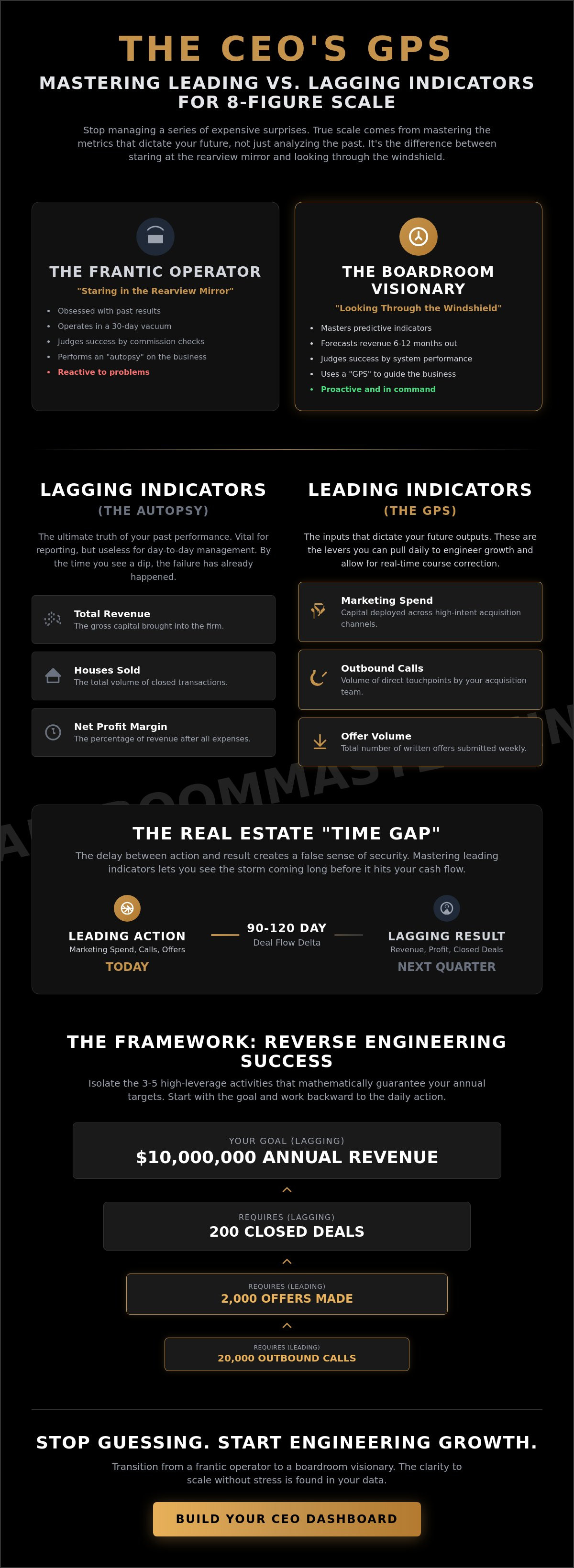
Lagging indicators represent the ultimate truth of your performance. They're the numbers that hit the spreadsheet after the work is done. These include:
- Total revenue: The gross capital brought into the firm.
- Number of houses sold: The total volume of closed transactions.
- Net profit margin: The percentage of revenue remaining after all operating expenses and cost of goods sold.
These metrics are vital for your tax returns and your legacy, but they're the worst possible tools for daily operations. They're historical. By the time you see a dip in net profit, the strategic failure happened 90 days ago. You can't manage what has already occurred.
Leading Indicators: The Predictive Power of High-Level Action
Leading indicators are your GPS. They're the inputs that dictate your future outputs. If you want to predict your revenue in Q4, you must audit your executive actions in Q3. These metrics allow for real-time optimization and form the core of a robust Business Operating System. High-level leading indicators include:
- Marketing spend: Capital deployed across high-intent acquisition channels.
- Outbound calls: The volume of direct touchpoints made by your acquisition team.
- Offer volume: The total number of written offers submitted to sellers weekly.
When you track leading and lagging indicators with precision, you stop guessing and start engineering growth. If you're only looking at lagging indicators, you're driving a Ferrari at 100 mph while staring in the rearview mirror. It's a recipe for a catastrophic wreck. Elite CEOs look through the windshield. They master the steering wheel. They control the lead.
Leading vs. Lagging Indicators: A Comparison for Real Estate Empires
To scale to 8 figures, you must stop managing your business by looking in the rearview mirror. Most investors obsess over lagging indicators because they're undeniable and easy to find. Your bank balance, total acquisitions for the quarter, and net profit are historical facts. They tell you where you've been, but they're functionally useless for changing where you're going. Leading indicators, by contrast, are predictive. They're the input variables that dictate your future equity. While lagging metrics are easy to track, leading metrics require disciplined systems and a commitment to data integrity that most operators simply lack.
The fundamental challenge in real estate is the "Time Gap." Unlike a retail business where a sale happens instantly, the gestation period of a deal is often 90 to 120 days. If your lead generation drops today, you won't feel the financial impact until next quarter. This delay creates a false sense of security for the undisciplined. Mastering leading and lagging indicators allows you to see the storm coming long before the clouds gather over your cash flow.
The Real Estate Metric Matrix
- Closed Deals (Lagging) vs. Total Offers Made (Leading): You can't force a seller to sign, but you can mandate a specific offer volume. If your acquisitions team makes 50 qualified offers this week, the law of averages guarantees a result in your pipeline.
- Revenue (Lagging) vs. Marketing Spend to Targeted Lists (Leading): Revenue is merely the echo of the capital you deployed 180 days ago into high-intent data sets.
The Deal Flow Delta is the specific duration of time it takes for a raw marketing touchpoint to mature into a verified settlement check.
Why Leading Indicators are the CEO’s Greatest Leverage
Leading indicators facilitate mid-course corrections. If your outbound call volume drops by 22% on a Tuesday, you don't wait for a lean commission check in October to address the failure. You pivot immediately. This level of granular control is what separates the frantic "hustler" from the sophisticated CEO. Mastering these metrics requires moving from an operator mindset to an owner mindset. High-level networking and exclusive mastermind groups help you identify which 3 or 4 metrics actually move the needle in a shifting market. If you want to refine your dashboard, observing the systems of an elite peer group is the fastest way to gain clarity.
Building Your CEO Dashboard: How to Identify Your Critical Levers
Most real estate operators drown in data while starving for insights. They track every click and comment but fail to understand the fundamental relationship between leading and lagging indicators. To scale toward an 8-figure legacy, you must strip away the noise. Your dashboard should focus on 3 to 5 critical levers that dictate your future bank balance. If a metric doesn't predict a closing within a 90-day window, it's likely a distraction.
We utilize the Reverse Engineering method to build these dashboards. You start with the destination. If your lagging goal is $10M in annual revenue and your average deal size is $30,000, you require 334 closings. If your contract-to-close ratio is 80%, you need 418 signed contracts. This logic chain continues until you reach the daily activity level. This is where you find your true leading indicators, such as the number of offers submitted daily or the total outbound talk time per acquisitions rep.
Data doesn't lie. People do. This is why you must guard against vanity metrics. Social media impressions and "total leads in CRM" look impressive in a slide deck, but they have zero correlation with net profit if the lead quality is sub-par. High-level CEOs ignore the fluff and focus on high-intent actions. If your "cost per lead" is dropping but your "cost per contract" is rising, your marketing is failing regardless of what the front-end stats suggest.
The 5-Step Framework for Metric Selection
- Define the primary lagging goal, such as hitting a specific $10M revenue milestone.
- Map the customer journey from the initial touchpoint to the final wire transfer.
- Isolate the conversion points where your team has the most direct influence.
- Select 3 leading indicators that represent the "Point of No Return" for a deal.
- Assign strict ownership of these metrics to specific department heads.
Systemizing the Data Collection
The CEO should never be the one manually pulling reports. Your leadership team must own the integrity of the data. When reporting is decentralized, accountability increases. To ensure your numbers are captured with surgical precision, you need to learn how to systemize your real estate business for automated reporting. This removes human bias and provides the "cold-blooded" transparency required for elite decision-making.
Stop guessing and start governed execution. Apply for the Boardroom Experience to audit your current dashboard and identify the hidden leaks in your scaling strategy.
Scaling Without the Stress: Integrating Metrics into Your Boardroom
Knowing your leading and lagging indicators is a baseline requirement. Managing them is what separates a high-earning operator from a true CEO. Statistics show that 95% of real estate investors remain buried in the daily "how" of their operations. They react to market shifts instead of dictating their own growth. The elite 1% of firms operate differently. They treat their dashboard as a living document, using it to audit their entire business model every 90 days. This level of scrutiny allows for 9-figure optimization while others are still guessing why their revenue stalled at the mid-seven-figure mark.
The Quarterly Audit: Course Correcting Like a CEO
Reviewing your metrics once a year is a strategy for stagnation. Markets shift in weeks, not months. Successful CEOs utilize a quarterly intensive environment to validate their data against peer benchmarks. The Quarterly Intensive experience provides the critical pressure test your business needs. It moves you beyond the vacuum of your own office. When you sit in a room of peers who are also scaling to 8 and 9 figures, your numbers have nowhere to hide. This is where you identify the 20% of activities driving 80% of your results. You stop guessing and start executing with precision.
Your Legacy is Written in Your Leading Indicators
Stop being a hustler. Start being a professional owner. Your business should be a predictable wealth-building machine, not a source of constant stress. If your leading and lagging indicators are dialed in, you don't need to be in every meeting. You manage the metrics, and the metrics manage the team. This is the final transition to true freedom. If you're ready to trade the daily grind for elite-level accountability and strategic clarity, apply for the Inner Circle. Your legacy depends on the systems you build today. Scaling is inevitable when you have the right data and the right room.
Master the Levers of 8-Figure Growth
Most real estate operators drive their business while looking only in the rearview mirror. They focus on closed volume and monthly revenue, which are merely the results of actions taken months ago. To secure a dominant market position, you must shift your focus to the distinction between leading and lagging indicators. By mastering the inputs you control today, you dictate the legacy you'll realize tomorrow. This strategic clarity transforms your dashboard from a simple scorecard into a powerful steering wheel that drives predictable expansion and allows you to transition from operator to owner.
Scaling to the 8-figure level and beyond requires more than just effort; it demands the right room. You don't have to architect your exit strategy in isolation. At The Boardroom Mastermind, you gain direct access to an elite circle of 7, 8, and 9-figure real estate peers who have already solved the bottlenecks you're facing. Our quarterly in-person business audits provide the unrivaled collective intelligence you need to optimize every system. It's time to claim your unfair advantage and achieve peak performance without the burnout.
Apply to join the elite at The Boardroom Mastermind
Your path to a nine-figure legacy is the logical conclusion when you have the right data and the right inner circle.
Frequently Asked Questions
What is the simplest way to explain leading vs lagging indicators to my team?
Think of lagging indicators as the scoreboard and leading indicators as the plays executed on the field. Your revenue is the final score at the end of the game; your outbound calls and offers submitted are the yardage gained in real time. If your team focuses only on the 10 million dollar revenue goal, they're looking backward. By focusing on 500 cold calls per week, they're controlling the future. This clarity transforms an abstract goal into a daily execution roadmap for your inner circle.
Can a lagging indicator ever become a leading indicator for a different goal?
Yes, a lagging indicator for one department often serves as a leading indicator for the next stage of your operational funnel. For instance, "Closed Contracts" is a lagging indicator for the acquisitions team, but it's a leading indicator for the construction or property management phase. In an 8-figure operation, the output of your sales engine becomes the input for your scaling infrastructure. This cascading logic ensures every win creates immediate momentum for the next milestone in your legacy play.
How many leading indicators should a real estate CEO track at once?
An elite CEO should monitor no more than 3 to 5 high-impact leading indicators to maintain absolute strategic focus. Tracking 15 different metrics creates noise and dilutes your ability to pivot quickly when markets shift. If you focus on 3 core drivers, such as 100 new leads weekly or a 20 percent lead-to-appointment conversion rate, you maintain the boardroom level clarity required for 40 percent year-over-year growth. Precision beats volume every time in high-stakes scaling.
Why do most real estate investors fail to track leading indicators?
Most investors fail because they prioritize the dopamine hit of a closed deal over the discipline of daily data entry. Research from the 2023 Real Estate Operations Report shows that 65 percent of firms lack a centralized CRM for real-time tracking. They operate on "gut feeling" rather than leading and lagging indicators, which keeps them trapped in the operator role. Without these metrics, you aren't a CEO; you're just a high-paid freelancer chasing the next commission.
What happens if my leading indicators are positive but my lagging results are down?
This discrepancy usually signals a breakdown in your conversion process or a time delay in your sales cycle. If your team hit 1,000 outbound dials this month but revenue is flat, your bottleneck is likely the quality of the leads or the closing script. Analyze the data from the last 90 days to identify where the friction exists. Positive leading and lagging indicators eventually align, but only if your systems are optimized to turn activity into profit.


