
Transitioning from Real Estate Investor to CEO: The Blueprint for 8-Figure Scale
Are you building a lasting legacy, or have you simply bought yourself a high-stress, 80-hour-a-week job? Many high-achievers hit a 7-figure ceiling because they're stuck in the tactical weeds of every transaction. Transitioning from real estate investor to ceo requires more than just working harder; it demands a total structural overhaul of your operating model and your mindset. If you're feeling the weight of being the primary engine for every deal, you're not alone.
You've likely realized that more hours no longer yield more growth. You're facing the burnout of constant involvement while managing staff who struggle to execute without your oversight. This article promises to break that cycle by showing you how to move from the business's engine to its architect. We'll examine the strategic shift toward visionary leadership, focusing on capital allocation, systemized deal flow, and the executive frameworks necessary to achieve 8-figure scale and complete operational autonomy.
Key Takeaways
- Identify why the operator mindset causes revenue plateaus and how to pivot your focus toward building long-term enterprise value.
- Discover the core pillars of an 8-figure Business Operating System (BOS) that transforms chaotic deal-making into predictable, systemized growth.
- Master the shift of transitioning from real estate investor to ceo by prioritizing the recruitment of A-player leaders over task-based assistants.
- Learn why your first executive hire serves as the critical catalyst for achieving total operational autonomy and legacy-scale expansion.
- Understand the role of elite proximity in providing the strategic shortcuts and audited models required to navigate the complexities of 9-figure success.
The 7-Figure Ceiling: Why the Investor Mindset Fails at Scale
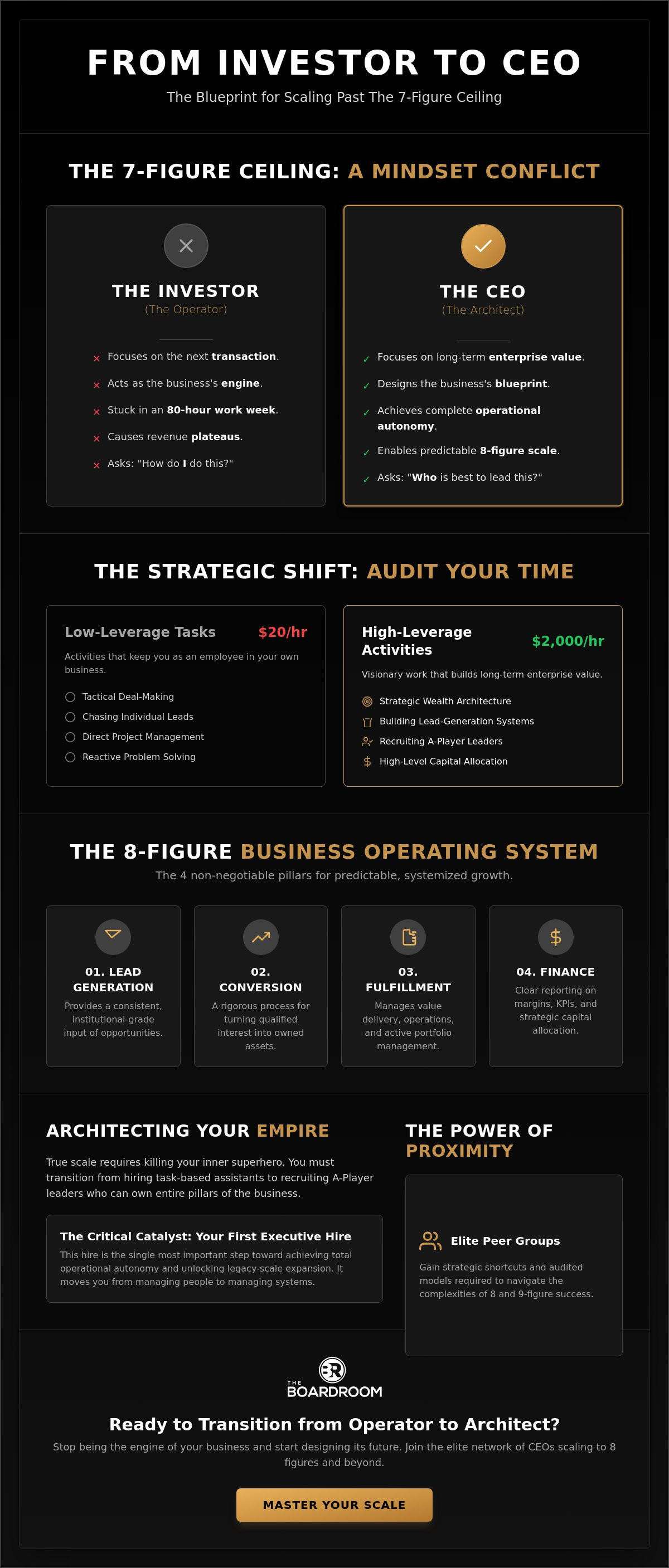
Most real estate investors are exceptional at doing deals, but few are skilled at building companies. This distinction is the difference between owning a high-paying job and owning a scalable asset. Operators focus on the next transaction; CEOs focus on enterprise value. If your revenue has plateaued, your team has stagnated, or you feel paralyzed by decision fatigue, you've likely hit the 7-figure ceiling. The grit and direct involvement that powered your first million are now the very things strangling your growth.
To break through, you must understand the formal duties of a chief executive officer, which prioritize high-level strategy and resource allocation over tactical execution. Transitioning from real estate investor to ceo is the fundamental shift from being the business's primary producer to its chief architect. It's about moving away from the "engine" and toward the "blueprint" of the organization.
To visualize the mechanics of this leadership evolution, watch this strategic briefing:
The Identity Crisis of the High-Growth Founder
The process of transitioning from real estate investor to ceo often triggers a psychological identity crisis. Scaling requires killing your inner superhero. You can't be the best salesperson, the best negotiator, and the best project manager simultaneously if you want to reach 8 figures. You must stop asking "How do I do this?" and start asking "Who is the best person to lead this?" This psychological hand-off is where most founders fail because they're addicted to the dopamine hit of the close. True leadership isn't about being the smartest person in the room; it's about building a room full of people smarter than you.
Audit Your Time: Low-Value vs. High-Leverage Activities
Success at the next level depends on where you spend your mental energy. Tactical deal-making is a low-leverage activity once you've reached the 7-figure threshold. Strategic wealth architecture and system design are where the real growth happens. If you're still chasing leads instead of building lead-generation systems, you're an employee of your own ambition. You must ruthlessly delegate the $20-per-hour tasks to protect your $2,000-per-hour visionary time. This transition requires a ruthless commitment to your own productivity, ensuring that every minute spent is a deposit into your company's future value.
Engineering an Unbreakable Business Operating System
Scaling to 8 figures is impossible if your business relies on your personal bandwidth. You need a Business Operating System (BOS). This is the repeatable infrastructure that makes growth a mathematical certainty rather than a stroke of luck. Transitioning from real estate investor to ceo means shifting from reactive management to proactive, KPI-driven oversight. When you stop managing people and start managing systems, you create a business that can breathe without you.
An effective BOS rests on four non-negotiable pillars. Without these, your empire is a house of cards. First, Lead Generation must provide a consistent input of opportunities. Second, Conversion requires a rigorous process for turning interest into assets. Third, Fulfillment covers the delivery of value and portfolio management. Finally, Finance provides clear-eyed reporting on margins and capital allocation. When these systems are institutionalized, the founder is no longer the central hub of information. Decisions are made based on data, not gut feelings. This structural independence is the hallmark of a true enterprise.
Predictable Deal Flow: Systemizing the Acquisition Engine
Stop relying on random acts of marketing. You need institutional-grade lead funnels that function regardless of your daily mood or schedule. A robust Business Operating System pillar ensures your pipeline remains full. This allows you to focus on high-level strategy rather than daily hunting. If you don't own your lead flow, you don't own your business.
The Quarterly Business Audit: Preventing Operational Drift
Operational drift is the silent killer of scale. You must step out of the daily grind to work ON the business every 90 days. This isn't a luxury; it's a strategic necessity. Utilizing a framework like The Boardroom Mastermind Experience allows you to audit your models against elite peers. It ensures your trajectory remains aligned with 8-figure goals. If you're ready to see how your current systems measure up, exploring proven case studies can provide the clarity needed for your next move.
Architecting Your Empire: Building an A-Player Leadership Team
A CEO's real product isn't real estate; it's the team that acquires and manages it. Transitioning from real estate investor to ceo requires a radical shift in how you view human capital. You aren't just buying time; you're buying expertise and decision-making power. Your first executive hire is the true inflection point for your business. It signals the end of your solo-operator era and the beginning of a legitimate enterprise. If you're still the smartest person in every meeting, your growth is capped by your own limitations.
Stop hiring for tasks and start hiring for outcomes. Most investors hire Virtual Assistants to save $10 an hour. CEOs hire Integrators to unlock $10 million in value. A VA waits for instructions; an Integrator brings the instructions to you. Successfully transitioning from real estate investor to ceo hinges on your ability to sell a vision that is bigger than a commission check. You must recruit talent based on future potential rather than current fires. Elite CEOs hire for where they want to be in three years, not where they are today.
The Real Estate Executive Hierarchy
Structure is the skeleton of scale. You need a clear division between the Visionary (CEO), who sets the strategic direction, and the Integrator (COO), who manages the daily execution. Adding a Head of Acquisitions to fuel the engine completes the foundation of an 8-figure firm. This hierarchy ensures that you are shielded from tactical noise so you can focus on high-level wealth architecture. For a deeper dive into these roles, consult our Building a Leadership Team blueprint.
Delegation as a Strategic Multiplier
True delegation is the "Transfer of Authority," not just the offloading of busywork. You aren't just handing off a spreadsheet; you're handing off the right to make decisions within a defined framework. This creates a culture of extreme accountability and high-performance standards. If your team must ask for permission for every minor expense, you haven't delegated; you've simply created a bottleneck with a different name. Systems should manage the work while people manage the systems. Ready to surround yourself with leaders who have already built these structures? Apply for The Boardroom Mastermind Membership today.
The Power of Proximity: Why Scaling Requires an Elite Peer Group
The path to 8 figures is paved with isolation. Most founders realize too late that the circle that helped them reach $1M is often the same one holding them back from $10M. High-stakes leadership requires a different vernacular. Transitioning from real estate investor to ceo is a solitary journey unless you deliberately curate your proximity. You need access to the "war stories" of those who have already navigated the minefields of rapid expansion. Without a peer group that operates at or above your level, you're forced to learn every lesson through expensive personal failure.
Radical transparency is the only antidote to stagnation. In a boardroom setting, elite peers identify the hidden bottlenecks you've become too accustomed to ignore. Proximity acts as a strategic shortcut, providing you with audited models and proven frameworks that eliminate guesswork. You can see how other high-achievers have successfully navigated the pivot from operator to visionary by reviewing our Member Spotlight, where real-world CEO transitions are documented in detail.
The ROI of Strategic Collaboration
Real scale happens when you move from competition to collaboration. In an exclusive mastermind space, your peers function as an unofficial Board of Advisors for your private company. They offer the objective clarity that your internal team cannot provide. This collective intelligence allows you to pressure-test your strategies before deploying capital. When you're surrounded by people who have already solved the problems you're currently facing, your speed of execution doubles. You aren't just gaining friends; you're acquiring a critical strategic asset.
Engineering Your Exit or Legacy
The final stage of transitioning from real estate investor to ceo is the creation of a business that exists independently of its founder. Your ultimate goal is to build an investable asset, not a high-stress job. This requires a total shift toward permanence and legacy-scale architecture. When your business can be sold, scaled, or passed down without a drop in performance, you've achieved true executive mastery. Don't navigate this transition in a vacuum. The shortcut to 8-figure scale is through elite access. Apply for The Boardroom Mastermind Membership and join the ranks of battle-tested visionaries who value time as much as profit.
Architecting Your Legacy: The Path to Institutional Scale
You've reached the threshold where raw effort no longer yields growth. Breaking the 7-figure ceiling requires a fundamental identity shift. You must move from being the business's primary producer to its chief visionary. By implementing a repeatable Business Operating System and architecting an A-player leadership team, you ensure that your empire thrives independently of your daily presence. Transitioning from real estate investor to ceo is the final, essential evolution for those who refuse to settle for a high-stress job disguised as a business.
True scale is never achieved in a vacuum. You need the radical transparency and audited models that only an elite peer group can provide. We've helped numerous members scale to institutional levels by providing direct access to 8 and 9-figure real estate mentors and rigorous quarterly in-person business audits. It's time to stop working in the weeds and start leading from the boardroom. Apply to join the elite at The Boardroom Mastermind and secure the strategic assets your legacy requires. Your future as a high-level executive starts today.
Frequently Asked Questions
What is the biggest difference between a real estate investor and a CEO?
The primary difference lies in the focus of their labor: an investor manages transactions while a CEO manages the enterprise that facilitates those transactions. Investors are often the primary producers within their own deals, creating a dependency that limits growth. A CEO builds the architecture of the business, focusing on long-term enterprise value and capital allocation rather than tactical execution.
When is the right time to hire a COO or Integrator for my real estate business?
You should hire a COO or Integrator when your personal bandwidth becomes the primary bottleneck for organizational growth. This usually occurs when you reach the 7-figure revenue threshold and find yourself managing people rather than strategy. Transitioning from real estate investor to ceo is impossible without a second-in-command to handle daily operations, allowing you to focus exclusively on high-level vision and market expansion.
How do I stop my team from constantly needing my approval on every deal?
Eliminating the approval bottleneck requires a formal Transfer of Authority framework combined with clearly defined guardrails. You must establish a set of Rules of Engagement that dictate exactly which decisions can be made without your involvement. If your team understands the specific financial and risk parameters for a deal, they can execute autonomously. This shifts your role from a micromanager to a strategic auditor who reviews outcomes rather than approving every step.
Can I really scale to 8-figures without working 80 hours a week?
Scaling to 8 figures is actually more sustainable when you work fewer, more focused hours on high-leverage activities. Working 80 hours a week is a symptom of a broken system, not a badge of honor for a high-level executive. By systemizing your deal flow and delegating tactical fulfillment to A-players, you trade frantic activity for strategic impact. True autonomy is the result of a business that operates through systems rather than founder-led heroics.
What specific metrics should a real estate CEO track daily?
A real estate CEO should prioritize high-level health indicators over granular task lists. Daily focus should remain on lead generation velocity, the total value of the acquisition pipeline, and the current conversion rate of those leads. You must also monitor your cash position and cost per acquisition to ensure the business remains profitable during rapid expansion. These metrics provide the data-driven clarity needed for successful transitioning from real estate investor to ceo.


