
The CEO’s Guide to Compensation Plans for Real Estate Acquisitions Managers
If your top acquisitions talent is one commission check away from becoming your biggest competitor, your business isn't a firm; it's a training ground for your rivals. You understand the cost of high turnover and the quiet dread that comes when a lead manager starts asking too many questions about your equity partners. It's the primary bottleneck preventing you from stepping out of the trenches and into true strategic oversight. Designing a sophisticated compensation plan for real estate acquisitions manager is no longer just about paying for performance. It's about engineering a wealth architecture that makes leaving your firm a mathematical mistake.
You need a framework that attracts A-players who think like owners without handing them the keys to your kingdom. We'll master the sophisticated structures required to align high-velocity deal flow with your 8 and 9-figure scaling goals. This briefing explores the precise balance of base salaries, tiered bonuses, and participation models that transform a volatile sales role into a predictable engine for growth. You'll learn how to transition from managing daily activity to overseeing a self-sustaining empire where your incentives and your team's ambitions are perfectly synchronized.
Key Takeaways
- Shift your focus from rewarding raw activity to incentivizing "alpha" and high-margin deal quality to drive 8-figure scaling velocity.
- Learn to structure a compensation plan for real estate acquisitions manager that balances competitive base pay with tiered bonuses and carried interest to ensure long-term loyalty.
- Implement weighted KPIs that prioritize lead-to-contract ratios and buy-side margins over low-quality volume to protect your bottom line.
- Create a talent moat by integrating high-level mentorship and network access as non-monetary pillars of your elite recruitment strategy.
- Establish a quarterly audit framework to ensure your incentives evolve as your firm reaches new tiers of financial and professional success.
The CEO Blueprint: Why Acquisitions Compensation Dictates Your Scaling Velocity
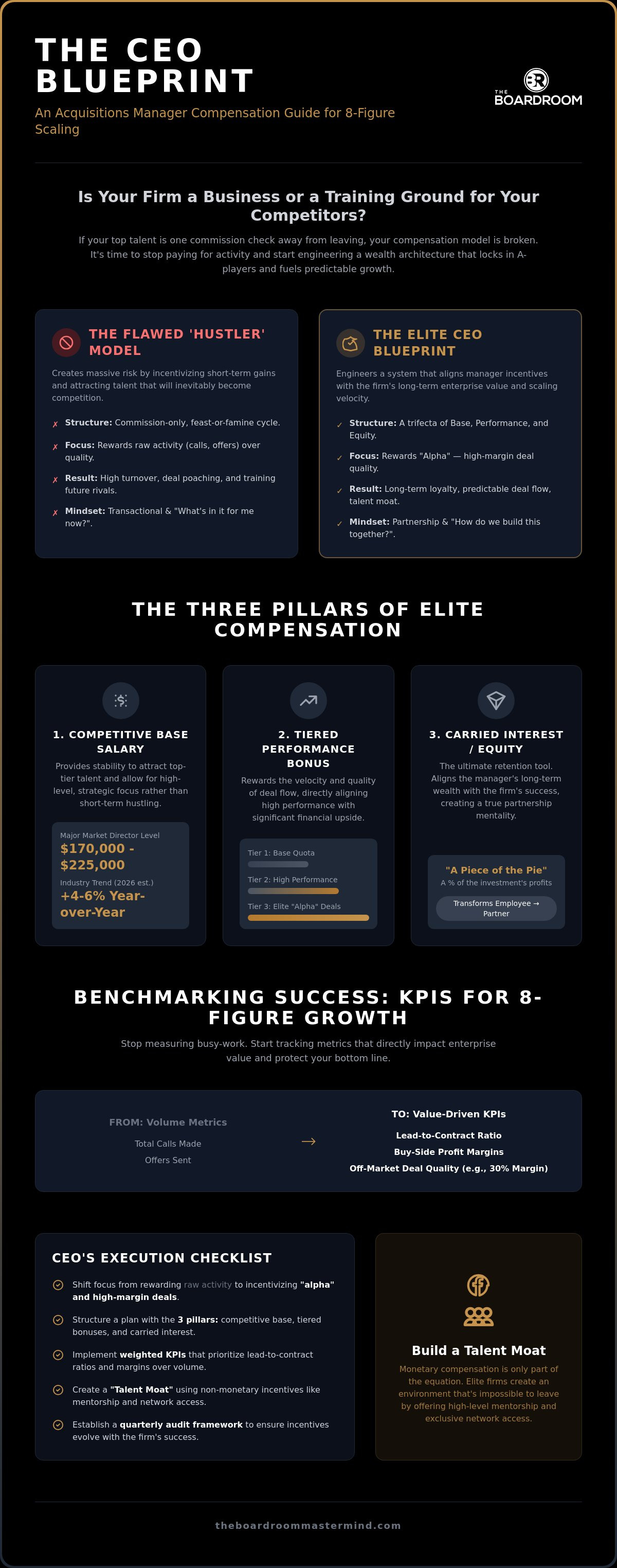
Your acquisitions manager is the engine of your 8-figure real estate business. If this engine isn't tuned, your scaling velocity hits a wall. Most operators pay for activity, counting calls and offers, but CEOs pay for alpha. They prioritize the spread between a mediocre deal and a high-margin asset that drives true enterprise value. A poorly designed compensation plan for real estate acquisitions manager doesn't just cost you money; it compromises your entire business operating system by incentivizing volume over quality. Paying for alpha means rewarding the manager who finds the off-market gem with a 30% margin, rather than the one who floods your CRM with low-spread leftovers.
To better understand how these compensation tiers function in a high-growth environment, watch this helpful video:
Compensation is your primary tool for engineering growth. It's the lever you pull to ensure your team brings in deals that fit your specific buy-box and margin requirements. With industry data indicating that base salaries for acquisitions roles are rising 4-6% in 2026, staying competitive is a baseline requirement. When you align their financial success with the firm's long-term equity goals, you stop managing people and start managing a system. This shift is what separates the $1M flipper from the $100M institution.
Moving Beyond the "Hustler" Pay Model
Commission-only structures are for amateurs. While they seem "safe" because you only pay when you close, they actually create massive risk. Top talent won't tolerate the feast-or-famine cycle, and those who do often end up "deal poaching" or leaving to start their own firms. Professionalizing your compensation plan for real estate acquisitions manager is a core part of The Operator to CEO Mindset Shift. You aren't just hiring a salesperson; you're recruiting a deal architect who understands Private Equity Real Estate Strategies. By providing a base that ensures focus and a bonus structure that rewards excellence, you secure loyalty and predictable deal flow.
Structuring the Three Pillars: Base, Performance, and Carried Interest
Building an elite acquisitions team requires moving past the simplistic "hustler" models of the past. An executive-grade compensation plan for real estate acquisitions manager must be a trifecta of stability, velocity, and legacy. You aren't just paying for a signature on a contract; you're investing in a deal architect who can navigate complex industry data on compensation structures to deliver consistent alpha. The base salary should be high enough to secure top-tier talent from institutional competitors but structured to keep the ceiling open for those who produce. In major markets, Director-level base salaries can range from $170,000 to $225,000, providing the financial security required for high-level focus.
Carried interest is a contractual right to a percentage of the investment’s profits, typically paid after investors receive their preferred return, serving as a long-term incentive that aligns the manager's wealth with the asset’s performance. By offering a "piece of the pie," you move the manager from a transactional mindset to a partnership mentality. This alignment is critical when scaling to 8 and 9 figures, as it ensures your team is as protective of the firm's capital as you are. Understanding these nuances is a core benefit of The Boardroom Mastermind Membership, where established owners share the specific frameworks used to retain high-performers.
The Power of Equity Participation
Equity participation, often structured as "phantom equity," serves as the ultimate retention tool. When a manager has significant profit interest vesting over a three to five-year period, the cost of leaving to become a competitor becomes mathematically prohibitive. These "golden handcuffs" create a sense of permanence. They ensure that your top talent is focused on the long-term health of your portfolio rather than just the next commission check. This structure transforms a job into a career and a staff member into a strategic asset.
Tiered Commission Structures
Standard commission rates often lead to stagnation once a manager hits their personal income goals. To prevent this, implement tiered structures that reward "stretch" performance. For example, a manager might earn a standard percentage up to their quarterly goal, but that rate should increase significantly for every dollar of margin generated beyond that threshold. This creates a relentless drive for volume without sacrificing deal quality. You want to incentivize the extra effort required to turn a good quarter into a record-breaking one.
Benchmarking Success: KPIs that Align Incentives with 8-Figure Growth
Activity is a vanity metric; alpha is the only reality that matters when scaling to 8 and 9 figures. To ensure your compensation plan for real estate acquisitions manager drives enterprise value, you must move beyond tracking mere calls. You need to focus on leading indicators that signal long-term health. These include the number of offers made, the lead-to-contract ratio, and the average buy-side margin. High-volume "garbage" deals clog your pipeline and drain your capital. By weighting deal quality as a primary KPI, you force your acquisitions team to think like underwriters rather than just salespeople. This distinction is critical because it shifts the focus from "winning" a deal to "winning" a return.
Effective management of these metrics is a pillar of Building a Leadership Team. As a CEO, your role is to architect the system that governs these behaviors. With many acquisition professionals expecting bonuses 25-50% less than target in 2026 due to market headwinds, your KPI structure must be transparent and achievable. If your targets are perceived as impossible, your A-players will look elsewhere. You aren't just paying for the contract; you're paying for the predictable profit that follows.
Clawbacks and Quality Control
Integrity in the due diligence phase is non-negotiable. Your compensation structure should include specific clawback provisions that protect the firm from negligence. Bonuses should be rescinded if a deal collapses due to a missed environmental issue or a foreseeable title defect that the manager should have flagged. This ensures the acquisitions manager stays "in the deal" until the first major milestone is met, such as the completion of initial rehab or the securing of a tenant. This level of accountability is what separates institutional-grade firms from amateur operations. To see how top-tier CEOs structure these high-stakes agreements, apply for The Boardroom Mastermind Membership today.
Integrating Talent Management into Your Business Operating System
Compensation isn't a static line item. It's a dynamic lever within your business operating system that requires constant calibration. A high-performance compensation plan for real estate acquisitions manager must be audited quarterly to ensure it still drives the desired behaviors as your firm scales. Stagnation is the silent killer of 8-figure growth. If your incentives don't evolve alongside your revenue, your top talent will eventually feel they've outgrown the container you've built for them. Regular audits allow you to adjust performance tiers and ensure your "alpha" targets remain both aggressive and attainable.
Sophisticated CEOs recognize that A-players value proximity as much as profit. Access to your network, your strategic thinking, and your high-level mentorship is a non-monetary pillar of compensation that competitors can't easily replicate. While mediocre firms focus on dental plans and standard benefits, elite leaders offer wealth architecture and access to power. By positioning your acquisitions manager as a future Partner or Vice President, you provide a career architecture that extends beyond the next deal. You're offering them a seat at the table of legacy builders. Refining these complex human capital structures is a core focus at The Boardroom Mastermind, where elite peers audit each other’s frameworks to eliminate operational blind spots.
The Retention Strategy: Beyond the Paycheck
Culture is your ultimate moat. Competitive talent is drawn to environments of high-stakes execution and radical accountability. You don't just offer a paycheck; you offer a culture of excellence. Quarterly intensives and strategic briefings function as executive perks that provide the mental "oxygen" high-performers need to stay engaged. These sessions reinforce the transition from tactical management to strategic oversight. When your team sees a clear path to autonomy and impact, they stop looking for the exit. If you've successfully navigated this transition and built a self-sustaining acquisitions engine, apply for a member spotlight to share your scaling success with our exclusive community of high achievers.
Architecting Your 9-Figure Exit
The transition from a high-volume operator to an institutional-grade CEO requires a fundamental shift in how you value your deal-making engine. You've moved beyond the amateur model of simple commissions and entered the realm of wealth architecture. By balancing competitive base salaries with tiered performance bonuses and the long-term alignment of carried interest, you create a talent moat that competitors cannot breach. Your compensation plan for real estate acquisitions manager is no longer a cost; it's the primary tool for engineering predictable scaling velocity. When deal quality and margin become the weighted KPIs, your business finally gains the autonomy required for true strategic oversight.
Success at this level isn't achieved in isolation. It requires a peer network that operates at the same high stakes. You need access to 8 and 9-figure real estate mentors and a rigorous environment for quarterly business model audits to ensure your growth remains sustainable. Refine your leadership team and ensure your incentives are built for permanence. Apply to join The Boardroom Mastermind and audit your leadership team structure to gain access to an elite peer network of high-growth founders. The path to the next level is clear for those who build with precision. It's time to step out of the daily deal flow and into the role of a true industry visionary.
Frequently Asked Questions
What is the average base salary for a Real Estate Acquisitions Manager in 2026?
As of July 2026, the national average base salary for a Real Estate Acquisitions Manager is $84,002 per year. However, high-performance firms in major markets like New York City or Miami should budget significantly more for Director-level talent. Base salaries for these senior roles typically range from $170,000 to $225,000, reflecting a 4-6% increase driven by the rising demand for sophisticated deal architects who can navigate complex capital markets.
How do I prevent my Acquisitions Manager from stealing my deal flow?
Preventing deal theft requires a strategy of financial alignment rather than just legal restriction. By integrating phantom equity or carried interest into your compensation plan for real estate acquisitions manager, you make leaving your firm a calculated financial loss. When a manager has a significant profit interest that vests over three to five years, the short-term gain of poaching a deal is outweighed by the loss of long-term wealth architecture.
Is it better to offer a flat commission per deal or a percentage of the net profit?
Percentage of net profit is the superior model for scaling because it aligns the manager's incentives with your firm's actual alpha. A flat commission encourages raw volume without regard for margin, which often leads to a pipeline of low-quality deals. Paying a percentage of net profit ensures your acquisitions team underwriters every deal as if their own capital were at risk, protecting your bottom line from high-volume, low-margin errors.
Should I offer equity to my first Acquisitions Manager hire?
Offering voting equity to your first hire is generally a strategic mistake that compromises your long-term control. Use phantom equity or profit-sharing instead. These structures provide the emotional and financial benefits of ownership without the legal complexities of a partnership. You want your first hire to feel like a stakeholder in the profits while you retain the absolute authority to steer the firm’s strategic direction and scaling velocity.
How do I structure a "draw" against commission for new acquisitions hires?
A recoverable draw functions as a pre-payment of future commissions, providing the manager with immediate cash flow while they build their initial pipeline. You set a monthly floor, typically between $5,000 and $8,000, which is then deducted from their closed-deal commissions once they hit their stride. This structure maintains performance pressure while ensuring your top talent isn't distracted by personal financial instability during the critical 90-day onboarding and ramp-up phase.


