
The CEO’s Edge: Mastering Accountability for Real Estate Entrepreneurs in 2026
Revenue is a vanity metric that often masks the structural rot within an expanding firm. You have likely reached a tier of success where the frantic energy of the initial build no longer serves you, yet you find yourself trapped in the day-to-day hustle of an 8-figure operation. It's a common paradox; you own the business, but the business owns your time. True accountability for real estate entrepreneurs at this level is not about tracking task lists or checking boxes. It is about auditing your business architecture to ensure every system operates with surgical precision without your direct intervention.
You deserve a predictable growth engine that functions as a strategic asset rather than a personal burden. This guide provides the blueprint to transition from a tactical operator to a strategic architect by implementing elite accountability frameworks designed for high-stakes scaling. We will explore how to navigate the 2026 FinCEN reporting requirements for all-cash purchases and leverage the permanent 100% bonus depreciation to solidify your wealth. By the end of this briefing, you will understand how to secure complete operational autonomy and gain the strategic clarity required to lead your industry with calculated confidence.
Key Takeaways
- Shift your focus from managing daily tasks to auditing business architecture. You'll learn how a system-focused mindset differentiates 8-figure CEOs from tactical operators trapped in the hustle.
- Establish a formal Business Operating System to remove emotion from high-stakes decision-making. Institutional-grade accountability for real estate entrepreneurs requires a clear hierarchy of self, leadership team, and elite peer networks.
- Stop relying on "accountability partners" who lack the context of your financial complexity. Discover why the proximity effect of being the smallest in the room is the fastest way to solve sophisticated operational bottlenecks.
- Implement a rhythmic cadence for auditing your business model through a structured framework. Master the "Stop, Start, Continue" method to ensure your resources are always aligned with strategic, long-term expansion.
The Evolution of Accountability: From Operator to Strategic Architect
Accountability is often misunderstood as a punitive measure or a simple checklist for subordinates. In reality, it is the structural bridge that connects a high-level vision to predictable, institutional-scale execution. For those operating at the highest tiers, the definition of accountability shifts from individual responsibility to systemic integrity. It's the difference between a business that relies on your presence and one that thrives on your architecture.
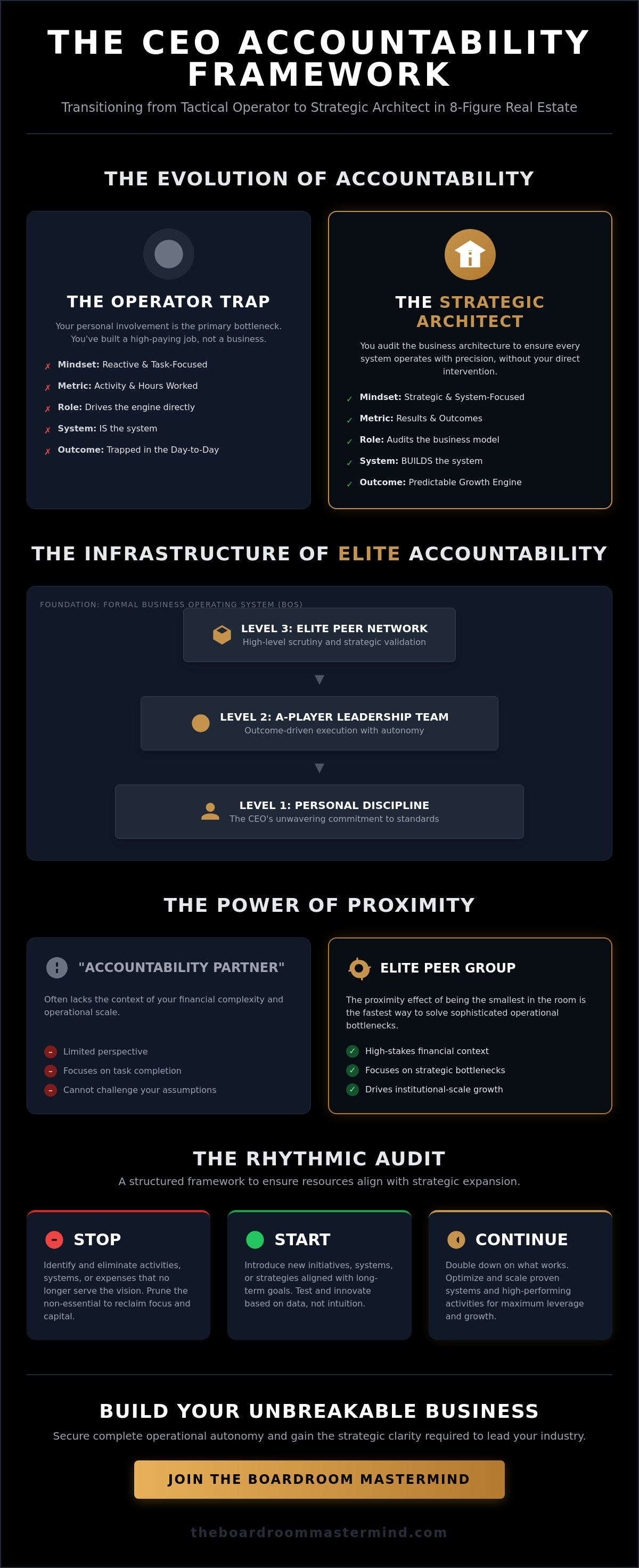
The "Hustler" mindset of early-stage growth is task-focused and reactive. By contrast, the 2026 "CEO" mindset is inherently system-focused. This evolution requires radical transparency as a prerequisite for elite business growth. You cannot scale what you cannot see. You cannot optimize what you refuse to measure with brutal honesty. True accountability for real estate entrepreneurs demands a transition from tracking hours to auditing outcomes.
The Operator Trap: Why Your Current Systems Are Failing
Standard management techniques inevitably break down once a firm hits the 7-figure ceiling. At this stage, your personal involvement becomes the primary bottleneck. If every critical decision requires your approval, you haven't built a business; you've built a high-paying job. Genuine accountability for real estate entrepreneurs at this level means removing yourself from the tactical loop. Are you the one driving the engine, or are you the one standing in its way? You can assess your current position by asking: Are You the Bottleneck?
Accountability as Architecture, Not Activity
True oversight shifts the focus from what was done to what the system produced. Activity is a vanity metric. Results are the only currency that matters in an 8-figure operation. Implementing a robust Architecture of 8-Figure Real Estate Scaling allows you to audit the business model rather than the individual. It replaces emotional management with data-driven clarity. When your accountability is built into the architecture, growth becomes a mathematical inevitability rather than a lucky break.
The Infrastructure of Elite Accountability Systems
High-growth firms don't survive on intuition. They thrive on a formal Business Operating System (BOS) that removes emotion from the decision-making process. Without this infrastructure, your leadership is reactive, governed by the volatility of the market or your personal energy levels. Elite accountability for real estate entrepreneurs is built on a rigid hierarchy: personal discipline, leadership team execution, and the high-level scrutiny of a peer network. This structure ensures every strategic move is validated by data. You need a scoreboard that tracks institutional milestones, ensuring you don't mistake top-line revenue for sustainable business health.
Identifying the Right Leading Indicators for Scale
Leading indicators are the predictive pulse of future revenue. While lagging indicators like closed deals tell you where you've been, leading metrics like cost per acquisition and capital efficiency dictate where you're going. You must audit these metrics weekly to prevent small operational leaks from becoming financial catastrophes. Even the Small Business Training & Education Center emphasizes foundational systems as the bedrock of entrepreneurial success. By tracking these predictive data points, you maintain a clear view of your firm's trajectory months before the revenue hits the bank.
Building an Unbreakable A-Player Leadership Team
Holding a leadership team accountable is not about micromanagement or busy work. It's about defining clear outcomes and providing A-players the autonomy to achieve them. If you're still monitoring daily tasks, you've either hired the wrong talent or failed to establish the right KPIs. Your role is to provide the vision and the resources, then step back to allow for high-level execution. For a strategic roadmap on selecting these individuals, study the CEO's blueprint for 8-figure scale. As you refine these internal structures, consider how a proven framework could accelerate your transition from operator to architect.
The Power of Proximity: Why Peer Groups Outperform Partners
The traditional concept of an accountability partner is fundamentally flawed for those operating at scale. Friends and casual colleagues rarely possess the context or the courage to hold you to 8-figure standards. They tend to empathize with your struggle when they should be questioning your strategy. Elite accountability for real estate entrepreneurs requires a shift from emotional support to strategic friction. You don't need someone to ask if you made your calls; you need a network that challenges the very logic of your business model. Comfort is the enemy of expansion.
This is the Proximity Effect in action. When you are the smallest in the room, your growth is no longer optional; it is a prerequisite for belonging. A professional Board of Advisors for your private real estate firm functions as an external nervous system. It identifies blind spots that your internal team is too close to see. By surrounding yourself with global high achievers, you move from a support group mentality to a strategic mastermind environment where the stakes are clear and the execution is non-negotiable. You aren't just looking for partners; you're looking for peers who have already solved the problems you currently face.
The ROI of High-Ticket Masterminds
Viewing a high-level community as an expense is a hallmark of the operator mindset. For the strategic architect, it's an investment in compressed time and the avoidance of catastrophic errors. Access to a peer advisory group provides the unfair advantage of collective intelligence. One avoided mistake or one optimized capital structure can return the initial investment ten times over. It's about buying the results of others' decades of experience to accelerate your own timeline. You're paying for the speed of execution that only comes from proven frameworks.
Engineering Your Elite Network
Audit your current circle with surgical precision. If your network consists primarily of individuals who look to you for answers, you are in a support group, not a mastermind. A strategic network should provide intellectual friction that refines your decision-making and grants access to institutional-grade systems. It must offer unfiltered feedback on your operational bottlenecks without the bias of friendship. Your network is a critical strategic asset. If you're ready to stop being the smartest person in your circle, join The Boardroom Mastermind Membership to secure your seat at the table.
The Quarterly Audit: Implementing the Boardroom Framework
Strategic momentum is maintained through a rhythmic cadence of evaluation. High-performing firms don't wait for year-end reviews to identify structural decay. Instead, they utilize a Quarterly Intensive to audit the entire business model. This isn't a casual discussion; it's a rigorous application of the "Stop, Start, Continue" framework for strategic resource allocation. You must identify which operations are creating friction, which systems need immediate deployment, and which high-yield activities deserve more capital. This transition from hustle to impact requires a level of accountability for real estate entrepreneurs that most simply cannot sustain alone.
The Boardroom Mastermind Experience serves as the ultimate shortcut to this framework, providing the external pressure required to execute these audits with surgical precision. By stepping away from the daily noise, you gain the clarity to optimize for permanence rather than just temporary revenue spikes. It's about moving from reactive management to proactive architecture.
The Annual Business Audit That Prevents Stagnation
Stagnation is rarely a lack of effort; it is a failure of architecture. To maintain 8-figure health, your annual audit must scrutinize capital efficiency, leadership team performance, and market positioning. If your systems haven't evolved to handle the 2026 reporting requirements or the shift in multifamily vacancy rates, your business is a liability. A truly institutional-grade audit ensures every department is aligned with the long-term vision of wealth preservation and market dominance.
Transitioning to True Autonomy
The ultimate objective of elite accountability for real estate entrepreneurs is the creation of a self-sustaining growth engine. Success isn't measured by how hard you work, but by how well the business performs in your absence. When the founder’s daily presence is no longer a requirement for expansion, you've achieved true autonomy. This is the path from operator to strategic architect. You can examine the trajectories of those who have already navigated this transition by reviewing our Case Studies of founders reaching 9-figure scale.
Architecting Your 8-Figure Legacy
The transition from a tactical operator to a strategic architect represents the most significant pivot in an executive career. You have already built the engine. Now you must ensure it runs without your hands on the gears. By implementing institutional-grade Business Operating Systems and committing to a rigorous audit cadence, you secure the autonomy required for long-term wealth building. High-level accountability for real estate entrepreneurs is not found in a vacuum. It is forged in the proximity of peers who operate at your level and possess the clarity to challenge your logic.
The path to institutional scale requires a combination of proven frameworks and elite access. Through our Quarterly In-Person Intensives across the US, you gain direct access to an exclusive community of 8 and 9-figure real estate leaders. This is where the world's most sophisticated owners refine their growth engines using a proven Business Operating System. It's time to stop managing the hustle and start architecting the impact.
Apply for The Boardroom Mastermind and Audit Your Path to 8-Figures. Your next milestone is a logical conclusion once the right architecture is in place.
Frequently Asked Questions
What is the difference between an accountability partner and a mastermind?
An accountability partner typically provides emotional support and mutual encouragement. By contrast, a mastermind offers strategic friction and institutional-grade scrutiny. While a partner might ask if you completed your task list, a mastermind challenges the very viability of your business architecture. For those pursuing 8-figure success, the mastermind environment provides the proximity to global high achievers who force you to justify your logic rather than just your activity.
How do I hold my real estate leadership team accountable without micromanaging?
You must manage outcomes instead of activities to avoid the trap of micromanagement. Effective accountability for real estate entrepreneurs requires defining clear, non-negotiable KPIs and granting your leadership team the autonomy to achieve them. If you're still monitoring daily checklists, you've failed to implement a robust Business Operating System. True leadership focuses on auditing systemic output while allowing A-players to own the tactical execution of your vision.
What are the most important KPIs for a scaling real estate business in 2026?
Prioritize leading indicators that predict future financial health, such as cost per acquisition (CPA) and capital efficiency. In 2026, real estate CEOs must also monitor compliance with FinCEN reporting requirements for all-cash residential purchases to mitigate legal risk. Tracking these technical metrics instead of vanity revenue numbers ensures your firm maintains structural integrity. It allows you to make data-driven decisions that support sustainable, institutional-grade expansion.
How often should a real estate CEO audit their business model?
You should conduct a formal audit of your business model every quarter. This rhythmic cadence allows you to identify and resolve operational bottlenecks before they jeopardize your long-term growth. By utilizing a structured framework to reallocate capital and human resources, you ensure the business remains agile. These intensives provide the strategic distance necessary to evaluate your firm's performance objectively, moving you from the day-to-day hustle into a role of oversight.
Is a high-ticket mastermind worth the investment for a 7-figure founder?
Elite masterminds are investments in compressed time and the mitigation of expensive mistakes. For a 7-figure founder, the ROI is found in the proximity to 8 and 9-figure peers who have already bypassed your current obstacles. This high-level accountability for real estate entrepreneurs provides the clarity needed to scale without sacrificing your lifestyle. It is the fastest route to building a predictable growth engine that functions independently of your daily presence.


