
The Architect’s Blueprint: Structuring Real Estate Joint Ventures for 8-Figure Scale
Why are you still the bottleneck in every deal you close? Most operators believe that scaling to 8 figures is a matter of effort, but effort doesn't scale. Systems do. If you're still manually managing every capital call and legal dispute, you aren't a CEO. You're a high-paid employee of your own ambition. Mastering the art of structuring real estate joint ventures is the only way to break this cycle. It's the difference between chasing the next transaction and architecting a permanent wealth engine that attracts institutional-grade partners.
You likely already understand that your current equity structures are reaching their breaking point. With 100% bonus depreciation now a permanent fixture under the One Big Beautiful Bill Act of 2025, the stakes for tax-efficient deal architecture have never been higher. This guide provides the sophisticated frameworks needed to refine your GP/LP roles and secure larger capital stacks. We will break down the precise legal and financial blueprints used by elite investors to ensure predictable growth and clean exits. You'll learn how to step away from tactical management and into a role of strategic oversight.
Key Takeaways
- Shift your focus from transactional management to strategic oversight by treating every partnership as a core component of your business operating system.
- Master the technical mechanics of structuring real estate joint ventures to move beyond the capital constraints and operational bottlenecks of small-scale syndication.
- Design advanced economic frameworks, including tiered equity waterfalls and promotes, that protect your equity while maximizing performance-based returns.
- Leverage elite peer proximity to vet potential partners who possess the operational maturity required to handle the reporting and compliance of 8-figure deals.
The Strategic Evolution: From Transactional Operator to Equity Architect
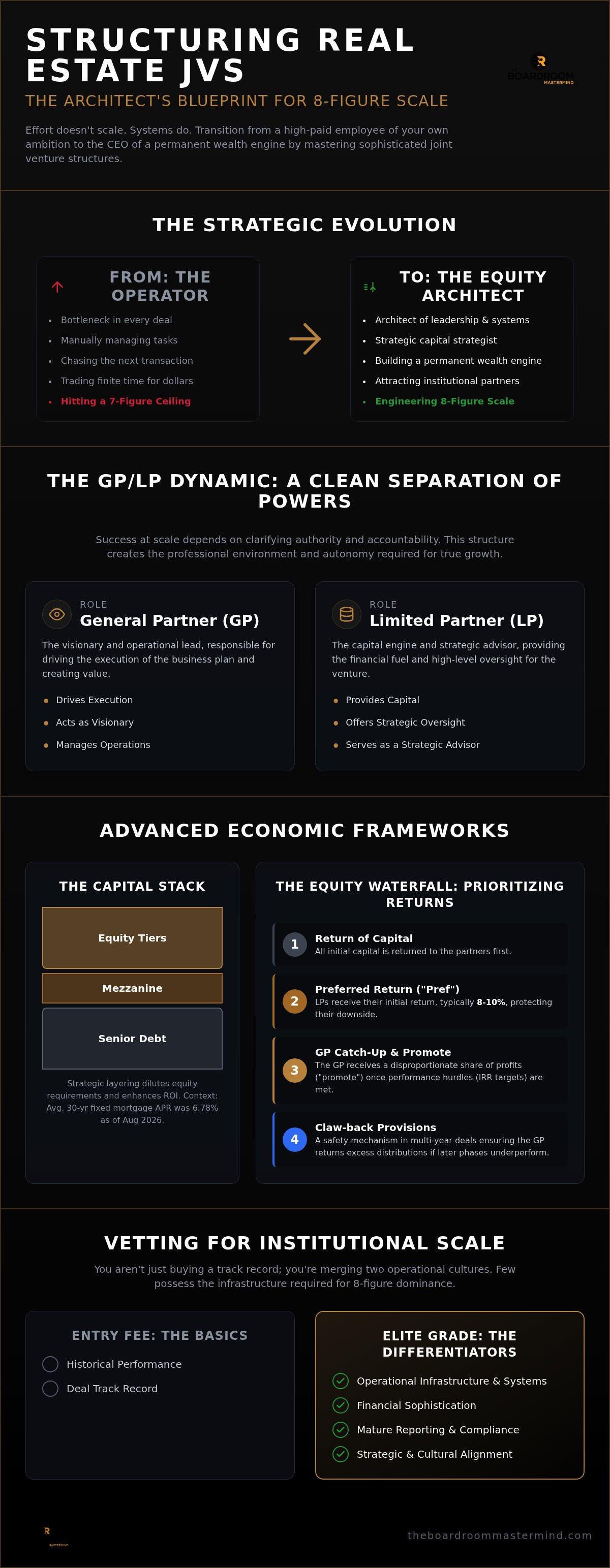
Many investors mistake a joint venture for a mere project-level necessity. It isn't. At the 8-figure level, a JV is a strategic asset designed to fuel a real estate empire. You must stop 'doing the work' and start architecting the leadership. If you're still the primary problem solver on every job site, you've built a job, not a company. This is the first hurdle in structuring real estate joint ventures for long-term dominance. You must move from tactical management to strategic oversight.
Equity Architecture is the strategic arrangement of capital, expertise, and risk to ensure predictable scale.
Individual deal-making creates a 7-figure ceiling that is impossible to shatter through sheer volume. Your time is finite. Scaling to 8 or 9 figures requires a fundamental shift in perspective. You are no longer a deal-finder; you are a capital strategist. When you shift your focus to structuring real estate joint ventures with institutional-grade partners, you stop trading time for dollars. You start building systems.
The GP/LP Dynamic: Clarifying Authority and Accountability
Success at scale depends on a clean separation of powers. The General Partner (GP) acts as the visionary and operational lead, driving the execution of the business plan. Conversely, the Limited Partner (LP) serves as the capital engine and strategic oversight. This structure is the primary vehicle for transitioning from a 'hustler' to a professional CEO, a core focus for members of The Boardroom Mastermind. By delegating the heavy lifting of capital and operations to specific roles, you gain the strategic oversight necessary for high-level execution. It creates a professional environment where accountability is baked into the agreement. This isn't just about protection; it's about creating the autonomy required for true growth and significant impact.
Advanced Economic Frameworks: Promotes, Waterfalls, and the Capital Stack
Incentive alignment is the bedrock of any high-stakes partnership. When structuring real estate joint ventures, the "Promote" serves as your primary lever for performance. It isn't just a fee; it's a disproportionate share of profits paid to the operator once specific return hurdles are met. This mechanism ensures that the General Partner remains aggressively focused on alpha generation. To understand how these structures fit into a broader institutional context, explore our guide on Real Estate Private Equity.
A sophisticated capital stack often integrates senior debt, mezzanine financing, and multiple tiers of equity to maximize ROI. With national average 30-year fixed mortgage APRs sitting at 6.78% as of August 2026, the cost of debt is a critical variable in your architecture. Strategic layering allows you to dilute the equity requirement while enhancing the returns on the remaining capital. Proper execution requires meticulous vetting a joint venture real estate partner to ensure they possess the financial sophistication to manage these complex instruments.
Structuring the Waterfall for 8-Figure Outcomes
The equity waterfall is the mathematical expression of your deal's priorities. It typically begins with a preferred return, often 8% to 10%, to protect the capital partner's downside. Once this hurdle is cleared, catch-up provisions allow the GP to claim their share of the initial profits, followed by performance tiers that increase the GP's promote as the project's IRR climbs. In multi-year developments, claw-back provisions are essential. They ensure that if later phases underperform, the GP returns excess distributions to maintain the agreed-upon split. Mastering these nuances is a hallmark of the elite operators within The Boardroom Mastermind, where we audit these frameworks for maximum scalability.
Vetting for Institutional Scale: Beyond the Track Record
Historical performance is merely the entry fee. While many sponsors boast of past returns, few possess the infrastructure required for 8-figure dominance. When structuring real estate joint ventures, you aren't just buying a track record; you're merging two operational cultures. The critical question isn't just "Can they find deals?" but "Can they handle the reporting requirements of institutional scale?" This requires a robust Business Operating System that functions independently of the founder's daily involvement.
The litmus test for any potential partner involves three non-negotiables: alignment on exit strategy, debt tolerance, and management philosophy. If your partner has a three-year horizon while you're architecting a decade-long hold, the venture is doomed before the first capital call. You might wonder, "How do I know I can trust a partner with my reputation?" The answer lies in proximity and rigorous auditing. You must move beyond surface-level rapport and scrutinize their internal systems.
The Operational Audit: Ensuring Your Partner Can Scale
Scale is a function of delegation. You must evaluate the partner's leadership team to ensure they aren't the bottleneck in their own business. A professional operator provides financial transparency through audited statements and real-time reporting, not just quarterly spreadsheets. Finally, demand a contingency plan for market corrections. With investor home purchases down 6% year-over-year in the first quarter of 2026, your partner must demonstrate a battle-tested strategy for navigating volatility. If you want to vet your next 8-figure partner among the industry's elite, apply for The Boardroom Mastermind Membership today.
The Boardroom Advantage: Engineering High-Performance Strategic Alliances
High-level joint ventures aren't found in public forums. They're forged in closed rooms where the stakes are high and the expertise is verified. The Boardroom Mastermind provides the "Power of Proximity," placing you among peers who operate at the highest tiers of financial success. This environment serves as a pre-emptive due diligence filter. When you're structuring real estate joint ventures for 8-figure scale, you can't afford to partner with an amateur. You need an operator whose business model has been audited and battle-tested by other global high achievers.
Our quarterly intensives provide a unique window into how your peers lead. You see their systems. You understand their debt tolerance. You witness their strategic oversight in action. This level of transparency is impossible to find in the general marketplace. Peer accountability ensures you don't sign a poorly structured agreement that could lead to litigation or stalled exits. By collaborating with elite partners, you finally break free from tactical management. You stop being the bottleneck and start being the visionary CEO of a scalable empire.
Accessing the Elite: Why Proximity is Your Best Due Diligence
There's a fundamental difference between a general networking group and a vetted peer group. Public forums are saturated with frantic energy and entry-level mentorship. In contrast, our community is a restricted-access asset for those who value time and privacy. We've seen numerous leaders scale through strategic Boardroom alliances. These members didn't just find capital; they found partners with aligned Business Operating Systems. This is the ultimate shortcut to achieving peak performance without sacrificing your lifestyle. Apply to join The Boardroom Mastermind and audit your scaling strategy.
Architecting Your Exit: The Path to 8-Figure Mastery
Transitioning from a transactional operator to a high-level real estate CEO requires more than just closing bigger deals. It demands a fundamental shift in how you view equity and partnership. By mastering the mechanics of structuring real estate joint ventures, you move from being the bottleneck to becoming the architect of a scalable enterprise. You've seen how sophisticated waterfalls and rigorous operational audits protect your downside while maximizing your upside. Now, the question is who you'll scale with. Systematize or stagnate.
The Boardroom Mastermind offers the exclusive proximity needed to find institutional-grade partners. Through quarterly in-person intensives and access to a peer network of 7, 8, and 9-figure investors, you can leverage REWW’s decade-plus of scaling expertise to audit your business model in real-time. Don't let your growth be limited by your current network. Apply to The Boardroom Mastermind: The Elite Network for 8-Figure Real Estate CEOs and secure your place among the industry's top performers. Your next level of impact is waiting for you to build the right structure.
Frequently Asked Questions
What is the most common mistake when structuring a real estate joint venture?
The most common mistake is failing to define a clear exit strategy and governance framework from the outset. Many operators focus exclusively on the buy-side and neglect the complexities of a stalled exit or a partner dispute. If your agreement doesn't specify buy-sell provisions or decision-making deadlocks, you're inviting litigation. Structuring real estate joint ventures requires anticipating the end of the partnership as rigorously as the beginning.
How do I determine a fair 'promote' for an operating partner?
A fair promote is typically determined by the level of alpha the operating partner brings to the deal. While a 20% promote over an 8% preferred return is a common industry benchmark, this varies based on the risk profile and asset class. You must ensure the promote is high enough to incentivize peak performance but not so aggressive that it dilutes the capital partner's appetite for future 8-figure deal flow.
Can a joint venture structure help me scale if I don't have institutional capital yet?
Absolutely. A joint venture is the ideal vehicle for scaling when you have the deal flow but lack the full capital stack. By partnering with high-net-worth individuals or family offices, you can access larger projects that would be impossible to fund solo. This approach allows you to build the track record required to eventually attract institutional-grade capital while maintaining significant strategic oversight and operational control.
What is the difference between a real estate syndicate and a joint venture?
The primary difference lies in control and the number of participants. A syndicate typically involves a large group of passive investors with zero management rights, whereas a joint venture usually consists of a few partners who share active decision-making authority. When structuring real estate joint ventures, the goal is often a strategic alliance between two sophisticated entities rather than a broad capital raise from the general public.
How do I protect my personal assets within a JV agreement?
Asset protection is achieved by utilizing bankruptcy-remote Special Purpose Vehicles (SPVs), typically LLCs, for each specific project. You should also negotiate for non-recourse debt to ensure your personal balance sheet isn't at risk if the project underperforms. Ensure your JV agreement includes robust indemnification clauses and that you maintain clear corporate formalities to prevent any "piercing of the corporate veil" by creditors or litigious partners.

Disclaimer
Mr. Clothier is an expert in real estate investing. As such his experiences are not necessarily typical to the standard real estate investor and whose results may vary. The successes shared on this site are not considered typical. Most individuals who order the educational materials and systems probably do not follow any of the techniques or strategies and consequently make little to no money due to their inaction. The company is in the process of determining the typical success of its clients. Stories shared herein are for example purpose only and should not be construed as "guarantees" of success. Results will vary based on background, education, and experience and actions taken.
This site is not a part of the Google/Facebook website or Google/Facebook Inc. Additionally, this site is NOT endorsed by or affiliated with Google/Facebook in any way. GOOGLE/FACEBOOK is a trademark of GOOGLE/FACEBOOK, Inc.
INCOME DISCLAIMER: This website and the items it distributes contain business strategies, marketing methods and other business advice that, regardless of referenced results and experience, may not produce the same results (or any results) for you. The Boardroom Mastermind makes absolutely no guarantee, expressed or implied, that by following the advice or content available from this web site you will make any money or improve current profits, as there are several factors and variables that come into play regarding any given business. Primarily, results will depend on the nature of the product or business model, the conditions of the marketplace, the experience of the individual, and situations and elements that are beyond your control. As with any business endeavor, you assume all risk related to investment and money based on your own discretion and at your own potential expense.
LIABILITY DISCLAIMER: By reading this website or the documents it offers, you assume all risks associated with using the advice given, with a full understanding that you, solely, are responsible for anything that may occur as a result of putting this information into action in any way, and regardless of your interpretation of the advice. You further agree that The Boardroom Mastermind, its affiliates, subsidiaries, officers and agents, cannot be held responsible in any way for the success or failure of your business as a result of the information provided. It is your responsibility to conduct your own due diligence regarding the safe and successful operation of your business. In summary, you understand that we make absolutely no guarantees regarding income as a result of applying this information, as well as the fact that you are solely responsible for the results of any action taken on your part as a result of any given information. In addition, you agree that our content is to be considered "for entertainment purposes only". Always seek the advice of a professional when making legal, financial, tax, or business decisions.
BUSINESS OPPORTUNITY: All products and services offered by The Boardroom Mastermind are intended to provide prospective purchasers with general business strategies, marketing methods and other general advice for business development and training. At no point is The Boardroom Mastermind soliciting anyone to enter into a new business nor is it representing, either expressly or by implication, that it will provide locations for a business, provide outlets, accounts, or customers, or purchase any of the goods or services made by the purchaser.
The products being offered through this promotion are packages of informational tools to help you learn about business and deal making strategies.


