
The Architect of Scale: Best Ways to Be a Great CEO in 2026
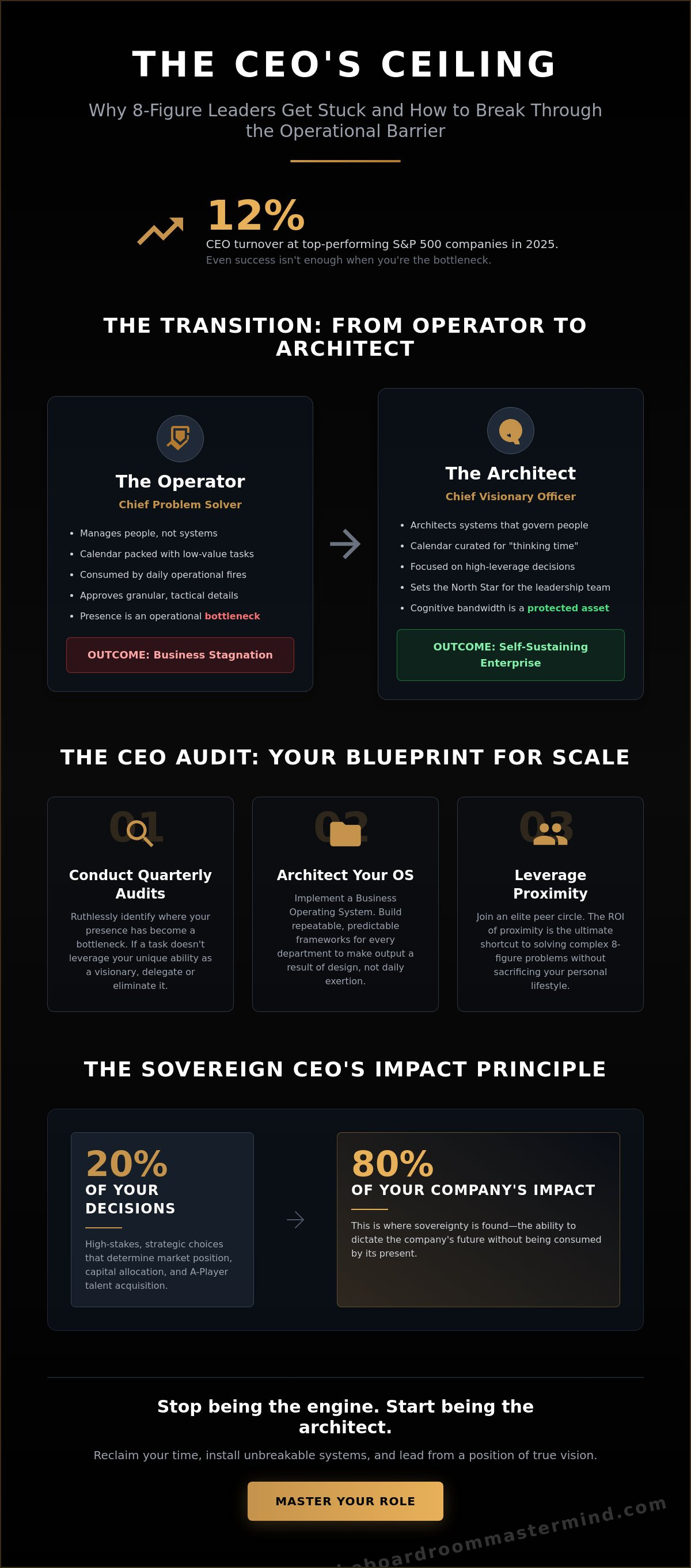
Why did CEO turnover at top-performing S&P 500 companies spike to 12% in 2025? It's a startling figure from the latest Semler Brossy report, proving that even successful leaders are hitting a ceiling they can't break through. You likely feel this same friction daily. Your business generates eight figures, yet it still demands your constant presence to function. You're searching for the best ways to be a great ceo because the operational fires are finally starting to obscure your vision. It's time to stop being the engine and start being the architect.
You know that true scale requires more than just working harder; it requires a fundamental shift in how you occupy your role. This article will show you how to master the transition from high-level operator to visionary architect of a self-sustaining enterprise. We'll examine how to leverage the SEC's May 2026 proposal for semi-annual reporting to streamline your strategic focus. You'll discover why joining a restricted circle of peers is the only way to solve complex 8-figure problems. You're about to learn how to reclaim your personal time while making your company’s growth entirely predictable.
Key Takeaways
- Transition from the Chief Problem Solver to the Chief Visionary Officer to ensure your time is invested in high-leverage decisions that drive long-term impact.
- Discover the best ways to be a great ceo by shifting your focus from managing individual team members to architecting the systems that govern them.
- Conduct a quarterly role audit to identify where your presence has become an operational bottleneck and smash the invisible ceiling holding you back from eight figures.
- Understand the Proximity Effect and why the ROI of an elite peer circle is the ultimate shortcut to scaling without sacrificing your personal lifestyle.
The Sovereign CEO: Reclaiming Your Time for Strategic Vision
The most dangerous trap for an eight-figure leader is the slow descent into tactical management. You aren't the Chief Problem Solver. You are the Chief Visionary Officer. One of the primary role and responsibilities of a CEO is to steer the ship, not to bail out the water. To master the best ways to be a great ceo, you must recognize that 80% of your impact originates from just 20% of your decisions. These are the high-stakes, strategic choices that determine market position and capital allocation. CEO sovereignty is the ability to dictate the company's future without being consumed by its present.
The Cost of Being 'Wildly Busy'
A packed calendar isn't a badge of honor. It's a symptom of operational decay. If your day is a sequence of back-to-back fires, you've failed to build the systems that manage the people. You must ruthlessly delete low-value activities like granular project approvals or minor vendor disputes. In 2026, the gap between the operator and the architect is defined by the white space on their calendar. Delegation isn't just about offloading tasks; it's about preserving your cognitive bandwidth for the moves that actually move the needle. Efficiency is the prize of the disciplined.
Curating the 8-Figure Vision
Elite leaders prioritize thinking time as their most valuable asset. This isn't passive; it's a strategic audit of market shifts and competitive threats. You are responsible for setting the North Star for your entire leadership team. Without this clarity, your team will drift into tactical silos and lose momentum. By protecting your schedule, you ensure that your company isn't just reacting to the market, but actively shaping it. This level of foresight is among the best ways to be a great ceo in an environment where speed and precision are the only currencies that matter. You lead through vision, not through activity.
The Architecture of Scale: Building Unbreakable Systems and Teams
Scaling to eight figures and beyond requires a fundamental shift in your operational philosophy. You must move from managing people to managing the systems that manage the people. One of the best ways to be a great ceo is to stop being the central hub through which every decision flows. Instead, you must implement a Business Operating System that provides a repeatable, predictable framework for every department. This architecture ensures that your company’s output is a result of design, not your daily exertion.
In high-stakes real estate investment, identifying "A-Player" traits is non-negotiable. These individuals don't just possess technical skills; they exhibit extreme ownership and the ability to operate autonomously within your framework. Your primary contribution to the culture is developing a long-term company vision that attracts this tier of talent. When the vision is clear and the systems are unbreakable, the business scales predictably without your constant presence. This is how you transition from a leader of tasks to a leader of impact.
Recruiting for the Executive Tier
Stop hiring for the problems you have today. You must hire for where you intend the company to be in three years. There's a massive gap between a manager who executes instructions and a leader who creates new paths for growth. Developing this bench strength is a core component of the best ways to be a great ceo in a competitive market. For a strategic roadmap on this transition, see our blueprint on Building a Leadership Team. Hire for leadership, and you'll buy back your freedom.
Systemizing Deal Flow and Operations
You are the architect of the business engine. Your job is to design the blueprints for acquisitions, dispositions, and investor relations so they function like a well-oiled machine. When these processes are systemized, deal flow becomes a predictable metric rather than a series of lucky breaks. If you're ready to see these blueprints in action among peers who have already mastered them, consider exploring the Boardroom experience. A well-designed system is the only way to achieve permanence in a volatile market.
The CEO Audit: Identifying and Smashing Your Operational Ceiling
The systems that propelled you to seven figures are often the very weights that prevent you from reaching eight. This is the "7-Figure Ceiling." It's a structural failure, not a lack of effort. To scale, you must perform a ruthless quarterly audit of your own role to identify where you've become the primary point of friction. An operational bottleneck is any process that requires the CEO's permission to proceed. If your approval is the final gate for every property acquisition or marketing spend, you've built a high-paying job rather than a scalable enterprise.
One of the best ways to be a great ceo is to treat your own position as a component that must be optimized or replaced. You should monitor your business from 30,000 feet using leading indicators like deal pipeline velocity rather than just lagging indicators like monthly revenue. Leading in 2026 requires you to look ahead, not behind. If you're ready to stop being the bottleneck and start being the architect, the Boardroom Mastermind Membership provides the framework to audit your operations and clear the path for 8-figure growth.
The Mirror Test: Are You the Drag?
Speed of execution is your company’s most vital asset. If your team is waiting on your "final look" before moving on a deal, you are the drag on your own momentum. Letting go of tactical control is a psychological hurdle, but it's the only way to increase the velocity of your organization. You must trust the systems you've built. If you can't trust the systems, the problem isn't the team; it's the architecture you designed.
Advanced KPIs for Strategic Oversight
Elite CEOs move beyond gross revenue to track more sophisticated metrics. You should be focused on net profit margins, investor LTV, and employee efficiency ratios. High-stakes decisions require calculated confidence, which only comes from clean, actionable data. When you lead with data instead of intuition, you remove the emotional volatility that plagues smaller operations. This shift in focus allows you to spot market shifts before they become crises, ensuring your company remains dominant regardless of the economic climate.
The Power of Proximity: Why Elite CEOs Never Lead in Isolation
Leadership at the eight-figure level is inherently isolating. Your team looks to you for answers, but you often find yourself with no one to challenge your own assumptions. The Proximity Effect dictates that your professional trajectory is capped by the average of your inner circle. One of the best ways to be a great ceo is to intentionally curate a room where your current success is merely the baseline. High-ticket exclusive mastermind groups act as a strategic asset, providing the peer accountability required to accelerate scaling far beyond what you could achieve alone. You don't need another mentor. You need a circle of peers who are navigating the same high-stakes complexities.
Escaping the Echo Chamber
Being the smartest person in the room is a liability, not a victory. In an echo chamber, your blind spots are reinforced by those who fear to challenge you. Elite CEOs seek out spaces where their strategies are stress-tested by those who have already cleared the hurdles they currently face. This is The Unfair Advantage that separates industry leaders from those who simply manage companies. Consider what you gain in an elite room:
- Unfiltered Feedback: Peers have no stake in your company's politics and can speak the truth.
- Shared Intelligence: Access to the collective data of multiple eight-figure enterprises.
- Strategic Alliances: Joint ventures and partnerships that are born from trust and shared status.
When you surround yourself with visionaries, your perspective shifts from survival to dominance. It's about finding the room where your "impossible" goals are considered standard operating procedure. Your network isn't just a list of contacts; it's the architecture of your future success.
The Boardroom Experience
The Boardroom is designed for those who value time and privacy as much as growth. Through our Quarterly In-Person Intensives, you gain access to a restricted environment where the only agenda is high-level execution. With CEO turnover rates climbing to 12.5% in 2025, the pressure to perform has never been higher. You can't afford to lead in isolation while the regulatory and competitive landscapes shift beneath you. If you're ready to elevate your proximity and master the best ways to be a great ceo, it's time to step into a higher tier of leadership. Apply for The Boardroom Mastermind and secure your seat among the architects of scale.
Architecting Your Eight-Figure Future
The transition from tactical management to strategic oversight is the only way to secure your legacy in an increasingly volatile market. You've learned that your value isn't in bailing water, but in designing the ship. By ruthlessly auditing your role and implementing unbreakable systems, you reclaim the sovereignty required to lead with clarity. Mastering these best ways to be a great ceo ensures your business scales predictably without demanding your constant presence. Growth is no longer a matter of effort; it's a matter of architecture.
True expansion happens in the presence of those who have already cleared your next hurdle. You don't have to lead in isolation. Through our Quarterly In-Person Intensives and access to an elite peer network of 8 and 9-figure investors, we provide the comprehensive business auditing and scaling frameworks needed for permanent impact. It's time to step out of the engine room and into the boardroom. Apply for The Boardroom Mastermind Experience and secure your position among the architects of scale. Your next level of leadership is waiting for you to claim it.
Frequently Asked Questions
What is the single most important habit of a great CEO?
The single most important habit is the ruthless protection of strategic thinking time. You must treat your schedule as a fortress, guarding it against the trivial tasks that attempt to hijack your cognitive bandwidth. Great CEOs spend their mornings auditing market shifts rather than answering emails. This discipline ensures that every decision is proactive rather than reactive. It's the only way to maintain the 30,000-foot view necessary for long-term dominance.
How do I know if I've outgrown my current leadership style?
You've outgrown your leadership style when your personal involvement becomes the primary bottleneck for operational speed. If the business cannot execute a mid-level project without your final approval, your current model has failed. This stagnation often manifests as a 7-figure ceiling where revenue flatlines despite increased effort. Recognizing these best ways to be a great ceo requires the humility to admit that the skills that built the foundation won't build the skyscraper.
Can a founder truly transition to a CEO role without losing the company's soul?
A founder transitions into a CEO by codifying the company's soul into unbreakable systems and culture. You don't lose the essence of the business by stepping back from daily operations; you preserve it by making it independent of your physical presence. When your values are baked into the Business Operating System, the company's DNA remains intact even as you move into a visionary role. This transition is the ultimate test of a leader's architectural skill.
What is the difference between a mastermind and a networking group for CEOs?
The difference lies in the level of strategic depth and peer accountability. Networking groups are casual environments for exchanging contacts, whereas an elite mastermind is a high-stakes advisory board. In a boardroom setting, your peers aren't just contacts; they are battle-tested visionaries who stress-test your business model. This restricted access ensures a sophisticated atmosphere where the focus is on 8-figure problem-solving rather than entry-level mentorship. Proximity is your greatest strategic asset.
How much time should a CEO spend on strategic planning versus execution?
An effective CEO should spend at least 80% of their time on strategic planning and only 20% on high-level execution oversight. If you're spending more than a few hours a week in the tactical weeds, you're neglecting your primary duty as the Chief Visionary Officer. One of the best ways to be a great ceo is to delegate every task that doesn't directly influence the company's North Star. Execution belongs to your leadership team; vision belongs to you.


