
The 9-Figure Real Estate Portfolio Strategy: Architecting Institutional Scale in 2026
The 8-figure ceiling is rarely a matter of effort; it's a failure of architecture. You've likely realized that the tactical hustle that got you to $20 million is the exact same force preventing you from reaching $200 million. While the general market chases the next deal, elite architects are building the systems that make those deals inevitable. You don't need more properties. You need a sophisticated financial institution that functions with or without your direct involvement.
You already know that being the smartest person in the room is a liability when you're aiming for institutional scale. This article delivers the blueprint for a 9 figure real estate portfolio strategy designed for the 2026 economic landscape, where 100% bonus depreciation under the One Big Beautiful Bill Act and 6.70% mortgage rates demand surgical precision. We'll explore how to transition from a high-level operator to a true CEO, secure institutional-grade capital, and build an executive team capable of managing 9-figure complexity. We will preview the frameworks used by members of The Boardroom Mastermind Membership to achieve permanent, scalable wealth through strategic oversight rather than mere activity.
Key Takeaways
- Escape the operator trap by shifting your focus from individual asset acquisition to building a scalable, institutional-grade financial machine.
- Master the 9 figure real estate portfolio strategy by transitioning from traditional bank debt to sophisticated institutional capital and private equity structures.
- Build an elite executive leadership team featuring a dedicated COO and CFO to manage tactical complexity and ensure operational permanence.
- Utilize high-level peer advisory networks to gain the strategic clarity and exclusive access necessary for reaching the $100 million milestone.
Beyond the 7-Figure Ceiling: Defining Wealth Architecture
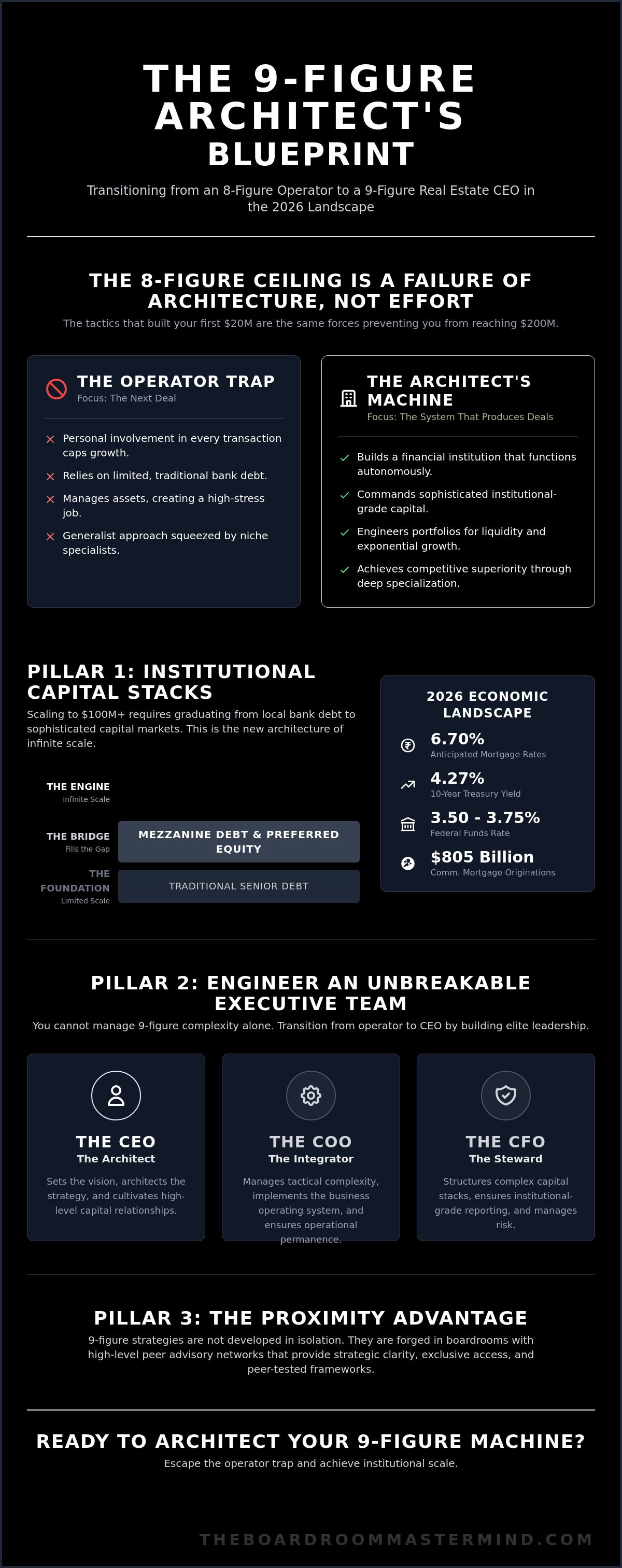
Stagnation at the 8-figure mark isn't a lack of effort. It's a structural failure. Most investors get stuck because they are essentially professional deal-finders. While Real estate investing fundamentals focus on the mechanics of a single transaction, a true 9 figure real estate portfolio strategy requires you to stop buying assets and start building a financial machine. You must escape the Operator Trap. The tactics that helped you scale to $10 million, like personal involvement in every negotiation and tactical deal-finding, are the same ones that will cap your growth at $100 million.
In this high-stakes environment, the difference between a Hustler and an Architect is the focus on permanence. The Hustler is consumed by the next closing. The Architect is consumed by the system that produces the closing. Wealth Architecture is the strategic alignment of capital, systems, and talent to achieve institutional permanence.
The Shift from Asset Management to Portfolio Engineering
Real scale requires looking beyond monthly cash flow. Institutional players prioritize yield-on-cost and exit multiples. They engineer the portfolio for liquidity and refinancing events that fuel exponential growth. This level of complexity is impossible to manage without a robust business operating system. If your operations depend on your presence, you don't own a portfolio; you own a high-stress job.
Auditing Your Current Business Model for 2026
You must identify the specific bottleneck in your current flow. Is it capital access or deal volume? In 2026, generalists are being squeezed by sophisticated, niche-dominant players. Transitioning to a 9 figure real estate portfolio strategy means narrowing your focus to a specific asset class or territory where you can exercise competitive superiority. It's about depth, not breadth. Audit your team. If they lack the executive depth to handle institutional reporting or complex capital stacks, they are the bottleneck.
Institutional Capital Stacks: Structuring for Infinite Scale
Local bank debt is a tool for the entry-level operator. When you're architecting a 9 figure real estate portfolio strategy, your reliance on community lenders must end. Scaling to $100 million and beyond requires a transition into sophisticated capital markets where private equity, family offices, and sovereign wealth funds operate. These entities aren't just looking for deals; they're looking for partners who can manage institutional-grade complexity. Leveraging Real Estate Private Equity is often the catalyst that bridges the gap between personal wealth and institutional dominance.
Structuring your GP/LP agreements correctly is the foundation of this expansion. By maintaining the General Partner position while attracting Limited Partner capital, you achieve maximum leverage without sacrificing control. This isn't about giving away your upside; it's about using other people's capital to build an empire that you govern. Many high-growth leaders find that refining these structures is best handled within the Boardroom Elite environment, where peer-tested frameworks are the standard.
Attracting Family Office and Sovereign Wealth Capital
Ultra-high-net-worth investors demand more than a spreadsheet. They require institutional reporting, absolute transparency, and a proven track record of fiduciary excellence. To attract this caliber of capital, you must create a Capital Flywheel. This is a system where your reputation and operational systems attract capital automatically, funding new acquisitions without your constant intervention. In 2026, with commercial mortgage originations forecasted to hit $805 billion, the liquidity is there for those who can prove they are architects, not just hustlers.
Debt vs. Equity: Balancing Risk in a 2026 Market
The 2026 landscape features a 10-year Treasury yield of 4.27% and a Federal Funds rate between 3.50% and 3.75%. Navigating these numbers requires more than just a mortgage broker. You need to utilize preferred equity and mezzanine debt to fill the capital stack when traditional senior debt, currently averaging 4.93% for conventional bank financing, falls short. Sophisticated hedging strategies are no longer optional; they're defensive necessities. Private credit funds are increasingly filling the void left by banks, offering the flexibility required for large-scale, 9-figure acquisitions.
Engineering an Unbreakable Executive Leadership Team
A $100 million portfolio is not a business you can run from your smartphone. It is a complex financial institution that demands executive-level oversight. If you're still the primary person finding deals or managing property managers, you've hit your ceiling. Your primary job as CEO must shift entirely toward recruiting and retaining A-players who manage the tactical day-to-day operations. Transitioning from simply hiring help to building a leadership team is the most critical pivot in any 9 figure real estate portfolio strategy.
To operate at this scale, you need a dedicated COO, CFO, and Head of Acquisitions. These aren't just staff members; they are the architects of your empire's permanence. A high-performance culture requires extreme accountability where every executive owns a specific vertical of the business. Without this structure, your growth will eventually collapse under the weight of its own complexity. If you're ready to architect this level of executive depth, apply for The Boardroom Mastermind Membership to access the frameworks used by industry leaders.
The CFO as the Architect of 9-Figure Deal Flow
A high-level CFO does more than balance books. They transform financial reporting into a strategic growth tool that identifies arbitrage opportunities your competitors miss. In a 2026 market where cap rates are stabilizing around 6.3% to 6.4%, having data-driven insights allows you to out-negotiate others in institutional markets. Your CFO should be the one structuring the capital stack to ensure liquidity while managing the interest rate volatility associated with the current 3.50% to 3.75% Federal Funds rate.
Incentivizing Performance: Carried Interest and Equity Participation
Top-tier talent won't work for a salary alone. To keep your best people from becoming your future competitors, you must align their personal success with the portfolio's long-term growth. This is achieved through sophisticated compensation structures like carried interest or equity participation. When your leadership team has skin in the game, their focus shifts from clock-watching to value creation. This alignment ensures that as you execute your 9 figure real estate portfolio strategy, your team is as invested in the outcome as you are.
The Proximity Advantage: Why 9-Figure Strategies are Built in Boardrooms
The Isolation Crisis is a silent killer of ambition. As you transcend the 8-figure ceiling, you'll find that your current network often lacks the vernacular of institutional capital and executive depth. The people who helped you reach $10 million are rarely the ones who can help you architect a $200 million empire. Executing a 9 figure real estate portfolio strategy requires a room where your "impossible" goals are the baseline. In these exclusive environments, the ROI is measured by the prevention of 7-figure structural mistakes that solo operators inevitably make.
Quarterly In-Person Intensives serve as a rigorous business audit. They ensure your trajectory remains fixed on institutional scale rather than drifting back into the gravitational pull of tactical management. These sessions provide the high-level friction necessary to stress-test your assumptions. For those ready to audit their path to scale and identify operational bottlenecks, The Boardroom Experience offers the clarity required for the next level of growth.
Strategic Alliances and Joint Ventures at the Highest Levels
Accessing off-market, institutional-sized opportunities is a matter of proximity, not effort. Within a high-level boardroom, strategic alliances form between peers who possess complementary capital and operational strengths. In the 2026 economy, collective intelligence is your most valuable defensive asset. These joint ventures allow you to take down larger assets that remain invisible to the general marketplace. You aren't just sharing information; you're sharing the burden of institutional expansion.
Applying for the Boardroom: The Litmus Test for 9-Figure Potential
Exclusivity is a strategic filter. It ensures that every collaboration is rooted in proven execution rather than theoretical advice. At this stage, you must stop seeking mentorship and begin demanding peer accountability. A 9 figure real estate portfolio strategy thrives on the pressure that only a room of battle-tested visionaries can provide. Joining The Boardroom Mastermind Membership is the final transition from being a successful investor to becoming a permanent fixture in the institutional landscape.
Architecting Your Institutional Legacy
Transitioning to a 9 figure real estate portfolio strategy requires more than just capital; it demands a complete overhaul of your operational identity. You've seen how institutional capital stacks and unbreakable executive teams provide the skeleton for this growth. Now, the final variable is your environment. High-level success is never achieved in a vacuum. It's forged through the collective intelligence of those who have already navigated the complexity of 9-figure operations. Our members have achieved over $5B in combined deal volume, proving that proximity is the ultimate growth lever.
The path from operator to CEO is paved with strategic audits and high-stakes accountability. We've been featured in top-tier business publications for real estate excellence because our frameworks work for those at the highest tiers of success. Through exclusive quarterly intensives, we ensure you stay on the path to institutional permanence. If you're ready to transcend the tactical and lead a true financial institution, Apply to Join The Boardroom Mastermind and Scale Your Empire. Your next level of scale isn't just possible; it's inevitable with the right architecture.
Frequently Asked Questions
What is the minimum portfolio size required to implement a 9-figure strategy?
Implementation of a 9 figure real estate portfolio strategy typically begins once you have crossed the $10 million to $20 million threshold. This is the critical juncture where manual, tactical deal-finding becomes a growth bottleneck. You don't wait until you have $100 million to build the architecture; you build the architecture specifically to bridge the gap between 8 and 9 figures.
How do I structure a real estate fund for institutional investors in 2026?
Structuring for institutional capital in 2026 requires utilizing SEC Regulation D, specifically Rule 506(c), to facilitate general solicitation among accredited investors. You must prioritize institutional-grade reporting and absolute transparency to satisfy the due diligence requirements of family offices and private equity firms. This involves a sophisticated GP/LP split that aligns your upside with the preferred returns expected in a market where cap rates average 6.3% to 6.4%.
What is the difference between a real estate operator and a real estate CEO?
A real estate operator is tethered to the tactical execution of individual transactions and property-level management. A real estate CEO focuses exclusively on capital markets, executive leadership, and portfolio engineering. The CEO's primary objective is the health of the financial machine, while the operator remains trapped in the daily noise of asset management and deal-finding.
How much liquidity do I need to maintain while scaling to a 9-figure portfolio?
Maintaining a liquidity reserve of 5% to 10% of your total portfolio value is the standard benchmark for institutional-scale operations. This cash position ensures you can navigate interest rate volatility and capitalize on distressed off-market opportunities without disrupting your long-term 9 figure real estate portfolio strategy. In an environment with 6.70% mortgage rates, liquidity is both a defensive shield and an offensive weapon.
Can a 9-figure real estate business be managed without a large internal team?
No, a 9-figure business cannot be managed effectively by a solo founder or a skeleton crew. While you don't need a massive headcount, you do need executive depth in the form of a dedicated CFO and COO. Relying on a solo-founder model at this scale creates a single point of failure that institutional investors will view as an unacceptable risk to their capital.


