
Succession Planning for Real Estate Business: The CEO’s Blueprint for Institutional Scale
Your business isn't truly an asset if it requires your heartbeat to survive; it's a high-paying job with a looming expiration date. While many founders view an exit as a final transaction, the reality is that succession planning for real estate business is your most potent growth lever. You've likely hit that seven-figure ceiling where operational burnout feels inevitable. You're the primary engine and the ultimate bottleneck. You know the enterprise cannot yet thrive without your daily intervention.
It's a common pressure point for elite leaders who have built significant wealth but lack the framework to achieve institutional scale. I'll show you how to master the strategic blueprint required to transition from a high-stakes operator to a visionary CEO by engineering a self-sustaining enterprise. We'll examine how to validate executive talent, navigate the 2026 FinCEN reporting rules for residential transfers, and leverage the $15 million individual estate tax exemption to protect your legacy. This is the path to achieving peak performance and permanent impact without sacrificing your personal well-being.
Key Takeaways
- Break through the seven-figure ceiling by shifting your focus from tactical management to institutional-grade wealth architecture.
- Replace personal bandwidth with a Business Operating System that delivers predictable, documented results across the real estate value chain.
- Approach succession planning for real estate business as a strategic scaling mechanism to engineer a self-sustaining asset.
- Identify and recruit A-player executive talent to own P&L outcomes and solve high-level operational bottlenecks.
- Leverage collective intelligence from elite peer networks to audit your path to an eight-figure scale and mitigate strategic risk.
The Succession Crisis: Why Your Success Has Created an Operator Trap
Success is a double-edged sword. For most founders, the very drive that built a seven-figure empire eventually becomes the primary obstacle to reaching eight or nine figures. This is the "Operator Trap." It's a state where your personal bandwidth is the hard ceiling for company growth. Succession planning for real estate business is not a retirement strategy; it is the deliberate engineering of an enterprise that functions independently of its creator. If the business collapses the moment you stop answering your phone, you don't own an asset. You own a high-stakes job.
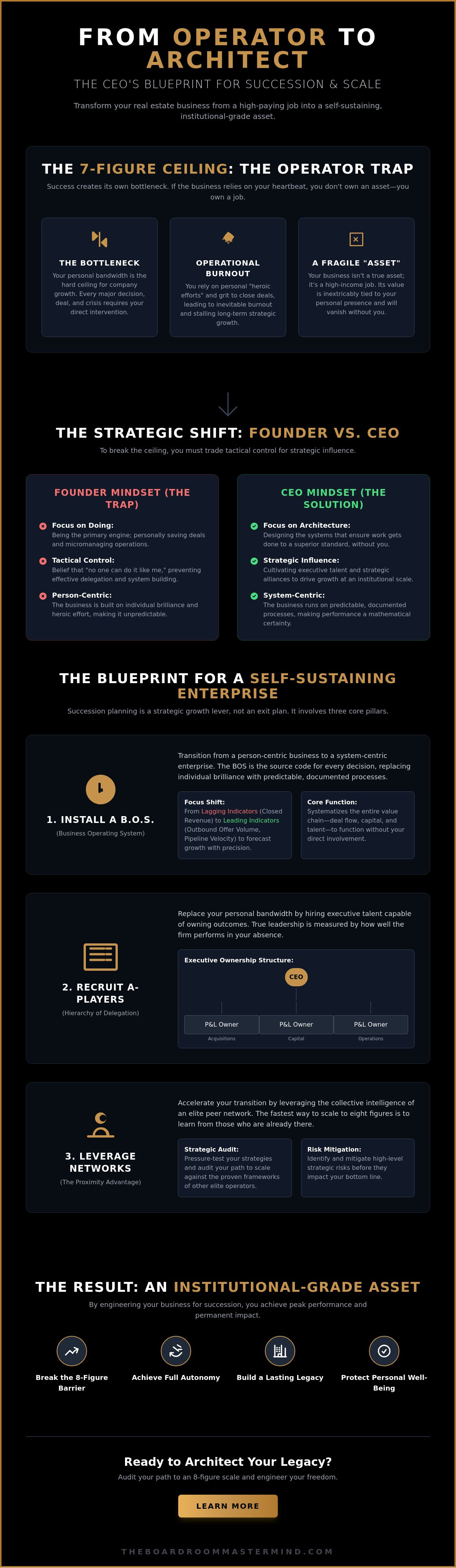
Institutional-grade scaling requires a shift from the "Hustler" mindset to the role of a professional CEO. At the seven-figure mark, complexity begins to outpace your ability to micromanage every deal. You cannot personally audit every contract or oversee every lead while simultaneously architecting long-term wealth. You must stop being the engine and start being the architect. This transition is the only way to break through the stagnation of the seven-figure ceiling. Succession planning is the framework that facilitates this move.
The Psychology of the Bottleneck
The most dangerous phrase in business is "no one can do it like me." It's a fallacy rooted in ego that prevents effective delegation. Moving from tactical management to strategic oversight isn't just a preference; it's a professional requirement for those seeking institutional scale. You must stop being the hero who saves every deal and start being the visionary who builds the system that ensures deals don't need saving. True leadership is measured by how well the firm performs in your absence.
Transitioning to a Founder vs CEO Mindset
A CEO’s primary responsibility is wealth architecture and the cultivation of strategic alliances. The skills that built your business, like grit, individual sales prowess, and relentless activity, are the exact ones currently stalling it. To break through, you must trade tactical control for strategic influence. This transition allows you to focus on high-level execution while your Business Operating System handles the operational heavy lifting. It's about moving from doing the work to ensuring the work gets done at a superior standard.
Wealth Architecture: Designing a Business Operating System for Autonomy
Wealth architecture is the structural transition from a person-centric business to a system-centric enterprise. To achieve institutional scale, you must install a Business Operating System (BOS) that acts as the source code for every decision, transaction, and hire. Most founders rely on "heroic efforts" to close deals. While grit gets you to seven figures, it fails at eight. A true BOS replaces individual brilliance with predictable, documented processes that ensure the firm’s performance is a mathematical certainty rather than a result of your personal stamina.
Effective succession planning for real estate business requires a holistic framework that manages deal flow, capital, and talent simultaneously. Simple SOPs are insufficient. You need a system that prioritizes "leading indicators," such as outbound offer volume and pipeline velocity, over "lagging indicators" like closed revenue. By focusing on the activities that precede the profit, you gain the ability to forecast growth with surgical precision. Government insights on The Importance of Succession Planning emphasize that protecting your license and your clients requires this level of operational resilience.
Systemizing the Real Estate Value Chain
Your acquisitions engine must function without your personal network. This means building a deal-flow machine that utilizes diverse channels and standardized underwriting criteria. When your acquisitions are predictable, your business becomes attractive to institutional-grade private equity. Structuring your capital stacks for transparency and scalability ensures that when you step back, the funding doesn't dry up. If you're ready to audit your current framework, the Boardroom experience provides the high-level perspective needed for this caliber of restructuring.
Operational Rhythm: The CEO’s Dashboard
A visionary leader manages by exception. You need a dashboard that highlights bottlenecks before they escalate into crises. Establishing a rigid meeting cadence, such as weekly leadership syncs and quarterly intensives, provides clarity without requiring your physical presence in every room. This operational rhythm allows the business to breathe on its own, moving the needle forward while you focus on high-level wealth architecture and strategic alliances.
The Hierarchy of Delegation: Recruiting A-Player Leaders to Own Outcomes
Delegation is not abdication; it is the strategic transfer of ownership. For a founder, succession planning for real estate business hinges on your ability to recruit A-Player leaders who don't just follow instructions but own the P&L. An A-Player is an executive who brings solutions to the table rather than problems. They are the individuals who allow you to step away from the daily grind without the engine stalling. Building a leadership team is the ultimate insurance policy against your own mortality as the firm’s primary operator.
The NAIOP Research Foundation study on succession planning highlights that business continuity requires a robust architecture of human capital. You must progress through the hierarchy of delegation, moving from offloading administrative tasks to empowering strategic decision-making. Be warned: a bad executive hire at this level is not just a setback. It is an eight-figure mistake that can dismantle years of growth and systemization. You are no longer hiring for "help"; you are hiring for institutional-grade leadership.
Identifying the "Seat" Before the Person
Successful recruitment begins with the architecture, not the individual. First, audit your business to identify critical leadership seats like a COO or an Acquisitions Lead. Second, define specific KPIs for each seat that align with your eight-figure scaling goals. If you cannot define what success looks like for a role, you aren't ready to fill it. Apply for Boardroom Elite to refine your executive hiring strategy with peers who have already scaled.
Empowering Autonomy Through Accountability
You cannot lead if you are still doing. Transitioning to a visionary role requires you to manage the Business Operating System through your team. High-stakes accountability ensures that your executive suite owns the outcomes, not just the activities. When your leadership team manages the systems, you gain the freedom to focus on the strategic alliances that drive permanent impact. This is how you move from a founder-led business to an enterprise-led organization.
The Proximity Advantage: Why Elite Networks Accelerate Succession
Isolation is a strategic liability. When you are the smartest person in your own circle, your growth is capped by your own limited perspective. High-stakes succession planning for real estate business requires pressure-testing your frameworks against those who have already exited or scaled to nine figures. In an environment of shifting regulations, such as the 2026 federal estate tax exemption of $15 million and new FinCEN reporting rules for residential transfers, navigating these complexities in a vacuum is a recipe for expensive errors.
Collective Intelligence is the ultimate shortcut to institutional scale. It allows you to identify operational blind spots that are invisible from the inside of your own organization. The benefits of a peer advisory group extend beyond simple networking; they provide a clinical audit of your business architecture. The Boardroom Mastermind serves as this elite environment, where battle-tested visionaries dissect each other's systems to ensure permanence, autonomy, and competitive superiority.
Auditing Your Way to Freedom
Our Quarterly In-Person Intensives function as a strategic reset for the high-growth CEO. These sessions force you out of the tactical weeds and back into the role of a visionary architect. Peer accountability is the only mechanism strong enough to prevent "Operator" relapse. It ensures you remain focused on high-level wealth architecture rather than falling back into the frantic energy of daily deal-chasing. By subjecting your Business Operating System to the scrutiny of your peers, you ensure it is truly self-sustaining.
The Final Step: Applying for Elite Access
The most successful CEOs don't scale in a vacuum. They prioritize proximity to power and expertise because they value time above all else. They understand that access to the right room is a critical strategic asset. If you've reached the seven-figure ceiling and are ready to engineer a business that thrives without your heartbeat, it's time to change your environment. Apply to join The Boardroom Mastermind and audit your path to 8-figure scale to secure your legacy and reclaim your time.
Engineering Your Legacy for Permanent Impact
You've identified the operator trap and the architecture required to dismantle it. Building a business that survives you isn't just about retirement; it's about creating an asset with institutional-grade value. By installing a robust Business Operating System and empowering A-player leaders to own outcomes, you transform your enterprise from a person-centric machine into a scalable wealth engine. Effective succession planning for real estate business is the ultimate differentiator between those who own a job and those who lead a legacy.
The Boardroom Mastermind provides exclusive access to an elite network of 7, 8, and 9-figure entrepreneurs, offering battle-tested strategies for growth. Through our Quarterly In-Person Intensives, you'll receive a clinical audit of your business architecture to ensure it's built for autonomy and scale. It's time to stop being the engine and start being the architect. The path to the next level is clear for those with the right access. Your future as a visionary leader starts here.
Apply for The Boardroom Mastermind and Audit Your Path to 8-Figure Scale
Frequently Asked Questions
How do I know if my real estate business is ready for a succession plan?
Your business is ready the moment your personal bandwidth becomes the hard ceiling for company growth. If your absence for thirty days would result in operational collapse or significant revenue loss, you have already waited too long. Succession planning for real estate business should begin when you realize that your company is a person-centric entity rather than a system-centric asset. It's about engineering permanence before a bottleneck turns into a crisis.
What is the first executive hire I should make to remove myself from operations?
An Integrator or Chief Operating Officer (COO) is the first critical hire for a founder seeking to exit the tactical weeds. This individual is responsible for translating your high-level vision into documented processes and ensuring the Business Operating System is executed with precision. They own the operational outcomes, allowing you to transition into the role of a visionary architect focused on strategic alliances and wealth expansion. Don't hire an assistant; hire an outcome-owner.
Can a real estate investment business really be fully systemized?
Every aspect of a real estate investment enterprise can be systemized through the implementation of a comprehensive Business Operating System. By documenting the entire value chain from acquisitions to capital stacking, you remove the reliance on individual heroics. Modern firms that prioritize systemization often see higher valuations. Research indicates that businesses with documented plans transact at a median of 6.8x EBITDA compared to 5.9x for peers without such frameworks.
What is the difference between a business coach and an elite mastermind for scaling?
A business coach often focuses on tactical performance and entry-level mentorship, while an elite mastermind provides proximity to peers operating at the highest tiers of success. Scaling to eight or nine figures requires a collective intelligence that coaching cannot replicate. Masterminds offer clinical auditing of your business architecture by high-achievers who have already navigated the complexities of institutional scale and high-stakes executive transitions.
How do I maintain quality control once I am no longer involved in daily deals?
You maintain quality control by managing through data-driven leading indicators rather than personal observation. Establish a dashboard that tracks specific KPIs and creates an operational rhythm where you manage by exception. When you define the "seat" and its accountability metrics correctly, your executive team ensures that every deal meets your superior standards. This data-centric framework is the cornerstone of effective succession planning for real estate business.


