
Strategic Planning Framework: The CEO’s Blueprint for 8-Figure Real Estate Scaling
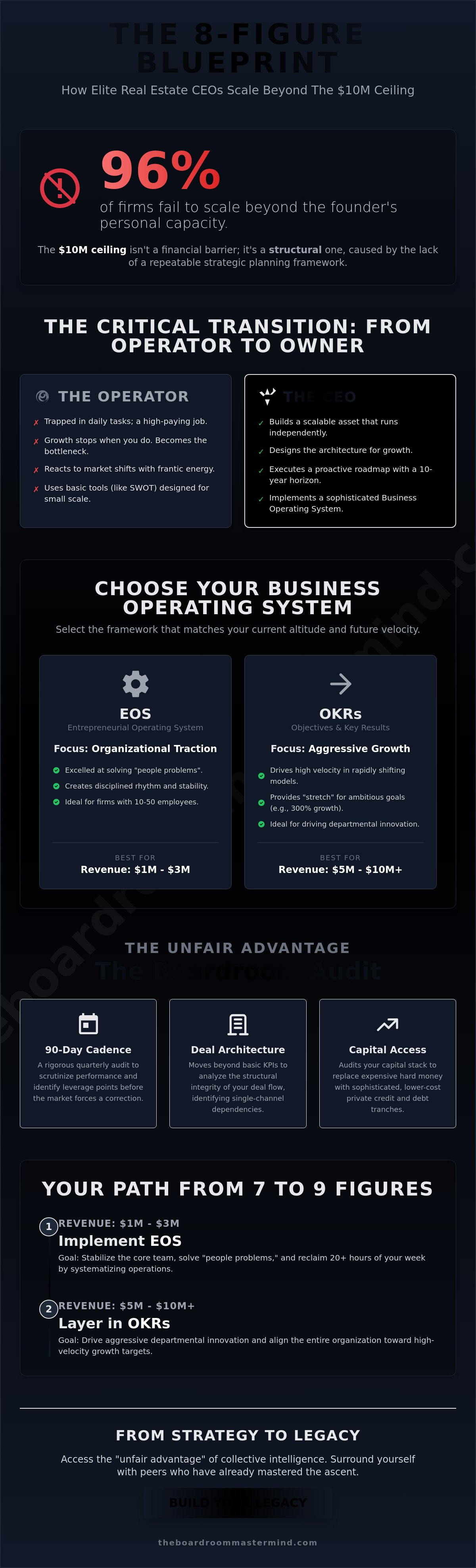
The $10 million ceiling isn't a financial barrier; it's a structural one. According to 2023 industry benchmarks, 96% of real estate firms fail to scale beyond the founder's personal capacity because they lack a repeatable strategic planning framework. You've built an impressive engine, but if your presence is still required for every high-level decision, you've created a high-paying job rather than a scalable asset. It's a precarious position where growth stops the moment you do.
It's frustrating to watch the fragmented systems that fueled your first $1 million break under the pressure of eight-figure volume. You understand that true wealth isn't found in the hustle, but in the architecture of a business that operates independently of your daily labor. This briefing promises to hand you the high-stakes blueprints used by the top 1% of real estate entrepreneurs to transition from operator to owner. We'll break down the transition to a professional CEO role, the optimization of your business operating system, and the exact steps to build a nine-figure legacy while reclaiming your personal freedom.
Key Takeaways
- Upgrade your operational architecture by moving beyond generic SWOT tools toward a sophisticated system that prioritizes capital stacks over basic checklists.
- Select the optimal strategic planning framework for your specific model by analyzing the organizational traction of EOS against the high-growth velocity of OKR systems.
- Implement a rigorous quarterly audit to successfully pivot from a high-level operator to the visionary owner of a scalable real estate empire.
- Access the "unfair advantage" of collective intelligence by surrounding yourself with a boardroom of peers who have already mastered the ascent to a nine-figure legacy.
Beyond the SWOT: Why Elite Real Estate CEOs Need a Higher-Stakes Strategic Planning Framework
A Strategic planning framework isn't a static document gathering dust in a drawer. It's your Business Operating System. Most real estate investors rely on generic SWOT analyses that fail to account for the complexity of 8-figure capital stacks and sophisticated debt tranches. You can't scale a portfolio to $50 million using a tool designed for a lemonade stand. While the "Hustler" reacts to every interest rate hike with frantic energy, the "Boardroom" CEO executes a proactive roadmap with calculated confidence. By 2026, your strategic planning framework must evolve into what we call Legacy Architecture. This shift ensures your enterprise functions as a wealth-generating machine that doesn't require your daily intervention to survive.
The 7-Figure Ceiling: When Your Current Systems Become Your Bottleneck
You hit the wall when deal-flow plateaus and your 60-hour work week yields diminishing returns. This is the 7-figure ceiling. It happens because you're still an operator, not a CEO. Data from industry benchmarks shows that 82% of founders who fail to transition to a systems-first approach experience burnout within 36 months of hitting their first million. Breaking through requires moving from the trenches to the exclusive mastermind groups where collective intelligence replaces solo effort. Without a rigorous strategic planning framework, you remain the primary bottleneck in every transaction.
The Architecture of Scale: Thinking in 10-Year Horizons
High-level entrepreneurs don't plan for the next quarter; they plan for the exit. Professional CEOs use compounding leverage to turn active income into generational wealth. Your 2026 roadmap needs to account for long-term market cycles and specific debt maturity dates. If your strategy doesn't include a 10-year horizon, you aren't building a business, you're just working a high-paying job. True scale requires an architecture that prioritizes freedom and impact. It's about building a legacy that remains unshakable regardless of short-term market volatility.
Comparing the 3 Core Frameworks for Scaling Real Estate Empires to 8 Figures
Scaling to $10 million and beyond isn't a matter of effort. It's a matter of architecture. If your business relies on your personal bandwidth, you've built a high-paying job, not a legacy. To break the ceiling, you need a proven business operating system that functions without your constant intervention. Understanding Why Is Strategic Planning Important? is the first step in moving from operator to owner. You must choose a structure that matches your current altitude while providing the runway for your next $20 million in growth.
EOS vs. OKRs: Which Drives More Traction in Real Estate?
EOS excels at creating organizational traction through disciplined rhythm. It's the choice for firms with 10 to 50 employees who need to solve "people problems" by putting the right seats in the right places. Conversely, OKRs drive aggressive growth in high-tech or rapidly shifting real estate models. While EOS focuses on the floor, OKRs focus on the ceiling. If your goal is a 300% increase in acquisition volume within 12 months, the OKR framework provides the necessary stretch to reach it.
The Boardroom Audit: Auditing Your Business Model for Unfair Advantages
Standard tools often miss the structural leaks that drain 8-figure potential. The Boardroom Audit is our proprietary strategic planning framework designed to scrutinize your Deal Architecture and Capital Access every 90 days. We don't just look at KPIs. We look at leverage. Are you using private credit or expensive hard money? Is your lead flow diversified or dependent on a single channel? This audit identifies where your model is fragile before the market forces a correction. It identifies the unfair advantage that ensures your wealth compounds while your competitors struggle for air.
Choosing your path depends on your current revenue and team size:
- Revenue $1M to $3M: Implement EOS to stabilize your core team and reclaim 20 hours of your week.
- Revenue $5M to $10M: Layer in OKRs to drive departmental innovation and aggressive market share capture.
- Revenue $10M+: Conduct a Boardroom Audit to optimize your capital stack and prepare for a high-multiple exit.
If you're ready to see how these systems integrate into an elite real estate operation, it's time to elevate your circle and refine your strategy.
Executing the Quarterly Audit: A Strategic Planning Template for High-Level Optimization
Scaling to 8 figures requires a ruthless commitment to the quarterly audit. This isn't a passive review; it's a surgical strike on inefficiency. By applying a rigorous strategic planning framework, you ensure every dollar of capital and every hour of talent is optimized for compounding growth. The goal is to identify bottlenecks before they become systemic failures.
- Step 1: The Personal Audit. Evaluate your time allocation. If you're still managing property-level disputes or individual vendor contracts, you're an operator, not a CEO. High-level visionaries focus 90% of their energy on capital markets, high-value networking, and strategic partnerships.
- Step 2: The Financial Audit. Move beyond lagging indicators like last month's net profit. Analyze leading indicators such as your pipeline velocity, cost per acquisition, and current debt yield across your real estate portfolio.
- Step 3: The Talent Audit. Assess your progress in building a leadership team. If your department heads aren't hitting 85% of their KPIs independently, your scaling engine is stalled.
- Step 4: The Strategy Pivot. Adjust your trajectory based on real-time market shifts. Whether it's a 25-basis point interest rate hike or a sudden shift in cap rates, your 90-day sprint must reflect the current economic reality.
The 90-Day Sprint: Turning Vision into Predictable Execution
Legacy goals are achieved in 13-week increments. Break your 10-year vision into actionable milestones that the team can grasp. Identify three "Rocks" for the quarter. These are the critical objectives that move the needle on your enterprise value. When you focus on fewer targets, your execution speed increases by as much as 40% because resources aren't diluted across low-impact tasks.
Leadership Accountability: Holding Your A-Players to the Framework
Your role as CEO is to facilitate the strategic planning framework, not to execute the tasks. Establish a rhythm of meetings, including a 60-minute weekly tactical and a full-day quarterly offsite. This structure ensures your A-players remain aligned with the mission. Accountability isn't about micromanagement; it's about creating a culture where performance is the only metric that matters. If you're ready to refine your operations, explore our case studies to see how elite firms execute at scale.
From Strategy to Legacy: Leveraging Collective Intelligence to Win
Even the most sophisticated strategic planning framework fails when it's built in an echo chamber. Your internal team, while competent, often lacks the external perspective required to challenge your core assumptions. They don't know what they don't know. To scale toward a 9-figure valuation, you need a "Boardroom" of peers who have already navigated the minefields you're currently approaching. Proximity is your most potent shortcut. It transforms years of expensive trial and error into months of clinical, precision execution.
Closing the gap between understanding a framework and executing it at an elite level requires more than just discipline. It demands access. When you surround yourself with entrepreneurs who dominate their markets, their floor becomes your ceiling. This environment forces a shift in your operating reality. You stop playing for the next quarter and start architecting a legacy that compounds over decades.
The Unfair Advantage of the Inner Circle
Internal teams often suffer from confirmation bias. Peer audits provide the unfiltered truth that only an outsider with 9-figure experience can offer. By engaging in The Boardroom Mastermind experience, you stress-test your strategic planning framework against the collective intelligence of the industry's top 1%. This process identifies the 20% of your operations that generate 80% of your revenue, allowing you to liquidate the distractions that stall growth.
Scaling Without the Stress: The Ultimate CEO Goal
The ultimate objective of any framework is freedom, not an increased workload. If your presence is required for every 10-million-dollar milestone, you've designed a high-paying job rather than a scalable asset. True wealth architecture enables the CEO to transition from operator to owner. This allows the systems to compound while you focus on high-level strategy and market positioning.
- Eliminate the bottlenecks that keep you tethered to daily operations.
- Optimize your leadership team to function with autonomous precision.
- Secure your exit strategy by building a business that operates without you.
If you're ready to stop the grind and start the ascent, apply for the inner circle today. It's time to execute at a level that your competition cannot match.
Secure Your Eight-Figure Legacy
Scaling a real estate empire isn't about working harder; it's about the architecture of your decisions. You've seen why a standard SWOT analysis fails at the eight-figure level and how a robust strategic planning framework transforms a chaotic operation into a predictable wealth engine. By implementing rigorous quarterly audits and shifting from operator to owner, you protect your most valuable asset: your time.
True dominance requires more than just individual talent. It requires the collective intelligence of a room where over $5B in collective member deal volume is the baseline. You don't have to navigate the complexities of high-level growth in isolation. Access exclusive quarterly intensives for 7-9 figure CEOs and join an elite peer network of the top 1% of real estate investors. The path to an unrivaled legacy is paved with the insights of those who have already cleared the hurdles you're facing.
Apply to Join the Boardroom Mastermind and Audit Your Path to 8 Figures
Your ascent to the next level is the only logical conclusion.
Frequently Asked Questions
What is the best strategic planning framework for a real estate business?
The most effective strategic planning framework for a real estate business is a hybrid of EOS and the Scaling Up methodology. This combination provides the operational rigor of the Level 10 meeting with the aggressive financial targets required for 8-figure growth. If you want to scale, you need a system that tracks your 13-week sprints against a 10-year target. Data from the 2023 RealTrends 500 shows that top-performing firms prioritize these structured rhythms to maintain a 20% net profit margin.
How often should a CEO update their strategic planning framework?
A CEO must review their strategic planning framework every 90 days and execute a full structural audit once a year. Markets move too fast for static five-year plans to remain relevant. If your quarterly objectives don't reflect current interest rate shifts or inventory fluctuations, your team loses focus. Successful 8-figure operators use these 90-day pulses to reallocate resources and ensure the organization remains lean. It’s about agility in execution while maintaining a fixed long-term vision.
Is EOS or OKR better for scaling from 7 to 8 figures?
EOS is generally better for the transition from 7 to 8 figures because it emphasizes organizational clarity and accountability. While OKRs work well for Silicon Valley tech giants, real estate firms require the "Visionary and Integrator" dynamic to stabilize operations during rapid growth. Research indicates that 70% of companies scaling past $10 million benefit from the structured "Rocks" and "Scorecards" found in EOS. It creates the predictable environment necessary for your team to execute at a high level.
What are the common mistakes in strategic planning for entrepreneurs?
Entrepreneurs often fail by creating overly complex plans that no one follows. They mistake activity for progress. Another fatal error is the CEO attempting to be both the Visionary and the Integrator. According to data from the Harvard Business Review, 40% of founders fail to scale because they refuse to delegate operational control. If your framework requires your presence in every meeting, you haven't built a business; you've built a high-stress job.
Can a strategic planning framework help me exit my business?
A robust framework is the single most important factor in maximizing your exit valuation. Professional buyers and private equity firms look for businesses that operate independently of the founder. If your systems are documented and your team hits targets without your daily input, you command a higher EBITDA multiple. Firms with institutionalized processes often see a 2x to 3x increase in their valuation compared to founder-led operations. You aren't just selling a company; you're selling a predictable profit machine.


