
Scaling Real Estate Operations: The CEO’s Blueprint for 8-Figure Growth
If your real estate portfolio requires your daily presence to survive, you don't own an enterprise; you own a high-stress job. Many established operators hit a hard seven-figure ceiling because they're still executing as high-stakes hustlers rather than strategic CEOs. You know the frustration of managing inconsistent lead flows, fighting talent turnover, and guessing your true profit per deal while acting as the ultimate bottleneck. True scaling real estate operations demands that you step out of the trenches and into architectural leadership.
It's entirely possible to reclaim your time without sacrificing your margins. This blueprint teaches you how to install the precise systems and leadership frameworks required to scale your empire beyond the seven-figure ceiling. We will preview the exact operational cadences and systematization rules that transition your business into a predictable, eight-figure asset.
Key Takeaways
- Identify the "Founder Bottleneck" and learn why transitioning from a high-stakes hustler to a strategic CEO is the only path to 8-figure growth.
- Deploy the P7 Framework to move your business from L1 intuition to L4 systematization, creating an enterprise that runs predictably without you.
- Install high-impact operational cadences, including the non-negotiable Builder’s Hour and a streamlined scoreboard for scaling real estate operations.
- Leverage elite peer auditing and quarterly intensives to replace chaotic tactical management with a clear, 12-quarter roadmap for long-term wealth.
The 7-Figure Ceiling: Why Your Current Real Estate Operations Won't Scale
Many real estate operators mistake transaction volume for enterprise growth. True scaling operations isn't achieved by purchasing more leads or working longer hours; it requires building a repeatable machine. If your business resides entirely within your head, you are trapped in an L1 operational condition. You don't own an asset. You own a demanding, high-stakes job that breaks the moment you step away. Moving beyond this ceiling requires an intentional shift from tactical execution to architectural oversight.
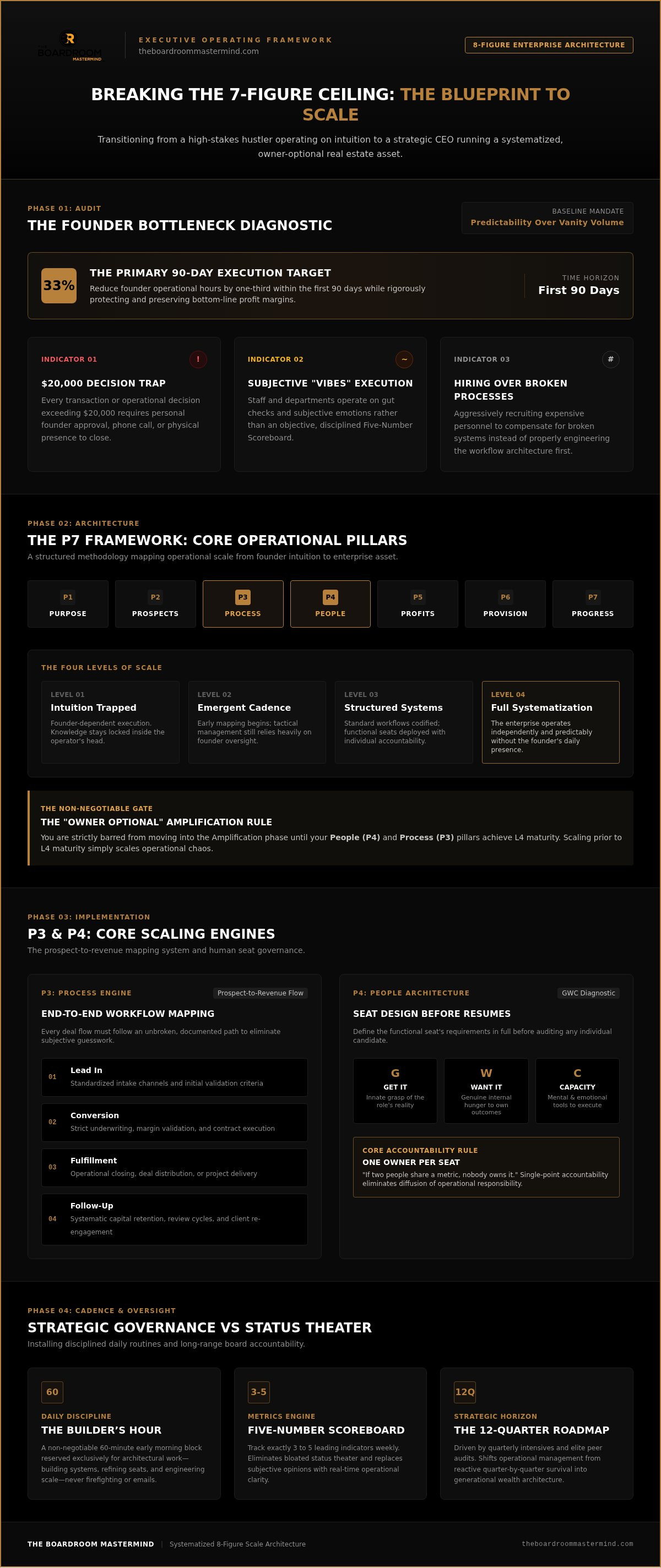
To bridge the gap between a frantic hustler and a strategic CEO, your focus must shift from vanity metrics like top-line revenue to strict unit economics and margin-per-deal. Real growth prioritizes predictability over sheer size. When you master scaling real estate operations, you protect the bottom line first. By installing systematic frameworks like those analyzed within The Boardroom Mastermind, our primary objective is a 33% target, reducing owner-hours by one-third within the first 90 days of execution while preserving your margins.
Are You the Bottleneck? Signs of Operational Stagnation
Operational stagnation is rarely a capital issue. It's a fundamental leadership bottleneck that caps your trajectory. Look for these critical indicators within your current firm:
- Every transaction or operational decision exceeding $20,000 requires your personal phone call, approval, or physical presence to close.
- Your team executes daily tasks based on subjective "vibes" and emotional checks rather than an objective, five-number scoreboard.
- You are aggressively hiring expensive new staff to escape a broken process problem instead of engineering the underlying workflow first.
The P7 Framework: The Architecture of an 8-Figure Real Estate Engine
Scaling real estate operations isn't a matter of luck; it's a matter of architecture. The P7 Framework provides the blueprint for this transition by focusing on seven core pillars: Purpose, Prospects, Process, People, Profits, Provision, and Progress. Most founders remain stuck because they operate at L1, where every decision is trapped in their head. To build a true asset, you must move through the four levels of scale. This journey requires advancing from founder-driven intuition to L4, where the business is fully systematized and operates independently of your daily presence.
You can't amplify a broken system. The "Owner Optional" gate is a non-negotiable threshold in our methodology. You aren't permitted to move into the Amplification phase until your People and Process pillars reach L4 maturity. If you try to scale before this, you simply scale chaos. For a deeper dive into this structure, review our guide on the Business Operating System: The Architecture of 8-Figure Real Estate Scaling.
P3 & P4: The Engines of Operational Scale
The core of your machine lies in Process (P3) and People (P4). Process documentation must map the entire prospect-to-revenue flow, specifically Lead In, Conversion, Fulfillment, and Follow-Up. Without these maps, your team is merely guessing. Regarding your team, you must design the "seat" before you ever look at a resume. Each seat requires a GWC diagnostic: does the candidate Get it, do they Want it, and do they have the Capacity to execute? We follow a strict operational rule: one owner per seat. If two people share a metric, nobody owns it. This level of clarity is what separates elite firms from chaotic ones. Mastering these pillars is the only sustainable way to handle scaling real estate operations at the 8-figure level. If you're ready to audit your current structure, consider exploring The Boardroom Mastermind to align with peers operating at this tier.
Installing the Cadence: How to Measure Progress Without 'Status Theater'
Growth happens in the silence of the early morning, not in the chaos of the afternoon. As a CEO, your most valuable asset is the "Builder’s Hour." This is a non-negotiable 60-minute block every morning dedicated exclusively to building the machine, not doing the work. If you spend this time answering emails or firefighting, you aren't scaling real estate operations; you're just surviving. This hour is where you refine the seats and structures discussed in our guide on Building a Leadership Team: The CEO’s Blueprint for 8-Figure Scale.
Measurement must be efficient to be effective. We utilize a Five-Number Scoreboard consisting of exactly 3 to 5 leading and 3 to 5 lagging KPIs. You should never track more than ten total metrics. This prevents "status theater" where teams report data that doesn't drive decisions. To maintain accuracy, don't use a BI tool until the scoreboard survives four weeks on paper. Accountability requires a rhythmic pulse. Hold weekly scoreboard meetings for exactly 30 minutes, same day, same time, such as every Monday at 9:00 am. The agenda is simple: read the numbers, identify the root cause of any misses, and pick one specific fix for the week.
Leading vs. Lagging Indicators in Real Estate
Distinguishing between these indicators is vital for real-time control. A leading KPI is an effort-based metric actionable within 48 hours, such as the number of offers made or outbound calls placed. Conversely, a lagging KPI is a result-based metric like closed deals or total profit. You cannot change a lagging number today. We use the 48-hour rule: if you can't act on the metric in two days, it’s a lagging indicator that belongs in the rearview mirror. To install these cadences under the guidance of battle-tested visionaries, apply to join The Boardroom Mastermind.
The Boardroom Audit: Moving From Tactical Management to Strategic Oversight
Strategic growth requires external friction because you cannot see the label from inside the bottle. Proximity to elite peers is your most critical strategic asset. It isn't about networking for referrals; it's about a cold-eyed audit of your business model. Scaling real estate operations at the 8-figure level demands that you step away from the daily grind for Quarterly Intensives. These multi-day sessions move you from tactical management to a deep audit of your 12-quarter roadmap, ensuring every 90-day sprint aligns with your primary objective.
Sustainability is built through a recursive operational loop that maintains momentum. This cycle begins with weekly scoreboard reviews and transitions into monthly financial closes. It culminates in quarterly audits and annual destination reviews. This rhythm creates a sense of inevitability for your expansion. When high-achieving peers audit your machine regularly, the path to "Owner Optional" status becomes visible and actionable. Ready to scale? Apply to join The Boardroom Mastermind.
Becoming the CEO of Your Life and Business
True scale must serve the life you intend to lead. We utilize the "Tuesday Page" to define this destination, detailing exactly what your life looks like three years from today with over 25 specific details. This isn't a vague exercise; it's a strategic filter. A crystal-clear destination dictates every hiring decision, partner selection, and deal structure you accept. Without this anchor, you risk building a cage rather than an empire. To understand how the right environment facilitates this transition, explore The 7-Figure Ceiling: A CEO Guide to Exclusive Mastermind Groups. Mastering the art of scaling real estate operations requires this alignment between professional growth and personal autonomy.
Claim Your Seat at the Operational Helm
True enterprise growth requires moving from a founder-dependent job to an owner-optional asset. By breaking through the seven-figure ceiling, you replace daily firefighting with structured morning disciplines and rigorous unit economics. Mastering the mechanics of scaling real estate operations demands both architectural clarity and elite accountability. You can't audit your own blind spots while stuck in the trenches of tactical management.
The path to sustainable expansion is clear for those with the right access. Gain direct access to the P7 Playbook Series and participate in quarterly in-person business audits alongside an exclusive peer network of 7, 8, and 9-figure investors. Your transition from tactical operator to strategic visionary is the logical conclusion of installing these systems. Scale your real estate empire at The Boardroom Mastermind. Build the machine that secures your wealth and buys back your time.
Frequently Asked Questions
How do I start scaling my real estate operations if I'm already overwhelmed?
Start by carving out a non-negotiable 60-minute block every morning called the Builder's Hour. You cannot fix your business while drowning in daily transactions. Use this protected time to map your current workflow on paper instead of hiring more headcount. Overwhelmed founders often try to hire their way out of broken processes. True scaling real estate operations begins by documenting your existing pipeline before delegating a single task.
What are the most important KPIs to track for a scaling real estate business?
Track exactly three to five leading indicators and three to five lagging indicators on a single-page scoreboard. Your metrics must never exceed ten total numbers. Focus heavily on effort-based leading KPIs that you can actively influence within 48 hours, such as outbound offers made or speed-to-lead. Lagging indicators like closed deals or net profit are results. If a metric has not driven an operational decision within 30 days, purge it.
When should I hire an Operations Manager to take over the daily grind?
You should only hire an Operations Manager after you have fully documented your core processes on paper. Hiring to escape a broken workflow is a critical mistake that scales chaos. Build the scorecard and define the seat requirements using the GWC diagnostic before posting the job. The business must define the seat first. If you bring an executive into an undefined role, you will waste capital and increase turnover.
Can I scale my real estate business without using complex BI software?
Yes, you can scale efficiently using simple shared sheets and paper scoreboards. We prohibit the use of complex BI software until your five-number scoreboard has survived at least four weeks on paper. Flashy dashboards often function as vanity metrics that disguise operational leaks. True scaling real estate operations relies on clean data and disciplined cadences rather than expensive software. Keep your tracking analog until your team masters the weekly review habit.
What is the difference between an operator and a CEO in real estate?
An operator runs a job that lives entirely inside their head, while a CEO builds a machine that runs independently. Operators rely on subjective vibes and personal intervention to close deals. CEOs install repeatable systems, design distinct seats with single ownership, and enforce strict operational cadences. If your business breaks when you step away for five weekdays, you are an operator. Passing the owner-optional gate requires achieving level four systematization across all seats.
Disclaimer
Mr. Clothier is an expert in real estate investing. As such his experiences are not necessarily typical to the standard real estate investor and whose results may vary. The successes shared on this site are not considered typical. Most individuals who order the educational materials and systems probably do not follow any of the techniques or strategies and consequently make little to no money due to their inaction. The company is in the process of determining the typical success of its clients. Stories shared herein are for example purpose only and should not be construed as "guarantees" of success. Results will vary based on background, education, and experience and actions taken.
This site is not a part of the Google/Facebook website or Google/Facebook Inc. Additionally, this site is NOT endorsed by or affiliated with Google/Facebook in any way. GOOGLE/FACEBOOK is a trademark of GOOGLE/FACEBOOK, Inc.
INCOME DISCLAIMER: This website and the items it distributes contain business strategies, marketing methods and other business advice that, regardless of referenced results and experience, may not produce the same results (or any results) for you. The Boardroom Mastermind makes absolutely no guarantee, expressed or implied, that by following the advice or content available from this web site you will make any money or improve current profits, as there are several factors and variables that come into play regarding any given business. Primarily, results will depend on the nature of the product or business model, the conditions of the marketplace, the experience of the individual, and situations and elements that are beyond your control. As with any business endeavor, you assume all risk related to investment and money based on your own discretion and at your own potential expense.
LIABILITY DISCLAIMER: By reading this website or the documents it offers, you assume all risks associated with using the advice given, with a full understanding that you, solely, are responsible for anything that may occur as a result of putting this information into action in any way, and regardless of your interpretation of the advice. You further agree that The Boardroom Mastermind, its affiliates, subsidiaries, officers and agents, cannot be held responsible in any way for the success or failure of your business as a result of the information provided. It is your responsibility to conduct your own due diligence regarding the safe and successful operation of your business. In summary, you understand that we make absolutely no guarantees regarding income as a result of applying this information, as well as the fact that you are solely responsible for the results of any action taken on your part as a result of any given information. In addition, you agree that our content is to be considered "for entertainment purposes only". Always seek the advice of a professional when making legal, financial, tax, or business decisions.
BUSINESS OPPORTUNITY: All products and services offered by The Boardroom Mastermind are intended to provide prospective purchasers with general business strategies, marketing methods and other general advice for business development and training. At no point is The Boardroom Mastermind soliciting anyone to enter into a new business nor is it representing, either expressly or by implication, that it will provide locations for a business, provide outlets, accounts, or customers, or purchase any of the goods or services made by the purchaser.
The products being offered through this promotion are packages of informational tools to help you learn about business and deal making strategies.


