
Scaling a Real Estate Portfolio Across Multiple Markets: The CEO Blueprint for 2026
If your physical presence is still required to stabilize an asset in a new zip code, you don't own a portfolio; you own a high-stress job that refuses to grow. Most operators hit a glass ceiling because they try to brute-force their way into new territories using the same manual tactics that worked in their backyard. Scaling a real estate portfolio across multiple markets in 2026 demands a radical shift from tactical management to strategic oversight. You've likely realized that more doors often lead to more bottlenecks rather than more freedom.
We agree that the "hustle" is a liability, not a badge of honor. This guide will show you how to architect an unbreakable business operating system that functions with clinical precision, regardless of the distance between your assets. You'll learn how to transition from a local operator to a multi-market mogul by securing institutional-level capital stacks and building an elite executive team. We are going to deconstruct the exact CEO blueprint for 2026, moving you from the day-to-day grind into a position of true strategic command.
Key Takeaways
- Break through the geographic ceiling by evolving from a local operator into a national wealth architect with a clear, multi-state vision.
- Master the architecture of scaling a real estate portfolio across multiple markets by deploying a standardized business operating system that ensures clinical precision.
- Recruit an elite leadership team of remote A-players to eliminate operational bottlenecks and manage assets with total autonomy.
- Move beyond tactical financing to leverage institutional-level capital stacks that signal maturity to family offices and private equity partners.
Defining the Multi-Market Pivot: Why Local Dominance Isn't Enough for 8-Figure Scale
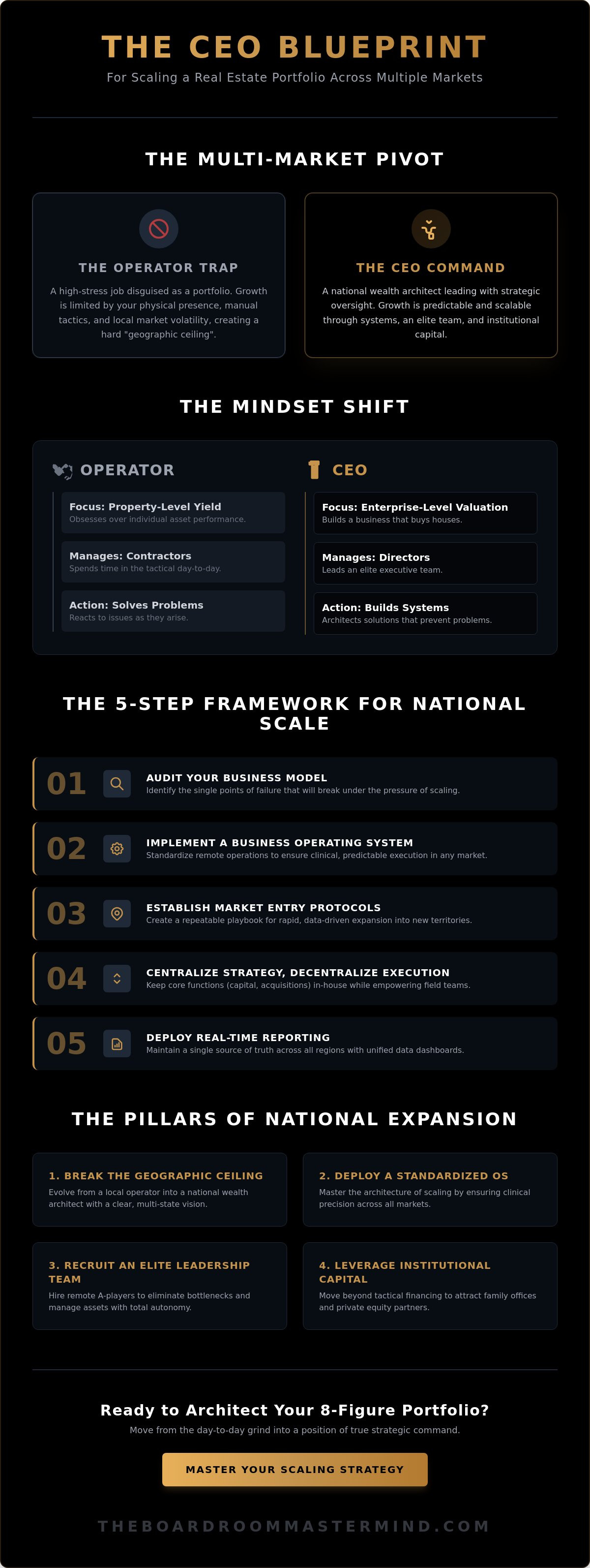
Local mastery is often the greatest obstacle to national expansion. You've conquered your home turf, you know every broker, and you understand every street corner. But that comfort creates a geographic ceiling. Relying on a single economy tethers your net worth to local volatility, leaving you vulnerable to regional shifts. True 8-figure and 9-figure growth requires scaling a real estate portfolio across multiple markets, moving from the role of a local operator to a national wealth architect. This transition isn't just a change in location; it's a fundamental restructuring of how you view your business.
The Strategic Imperative of Geographic Diversification
Diversification acts as your portfolio’s immune system. When one market faces a regulatory shift or an industrial exit, your assets in other regions provide the necessary ballast. A deep understanding real estate investing at this level means recognizing that market cycles don't move in unison. You must find the "sweet spot" where you have enough density to maintain operational efficiency without becoming overly exposed to a single municipality's tax whims or job market fluctuations. Spreading risk across varied economic drivers ensures that your wealth architecture remains resilient against localized downturns.
From Operator to CEO: The Mindset Shift
Most investors fail because they attempt to export their "hustle" to new cities. They try to be the one making every decision, which inevitably leads to operational collapse. The Operator Mindset is focused on buying houses; the CEO Mindset is focused on building a portfolio business that buys houses. Consider the distinction:
- Operators prioritize property-level yield; CEOs prioritize enterprise-level valuation.
- Operators manage contractors; CEOs manage directors.
- Operators solve problems; CEOs build systems that prevent them.
The CEO's role is defined by strategic oversight and capital allocation rather than tactical management or property-level execution. Your local success might be the very thing preventing expansion because it's built on your personal involvement. Moving beyond the "hustle" requires you to architect a structure that stands independent of its creator, allowing for predictable growth across any territory you choose to enter.
The 5-Step Framework for Scaling a Real Estate Portfolio Across Multiple Markets
Scaling isn't about buying more; it's about building better. If your current model relies on your personal cell phone to solve property-level issues, you've built a bottleneck that will shatter under the pressure of secondary markets. Scaling a real estate portfolio across multiple markets requires a shift from intuition to architecture. You must follow a disciplined framework to ensure growth doesn't lead to operational collapse.
- Step 1: Audit your current business model to identify the single points of failure that will break at scale.
- Step 2: Implement a business operating system to standardize remote operations and ensure clinical execution.
- Step 3: Establish market entry protocols for rapid, data-driven expansion into new territories.
- Step 4: Centralize your core strategic functions while decentralizing field execution.
- Step 5: Deploy real-time reporting dashboards to maintain a single source of truth across all regions.
Architecting the Business Operating System
Standard Operating Procedures (SOPs) are the DNA of your expansion. They ensure that a property in Texas is managed with the same rigor as one in Tennessee. Without these systems, you're merely guessing. Technology must serve as your eyes and ears, providing real-time data that replaces the need for physical presence. If you're ready to refine these protocols, The Boardroom Mastermind Experience provides the elite environment needed to audit and upgrade your existing architecture.
Centralised vs. Decentralised Management
Strategic efficiency lives in the clinical balance between headquarters and the field. Functions such as capital raising, acquisitions strategy, and underwriting must remain centralized at your core command center. These require high-level strategic oversight and brand consistency. Conversely, tactical functions like maintenance, leasing, and property inspections must be decentralized. You need local experts who understand the nuances of their specific market, but they must report into your centralized system to ensure quality control remains absolute.
Building Remote A-Player Teams and the Power of Strategic Proximity
Expansion is a leadership stress test. If you're still managing contractors via text messages and hoping for the best, you aren't building an empire; you're managing a mess. Scaling a real estate portfolio across multiple markets requires building a leadership team that owns outcomes rather than just executing tasks. You cannot be in three cities at once, which means your regional directors must possess the autonomy to make high-stakes decisions without your constant intervention.
An A-Player in a remote market is a "mini-CEO" of their territory. This individual doesn't just call the plumber; they manage the local P&L, maintain broker relationships, and ensure the asset's performance aligns with your national standards. Accountability in this environment isn't about micromanagement. It's about clear KPIs and a culture of radical ownership. If your remote team doesn't feel the weight of the asset's success, the architecture of your expansion will eventually crumble under its own weight.
Engineering Your Elite Network
The benefits of a peer advisory group become undeniable when you enter a new territory. You need "boots on the ground" insights that data aggregators simply cannot provide. Accessing a network of high-level operators allows you to bypass the expensive learning curve of a new zip code. Quarterly In-Person Intensives serve as the ultimate audit for your remote business models, where peers challenge your assumptions and sharpen your strategy. Proximity to other 8-figure investors is the ultimate shortcut to remote market intelligence because it grants you access to vetted talent and battle-tested regional directors.
The CEO’s Role in Talent Acquisition
Your role has shifted from finding deals to finding the people who find deals. You must stop hiring for labor and start hiring for leadership. A task-based hire asks what to do next, while an outcome-based leader tells you how they intend to hit the target. By focusing your energy on talent acquisition at the executive level, you ensure the scalability of your business model remains intact as you cross state lines. Secure your seat at the next level by joining The Boardroom Mastermind Membership to gain the proximity required for national dominance.
Wealth Architecture: Moving Beyond Tactical Financing to Institutional Capital Stacks
Tactical financing is for operators. Institutional capital is for architects. If you're still chasing individual DSCR loans for every acquisition, you've reached the limit of your expansion velocity. Scaling a real estate portfolio across multiple markets in 2026 requires a sophisticated understanding of real estate private equity. While the average 30-year fixed mortgage rate remains in the 6.33% to 6.52% range as of June 2026, relying on retail debt products creates a friction that slows 9-figure ambitions. You need a capital stack that balances senior debt with preferred equity and mezzanine financing to maintain liquidity while maximizing leverage.
A mature capital stack is about more than just interest rates; it's about velocity and control. By structuring your business to attract family offices, you shift from begging for bank approvals to dictates of terms. This transition allows you to move rapidly when market variations create diverse opportunities, whether you're targeting the 16% forecasted growth in commercial investment activity or capitalizing on the resilience of the multifamily sector. You aren't just buying property; you're engineering a financial vehicle designed for institutional-grade performance.
Institutional Scale and Private Equity
The conversation changes once you cross the 8-figure threshold. Family offices and institutional partners don't care about your "hustle." They care about financial transparency, risk mitigation, and audit-ready books. To attract this level of partnership, your business must present as a professional investment vehicle rather than a collection of deeds. This means moving away from the "lock-in effect" of low-rate personal mortgages and embracing corporate-level debt facilities that allow for rapid portfolio-wide refinancing across different geographic regions.
The Final Leap: From Portfolio Owner to Fund Manager
Raising outside capital is the logical conclusion of a successful multi-market strategy. Your track record across diverse territories proves that your operating system is market-agnostic. This evidence allows you to transition from a portfolio owner into a fund manager, where you earn on the spread and the management fees rather than just the rental yield. It's the ultimate shift from labor to capital. If you're ready to audit your business for institutional scale, apply for The Boardroom Mastermind to begin your transition into the elite tiers of wealth architecture.
Architecting Your Multi-Market Legacy
You've moved beyond the tactical grind. You now understand that scaling a real estate portfolio across multiple markets is a challenge of business architecture rather than property acquisition. By implementing a clinical operating system and recruiting remote A-players, you've replaced "hustle" with strategic oversight. The transition to institutional capital stacks and fund management is the final step in securing your position as a national wealth architect. You've laid the groundwork; now you must execute with precision.
True expansion isn't a solo pursuit; it requires proximity to those who have already breached the 9-figure barrier. You need battle-tested frameworks for transitioning from Operator to CEO and exclusive access to Kent Clothier’s elite peer network to bypass the expensive learning curves of new territories. Through quarterly in-person business audits with 8 and 9-figure investors, you can stress-test your systems before they break under the weight of your ambition. The path to the next level is clear for those who choose the right access.
Apply to Join The Boardroom Mastermind and Scale Your Empire.
Frequently Asked Questions
How do you manage real estate in different markets without a local office?
You deploy a centralized digital infrastructure paired with decentralized field leadership. By leveraging real-time property management software and standardized operating procedures, you create a single source of truth at your headquarters. Local execution is handled by regional directors or vetted partners who report into your system. This ensures clinical precision across your entire portfolio without the unnecessary overhead of a physical headquarters in every zip code.
What is the biggest risk when scaling a real estate portfolio across multiple markets?
The primary risk is operational fragmentation leading to capital erosion. When you're scaling a real estate portfolio across multiple markets, losing visibility into asset performance can cause localized issues to metastasize into portfolio-wide failures. Without a rigid business operating system, you risk overextending your leadership team and diluting the quality of your underwriting. This dilution eventually compromises your institutional credibility and investor trust.
When is the right time to expand into a second or third real estate market?
Expand only when your current local operation is fully systemized and functions without your daily tactical involvement. If you can't step away for thirty days without a drop in performance, you aren't ready for a new territory. Expansion should be driven by data rather than boredom. Wait until your core market reaches saturation or your capital stack requires geographic diversification to mitigate regional economic volatility.
How do I find reliable A-players in a market where I don’t have any connections?
Leverage the power of strategic proximity by accessing elite peer networks and high-level mastermind communities. Instead of cold-calling local brokers, you should tap into a vetted circle of 8-figure investors who already have boots on the ground. This allows you to borrow their regional intelligence and talent pools. It ensures you hire for proven outcomes rather than taking a gamble on unvetted contractors or managers.
What is the difference between a real estate operator and a real estate CEO?
An operator focuses on property-level yield and tactical problem-solving, while a CEO focuses on enterprise-level valuation and strategic architecture. Operators are often the primary bottleneck in their own business because they manage every task personally. A CEO builds a scalable machine that functions autonomously. This allows them to focus on capital allocation, leadership development, and long-term wealth architecture rather than the day-to-day hustle of management.


