
Real Estate Team Compensation Models: Architecting for 8-Figure Scale
Your current commission split isn't a growth strategy; it's a ceiling on your personal freedom. Most high-volume operators are trapped in a cycle where they pay for the leads, take the risks, and yet remain the most overworked person in the room. With the average cost per lead now reaching between $342 and $480 in 2026, the traditional 50/50 split is no longer a viable path to 8-figure scale. It's a formula for burnout that fails to attract the executive leadership you need to step back. You know the exhaustion of watching top-performing agents leave just as they become profitable, taking your systems and your database with them. You've built a high-volume machine, but you're still the one fixing the gears at midnight while your profit margins remain stagnant.
To build a permanent legacy, you must master sophisticated real estate team compensation models that reward leadership and long-term impact rather than just the next closing. This briefing provides the blueprint to transition from a frantic operator to a strategic CEO by implementing wealth-sharing architectures that anchor A-players to your vision. We will explore how to protect your margins against rising operational costs while creating an environment of exclusive belonging. You're about to learn how to structure your business so it serves your life, rather than consuming it.
Key Takeaways
- Stop falling into the "Split Trap" by shifting your focus from high-volume transactional activity to a system that prioritizes enterprise EBITDA and long-term business health.
- Learn how to architect sophisticated real estate team compensation models that utilize tiered performance splits and profit-sharing to retain A-players without eroding your margins.
- Implement a robust Business Operating System that leverages leading indicators to ensure your pay structures remain both predictable and scalable as you expand.
- Discover why high-level proximity and strategic masterminds are the ultimate shortcuts to refining a compensation framework capable of supporting 8-figure growth and beyond.
Beyond the Split: Why Traditional Real Estate Team Compensation Models Fail at Scale
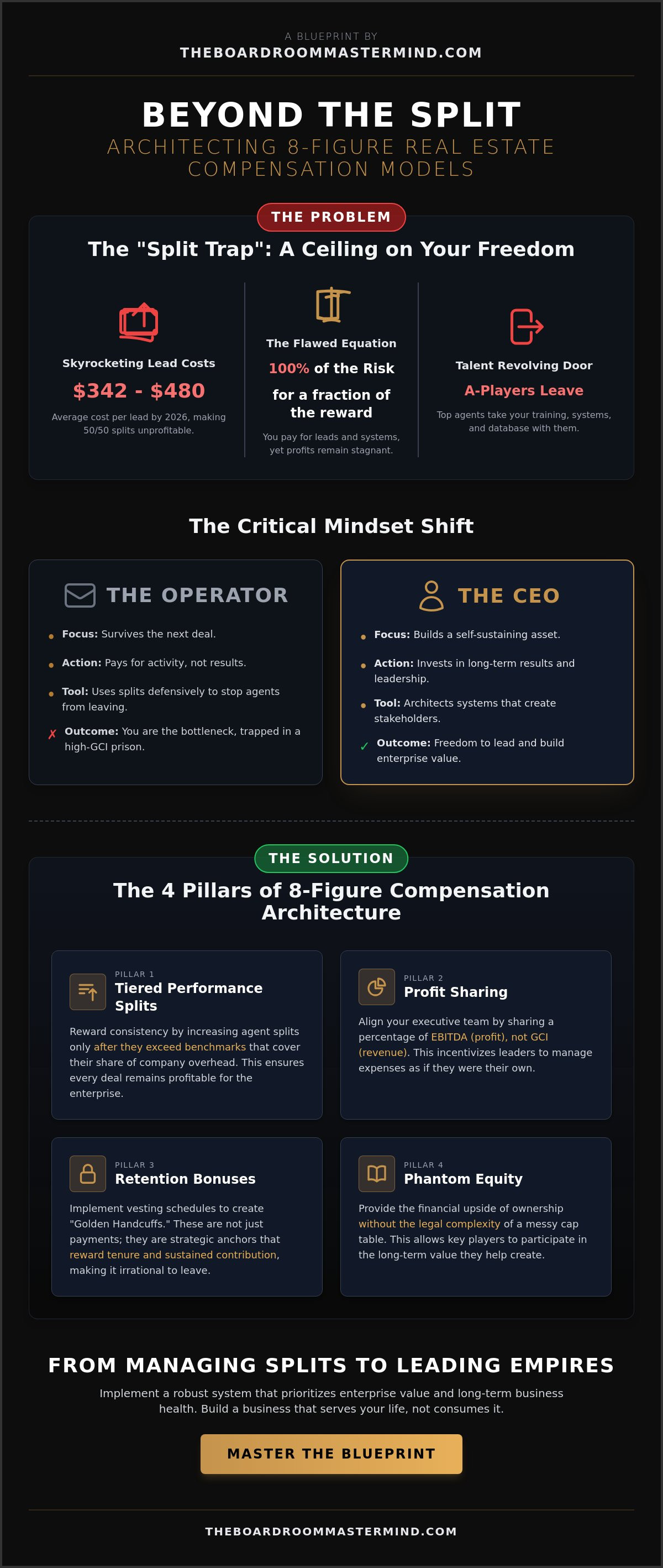
Scale isn't a byproduct of volume; it's a result of architecture. Most real estate team compensation models are built on a house of cards. They prioritize gross commission income (GCI) while ignoring the erosion of enterprise EBITDA. This is the "Split Trap." By offering high commission splits to top producers, you inadvertently create a zero-margin business where you assume 100% of the risk for a fraction of the reward. You aren't building a company; you're subsidizing someone else's career. If your profit margins don't allow for executive-level hires, your model is broken.
True scale requires a shift from paying for activity to paying for results and leadership. Real estate agent compensation has traditionally focused on the transaction. However, 8-figure founders understand that enterprise value is the measurable durability of a business that functions independently of its founder's daily transactional involvement. You must stop paying agents just to "show up" and start rewarding those who contribute to the company's bottom-line health.
The Operator vs. CEO Compensation Mindset
Operators pay to survive the next deal. They treat splits as a defensive tool to prevent agents from leaving, which creates a revolving door of talent that drains your time. This frantic energy prevents you from focusing on high-level strategy. CEOs don't pay for survival; they invest in a self-sustaining asset. If your model doesn't incentivize agents to act like stakeholders, you'll always remain the bottleneck of your own organization.
Calculating the Real Cost of Your Current Model
The hidden costs of agent turnover are staggering. When a top performer leaves, you lose the database, the training hours, and the momentum. If your current splits are too generous, you'll never find the capital to hire a COO or a Sales Manager. You're essentially trading your freedom for a high GCI that looks good on an awards stage but feels like a prison in your bank account. Reframing your structure is the only way to reclaim your time and achieve peak performance, a transition often facilitated through the strategic proximity found in The Boardroom Mastermind Membership.
The Four Pillars of 8-Figure Compensation Architecture
Building a high-impact organization requires moving beyond the simplistic formulas found in most real estate team compensation models. To scale toward 8 figures, your architecture must balance aggressive growth with rock-solid profitability. A sophisticated framework doesn't just pay for past performance; it buys future loyalty and operational excellence. This transition requires four specific pillars that align individual greed with corporate health.
- Pillar 1: Tiered Performance Splits. Reward consistency by increasing agent splits only after they exceed benchmarks that cover their share of company overhead. This ensures every deal remains profitable for the enterprise.
- Pillar 2: Profit Sharing. Align your executive team with the company's bottom-line health. By sharing a percentage of EBITDA rather than GCI, you incentivize leaders to manage expenses as if they were their own.
- Pillar 3: Retention Bonuses. Implement vesting schedules that keep A-players anchored. These are not just payments; they're strategic anchors that reward tenure and sustained contribution.
- Pillar 4: Phantom Equity. Provide the financial upside of ownership without the legal complexity of a messy cap table. This allows key players to participate in the long-term value they help create.
Incentivizing the Leadership Team (COO and Sales Managers)
Your leadership team shouldn't be focused on their own production. They should be focused on yours. Transitioning a COO or Sales Manager from GCI-based splits to EBITDA-based bonuses is the only way to ensure they prioritize the firm's scalability. This creates "Golden Handcuffs" that make it financially irrational for your best people to leave. Successfully building a leadership team requires this shift in financial alignment to move from a frantic owner-operator model to a true empire. Many founders refine these leadership tiers during our Quarterly In-Person Intensives.
Equity and Phantom Shares for Long-Term Alignment
Phantom equity is a powerful tool for private firms. It offers a contractual right to a cash payment tied to the company's value, simulating stock ownership without granting actual shares. This is ideal for securing 5 plus year commitments from key executives. When your leadership knows they have a stake in the eventual exit or the long-term valuation, their decision-making shifts from tactical to strategic. You aren't just hiring employees anymore; you're developing partners in wealth architecture.
Implementing Systems for Predictable Margins and Talent Retention
Systems are the bedrock of scalability. You cannot manage sophisticated real estate team compensation models on a spreadsheet or through verbal agreements. A robust business operating system ensures that your financial incentives are baked into the daily workflows of your team. This alignment prevents the common "margin creep" that happens when incentives are disconnected from operational reality. When your systems are tight, your profitability becomes predictable rather than accidental.
You must distinguish between leading and lagging indicators. While the Average Real Estate Agent Commission is a lagging indicator of success, your pay structure should also recognize leading indicators like lead conversion speed or database health. Refining your real estate team compensation models requires a cold-blooded look at your data. Conduct a "Compensation Audit" annually. Identify where you are overpaying for low-value administrative tasks. If you're paying a high split for an agent to perform data entry, you're hemorrhaging capital that should be fueling your expansion.
The Role of Technology in Managing Complex Models
Complexity is the enemy of execution. Use integrated CRM and ERP data to automate performance tracking and commission calculations. When payouts are clear, accurate, and fast, you eliminate the friction that erodes team morale. Trust is built when an A-player sees their impact reflected in their portal in real-time. This level of automation allows you to focus on high-level strategy rather than debating a commission check.
Transparency vs. Privacy in Executive Pay
Discretion is a hallmark of elite leadership. While you should be transparent about the path to higher tiers to drive motivation, specific executive pay remains private to avoid unnecessary friction. Your model is the law of your empire. When a "top producer" demands a split that breaks your financial model, you must have the systems in place to show them the door. If you're ready to audit your current structure and protect your margins, apply for Boardroom Elite to see how the world's highest-performing founders architect their success.
Scaling the Architect: From Managing Splits to Leading Empires
Scaling to 8 figures isn't a solo sport. You've spent years refining the mechanics of your team, but the final hurdle isn't mathematical; it's strategic. Refining real estate team compensation models in a vacuum is a recipe for blind spots. True proximity allows you to audit your model against those who've already crossed the 9-figure threshold. This isn't about general mentorship. It's about elite decision-making and wealth architecture. You're no longer just an agent with a team; you're the architect of a financial empire.
When you position your business as a strategic asset rather than a high-paying job, your perspective on compensation shifts. You stop looking at what you're losing in a commission split and start looking at what you're gaining in enterprise durability. The goal is to build a legacy that functions with precision while you focus on high-impact oversight. This transition from "hustler" to CEO is the difference between owning a job and owning an asset that produces wealth regardless of your daily activity.
Why the Boardroom Mastermind is the Final Step
The transition to CEO requires a room where your current ceiling is someone else's floor. The Boardroom Mastermind Membership provides exclusive access to Quarterly In-Person Intensives. In these rooms, business models aren't just discussed; they're audited by peers who understand the high stakes of 8-figure growth. It's a space where your most complex operational bottlenecks are viewed as standard hurdles. This provides the clarity needed to cut through the noise of the general marketplace and implement systems that stick.
The CEO’s Roadmap to Freedom
Sophisticated compensation is the ultimate currency for buying back your time. By architecting a model that rewards leadership and results, you empower a team that doesn't need your constant intervention. This is the roadmap to personal freedom and peak performance. You've built the volume; now it's time to build the structure that supports your life. Join the elite 5% of founders who've moved beyond the operator mindset. If you're ready to stop being the bottleneck and start leading an empire, apply for Boardroom Elite today.
Architecting Your Exit from the Day-to-Day
Your GCI is a vanity metric if it doesn't eventually buy your freedom. We've established that scaling to 8 figures requires a fundamental shift from defensive commission splits to a proactive wealth-sharing architecture. By implementing the four pillars of sophisticated real estate team compensation models, you stop subsidizing agent careers and start building a durable enterprise. You've seen how a robust Business Operating System and phantom equity transform a high-volume team into a self-sustaining asset. The path from operator to CEO is paved with these strategic decisions; it's about replacing frantic activity with systemic precision.
The final step is proximity. You need a room where your current ceiling is merely the starting point for your peers. Our Case Studies demonstrate the massive business growth possible when you audit your model alongside an elite peer network of 7, 8, and 9-figure investors. Through our Quarterly In-Person Intensives, you gain the clarity to execute at the highest level without the noise of the general marketplace. Apply to join the elite network of 8-figure real estate CEOs at The Boardroom Mastermind. It's time to build a legacy that operates with precision while you focus on high-impact oversight. Your next level of impact is waiting.
Strategic Briefing: Frequently Asked Questions
What is the most common mistake real estate founders make with compensation?
The most common mistake is over-prioritizing Gross Commission Income (GCI) while ignoring the erosion of enterprise EBITDA. Founders often fall into the "Split Trap" by offering high commissions to retain top producers; this reactive approach creates a zero-margin business. You aren't building an asset if your margins don't support a self-sustaining operation. True scale requires protecting the bottom line to fund executive leadership.
How do I transition an existing team to a new compensation model without losing my best agents?
Transitioning requires a value-based rollout rather than a sudden mandate. You should grandfather in existing contracts for a set period while demonstrating how the new real estate team compensation models provide superior support, leads, and long-term wealth opportunities. A-players will stay if the new structure reduces their operational friction. They value systems over raw percentages. It's about increasing their net income through better architecture.
Should I offer equity to my real estate team members?
You should avoid granting hard equity to team members because it complicates the cap table and creates permanent legal obligations. Instead, utilize phantom equity or profit-sharing units to provide the financial upside of ownership without the structural risks. This allows your leadership team to participate in the company's valuation growth. You maintain absolute control over the firm's strategic direction and long-term exit potential.
What is the difference between a commission split and a profit-sharing model?
A commission split is a transactional arrangement where agents receive a percentage of the gross revenue from a single deal. In contrast, profit-sharing models align the team with the company's bottom-line health by distributing a portion of net EBITDA. Splits incentivize individual activity. Profit-sharing encourages your executive team to manage expenses and optimize systems. This shifts their focus from personal production to collective enterprise value.
How much should I pay a COO in a real estate investment business?
A high-impact COO should be paid a competitive base salary combined with performance bonuses tied directly to EBITDA growth. This structure creates "Golden Handcuffs" by aligning their personal wealth with the firm's profitability rather than just transaction volume. While base salaries vary by market, the total compensation package must feel substantial enough to secure a 5 plus year commitment. They must act as a true partner in your wealth architecture.


