
Real Estate Syndication Legal Structure: Engineering an Institutional-Grade Empire
Your current real estate syndication legal structure is either the engine of your expansion or the ceiling on your net worth. Most sponsors treat compliance as a necessary evil; however, the world’s most successful firms view it as the strategic architecture that attracts eight and nine figure capital commitments. If your legal framework feels like a series of tactical hurdles rather than a repeatable system, you aren't acting as a CEO. You're acting as a high-paid freelancer.
It's exhausting to operate with the frantic energy of a hustler while managing sophisticated assets and high-tier investors who demand institutional-grade precision. You deserve a bulletproof fortress that protects your equity and ensures operational sovereignty. This article provides the blueprint to master the complex legal frameworks required to move beyond one-off deals and build a scalable empire. We will break down the specific mechanics of Regulation D exemptions, the necessity of filing Form D within 15 days of your first sale, and how to structure profit-sharing models that align with the expectations of the global elite.
Key Takeaways
- Transition from tactical single-asset LLCs to sophisticated Limited Partnership vehicles to meet the rigorous demands of institutional capital.
- Optimize your real estate syndication legal structure by selecting the precise Regulation D exemption that aligns with your capital-raising velocity and investor network.
- Engineer waterfall structures that secure investor confidence through preferred returns while protecting your upside via performance-based GP promotes.
- Evolve from a deal-focused operator into a strategic architect by establishing formal governance frameworks and professionalizing your compliance oversight.
The Architecture of Scale: Choosing Your Legal Vehicle
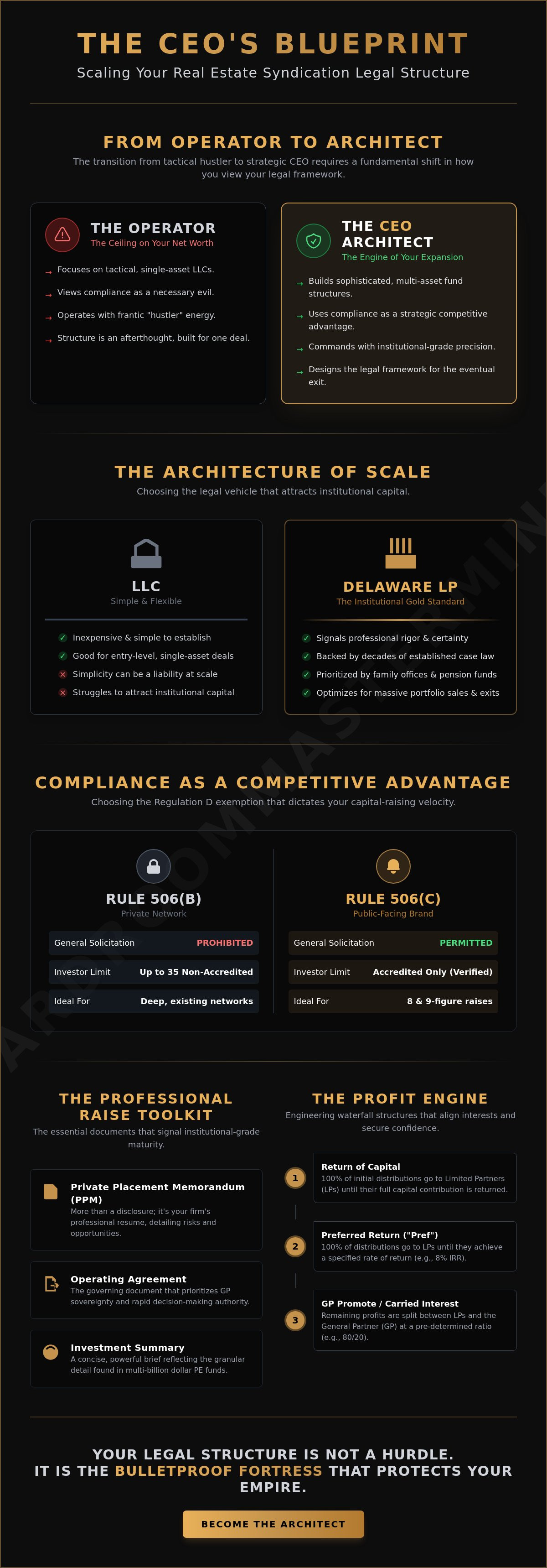
Entry-level operators fixate on single-asset LLCs because they are simple and inexpensive to establish. If you intend to manage hundreds of millions, simplicity is a liability. Scaling requires a strategic pivot toward multi-asset fund structures that allow for rapid capital deployment across a diversified portfolio. This shift represents the transition from a deal-by-deal operator to a strategic architect of wealth. Your real estate syndication legal structure must be designed for the eventual exit, not just the initial acquisition.
While the manager-managed LLC offers significant flexibility and centralized executive control, the Limited Partnership (LP) remains the undisputed gold standard for institutional capital. Family offices and pension funds prioritize predictability. They want a vehicle backed by decades of established case law. Utilizing a Delaware LP provides this assurance, signaling to high-tier investors that your operation is built on a foundation of professional rigor rather than amateur convenience.
LLC vs. LP: The Institutional Perspective
Institutional investors don't just buy assets; they buy certainty. A Delaware LP offers a level of statutory protection and tax efficiency that standard LLCs often struggle to match in high-stakes environments. If your goal is a massive portfolio sale or a future public offering, your legal vehicle determines your liquidity. To facilitate this, many sponsors employ a Delaware Flip, which is the strategic reorganization of a local entity into a Delaware-domiciled partnership to meet the rigid compliance and governance standards required by institutional-grade capital.
The Role of the GP and LP in High-Stakes Deals
In a sophisticated Real Estate Syndication, the General Partner (GP) functions as the strategic visionary who engineers the deal architecture. They assume the liability and the decision-making authority. Conversely, the Limited Partners (LP) are protected, passive participants whose risk is strictly limited to their capital contribution. This clear separation of powers ensures frictionless capital calls and maintains the operational sovereignty required to execute complex business plans without interference from minority stakeholders. Isolation of risk is further achieved through parent-subsidiary models or series structures, ensuring a single asset's failure cannot compromise the integrity of your entire empire.
Compliance as a Competitive Advantage: Navigating Securities Law
Amateur syndicators view securities law as a barrier to entry. Elite sponsors recognize it as a moat. Your real estate syndication legal structure provides the regulatory framework necessary to command respect from high-net-worth individuals and institutional players. When you lean into the rigors of SEC compliance, you aren't just checking boxes; you're signaling a level of professional maturity that competitors simply cannot match. This commitment to transparency is what separates a local operator from a global visionary.
The choice between Regulation D Rule 506(b) and 506(c) dictates your capital-raising velocity. While Rule 506(b) allows for up to 35 sophisticated, non-accredited investors, it prohibits general solicitation. This is ideal for those with deep, existing private networks. However, for 8-figure raises, Rule 506(c) is the superior choice. It permits public advertising, provided you take reasonable steps to verify that every investor is accredited. This verification process shouldn't be viewed as friction. It's a mark of exclusivity that protects the integrity of your fund and ensures you're only dealing with the highest tier of capital.
The 506(c) Revolution for Modern CEOs
Leveraging Rule 506(c) allows you to build a public-facing brand that attracts capital on autopilot. By removing the "quiet period" constraints, you can showcase your track record and mission openly. This transparency builds the trust required for rapid scaling. Adhering to SEC guidance on real estate syndicates ensures your marketing remains within legal bounds while you scale your influence across the marketplace.
Essential Documents of a Professional Raise
The Private Placement Memorandum (PPM) is more than a disclosure; it's your firm's professional resume. It must be paired with an Operating Agreement that prioritizes GP sovereignty and decision-making speed. To secure institutional real estate capital, your Investment Summary must reflect the same level of granular detail found in multi-billion dollar private equity funds. Don't forget that national scale requires a multi-state strategy to comply with various Blue Sky laws. If you're ready to professionalize your raise, joining an elite network can provide the strategic framework you need to execute at this level.
The Profit Engine: Designing Sophisticated Waterfall Structures
If the legal vehicle is the chassis, the profit waterfall is the engine. Your real estate syndication legal structure exists to facilitate the flow of capital and the precise distribution of rewards. In institutional environments, the waterfall isn't a simple split; it's a precision instrument. A preferred return, typically ranging from 7% to 9%, serves as the baseline for investor trust. However, the real engineering happens in the tiers above that hurdle, where the sponsor's expertise is truly compensated. The California Department of Real Estate on Syndication provides historical and regulatory context on how these frameworks balance sponsor incentives with necessary investor protections.
High-performance sponsors utilize "Catch-Up" provisions to maximize their upside. Once the Limited Partners receive their preferred return and a return of capital, the GP "catches up" to a specific percentage of the total profits before moving into the next tier of the promote. This ensures you're rewarded for outsized performance without alienating the capital that made the deal possible. It's a mechanism that rewards the architect for delivering results that exceed the baseline expectations of the market.
Tiered Promotes and Performance Hurdles
Scaling to an institutional level requires moving beyond static 80/20 splits. Sophisticated architects use tiered promotes based on Internal Rate of Return (IRR) or Equity Multiple targets. You might structure a deal with an 80/20 split up to a 14% IRR, shifting to 70/30 or even 50/50 as performance exceeds aggressive benchmarks. This structure aligns interests and proves you're willing to bet on your own execution. Don't forget that elite LPs expect you to have "skin in the game" by investing your own capital alongside them.
Distributions and Capital Recovery
The distinction between "Return of Capital" and "Return on Capital" is critical for the tax efficiency your investors demand. High-net-worth LPs prioritize the pass-through of deductions like depreciation. For a $5 million property, annual depreciation can range from $128,000 to $185,000, which significantly impacts the net yield reported on a Schedule K-1. To protect the long-term integrity of your fund, always include Clawback Provisions. These ensure that if a deal underperforms in its final years, any excess promote paid to the GP is returned. If you're ready to master these high-level financial architectures, apply for The Boardroom Mastermind to join a peer group operating at this scale.
From Operator to Architect: Implementing Your Governance Framework
Scaling a syndication business is a leadership challenge disguised as a legal one. While your real estate syndication legal structure provides the rules of engagement, your governance framework provides the discipline required for 8-figure growth. If you are still the primary person signing every operational document, you aren't a CEO. You're a bottleneck. To move beyond tactical management, you must build a system that prioritizes strategic oversight and fiduciary excellence.
Establishing a Board of Advisors is the first step toward institutional maturity. These individuals provide the strategic direction that high-tier investors expect from a professional firm. It's about creating a structure that survives the founder. This process requires delegating the "legal bottleneck" to a dedicated General Counsel or a specialized compliance firm. By removing yourself from the minutiae of SEC filings and state notice requirements, you reclaim the mental bandwidth necessary for high-level wealth architecture.
Governance as the Foundation of Scale
A robust building a leadership team strategy is inseparable from your legal governance. You must implement voting rights and removal clauses that maintain the founder's vision while providing Limited Partners with the security of professional oversight. Transparency becomes your most potent tool for scaling beyond the San Diego market. Annual audits aren't just a compliance requirement; they are a marketing asset that proves your operational rigor to global capital sources.
The CEO’s Final Transformation
The ultimate objective is to build a management company that is itself a sellable asset. Ensuring your legal structure allows for the sale of the General Partner entity is the difference between owning a job and owning an empire. This requires a shift in your daily rhythm. You move from the chaos of deal sourcing to the composure of reviewing quarterly audits. Elite founders don't navigate this evolution in isolation. They join The Boardroom Mastermind to audit their business architecture alongside peers who have already conquered these complexities. This is the final stage of your evolution: becoming the architect of a self-sustaining financial fortress.
Mastering the Architecture of an Institutional Empire
The transition from a tactical deal-maker to a strategic architect requires more than just capital; it requires the discipline to build a self-sustaining fortress. You've learned that your real estate syndication legal structure is the foundation of this evolution. By choosing sophisticated Limited Partnership vehicles and implementing precise waterfall tiers, you signal to the market that your operation is ready for institutional-grade commitments. You are no longer just buying assets. You're building a legacy that survives your daily involvement.
True scale is never achieved in isolation. The most successful visionaries recognize that their business architecture requires constant auditing by those who have already conquered the 8 and 9-figure milestones. This is why elite founders join our network of battle-tested leaders to refine their governance and maximize their operational sovereignty. If you're ready to move beyond the noise and secure your seat among the global high achievers, it's time to elevate your environment.
Apply for The Boardroom Mastermind and audit your business architecture with 8-figure peers to gain access to our quarterly in-person intensives and battle-tested scaling frameworks. Your empire is waiting for its architect. We look forward to seeing you at the next level.
Frequently Asked Questions
What is the best legal entity for a real estate syndication?
The Delaware Limited Partnership (LP) remains the undisputed gold standard for those building an institutional-grade empire. While a manager-managed LLC offers significant operational flexibility, sophisticated family offices and pension funds prioritize the predictable case law associated with a Delaware LP. This structure ensures a clear, legally fortified boundary between your strategic General Partner entity and the passive Limited Partners.
Do I need a Private Placement Memorandum (PPM) for every deal?
You must utilize a PPM for any offering where you are selling securities to ensure comprehensive disclosure and mitigate future liability. This document acts as your legal shield, providing investors with the granular detail required to make an informed decision while protecting you from claims of material misrepresentation. Skipping this step is a tactical error that compromises your entire real estate syndication legal structure and your long-term reputation.
What is the difference between a 506(b) and 506(c) offering?
Rule 506(b) allows for an unlimited number of accredited investors and up to 35 sophisticated non-accredited investors, but it strictly prohibits general solicitation or advertising. Conversely, Rule 506(c) permits you to advertise your offering publicly to reach a global audience. The trade-off is that every investor in a 506(c) raise must be accredited, and you are legally required to take reasonable steps to verify their status through third-party documentation.
How much does it cost to set up a real estate syndication legal structure?
Expect to invest between $10,000 and $25,000 for a standard Private Placement Memorandum alone, depending on the complexity of your waterfall. While the SEC does not charge a filing fee for Form D, you must account for state-level "Blue Sky" filing fees, which vary by jurisdiction. Treat these costs as a critical investment in your firm's infrastructure rather than a mere administrative expense.
Can a syndication have non-accredited investors?
You can include up to 35 sophisticated, non-accredited investors if you utilize a Regulation D Rule 506(b) offering. However, this inclusion triggers more rigorous disclosure requirements and prohibits you from any form of public solicitation. Most CEOs focused on 8-figure raises eventually move exclusively to accredited-only pools to streamline their compliance and attract higher tiers of capital.
What happens if a syndicator violates SEC regulations?
Violating securities laws is operational suicide that results in heavy fines, the forced return of all investor capital, and a permanent ban from future capital raises. The SEC may also pursue "disgorgement," which requires you to pay back any profits earned from the illicit offering. Maintaining a bulletproof real estate syndication legal structure is the only way to ensure your growth remains permanent and your reputation stays untarnished.


