
Real Estate Investor KPIs: The CEO’s Blueprint for 8-Figure Scaling
Most real estate investors don't actually own a business. They own a high-stress, 24/7 job that happens to involve title deeds. While you might be closing deals in a bifurcated market where luxury inventory is shrinking and 30-year fixed rates hit 6.66%, high volume doesn't equate to high enterprise value. If your business feels like an unpredictable black box, you are likely relying on lagging indicators that only tell you where you've been, not where you're going. To scale an empire, you must master the high-level real estate investor kpis that separate the frantic operator from the strategic CEO.
You probably agree that the grit that got you to seven figures is exactly what's preventing you from reaching nine. It's frustrating to face 1.25 DSCR requirements and shifting regulations without a dashboard that predicts your next twelve months of cash flow. This guide promises to provide the CEO’s blueprint for 8-figure scaling, transforming your operational chaos into a predictable machine. We will preview the essential metrics for capital efficiency, team performance, and market timing that allow you to step back from the daily grind and lead with calculated confidence.
Key Takeaways
- Shift your focus from lagging property reports to predictive leading indicators that signal exactly when to scale or pivot your capital.
- Transition from personal credit to institutional capital stacks by mastering the specific debt-to-equity metrics required for high-growth portfolios.
- Optimize your operational machine by applying sophisticated real estate investor kpis like Customer Acquisition Cost (CAC) and Lifetime Value (LTV) to your deal flow.
- Conduct a rigorous business audit to identify the operational bottlenecks preventing your transition from a tactical operator to a strategic visionary.
The CEO’s Dashboard: Distinguishing Leading vs. Lagging Indicators
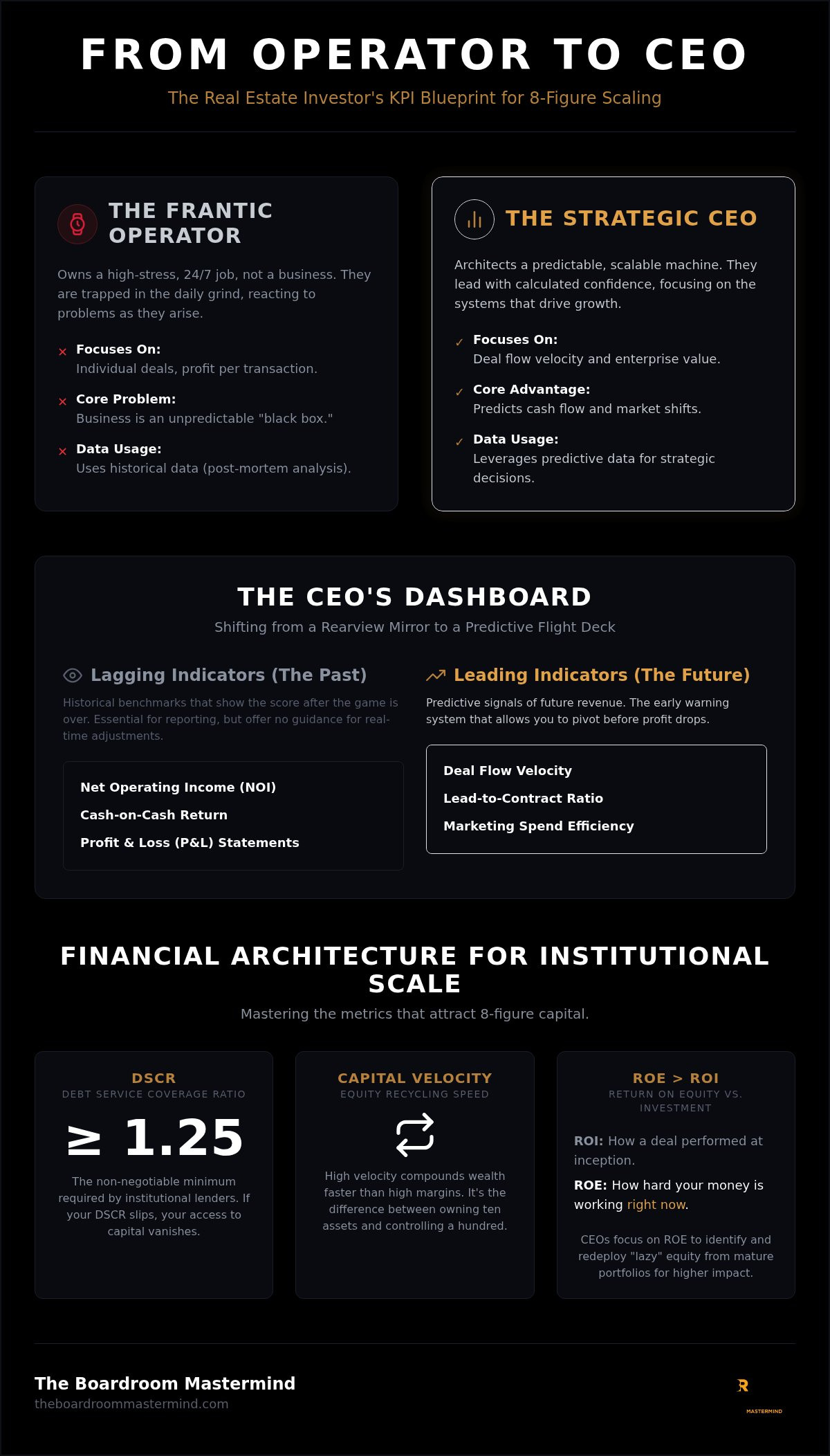
Your real estate investor kpis are more than just numbers on a property report; they are the vital signs of your business architecture. Most investors treat data like a post-mortem, examining what went wrong only after the deal has already settled. A CEO views these metrics as a flight deck. If you're building an 8-figure empire, you need to know if you're flying into a storm before you see the clouds. This requires a fundamental shift from tactical management to strategic oversight.
Operators obsess over profit, which is a result, not a driver. CEOs manage deal flow velocity. While real estate benchmarking often focuses on static figures like gross rent multipliers, true scaling requires a dynamic dashboard. You must distinguish between what happened and what will happen. If you don't make this distinction, you're driving a high-performance vehicle while looking exclusively in the rearview mirror. You'll hit the wall before you even realize you've drifted off course.
Lagging Indicators: The Scoreboard of Past Performance
Lagging indicators tell you how you performed last quarter. Metrics like Net Operating Income (NOI) and Cash-on-Cash Return are essential for reporting, but they are historical benchmarks. They show you the score after the game is over. Relying solely on your P&L keeps you trapped in the 'Hustler' phase because it doesn't allow for proactive adjustment. These metrics are the final confirmation of whether your strategy succeeded or failed, but they offer zero guidance on how to fix a failing system in real time.
Leading Indicators: The Early Warning System for Scale
Leading indicators are the predictive signals of future revenue. You should be tracking marketing spend efficiency and lead-to-contract ratios with clinical precision. These metrics allow you to monitor the health of your acquisition funnel before a dry spell hits your bank account. Deal flow predictability is the only way to ensure your capital is always deployed at peak efficiency. This level of foresight is a core component of a sophisticated Business Operating System: The Architecture of 8-Figure Real Estate Scaling. When your real estate investor kpis dip, you pivot before the profit drops. That is the definition of strategic control.
Financial Architecture: Metrics for 8-Figure Capital Management
Scaling to an 8-figure enterprise requires a fundamental shift in how you view liquidity. You are no longer just buying properties; you are architecting a sophisticated financial vehicle. Transitioning from personal credit to institutional capital stacks is the hallmark of a true CEO. In this tier, your primary real estate investor kpis revolve around the efficiency of your capital, not just the size of your portfolio. If you don't master these metrics, your growth will be capped by the limits of your own balance sheet.
Cost of capital is the single most important metric for real estate private equity. It determines your competitive edge in a crowded market. Along with cost, you must monitor capital velocity. This is the speed at which you can recycle your equity into the next acquisition. High velocity compounds wealth faster than high margins ever could. It's the difference between owning ten assets and controlling a hundred.
Optimizing the Capital Stack
Institutional scale requires a deep understanding of your Weighted Average Cost of Capital (WACC). You must balance senior debt, mezzanine financing, and equity to lower your overall hurdle rate. With 30-year fixed rates hitting 6.66% in mid-2026, managing your debt service coverage ratio (DSCR) is critical. Lenders typically require a minimum DSCR of 1.25, making this a non-negotiable metric for anyone seeking Real Estate Private Equity: The Architect’s Guide to Institutional Scale. If your DSCR slips, your access to capital vanishes.
Return on Equity (ROE) vs. Return on Investment (ROI)
While most operators focus on ROI, the CEO focuses on ROE. ROI tells you how a deal performed at inception. ROE tells you how hard your money is working right now. As properties appreciate, equity becomes "lazy." A mature portfolio often hides stagnant capital that should be redeployed for higher impact. Identifying these bottlenecks is a core focus for those who audit their business systems to ensure every dollar is optimized for maximum enterprise value.
Operational Efficiency: Tracking the Machine, Not the Deals
Stop obsessing over individual property performance. To scale an 8-figure empire, you must treat your business itself as the primary product. This requires a fundamental shift from tactical deal-hunting to operational optimization. High-level real estate investor kpis at this stage focus on the efficiency of your engine, not just the output of a single asset. If your team isn't optimized, every new deal simply adds more weight to a collapsing structure.
Consider your Customer Acquisition Cost (CAC) and Lifetime Value (LTV). In a professional investment firm, CAC isn't just marketing spend; it's the total cost of the systems and personnel required to secure a contract. LTV measures the total profit generated from a specific lead source or investor relationship over time. Monitoring these real estate investor kpis allows you to see the friction before it stalls your growth. Human Capital Efficiency is the total revenue generated per employee within your organization.
Revenue per Employee: The Ultimate Scalability Metric
Benchmarking your team against 8-figure industry standards reveals the true health of your leadership. If your revenue per employee is low, you don't have a talent problem; you have a 'Founder Bottleneck.' You're likely still the primary decision-maker for every minor operational hurdle. To break this ceiling, you must transition to strategic oversight. This starts with Building a Leadership Team: The CEO’s Blueprint for 8-Figure Scale.
Deal Lifecycle Velocity
Velocity is the silent killer of margins. You must measure the precise time from 'Lead In' to 'Disposition Out.' Operational friction points, such as delayed inspections or slow contractor turnarounds, erode your capital velocity. When your deal lifecycle stretches, your cost of capital effectively rises. If you want to identify exactly where your machine is leaking profit, you need to audit your operational machine with a peer network of 8-figure leaders who have already solved these bottlenecks.
The Annual Audit: Turning Data into Strategic Autonomy
Data without a framework for execution is just noise. To achieve true strategic autonomy, you must use your dashboard to conduct a rigorous business audit. This isn't a passive review of your P&L. It's a high-stakes stress test of your entire operational architecture, mirroring the quarterly audits conducted during Boardroom Intensives. The ultimate litmus test for scaling is simple: Does your data show a business that relies on your presence, or a system that runs itself? If your real estate investor kpis flatline the moment you step away, you haven't built an empire. You've built a cage.
The leap from 7 to 8 figures is rarely a deal problem. It's a system problem. Most investors fail here because they can't identify the #1 bottleneck: their own involvement in tactical decision-making. You must have the clinical detachment to look at your metrics and recognize where your ego is obstructing your growth. This is why 95% of applicants are rejected from elite circles; they haven't mastered the systems required to lead at the highest tiers of financial success. During an audit, you should ask:
- Is my Revenue per Employee increasing as the team grows?
- Does my Debt-to-Equity ratio align with institutional risk standards?
- Which leading indicators accurately predicted last month's dry spells?
From Operator to CEO: The Final Mindset Shift
Stop hiring based on gut feeling and start using data to justify high-level executive roles. Your KPI dashboard should signal exactly when to bring on a COO or a Director of Acquisitions. Interpreting these complex financial data points requires more than just a spreadsheet. It requires the perspective of peers who have already scaled through the same bottlenecks. Peer accountability ensures you don't rationalize poor performance or ignore early warning signs in your capital stack. You can audit your business model with elite peers at the next Boardroom Intensive to gain this clarity.
Engineering Your Elite Network
High-level real estate investor kpis require a high-level network to validate them. Without a peer group of 8 and 9-figure entrepreneurs, you're measuring your progress against a mediocre marketplace. Access to a battle-tested community provides the benchmark you need to ensure your growth is both predictable and permanent. This is the essence of The 7-Figure Ceiling: A CEO Guide to Exclusive Mastermind Groups. Joining The Boardroom Mastermind isn't just about networking; it's about securing the strategic assets necessary for legacy-level impact.
Architecture for the 8-Figure Horizon
Transitioning from a high-stakes operator to a strategic visionary requires more than just deal volume. It demands a clinical mastery of the data that drives enterprise value. You now understand how leading indicators provide the early warning signals needed to navigate market shifts, and why optimizing your capital velocity is the only path to institutional scale. By prioritizing human capital efficiency and sophisticated debt structures, you transform a fragile hustle into a resilient investment empire.
Mastering these real estate investor kpis is the first step toward reclaiming your time and maximizing your impact. However, data alone is insufficient without the elite perspective required to interpret it. True growth happens when you pressure-test your systems against the standards of the world's most successful owners. If you're ready to stop being the bottleneck and start leading as a CEO, you need a room that matches your ambition.
The Boardroom Mastermind offers exclusive access to a peer network of 8 and 9-figure entrepreneurs and quarterly in-person auditing intensives designed to refine your growth frameworks. This is the ultimate shortcut to achieving peak performance without sacrificing your lifestyle. Apply to Join The Boardroom Mastermind and Scale Your Empire. The path to your next milestone is clear. It's time to build the legacy you've engineered.
Frequently Asked Questions
What are the most important KPIs for a scaling real estate investor?
The most critical real estate investor kpis for scaling are those that measure capital efficiency and operational throughput rather than just property-level returns. You must prioritize debt-to-equity ratios to manage risk and capital velocity to ensure your equity is constantly recycled into new acquisitions. These metrics signal the health of the entire investment machine rather than the performance of a single asset.
How do I calculate Customer Acquisition Cost (CAC) for real estate deals?
You calculate Customer Acquisition Cost by dividing your total marketing, sales, and acquisition-related overhead by the number of deals successfully closed within a specific period. This must include the salaries of your acquisition team and any technology costs associated with lead generation. If your CAC exceeds the average spread on your deals, your scaling efforts will eventually lead to a liquidity crisis.
What is the difference between a leading and a lagging indicator in real estate?
A lagging indicator is a historical result like Net Operating Income or total profit that confirms the success of a past strategy. In contrast, a leading indicator is a predictive signal, such as lead-to-contract ratios or marketing spend efficiency, that forecasts future revenue. CEOs manage leading indicators to pivot before the lagging indicators show a decline in performance.
How often should a real estate CEO review their KPI dashboard?
A real estate CEO should review leading indicators daily and conduct a comprehensive tactical dashboard review weekly. This ensures that operational friction is identified before it impacts the capital stack. Strategic audits of these real estate investor kpis should happen quarterly to align the business architecture with long-term scaling goals and institutional requirements.
What is a good Revenue per Employee benchmark for a real estate investment firm?
High-growth investment firms typically target a Revenue per Employee benchmark of at least $500,000, with elite 8-figure operations often exceeding $1 million. If your revenue per head is significantly lower, it usually indicates a lack of systems or a founder who is still too involved in tactical management. This metric is the definitive proof of your operational efficiency and scalability.

Disclaimer
Mr. Clothier is an expert in real estate investing. As such his experiences are not necessarily typical to the standard real estate investor and whose results may vary. The successes shared on this site are not considered typical. Most individuals who order the educational materials and systems probably do not follow any of the techniques or strategies and consequently make little to no money due to their inaction. The company is in the process of determining the typical success of its clients. Stories shared herein are for example purpose only and should not be construed as "guarantees" of success. Results will vary based on background, education, and experience and actions taken.
This site is not a part of the Google/Facebook website or Google/Facebook Inc. Additionally, this site is NOT endorsed by or affiliated with Google/Facebook in any way. GOOGLE/FACEBOOK is a trademark of GOOGLE/FACEBOOK, Inc.
INCOME DISCLAIMER: This website and the items it distributes contain business strategies, marketing methods and other business advice that, regardless of referenced results and experience, may not produce the same results (or any results) for you. The Boardroom Mastermind makes absolutely no guarantee, expressed or implied, that by following the advice or content available from this web site you will make any money or improve current profits, as there are several factors and variables that come into play regarding any given business. Primarily, results will depend on the nature of the product or business model, the conditions of the marketplace, the experience of the individual, and situations and elements that are beyond your control. As with any business endeavor, you assume all risk related to investment and money based on your own discretion and at your own potential expense.
LIABILITY DISCLAIMER: By reading this website or the documents it offers, you assume all risks associated with using the advice given, with a full understanding that you, solely, are responsible for anything that may occur as a result of putting this information into action in any way, and regardless of your interpretation of the advice. You further agree that The Boardroom Mastermind, its affiliates, subsidiaries, officers and agents, cannot be held responsible in any way for the success or failure of your business as a result of the information provided. It is your responsibility to conduct your own due diligence regarding the safe and successful operation of your business. In summary, you understand that we make absolutely no guarantees regarding income as a result of applying this information, as well as the fact that you are solely responsible for the results of any action taken on your part as a result of any given information. In addition, you agree that our content is to be considered "for entertainment purposes only". Always seek the advice of a professional when making legal, financial, tax, or business decisions.
BUSINESS OPPORTUNITY: All products and services offered by The Boardroom Mastermind are intended to provide prospective purchasers with general business strategies, marketing methods and other general advice for business development and training. At no point is The Boardroom Mastermind soliciting anyone to enter into a new business nor is it representing, either expressly or by implication, that it will provide locations for a business, provide outlets, accounts, or customers, or purchase any of the goods or services made by the purchaser.
The products being offered through this promotion are packages of informational tools to help you learn about business and deal making strategies.


