
Real Estate Integrator: The Architect of 8-Figure Operational Excellence
The most expensive bottleneck in your real estate empire isn't the 6.65% mortgage rate or the complexities of the 2026 market; it's you. You've reached a level of success where your own genius has become a ceiling. Every deal flows through your desk, and every strategic initiative dies in the execution phase because you're too busy being the "hustler" to act as the CEO. It's a common trap for high-achievers who have the vision but lack the structural support to handle institutional scale.
You likely agree that your time is better spent on 9-figure strategy than on managing disconnected software tools or manual data entry. To break through, you must master the visionary integrator relationship real estate leaders use to decouple their personal activity from their company’s growth. This article reveals why a real estate integrator is the missing link between your big ideas and a predictable, 9-figure business architecture. We'll explore the path to transitioning from tactical management to strategic oversight, ensuring your business runs with precision even when you aren't in the room.
Key Takeaways
- Distinguish between a technical software integrator and a true Chief Operating Officer to ensure your operational leadership matches your financial ambitions.
- Master the visionary integrator relationship real estate executives use to separate long-term wealth architecture from the friction of daily deal management.
- Recognize why scaling a broken process with new software only creates automated chaos and how to build a resilient system first.
- Leverage high-stakes business audits to identify critical bottlenecks and determine when your organization is ready for an institutional-grade integrator.
What is a Real Estate Integrator? Beyond Software Connectivity
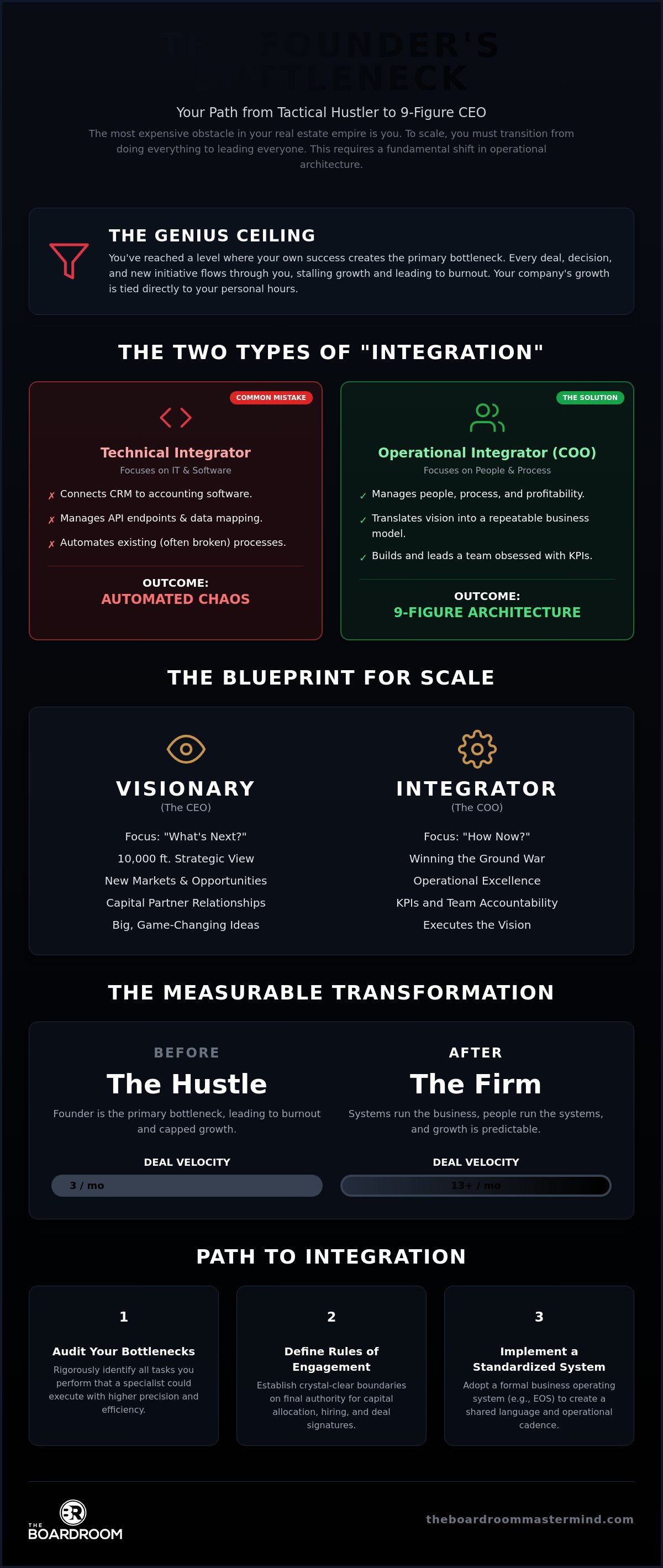
Most real estate founders confuse integration with IT support. They believe that if their CRM talks to their accounting software, they've achieved "integrated" operations. This is a dangerous misconception that stalls growth at the mid-seven-figure mark. True integration is a dual-force mechanism. It requires both technical systems that function without friction and an operational leader who can translate a founder’s high-level strategy into a repeatable business model.
To better understand how these roles differ and why the synergy is vital, watch this breakdown:
A Real Estate Integrator is the executive bridge between a founder’s vision and the company’s daily execution. While a software integrator focuses on API endpoints and data mapping, an operational integrator focuses on people, processes, and profitability. Many 7-figure firms fail because they possess the right software but lack the human architect required to manage it. Without this human element, you don't have a business; you have a collection of expensive tools that no one knows how to drive.
The Technical Layer: Syncing Your Real Estate Stack
At the 8-figure level, "out-of-the-box" solutions rarely suffice. Your CRM, transaction management platform, and accounting software must operate as a singular, unified nervous system. This often requires custom scripts to handle the specific nuances of high-volume deal flow and complex capital stacks. Clean data is the prerequisite for elite decision-making. If your data is siloed, your strategy is guesswork.
The Human Layer: The Integrator as the COO
The integrator serves as the "Steady Force" within the visionary integrator relationship real estate leaders rely on to maintain sanity. They filter the founder’s endless stream of ideas, selecting only those that align with the core mission. This role is responsible for building a leadership team that is obsessed with KPIs. They ensure that while the Visionary is looking at the horizon, the business is winning the ground war of daily operations.
The Visionary-Integrator Relationship: A Blueprint for 9-Figure Scale
Scaling a real estate enterprise to nine figures requires more than just capital; it requires a psychological surrender. The EOS framework identifies a fundamental friction in high-growth companies: the tension between the creative founder and the disciplined executor. Within a high-volume real estate context, this visionary integrator relationship real estate leaders master is the only way to decouple growth from founder hours. While the Visionary is obsessing over "What’s Next"-new markets, capital partners, and innovative acquisition strategies-the Integrator is relentlessly focused on "How Now." They ensure the current machine is achieving operational excellence across every asset in the portfolio.
The ROI of this partnership is immediate and measurable. When a founder stops being the primary bottleneck in every deal, deal velocity accelerates. You move from closing three deals a month to thirteen because the systems don't rely on your personal approval for every line item. This shift reduces founder burnout and transforms the business from a chaotic "hustle" into a professional investment firm. For those ready to explore this transition, The Boardroom experience offers a peer-led framework for identifying your ideal second-in-command.
5 Steps to Establishing the Integrator Dynamic
- Audit Your Bottlenecks: Conduct a rigorous review to identify tasks you perform that a specialist could execute with higher precision.
- Define Rules of Engagement: Establish clear boundaries on who has the final authority regarding capital allocation, hiring, and deal signatures.
- Implement a Standardized System: Adopt a formal business operating system to provide the shared language and cadence required for alignment.
- Surrender the Vine: Commit to letting go of tactical control to focus exclusively on high-level wealth architecture.
- Synchronize Quarterly: Maintain alignment through deep-dive audits of the business model to ensure the Integrator’s systems still support the Visionary’s goals.
Signs You Are Ready for a Full-Time Integrator
Most founders wait too long. If you've hit a "7-figure ceiling" where increasing your workload no longer results in higher net profit, you're already behind. This plateau signifies that your current management style cannot support more complexity. The transition from tactical management to strategic oversight is the hallmark of a professional CEO. If your business stops moving the moment you turn off your phone, you don't have a company; you have a high-paying job that needs an architect.
Systemic Integration vs. Software Automation: Why Most Founders Fail
The most expensive mistake a high-level founder can make is attempting to solve a leadership void with a software patch. You've likely heard the objection: "I don't need a COO; I just need a better CRM." This logic is flawed. Software doesn't fix a broken process; it merely accelerates it. When you scale a dysfunctional workflow with automation, you create "Automated Chaos." This accelerates your burn rate and alienates your capital partners faster than any market downturn could. Sophisticated real estate firms that reach nine figures prioritize a strict hierarchy: Process First, People Second, Platform Third.
Before you commit to a new tech stack, you must have the business logic to support it. By leveraging a peer advisory group, elite founders can identify systemic flaws in their operations before they are encoded into expensive software. Within the visionary integrator relationship real estate titans utilize, the Integrator acts as the gatekeeper. They ensure that every tool added to the business serves a specific, documented process rather than chasing a "shiny object" feature that promises a magic bullet for growth.
If you are ready to audit your current architecture and eliminate the friction holding you back, apply to join The Boardroom Mastermind and gain access to institutional-grade scaling frameworks.
The Danger of "Shiny Object" Software Integration
High-level founders often get distracted by the latest AI-driven lead generation tools or predictive analytics platforms. While these have value, they are useless without a "Single Source of Truth" in your data architecture. If your CRM doesn't talk to your transaction management system with 100% accuracy, you're making 8-figure decisions based on 4-figure data. Your Integrator's job is to ruthlessly eliminate tech bloat and ensure your data remains institutional grade.
Auditing Your Systems for Institutional Scale
You cannot reach 9-figure scale using "Hustler" spreadsheets and manual workarounds. Transitioning to institutional reporting requires a shift from tracking activities to tracking outcomes. A rigorous annual business audit is the primary tool for systemic health. It allows you to tear down outdated workflows that served you at $5 million but are now strangling you at $50 million. This audit isn't just about software; it's about ensuring your leadership structure is robust enough to handle the next level of complexity.
Auditing Your Architecture: How The Boardroom Mastermind Facilitates Scale
The transition from a high-earning operator to a professional CEO is rarely achieved in isolation. It requires a mirror held up by those who have already navigated the complexities of institutional scale. This is where The Boardroom Mastermind becomes a critical strategic asset. We provide the high-stakes environment where elite founders finally gain the clarity to master the visionary integrator relationship real estate requires for 9-figure expansion. You don't just learn about systems here; you audit your entire leadership structure alongside peers who are managing hundreds of millions in assets.
Membership serves as the ultimate shortcut to operational excellence. By networking with 8 and 9-figure investors, you bypass the trial-and-error phase of hiring an executive team. You see the blueprints of successful integrations in real-time, allowing you to implement battle-tested frameworks immediately. This is not a place for theory. It's a space for battle-tested visionaries who value privacy and high-level execution.
Quarterly Intensives: The CEO’s Strategy Session
Working in the business is a trap that keeps you small. Our quarterly in-person business model audits are designed to force you out of the tactical weeds. During these intensives, you leverage the collective intelligence of the room to solve complex integration bottlenecks. Whether it's refining your capital stack or restructuring your department heads, these sessions ensure your daily operations remain aligned with your 9-figure strategy. You leave each session with a clear, audited blueprint for the next 90 days of growth.
The Exclusive Path to 9-Figure Impact
We maintain a rigorous standard of excellence to protect the caliber of our strategic atmosphere. We reject 95% of applicants because this community is reserved for those who value time and high-level execution above all else. If you are ready to stop being the bottleneck and start building a legacy, the next step is clear. Apply to join the elite at The Boardroom Mastermind and secure your seat at the table where the future of real estate architecture is defined.
Architecting Your 9-Figure Legacy
True scale is never a product of chance; it's the result of a rigorous commitment to operational excellence. You've seen that software is merely a tool, and without a high-level architect to drive it, automation only accelerates dysfunction. Mastering the visionary integrator relationship real estate titans use allows you to stop being the operator and start being the architect of your wealth. By surrendering tactical control, you gain the strategic oversight necessary to command a multi-million dollar portfolio with precision.
The path to this level of autonomy requires more than just intent. It requires the right environment. Through comprehensive business model auditing and quarterly in-person strategy intensives, our members move from chaotic deal-making to institutional-grade execution. You don't have to navigate this transition alone. Surround yourself with a peer network of 7, 8, and 9-figure founders who have already built the systems you currently lack. It's time to stop fighting the friction and start building the machine. Apply to join The Boardroom Mastermind and scale your empire today. Your next level of growth is waiting for the leader you're about to become.
Frequently Asked Questions
What is the difference between a real estate integrator and a virtual assistant?
An integrator is a high-level executive partner, while a virtual assistant is a tactical task-executor. The visionary integrator relationship real estate leaders utilize is built on shared accountability for the company's P&L and strategic growth. A VA follows a checklist; an integrator builds the checklist and manages the team that follows it. They are the architect of your operational excellence, not just a set of hands.
Does a real estate integrator need to have a real estate license?
Licensing requirements depend on the specific duties and state regulations; however, many high-level integrators function as COOs without a license if they don't perform licensed activities like negotiating deals. In the post-NAR settlement environment of 2026, an integrator must be intimately familiar with compliance and paperwork-first operations. Their primary value is in systemic oversight and leadership rather than individual production or brokerage.
How much does a high-level real estate integrator typically cost an 8-figure business?
For an 8-figure real estate enterprise, a Chief Operating Officer or Integrator typically commands a salary ranging from approximately $123,587 to over $339,000 annually. This cost reflects the high stakes of managing institutional-grade deal flow and complex capital stacks. While some residential-focused firms report averages closer to $100,000, top-tier talent often requires performance-based incentives tied to the company's overall profitability and scale.
Can I be both the Visionary and the Integrator in my real estate company?
You can occupy both roles temporarily, but you will inevitably hit a ceiling that prevents 9-figure growth. Attempting to be both the creative visionary and the disciplined executor creates a "founder bottleneck" that slows deal velocity and leads to burnout. True scale is achieved when you separate these functions, allowing each partner to operate within their unique zone of genius without distraction.
What software skills should a real estate systems integrator possess?
A real estate systems integrator must be proficient in unified platforms that consolidate CRM, transaction management, and accounting data. They should possess deep expertise in tools like Salesforce or specialized real estate CRMs, alongside automation middleware for custom data flows. Their goal is to eliminate data silos and ensure a "Single Source of Truth" for reporting, moving the business away from fragmented point solutions.


