
Real Estate CEO Peer Group: The Blueprint for 8-Figure Scaling in 2026
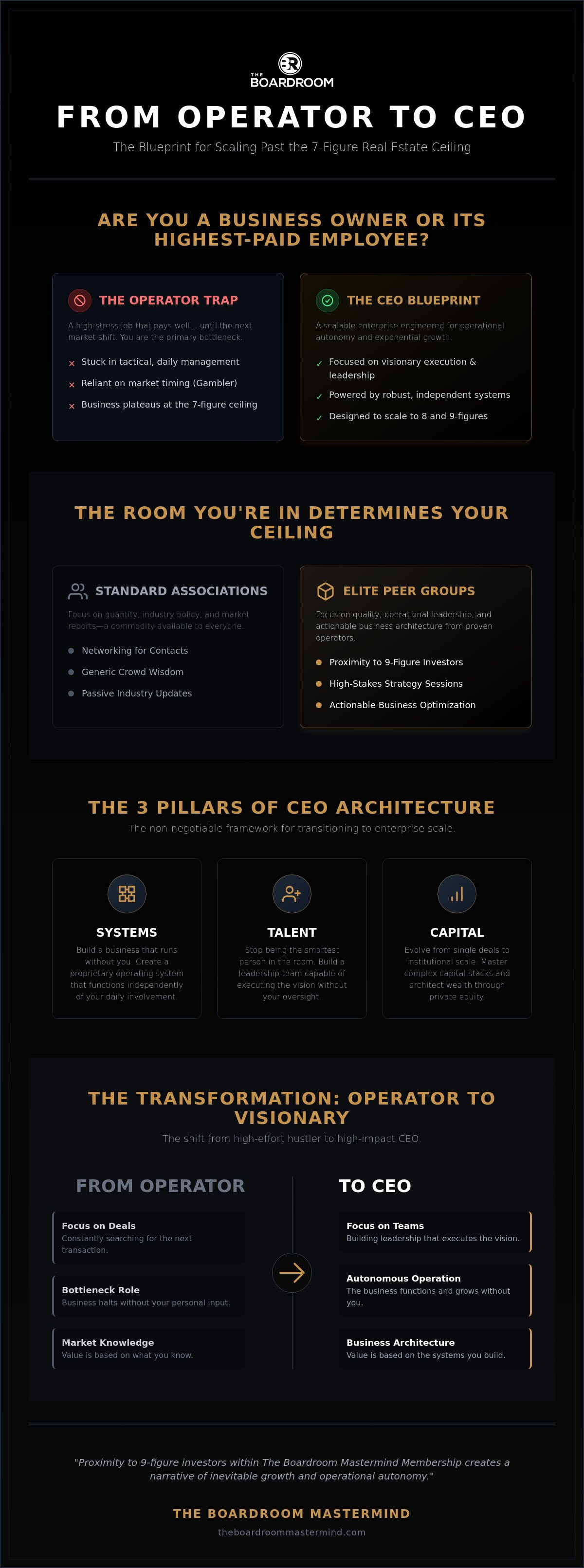
Most real estate investors aren't actually building a business. They're simply buying themselves a high-stress job that pays well until the next market shift. You've likely hit the seven-figure ceiling and realized that joining a high-level real estate ceo peer group is the only way to break through. It's a common trap for high achievers who mistake tactical management for true leadership. If you're still the primary bottleneck for every decision, you don't have a scalable enterprise; you have a glorified self-employment contract.
You've worked too hard to remain stuck in the weeds of daily operations. This guide reveals how elite masterminds transform established operators into strategic CEOs capable of scaling to eight and nine figures. We'll explore the specific leadership systems and delegation frameworks required to dominate the 2026 market landscape. By the end of this briefing, you'll have a clear roadmap to transition from tactical oversight to visionary execution. The path to the next level is clear for those with the right access.
Key Takeaways
- Identify the critical distinction between passive industry associations and high-stakes operational leadership designed for rapid scaling.
- Execute the transition from operator to visionary by mastering the three pillars of CEO architecture: systems, talent, and capital.
- Implement a strategic audit to evaluate a real estate ceo peer group based on its ability to provide actionable business optimizations rather than generic advice.
- Discover how proximity to 9-figure investors within The Boardroom Mastermind Membership creates a narrative of inevitable growth and operational autonomy.
Defining the Real Estate CEO Peer Group: Beyond the Trade Show Floor
The traditional real estate conference is a relic. While entry-level operators chase business cards on crowded trade show floors, elite investors move in different circles. A modern real estate ceo peer group is not a networking club. It's a high-stakes strategy session for owners who have outgrown tactical management. Associations focus on industry policy and politics. Operational leadership focuses on scaling and systems. These are not the same. Elite investors avoid generic crowds for restricted-access intensives. They know that a 9-figure trajectory requires a ruthless quarterly audit, not a market report.
To better understand the strategic value these environments provide, watch this helpful video:
The Distinction Between Networking and Proximity
Networking is a game of quantity that rarely translates to the bottom line. Proximity is about the quality of the room and the shared vernacular of high-net-worth founders. When you're operating at the highest tiers of financial success, you need peers who understand the specific bottlenecks of the 7-figure ceiling. You don't need more contacts. You need access to a sophisticated Mastermind group of battle-tested visionaries who have already solved the problems you're currently facing. This level of proximity provides the mental models necessary for aggressive expansion.
The Shift from Market Knowledge to Business Architecture
Market reports have become a commodity. Anyone can download a cap rate summary or a GDP forecast. A proprietary business operating system, however, is a strategic asset that creates competitive superiority. The most effective real estate ceo peer group environments ignore external noise to focus on internal architecture. If your business relies on market timing rather than robust systems, you aren't a CEO; you're a gambler. True scaling happens when you build an unbreakable framework for talent acquisition and capital deployment that functions independently of your daily involvement.
The CEO Architecture: Core Pillars of High-Level Real Estate Leadership
The transition from a high-volume hustler to a professional CEO is the definitive outcome of a high-tier real estate ceo peer group. Most operators are trapped by their own success. They've built a machine that requires their constant presence to function. This is the "Founder's Bottleneck." If your physical involvement is required for a deal to close or a system to run, you haven't built a business; you've built a cage. Scaling to eight and nine figures requires a complete architectural overhaul of your operational role.
True leadership at this level rests on three non-negotiable pillars: Systems, Talent Acquisition, and Capital Architecture. You must stop searching for the next deal and start building a leadership team that can execute without your oversight. When you stop being the smartest person in the room, your business finally has the oxygen it needs to grow. This shift is what separates those stuck at the seven-figure ceiling from those who dominate their markets.
Graduating to Real Estate Private Equity
Single deals are for operators. Institutional-scale real estate private equity is for CEOs. A sophisticated peer environment facilitates this evolution by providing the collective intelligence needed to structure eight-figure fund management. You move from "buying houses" to "architecting wealth." This involves mastering complex capital stacks and investor relations. It's a game of precision and systems, not effort and sweat. Those who make this leap find that their impact expands while their personal workload contracts.
The Role of Radical Accountability
Calculated confidence is a requirement at the top, but it can also be a blind spot. There are numerous reasons to join a CEO peer group, but none are as vital as radical accountability. You need a room of peers who will audit your business model without bias or ego. They see the operational rot you've grown accustomed to. They challenge your assumptions. They force you to move from "hustling" for the next transaction to managing a predictable wealth architecture. If you're ready to submit your model to this level of scrutiny, you might be ready for The Boardroom Mastermind Membership.
Auditing Strategic Value: How Elite Investors Evaluate Peer Group ROI
Sophisticated investors don't join clubs. They acquire strategic assets. When you evaluate a real estate ceo peer group, your primary metric must be the quality of the business audit, not the entertainment value of the keynote speaker. Observation is for the general public. Interaction is for the elite. If you're the smartest person in the room, you're in the wrong room. You need to be surrounded by nine-figure mentors who have already conquered the operational hurdles currently slowing your growth. A true audit of your business model should be uncomfortable because that discomfort is the precursor to a breakthrough.
Quarterly consistency is the heartbeat of scaling. A one-off annual event provides a temporary spike in energy, but it lacks the sustained pressure required for systemic change. High-level organizations like the Real Estate Executive Council demonstrate how industry leaders leverage collective influence for professional growth. Your peer group should function as a recurring board of directors. This ensures your trajectory remains aligned with your long-term wealth architecture rather than drifting back into tactical management.
Calculating the Value of Strategic Alliances
One deal-flow partnership often covers the cost of membership for a decade. Beyond simple networking, you should look for the strategic benefits of a peer advisory group that include proximity to institutional-grade capital. When you share a room with investors moving tens of millions in private equity, the cost of business expansion drops. You aren't just gaining advice; you're gaining a streamlined path to capital deployment and risk mitigation.
The ROI of Time: Buying Back Your Freedom
Revenue is a vanity metric if you're still working eighty hours a week to generate it. A true real estate ceo peer group teaches you how to buy back your freedom. Success is measured by the autonomy of the CEO and the impact of the enterprise, not just the gross volume. If you aren't being shown how to remove yourself from the day-to-day operations, the group is failing its primary mission. Audit your current scaling strategy by applying for The Boardroom Mastermind Membership today.
The Boardroom Mastermind: Engineering Proximity for 9-Figure Outcomes
The Boardroom Mastermind Membership stands as the premier national destination for real estate leaders operating at the seven, eight, and nine-figure levels. This is not a general networking group. It is a restricted-access community designed for those who have already achieved substantial success but refuse to stagnate. To maintain the highest tiers of financial and operational excellence, the community rejects 95% of applicants. This selectivity ensures that every individual in the room contributes to a shared vernacular of high-level execution and wealth architecture. When you enter this environment, you aren't just joining a real estate ceo peer group; you're entering a strategic partnership with the industry’s most battle-tested visionaries. This is the definitive real estate ceo peer group for those focused on permanence and significant impact.
The Boardroom Experience is centered around quarterly intensives that serve as a ruthless audit of your current business model. These aren't passive seminars. They are high-stakes strategy sessions where your systems, talent, and capital structures are dissected and optimized by peers who understand the weight of your specific bottlenecks. To see the tangible results of this process, you can view our Member Case Studies, which document the transition from tactical operator to strategic CEO.
Quarterly Intensives: The CEO Strategic Rhythm
A multi-day intensive provides the strategic cadence required for predictable growth. The structure moves rapidly from deep-dive business auditing to collaborative problem-solving, ensuring that no operational rot remains unaddressed. Because the stakes are high, privacy and restricted access are non-negotiable. This environment allows for the level of transparency and vulnerability required to identify the true bottlenecks preventing your next level of scale. You aren't just observing a presentation; you're participating in a collective intelligence audit designed to maximize your autonomy.
The Path to 9-Figures Starts with an Application
Your current business readiness is tested before you ever step foot in the room. The application process serves as a litmus test, filtering for those who possess the ambition and operational foundation necessary for institutional-scale expansion. If you're ready to stop working in the weeds and start architecting a legacy, the next step is clear. Apply for The Boardroom Mastermind and secure your place among the elite.
Secure Your 9-Figure Trajectory in 2026
Scaling to eight figures isn't a matter of working harder; it's a matter of architecting a more sophisticated business. You've identified the operational bottlenecks. You know that tactical management is the enemy of true expansion. By mastering systems, talent acquisition, and capital architecture, you've begun the transition from operator to visionary. However, maintaining this momentum requires a room that matches your ambition. A high-tier real estate ceo peer group provides the radical accountability and strategic audits necessary to ensure your growth is both predictable and permanent.
The Boardroom Mastermind Membership offers quarterly in-person intensives across the US. We've built an exclusive community specifically for 7, 8, and 9-figure investors who prioritize execution over activity. Our impact is documented and Trustpilot verified: Read Our Reviews. If you're ready to exit the operational weeds and claim your role as a true industry leader, the path forward is restricted to those who take action.
Apply to Join the Elite: The Boardroom Mastermind. Your next milestone is the logical conclusion of the right proximity.
Frequently Asked Questions
What is the difference between a real estate conference and a CEO peer group?
A real estate conference is a passive broadcast event designed for the masses, while a real estate ceo peer group is an active, restricted-access strategy session. Conferences focus on "what" is happening in the market through generic keynote speeches. Peer groups focus on "how" to scale your specific business through rigorous audits and peer feedback. You move from being a spectator to an architect of your own operational systems. It's the difference between hearing about success and engineering it.
How do I know if I have outgrown my current real estate network?
You've outgrown your network when you're the smartest person in every room and your peers are still discussing tactical deal-finding rather than institutional scaling. If your current circle can't help you navigate 8-figure tax strategies or leadership delegation, they've become a liability to your growth. High-level visionaries require a shared vernacular of private equity and wealth architecture. When the conversation at the table no longer challenges your business model, it's time to find a new table.
Is a real estate CEO peer group worth the investment for a 7-figure founder?
Joining a real estate ceo peer group is often the only way to break the 7-figure ceiling without suffering operational burnout. For a founder stuck in daily management, the ROI isn't just in increased revenue; it's in the transition to strategic oversight. You aren't paying for a social club; you're investing in the systems that turn a high-stress job into a scalable enterprise. This proximity provides the mental models necessary to manage millions without sacrificing your lifestyle.
What specific systems should be covered in a high-level real estate mastermind?
Elite masterminds focus on three core pillars: talent acquisition, capital architecture, and automated business operating systems. You should expect deep dives into hiring executive leadership, structuring private equity funds, and implementing KPIs that track impact rather than just activity. These systems ensure the business functions independently of the founder's physical involvement. Without these frameworks, scaling remains a chaotic pursuit of more volume without more profit. You need a blueprint for permanence, not just performance.
How often should a real estate CEO attend strategic intensives?
A quarterly rhythm is the industry standard for maintaining strategic alignment and operational momentum. Strategic intensives held every ninety days allow you to audit your progress, adjust for 2026 market shifts, and reset your leadership focus before operational drift occurs. This cadence provides enough time to implement new systems while ensuring you never go too long without a high-level reality check. Consistency in these intensives is what builds the narrative of inevitable 9-figure success.


