
Real Estate CEO Challenges: Navigating the High-Stakes Path to 8 and 9 Figures
Most real estate founders are the single greatest liability in their own companies. You've likely realized that the grit required to hit seven figures is exactly what's preventing you from reaching nine. It's frustrating to feel like a glorified operator when you should be a visionary leader, especially when operational drag slows down every deal you touch. These real estate ceo challenges aren't just about the market; they're about the internal architecture of your business.
We'll show you how to break through these bottlenecks and reclaim your time. This guide provides a clear roadmap to transition from a high-level hustler to a professional CEO with the systems and talent needed for institutional scale. We'll explore the strategic shifts necessary to attract A-player executives and the predictable frameworks required to navigate a high-stakes environment where the Federal Funds Rate sits at 3.50% and precision is the only path to permanence.
Key Takeaways
- Master the psychological transition from a high-level operator to a strategic visionary to break through the seven-figure ceiling.
- Learn how to architect an executive leadership team that owns its own performance metrics, effectively removing you from daily tactical management.
- Identify and dismantle the specific real estate ceo challenges that create operational drag and prevent your portfolio from reaching institutional scale.
- Develop a roadmap for graduating from individual syndications toward sophisticated fund management and advanced wealth architecture.
- Leverage the strategic ROI of elite peer proximity to eliminate the isolation of high-level leadership and accelerate your path to nine figures.
Scaling Beyond the 'Hustler' Identity: The Identity Crisis of the Real Estate CEO
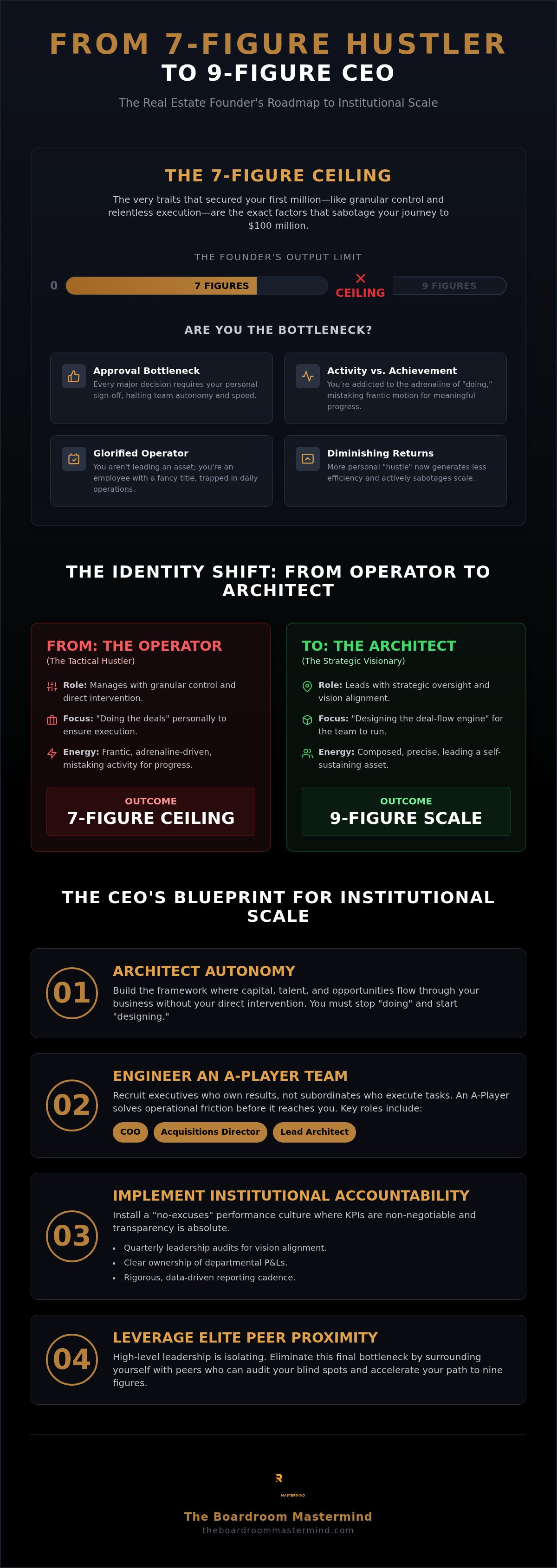
The transition from a high-performing founder to a professional CEO is the most violent shift in the lifecycle of an enterprise. In the real estate business, most leaders are addicted to the adrenaline of the deal. They mistake activity for achievement. By 2026, market dominance requires a shift from being the primary engine of growth to becoming the architect of the growth machine. If you're still relying on personal effort to scale, you've already reached your limit.
The "7-figure ceiling" is a mathematical reality where individual output no longer correlates with revenue expansion. You've reached the point where more "hustle" results in less efficiency. This is the "Hustler's Trap." The very traits that secured your first million, like granular control and relentless execution, are the exact factors that will sabotage your journey to $100 million. True real estate ceo challenges are rarely about the properties; they're about the refusal to evolve into a Business Architect who designs systems rather than executing tasks.
Are You the Bottleneck? Signs You've Outgrown Your Current Role
Operational drag is the silent killer of institutional scale, manifesting as a symptom of founder-led bottlenecks. If every major decision, from marketing spend to final signatures, requires your personal approval, you aren't a CEO; you're an employee with a fancy title. This lack of autonomy prevents your team from operating at peak capacity. To understand how to break this cycle, you must recognize the limitations of the The 7-Figure Ceiling: A CEO Guide to Exclusive Mastermind Groups and how peer auditing can expose your blind spots.
The Architecture of Autonomy
Scaling requires moving from tactical management to strategic oversight. You must stop "doing the deals" and start "designing the deal-flow engine." This involves building a framework where capital, talent, and opportunities flow through your business without your direct intervention. When you solve these real estate ceo challenges through system design, you trade the frantic energy of a hunter for the composed precision of a visionary. You're no longer managing a job; you're leading an asset.
Engineering an Unbreakable A-Player Leadership Team
Scaling to nine figures isn't a solo sport. It's an architectural feat. One of the most persistent real estate ceo challenges is the transition from hiring "help" to recruiting leaders. Most founders fail here because they look for subordinates to execute tasks rather than executives to own results. If you're still the smartest person in every meeting, you hasn't built a company; you've built a cage.
Attracting institutional-grade talent requires a shift in your value proposition. High-performers don't just look for a paycheck. They look for an environment where they can exercise autonomy and drive significant impact. You can see how this looks in practice by reviewing our Member Spotlight, where elite teams operate with surgical precision. The cost of settling for a B-Player is catastrophic. While an A-Player is defined as someone who identifies and solves operational friction before it ever reaches your desk, a B-Player creates a management tax that slows down every transaction and dilutes your culture.
The Blueprint for an 8-Figure Executive Team
Your leadership structure must be designed for scale, not just current capacity. A robust 8-figure team typically requires a COO to manage internal systems, an Acquisitions Director to fuel the pipeline, and a Lead Architect to oversee project viability. Staying ahead of significant trends in commercial real estate is vital for these roles as they navigate market volatility. For a deeper dive into these specific positions, refer to our guide on Building a Leadership Team: The CEO’s Blueprint for 8-Figure Scale.
Accountability as a Core Operating System
Institutional growth demands institutional accountability. You must implement a performance culture that mirrors top-tier private equity firms, where KPIs are non-negotiable and transparency is absolute. This involves:
- Quarterly leadership audits to ensure vision alignment.
- Clear ownership of departmental P&Ls.
- A "no-excuses" reporting cadence that highlights bottlenecks early.
Navigating Sophisticated Capital and Portfolio Complexity
Graduating from deal-by-deal syndications to institutional fund management is a threshold most founders never cross. It requires a fundamental redesign of your financial architecture. While syndication relies on the strength of a single asset, a fund requires the strength of a predictable system. This transition represents one of the most significant real estate ceo challenges, as it demands a level of transparency and reporting that many mid-market firms aren't prepared to deliver. Without this evolution, you remain trapped in a high-velocity cycle of constant fundraising rather than deploying capital with institutional efficiency.
Managing a high-velocity portfolio in the 2026 economic landscape requires a sober assessment of risk. With the Bank Prime Loan Rate at 6.75%, the margin for error has evaporated. Unoptimized systems often result in a "Complexity Tax," which can drain 15-20% of net profits through operational friction and missed opportunities. To mitigate this, leaders must stay aligned with the Top Ten Issues Affecting Real Estate to anticipate capital shifts before they impact the bottom line. For those ready to build a more resilient structure, our Real Estate Private Equity: The Architect’s Guide to Institutional Scale provides the blueprint for this financial transformation.
Structuring the 8-Figure Capital Stack
The move from private money to family office and institutional capital changes the rules of engagement. You're no longer just selling a return; you're selling a partnership with a sophisticated entity that values governance as much as yield. The primary challenge here is maintaining strategic control while accepting the oversight that comes with outside investment. It requires a sophisticated legal and financial framework that protects your vision while providing the liquidity needed for aggressive expansion.
Implementing a Business Operating System for Scale
Chaos is the natural state of an un-systemized 7-figure business, and it only amplifies as you add more zeros to your AUM. Your enterprise needs a "central nervous system" to handle the increasing complexity of multi-market operations and diverse asset classes. This operating system ensures that data flows vertically and horizontally without your constant intervention. You can witness how these systems are architected by exploring The Boardroom Mastermind Experience. If you're ready to stop managing fires and start leading an empire, apply to join our elite network of 8 and 9-figure founders today.
The Architecture of Elite Growth: Why Isolation is the Final Bottleneck
Isolation is the silent tax on high-level growth. You've likely heard the phrase "it's lonely at the top," but this is a myth used to justify stagnant performance. In reality, isolation is a strategic failure. Operating in a vacuum means you're relying entirely on your own perspective to solve complex real estate ceo challenges. Without an external, unbiased audit of your business model, you're blind to the structural cracks that inevitably appear as you scale toward nine figures. You don't need more information; you need a higher level of perspective.
Proximity is your most valuable asset. Sitting in a room with individuals who have already conquered the milestones you're currently facing provides an immediate ROI that no software or consultant can match. It's about access to a shared vernacular of success. High-level peer advisory is the only way to pressure-test your assumptions before they become expensive mistakes. This environment serves as the ultimate shortcut, allowing you to achieve peak performance and institutional scale without sacrificing your personal well-being or lifestyle.
The Power of the Quarterly Intensive
Local markets often become echo chambers. If you're the biggest player in your city, no one there can actually challenge your strategy or expose your blind spots. Our quarterly in-person intensives at The Boardroom Mastermind break this cycle. These meetings provide a high-pressure environment for peer auditing, where battle-tested visionaries dissect your operations and demand excellence. It's where the transition from tactical management to strategic oversight is finalized through collective intelligence.
Rejecting the 95%: Why Exclusivity Matters
Generic networking groups are a drain on your time. You don't need a community of "strivers," you need a council of peers who understand the weight of 8 and 9-figure decisions. There's a fundamental difference between a social club and an elite mastermind focused on wealth architecture. Exclusivity drives the accountability required for massive impact. By surrounding yourself only with those operating at the highest tiers, your attainment of the next milestone becomes a logical inevitability. If you're ready to solve the final real estate ceo challenges and join an elite cadre of high achievers, you can apply for The Boardroom Mastermind to begin your transition.
Architecting the Nine-Figure Future
Institutional scale isn't an accident of effort; it's a result of deliberate design. You've seen that breaking the seven-figure ceiling requires abandoning the operator identity and installing a leadership team that owns its own performance. Solving the most persistent real estate ceo challenges means moving from tactical deal-making to strategic portfolio architecture. It requires the courage to audit your systems and the humility to seek proximity to those who have already scaled the mountain.
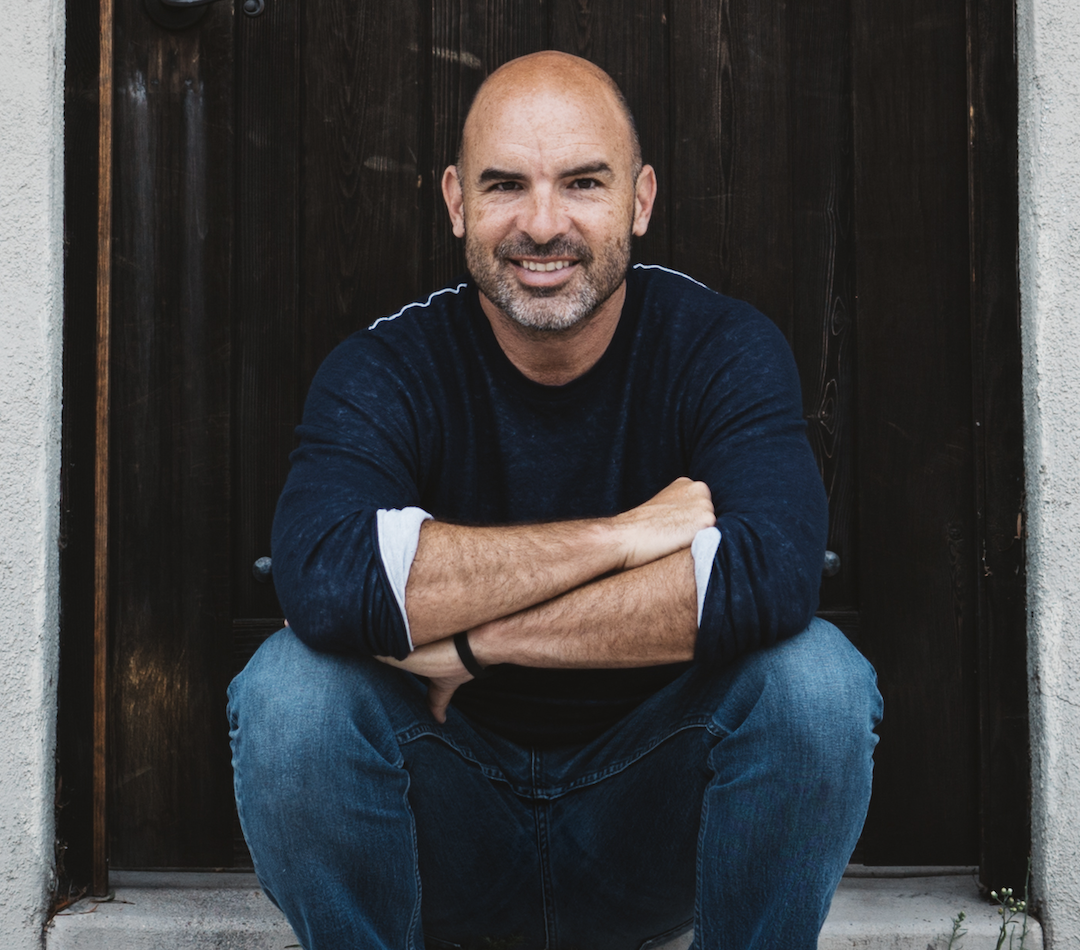
Isolation is the final bottleneck you must dismantle. The Boardroom Mastermind provides the restricted access and elite peer network necessary to pressure-test your vision. Led by Kent Clothier, this community offers quarterly in-person business audits that strip away the noise and focus on high-impact execution. You don't have to navigate the transition to nine figures in a vacuum. The roadmap is clear for those with the right access. It's time to step into the role your business requires.
Apply to Join The Boardroom Mastermind and secure your seat among the industry’s top-tier visionaries. Your empire is ready for its CEO.
Frequently Asked Questions
What are the most common challenges for real estate CEOs in 2026?
The primary real estate ceo challenges in 2026 center on navigating a 6.75% Bank Prime Loan Rate while transitioning from a tactical founder to a strategic architect. CEOs must manage increased regulatory scrutiny while simultaneously building the internal systems required for institutional scale. Success now requires a focus on capital efficiency and executive leadership over mere transaction volume. It's about moving from deal-making to empire-building.
How do I know if I have hit the '7-figure ceiling' in my investment firm?
You've hit the 7-figure ceiling when your personal involvement in every transaction is the only thing keeping the business moving. If deal execution slows the moment you step away, or if revenue has plateaued despite your increased work, you've reached the limit of your current identity. This ceiling is characterized by operational drag and a lack of A-player leadership capable of owning high-level KPIs without your constant oversight.
What is the difference between a real estate coach and a mastermind group?
A real estate coach typically provides individual instruction, whereas a mastermind group is an elite council of peers operating at your financial tier. While coaching focuses on tactical skills, a mastermind provides the strategic architecture and peer auditing necessary for 8 and 9-figure growth. It's the difference between being taught how to work and being challenged on how you lead. High-stakes growth requires peer proximity.
How can a real estate CEO effectively delegate without losing control of deal quality?
Navigating common real estate ceo challenges like delegation requires a deal-flow engine built on rigid, documented systems rather than your personal intuition. By hiring A-player executives who solve problems before they reach your desk, you maintain quality through high-stakes accountability. This shift allows you to focus on strategic oversight while your team executes the tactical requirements. You don't lose control; you gain a more predictable outcome.
Why is peer accountability more effective than self-discipline for high-achievers?
High achievers are masters at justifying their own shortcomings to themselves, but they can't out-negotiate a room of peers who have already achieved 9-figure success. Peer accountability works because it provides an unbiased audit of your business model that self-discipline alone can't offer. Proximity to other elite founders creates a competitive environment where performance is the only currency. This makes your professional evolution a logical inevitability.
Disclaimer
Mr. Clothier is an expert in real estate investing. As such his experiences are not necessarily typical to the standard real estate investor and whose results may vary. The successes shared on this site are not considered typical. Most individuals who order the educational materials and systems probably do not follow any of the techniques or strategies and consequently make little to no money due to their inaction. The company is in the process of determining the typical success of its clients. Stories shared herein are for example purpose only and should not be construed as "guarantees" of success. Results will vary based on background, education, and experience and actions taken.
This site is not a part of the Google/Facebook website or Google/Facebook Inc. Additionally, this site is NOT endorsed by or affiliated with Google/Facebook in any way. GOOGLE/FACEBOOK is a trademark of GOOGLE/FACEBOOK, Inc.
INCOME DISCLAIMER: This website and the items it distributes contain business strategies, marketing methods and other business advice that, regardless of referenced results and experience, may not produce the same results (or any results) for you. The Boardroom Mastermind makes absolutely no guarantee, expressed or implied, that by following the advice or content available from this web site you will make any money or improve current profits, as there are several factors and variables that come into play regarding any given business. Primarily, results will depend on the nature of the product or business model, the conditions of the marketplace, the experience of the individual, and situations and elements that are beyond your control. As with any business endeavor, you assume all risk related to investment and money based on your own discretion and at your own potential expense.
LIABILITY DISCLAIMER: By reading this website or the documents it offers, you assume all risks associated with using the advice given, with a full understanding that you, solely, are responsible for anything that may occur as a result of putting this information into action in any way, and regardless of your interpretation of the advice. You further agree that The Boardroom Mastermind, its affiliates, subsidiaries, officers and agents, cannot be held responsible in any way for the success or failure of your business as a result of the information provided. It is your responsibility to conduct your own due diligence regarding the safe and successful operation of your business. In summary, you understand that we make absolutely no guarantees regarding income as a result of applying this information, as well as the fact that you are solely responsible for the results of any action taken on your part as a result of any given information. In addition, you agree that our content is to be considered "for entertainment purposes only". Always seek the advice of a professional when making legal, financial, tax, or business decisions.
BUSINESS OPPORTUNITY: All products and services offered by The Boardroom Mastermind are intended to provide prospective purchasers with general business strategies, marketing methods and other general advice for business development and training. At no point is The Boardroom Mastermind soliciting anyone to enter into a new business nor is it representing, either expressly or by implication, that it will provide locations for a business, provide outlets, accounts, or customers, or purchase any of the goods or services made by the purchaser.
The products being offered through this promotion are packages of informational tools to help you learn about business and deal making strategies.


