
Peer Advisory Groups for Real Estate Investors: Scaling to 8 and 9 Figures
Most real estate investors hit a ceiling not because they lack capital, but because they lack the right room. You've conquered your local market, yet you're still the smartest person at every table you sit at. It's a dangerous place to be. You've likely realized the relentless hustle that built your first seven figures is now the primary obstacle to your next nine. This is why elite peer advisory groups for real estate investors have become the essential infrastructure for those moving beyond the operator phase. You're trapped in the gears of your own machine, acting as a manager when you should be architecting a legacy.
It's isolating when your peers can't fathom the complexity of your current scale. We understand that at this level, you don't need entry-level tips; you need a high-level board of directors. This article reveals how the right proximity provides the strategic architecture required to transition from a tactical operator to a 9-figure CEO. We'll examine the specific frameworks that shift your focus from daily management to strategic oversight, ensuring your growth is both predictable and permanent. It's time to stop chasing deals and start engineering an enterprise.
Key Takeaways
- Break the 7-figure ceiling by identifying the specific point where individual hustle becomes your company's primary growth inhibitor.
- Discover how high-level peer advisory groups for real estate investors provide a private cabinet of peers to audit your business systems.
- Shift your focus from tactical deal-chasing to strategic architecture by leveraging collective intelligence that identifies blind spots before they become costly.
- Learn why quarterly in-person intensives are essential for the deep-dive strategy sessions required to scale toward a 9-figure legacy.
- Use a definitive 5-point checklist to ensure any potential board matches your revenue floor and shares your commitment to elite execution.
The 7-Figure Ceiling: Why Elite Real Estate Investors Outgrow Their Networks
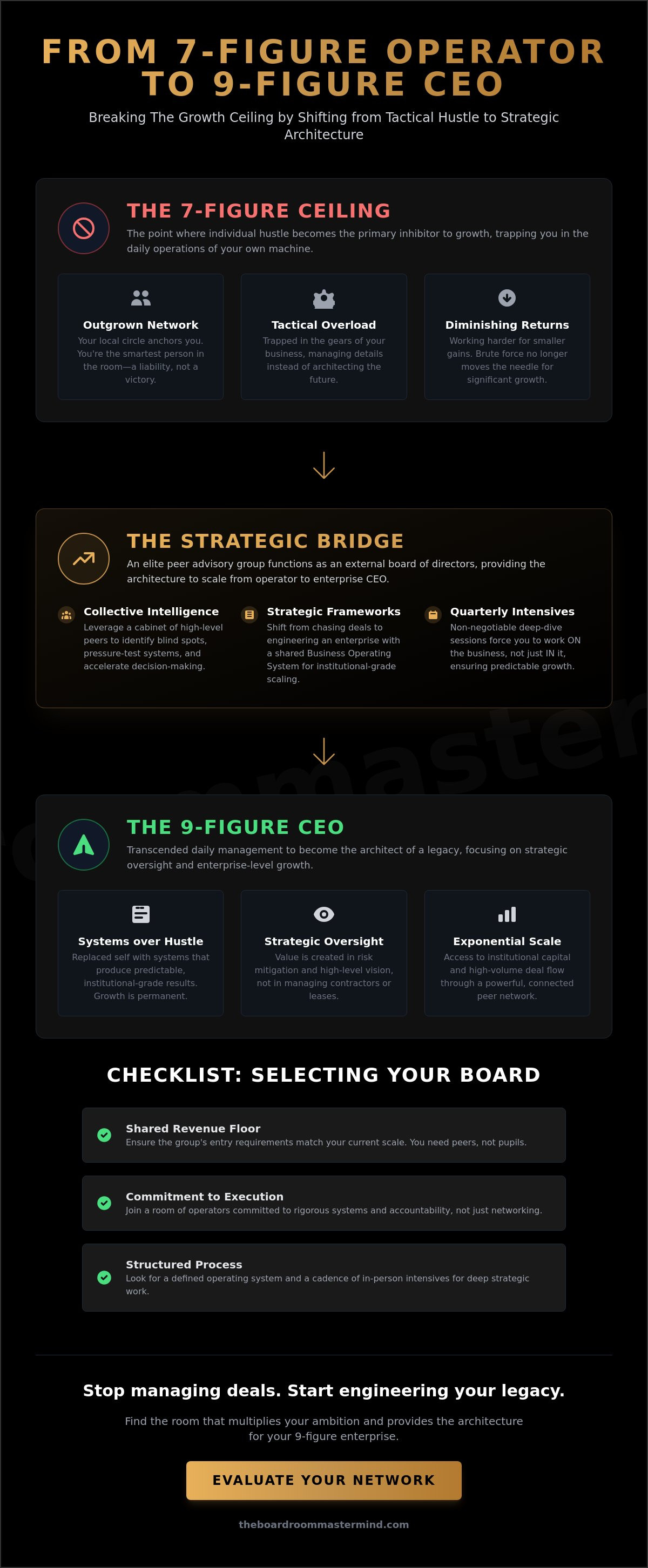
Most real estate investors reach a point where the brute force of their own will no longer moves the needle. You've mastered the acquisition. You've stabilized the portfolio. But now, you're working harder for diminishing returns. The 7-figure ceiling is the point where systems, not activity, dictate growth. To cross it, you must stop being the engine and start being the architect of your enterprise.
Your current circle likely consists of local agents, contractors, and mid-tier investors. While they were instrumental in your early success, they often become your primary growth inhibitor as you scale. They lack the vernacular of institutional capital and the foresight of high-level operations. If your network doesn't challenge your strategic framework, it's anchoring you to your current revenue floor. This is why specialized peer advisory groups for real estate investors are critical for the transition to 8 and 9 figures. These structures function as a high-stakes Mastermind group, providing the external board of directors you need to audit your expansion.
The Isolation of the High-Achieving Founder
Scaling creates a unique vacuum. As your deal size grows and your team expands, the pool of people who understand your operational bottlenecks shrinks. You've outpaced your local peers. Sitting at a table where you're the most successful person is a liability, not an achievement. It's lonely at the top because your problems have become more sophisticated. Transitioning requires a shift in proximity. You need a room where your "big" ideas are considered baseline requirements. To understand this shift, read The 7-Figure Ceiling: A CEO Guide to Exclusive Mastermind Groups which illustrates the necessity of elite proximity.
From Tactical Management to Strategic Oversight
The "hustler" mindset is a prerequisite for entry, but it's a poison for scale. At the 8-figure level, your value isn't found in managing contractors or reviewing individual leases. It's found in strategic oversight and risk mitigation. You're moving from a real estate operator to a professional CEO. This shift requires a board-level perspective on your internal operations. Without it, you're just a high-paid employee in a business you happen to own. True scale demands that you replace yourself with systems that produce predictable, institutional-grade results. Elite peer advisory groups for real estate investors provide the blueprint for this transformation, ensuring your growth is both permanent and profitable.
The Anatomy of a High-Stakes Peer Advisory Group for Real Estate
An elite mastermind isn't a social club; it's a professional cabinet of peers. At the 8 and 9-figure level, you don't need "tips" or general motivation. You need a rigorous pressure test of your current infrastructure. The most effective peer advisory groups for real estate investors function as an external board of directors, providing a level of scrutiny that internal teams often cannot. This environment utilizes a shared Business Operating System, creating a common vernacular for efficiency, wealth architecture, and institutional-grade scaling. When every member speaks the language of systems and equity, the speed of decision-making accelerates exponentially.
Proximity is your greatest strategic multiplier. When you align with individuals operating at ten times your current volume, the tactical hurdles that once felt insurmountable become simple math. This high-level proximity doesn't just improve your mindset; it directly impacts your deal flow and capital access. It's about moving from a siloed operator to a connected CEO who leverages collective intelligence to Drive Performance And ROI. If you're looking to bridge the gap between your current portfolio and your ultimate legacy, you should evaluate your current strategic network.
Quarterly Intensives: The Rhythm of Strategic Growth
High-stakes growth requires a consistent cadence of evaluation. Quarterly in-person intensives are non-negotiable because they force a total withdrawal from daily operations to focus on the enterprise itself. These sessions involve deep-dive business audits where peers identify your specific operational bottlenecks. You leave with a clear, 90-day execution roadmap rather than a list of vague ideas. Discover the Boardroom Experience to see how this structured rhythm transforms stagnant portfolios into scalable machines.
Vetted Eligibility: Why the "Room" Matters Most
High entry barriers are a feature, not a bug. Elite peer advisory groups for real estate investors maintain a strict revenue floor to protect the quality of collaboration. For example, a 95% rejection rate ensures the room remains unsullied by those still learning the basics. In 2024, The Boardroom Mastermind received over 2,200 applications but accepted only 97 new members. This selectivity ensures that every person at the table is a contributor, not just a consumer, of high-level strategy.
Beyond Networking: The ROI of Collective Intelligence and Business Auditing
The return on investment for elite peer advisory groups for real estate investors isn't found in a spreadsheet of "tips." It's found in the structural integrity of your wealth architecture. While entry-level groups focus on acquisition tactics, high-level masterminds focus on strategic architecture. This distinction is what separates the operator who owns a job from the CEO who owns an institution. By moving beyond simple deal-chasing, you gain the clarity required to transition into Real Estate Private Equity and institutional scale. Read our member case studies to see how this shift in perspective produces quantifiable 8 and 9-figure results.
True ROI is often measured by the million-dollar mistakes you avoid. Research in the Harvard Business Review suggests that Peer Support Groups provide the necessary friction to challenge cognitive biases and prevent strategic drift. In this room, your business isn't just discussed; it's audited. You don't need another friend. You need a peer who will tell you your hiring process is broken before it costs you a seven-figure turnover. If you're ready for a rigorous audit of your expansion plans, apply to join our next intensive.
The External Board of Directors
Your internal leadership team is often too close to the operational noise to provide an objective critique. Peers operating at your level or higher provide the "unbiased audit" that internal staff cannot give. This external board serves as a vetting mechanism for your most critical decisions, from capital allocation to executive recruitment. Refer to Building a Leadership Team: The CEO’s Blueprint to understand how high-level peer feedback ensures you hire for where you're going, not where you've been.
Engineering Strategic Alliances
Transactional relationships are temporary. Strategic alliances are permanent. Within these elite circles, the proximity to other 8 and 9-figure leaders facilitates joint ventures and capital sharing that would be impossible in the general marketplace. You aren't just networking. You're engineering 9-figure deal structures with partners who have already been vetted by the room. This collective intelligence accelerates your systems, allowing you to scale with the speed of a veteran firm while maintaining the agility of a private owner.
Selecting Your Board: Criteria for Joining an Elite Real Estate Mastermind
Choosing a seat at a table is the most significant investment you'll make in your second decade of growth. As you transition from operator to CEO, your room must match your ambition. Not all peer advisory groups for real estate investors are created equal. Many are simply social clubs disguised as strategic assets. To ensure you're entering a space of elite execution, evaluate potential groups against this 5-point architectural checklist:
- Revenue Floor: Are the other members operating at or above your current scale? Proximity to those trailing behind you is a cost, not a benefit.
- Facilitation: Is the group led by a battle-tested visionary who has actually scaled to 9 figures? Leadership matters. Ensure the room is directed by an executive like Kent Clothier who understands the mechanics of institutional scale.
- Accountability: Does the group require a rigorous business audit, or is it just a lecture series? True growth requires the friction of a peer-reviewed roadmap.
- Culture: Is there a focus on the harmony between business expansion and personal impact? Scaling a business at the expense of your life is a failure of design.
- Systems-First Vernacular: Does the group prioritize strategic architecture over tactical "hustle"? You need a room that speaks the language of systems.
Identifying "Fake" Masterminds
Distinguishing between high-stakes proximity and low-barrier networking is vital. Warning signs of a "fake" mastermind include a lack of vetting, a focus on generic motivation rather than operational mechanics, and a high-volume entry model. These groups often operate on frantic energy, which is a desperate search for the next deal. Elite peer advisory groups for real estate investors operate on calculated confidence. They prioritize privacy, selectivity, and the long-term permanence of your wealth architecture. If the room is open to anyone with a credit card, you're in the wrong room.
The Application as a Litmus Test
A rigorous application process isn't a hurdle; it's a security measure. It ensures that every member at the table is a high-level contributor who brings institutional-grade experience to the audit. When a group is as selective about its members as you are about your limited partners, the resulting synergy is explosive. This is the only way to maintain the integrity of an 8 and 9-figure network. If you're ready to submit your business to the scrutiny of the industry's elite, apply for The Boardroom Mastermind and secure your seat among peers.
Architecting Your 9-Figure Legacy
Scaling beyond the seven-figure ceiling isn't a matter of working harder; it's a matter of working differently. You've seen how elite peer advisory groups for real estate investors provide the strategic architecture and collective intelligence required to move from tactical operations to institutional oversight. By auditing your business through a cabinet of high-performing peers, you eliminate the blind spots that stall growth and replace them with systems designed for permanence. The shift from real estate operator to CEO is the final hurdle in your journey toward a massive financial footprint.
Success at this level is a choice of proximity. Led by battle-tested visionary Kent Clothier, The Boardroom Mastermind maintains an elite 95% rejection rate to ensure every member contributes to a culture of 8 and 9-figure excellence. If you're ready to submit your expansion plans to the most rigorous audit in the industry, it's time to apply to join the most elite room in real estate. Your next level of scale isn't just a goal. It's the logical conclusion of the right access and the right strategy. We look forward to seeing you at the top.
Frequently Asked Questions
What is the difference between real estate coaching and a peer advisory group?
Real estate coaching typically follows a top-down, instructional model focused on skill acquisition for operators. In contrast, peer advisory groups for real estate investors offer a horizontal structure where established CEOs audit each other's business architecture. While a coach provides a map, a peer advisory board provides a rigorous pressure test. You're moving from learning how to close a deal to learning how to lead a multi-million dollar enterprise.
How much revenue do I need to be eligible for an elite real estate mastermind?
Elite masterminds generally require a minimum revenue floor to ensure the room remains focused on institutional-level challenges. While specific requirements vary by organization, most high-stakes groups look for investors already operating at a seven-figure annual revenue level or higher. This vetting process is essential. It guarantees that every participant brings sophisticated systems to the table, preventing the dilution of strategic discussions with entry-level inquiries.
Are peer advisory groups for real estate investors remote or in-person?
High-level groups utilize a hybrid model that balances digital access with deep-dive physical proximity. While digital portals allow for continuous data sharing, the core of the experience resides in quarterly in-person intensives. These multi-day sessions are non-negotiable for investors seeking 9-figure scale. Physical proximity fosters a level of trust and strategic auditing that remote calls cannot replicate, providing the focused environment required for a total business overhaul.
How does a peer advisory group help with scaling to 8 figures?
A peer group facilitates 8-figure growth by shifting your focus from deal-chasing to systems engineering. By leveraging collective intelligence, you identify the operational bottlenecks that your internal team might overlook. These groups provide a shared Business Operating System that standardizes growth. You gain access to vetted vendor networks and capital partners, allowing you to scale with the speed of an established firm while maintaining your private ownership structure.
What is the typical time commitment for a high-level real estate mastermind?
The time commitment for a high-level mastermind is structured as a strategic withdrawal from daily operations rather than an addition to your to-do list. Expect to dedicate approximately 12 to 15 days per year to in-person intensives and strategic audits. This is not time away from your business; it's time spent working on the enterprise itself. Between sessions, digital portal access requires minimal weekly engagement to maintain momentum and track key performance indicators.


