
Organizational Structure for Real Estate Investment Company: The 8-Figure Blueprint
If you are still the primary engine behind every deal in your portfolio, you don't own a business; you own a high-stress job that happens to involve deeds and titles. Scaling to an institutional level requires more than just grit. It demands a sophisticated organizational structure for real estate investment company growth that prioritizes systems over superstars. You likely feel the weight of being the ultimate bottleneck, where every decision from capital raises to property acquisitions requires your personal sign-off. This state of constant involvement is the single greatest barrier to your next $10 million in assets under management.
We understand that the transition from a high-stakes operator to a true CEO is the hardest leap a founder will make. It's the difference between a frantic hustle and a legacy firm. This article provides the 8-figure blueprint you need to architect a firm that runs on precision rather than personality. You will learn how to build clear reporting lines that eliminate operational chaos and attract the high-level executive talent necessary for rapid expansion. We are diving into a roadmap for department-level organization that secures your time and ensures your growth is both predictable and permanent.
Key Takeaways
- Dismantle the "Founder Trap" by identifying the hub-and-spoke bottlenecks that prevent your firm from scaling past the seven-figure ceiling.
- Implement the three pillars of institutional scale to ensure your acquisitions engine and asset management systems operate with autonomous precision.
- Architect an organizational structure for real estate investment company success by integrating a high-level COO who translates your vision into repeatable growth.
- Conduct a strategic architectural audit to identify profit leaks and transition your team from a group of contractors to a unified executive layer.
- Master the hiring sequence for A-players, allowing you to move from a high-stakes operator to a strategic CEO focused on long-term wealth architecture.
The Founder Trap: Why Your Current Structure Fails at 7 Figures
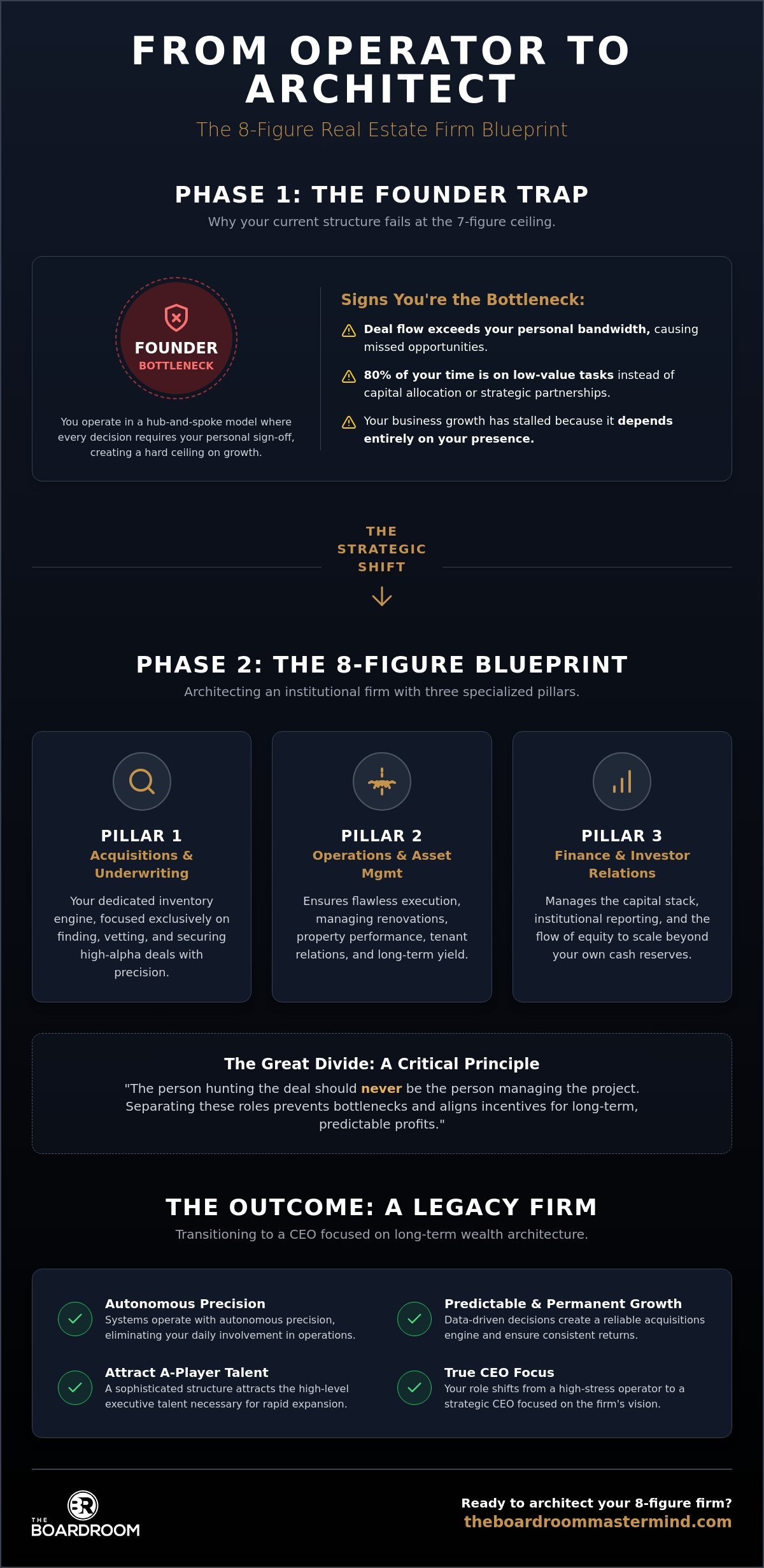
Most real estate entrepreneurs reach a point where their ambition outpaces their infrastructure. This is the "Founder Trap." You operate in a hub-and-spoke model where every decision, from a minor repair to a multi-million dollar acquisition, requires your personal sign-off. While this level of control feels safe, it creates a hard ceiling on your growth. An effective organizational structure for real estate investment company scaling requires you to stop being the engine and start being the pilot.
To better understand how elite investors partition their assets and operations for maximum efficiency, watch this helpful video:
The seven-figure ceiling is a byproduct of manual oversight. When you are the primary operator, your business is limited by your 24 hours. Compare this to an institutional Real Estate Investment Trust (REIT). These entities manage billions because they rely on systems, not individuals. Your shift from operator to architect means your new job is building the machine, not running it. Many founders argue that "nobody can do it as well as I can." This isn't a testament to your talent; it's an indictment of your system design. If your results depend on your presence, you haven't built a scalable organizational structure for real estate investment company success yet.
Signs You Have Outgrown Your Current Role
The "bottleneck effect" occurs when your deal flow and operational demands consistently exceed your personal bandwidth, causing profitable opportunities to wither. You must master the operator to CEO mindset shift to move from daily fires to long-term wealth architecture. This requires identifying the low-value activities, like chasing contractors or basic data entry, that currently occupy 80% of your calendar. If an activity doesn't involve high-level capital allocation or strategic partnerships, it's a drain on your firm's potential.
The 8-Figure Blueprint: Three Pillars of Institutional Scale
While many investors focus solely on the legal "wrapper" of an LLC, the true secret of high-growth firms lies in their operational architecture. To build a firm that manages hundreds of millions in assets, you must divide your company into three distinct, specialized pillars. This specialized organizational structure for real estate investment company growth creates a business that is resilient, scalable, and attractive to institutional partners. These departments function as independent gears in a larger machine, allowing the founder to step back from daily mechanics.
- Pillar 1: Acquisitions & Underwriting — This is your inventory engine, focused exclusively on finding, vetting, and securing high-alpha deals.
- Pillar 2: Operations & Asset Management — This pillar ensures execution, managing renovations, property performance, and tenant relations.
- Pillar 3: Finance & Investor Relations — This department manages the capital stack, institutional reporting, and the flow of equity.
Acquisitions vs. Asset Management: The Great Divide
The person hunting the deal should never be the person managing the project. Their incentives often clash. An acquisitions specialist is focused on the close, while an asset manager is focused on the long-term yield and operational efficiency. If you don't separate these roles, your "Deal Desk" becomes a bottleneck rather than a filter. By creating this divide, you can systemize deal flow to ensure Predictable Profits through data-driven decisions rather than emotional gut feelings.
The Finance Pillar: Scaling Beyond Your Own Cash
True scale requires access to institutional capital. This necessitates a robust Finance pillar that integrates Investor Relations directly into your core organizational chart. You must distinguish between a "Capital Raiser," who secures the funds, and a "Transaction Coordinator," who manages the complex flow of closing documents. This level of sophistication is mirrored in the academic analysis of REIT structures, where capital management is treated as a core competency. If you want to move toward Institutional Scale, your structure must facilitate the high-level reporting that high-net-worth partners demand.
Building the Executive Layer: Hiring A-Players for Your Empire
Building a scalable organizational structure for real estate investment company operations requires moving beyond a team of helpers and toward a board of executives. You need leaders who don't just follow instructions; they must own their respective domains. The Chief Operating Officer (COO) is your Integrator. While you focus on the horizon, the COO focuses on the machine, turning your vision into a repeatable, scalable reality. This role is the bridge between your ambition and your firm's actual performance.
Your Acquisitions Director must evolve from a simple lead generator into a portfolio strategist. They shouldn't just find houses. They should evaluate market cycles, risk-adjusted returns, and strategic inventory alignment. Similarly, an 8-figure firm requires a CFO, not just a bookkeeper. You need someone capable of managing complex capital stacks and institutional debt structures. To attract this level of talent, your compensation models must shift. High-level executives aren't looking for flat commissions. They want equity-aligned incentives that reward long-term value creation and firm-wide growth.
The CEO’s Blueprint for 8-Figure Scale
Identifying A-players requires looking for individuals who have already operated at the scale you intend to reach. It's about recruiting for where you're going, not where you are. You must establish a high-performance culture that thrives on radical accountability and clear KPIs. For a deeper dive into this process, read our guide on building a leadership team to ensure your foundation is unbreakable.
The Board of Advisors: Your External Org Chart
Elite founders understand that their internal team is only half the battle. You need a shadow cabinet of peers who have already conquered the bottlenecks you're currently facing. Proximity to other 8-figure earners accelerates your structural maturity through shared intelligence. A high-level mastermind provides the strategic planning necessary to audit your business model and identify blind spots before they become liabilities. If you're ready to stop being the bottleneck and start being the architect of your empire, apply to join The Boardroom Mastermind Membership today.
Auditing Your Architecture: Engineering Growth Through Elite Proximity
Designing an organizational structure for real estate investment company success is not a set-it-and-forget-it task. It is a living blueprint that requires constant refinement. An Annual Business Audit is the only way to expose where your current structure is leaking profit through operational friction or redundant roles. If your overhead is climbing but your deal velocity is stagnant, your architecture is broken. You must identify the cracks in your reporting lines before they become institutional failures.
Many founders mistake a collection of independent contractors for a high-performance team. This is a fatal error. Contractors prioritize their own bottom line; employees and equity-aligned leaders prioritize your firm's mission. Transitioning to a true Business Operating System allows you to step away from the daily grind and trust the machine to perform. This is how you move from a frantic hustler to a strategic CEO who owns an asset, not a job.
From Hustle to High-Level Execution
Moving from "doing everything" to "owning everything" is a psychological hurdle as much as a structural one. It requires the discipline to step back and view your company from a 30,000-foot perspective. Quarterly intensives serve as the ultimate reset, allowing you to recalibrate your organizational structure for real estate investment company growth. You can see how other elite members have successfully navigated this transition in our Member Spotlight section, where 8-figure success is the standard, not the exception.
Your Next Strategic Move
The right network is the ultimate shortcut to organizational excellence. You don't have time to learn every structural lesson through trial and error. By surrounding yourself with peers who have already architected 8 and 9-figure empires, you gain access to the battle-tested frameworks that work in today's market. If you're ready to stop guessing and start scaling with precision, apply to join the elite peer group at The Boardroom Mastermind. Your next level of growth is waiting on the other side of your next strategic decision.
Architect Your 8-Figure Empire
Transitioning from a high-stakes operator to a strategic CEO is a deliberate act of business engineering. You understand that the "Founder Trap" is a choice, not an inevitability. By implementing the three pillars of institutional scale and building a robust executive layer, you move from managing daily fires to overseeing a legacy firm. A sophisticated organizational structure for real estate investment company growth is the only vehicle capable of carrying you to 8 and 9-figure success.
True scale requires more than just information; it demands elite proximity. Through quarterly in-person business audits and strategic intensives, you can refine your systems alongside a peer group of 7, 8, and 9-figure real estate investors. Access to our "Architecture of Scale" framework provides the ultimate shortcut to operational excellence and personal freedom. You don't have to solve these structural puzzles in isolation when the blueprint already exists.
Apply to Join The Boardroom Mastermind and Scale Your Empire. The machine you build today determines the impact you make tomorrow. It's time to step into your true role as the visionary architect of your firm.
Frequently Asked Questions
What is the best legal structure for a real estate investment company?
The Limited Liability Company (LLC) is the most effective legal foundation for most investors because it offers pass-through taxation and robust personal liability protection. For those scaling toward an 8-figure portfolio, a two-company structure is often superior. This involves an operating company that handles all management activities and a separate holding company, such as a series LLC, to own the actual real estate assets. This separation ensures that operational risks don't jeopardize your entire asset base.
When should I hire my first COO in a real estate business?
You should recruit a Chief Operating Officer when your personal involvement in daily logistics becomes the primary bottleneck for firm growth. This typically happens as you approach the seven-figure ceiling and find that 80% of your time is spent on tactical management rather than strategic capital allocation. A COO acts as the integrator who builds the systems necessary for your organizational structure for real estate investment company success to function without your constant oversight.
How do I compensate an Acquisitions Director to keep them long-term?
Retaining elite acquisitions talent requires a shift from transactional commissions to equity-aligned incentives. High-level directors are looking for a competitive base salary coupled with a performance bonus tied to deal quality and a "carried interest" or profit-sharing stake in the assets they secure. This structure transforms them from a lead generator into a long-term partner who is financially invested in the permanent performance of your portfolio.
What is the difference between a real estate team and an investment company structure?
A real estate team is usually a group of independent contractors sharing leads; an organizational structure for real estate investment company growth is a unified firm with specialized, interdependent departments. In an investment company, underwriting, asset management, and finance are distinct roles with clear reporting lines. This institutional approach prioritizes firm-wide systems and predictable growth over the erratic performance of individual "superstars" or solo operators.
How do I structure my company to attract institutional capital?
Attracting institutional partners requires a structure that emphasizes transparency, rigorous asset management, and professional reporting standards. You must move away from informal bookkeeping toward institutional-grade accounting that can withstand the scrutiny of private equity due diligence. Establishing a clear finance pillar that manages the capital stack independently of operations demonstrates to high-net-worth partners that your firm is capable of managing significant capital with professional precision.


