
Operations Manual for Real Estate Investment Company: The 8-Figure Blueprint
Why are you still the most expensive employee in your own firm? You've scaled your portfolio to impressive heights, yet you remain the primary bottleneck in every transaction. Building a robust operations manual for real estate investment company is the only way to escape this cycle of tactical management. With the 21st Century ROAD to Housing Act now federal law and new FinCEN reporting rules complicating all-cash deals as of 2026, the margin for operational error has vanished. You need a system that outpaces the market.
We understand that relinquishing control feels like a risk to the excellence you've built. However, a true business operating system isn't a collection of rules; it's the architectural blueprint for a self-managing engine. This article reveals how to transition from a frantic operator to a strategic CEO by installing systems that scale without your daily intervention. We will explore the specific frameworks required to achieve total operational autonomy and predictable deal flow, allowing you to focus on high-level wealth architecture instead of administrative friction.
Key Takeaways
- Redefine your business as a high-performance engine by replacing static policy manuals with a dynamic operating system designed for eight-figure scale.
- Implement the four critical pillars of an operations manual for real estate investment company to ensure predictable acquisitions and institutional-grade capital management.
- Utilize the "Audit and Extract" framework to remove yourself as the operational bottleneck and institutionalize your firm's unique competitive advantages.
- Transition from tactical manager to strategic CEO by adopting a system-first mindset that prioritizes long-term wealth architecture over daily fire-fighting.
Beyond the Policy Manual: The Architecture of an 8-Figure Investment Engine
Your business is not merely a collection of assets; it's a high-performance software application designed to generate yield with surgical precision. If the fundamentals of real estate investing provide the raw data, your operations manual for real estate investment company is the underlying code that processes that data into predictable profit. Most operators fail because they mistake static SOPs for true systems. These documents are often too rigid and tactical for a market that demands agility. They focus on administrative minutiae while ignoring the strategic architecture required to scale to eight figures and beyond.
The core thesis of a sophisticated manual must shift from "what to do" to "how we create value." This distinction is critical. To move from a bottlenecked operator to a visionary leader, you must install a comprehensive Business Operating System. This framework serves as the nervous system of your firm, ensuring that every decision aligns with your overarching wealth architecture without requiring your constant intervention.
The Difference Between a Policy Handbook and an Execution Playbook
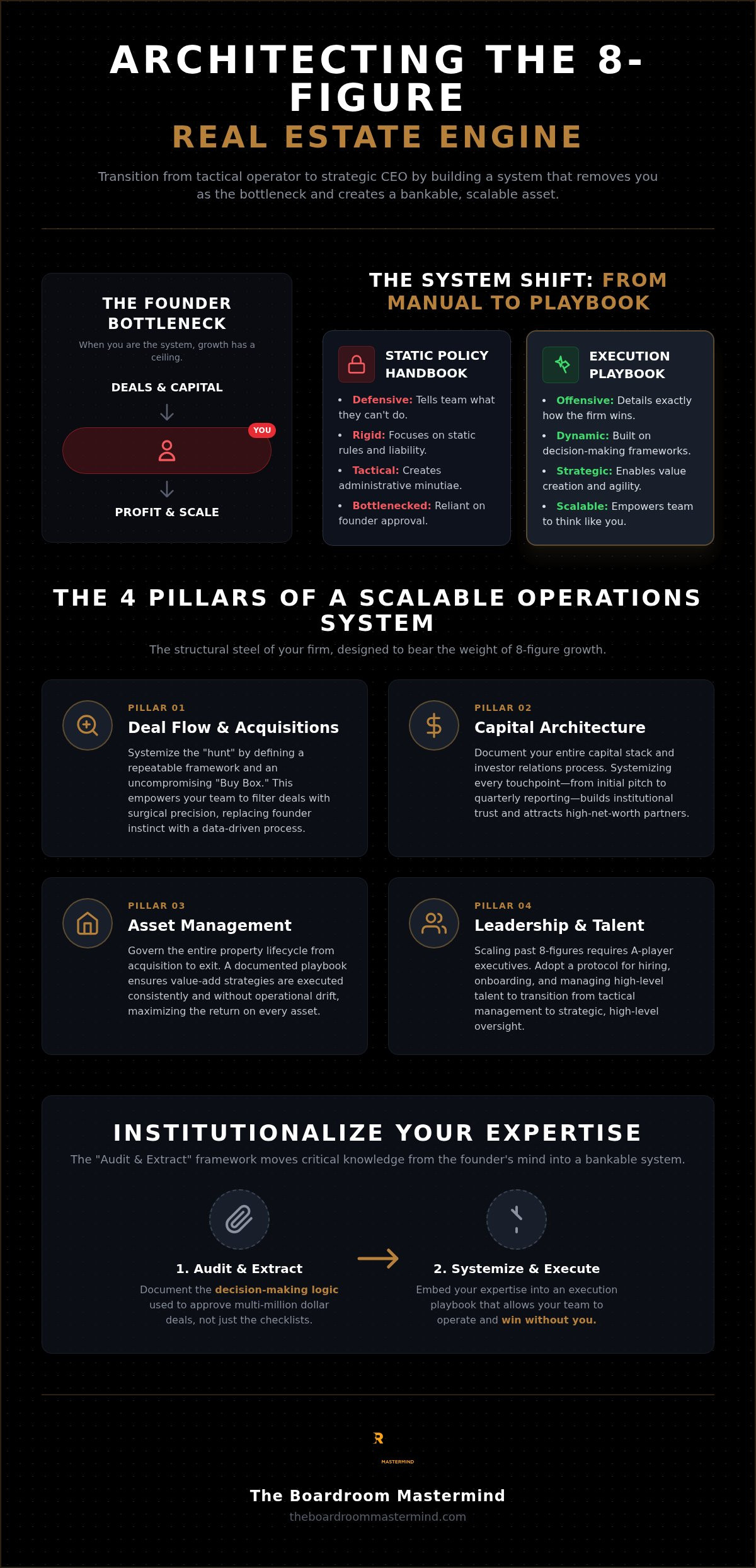
Policy handbooks are defensive; they tell your team what they can't do to avoid liability. Execution playbooks are offensive. They detail exactly how your firm wins in a competitive landscape. Elite firms prioritize decision-making frameworks over simple task lists. Instead of a checklist for due diligence, they document the logic used to approve a multi-million dollar acquisition. This allows your team to think like you, effectively duplicating your expertise across the entire organization.
The ROI of Systemization: Why Your Manual is Your Most Valuable Asset
Documented systems are the ultimate force multiplier for enterprise value. Institutional capital and high-net-worth partners don't invest in a founder's individual brilliance; they invest in a predictable, scalable engine. Transitioning from a founder-led model to a system-led model is the primary requirement for reaching nine-figure milestones. Your operations manual for real estate investment company isn't just a guide. It's a bankable asset that ensures your business remains profitable even when you aren't in the room.
The 4 Essential Pillars of a Scalable Real Estate Operations Manual
Generic SOPs focus on transaction coordination. An 8-figure blueprint focuses on wealth architecture. Your operations manual for real estate investment company must address four critical pillars to sustain institutional-grade growth. These pillars serve as the structural steel of your firm, allowing it to bear the weight of massive scale without fracturing under pressure.
- Pillar 1: Deal Flow & Acquisitions. Systemizing the "hunt" means defining a repeatable framework that your team executes with surgical precision.
- Pillar 2: Capital Architecture. You must document your capital stack, from private lenders to the complex structures used when understanding REITs and institutional equity.
- Pillar 3: Asset Management. This governs the property lifecycle from acquisition to final exit, ensuring value-add strategies are executed without operational drift.
- Pillar 4: Leadership & Talent. Scaling requires high-level executives. You must adopt the Building a Leadership Team protocol to transition from tactical management to strategic oversight.
Systemizing High-Stakes Acquisitions
Consistency is the hallmark of professional firms. Your manual should contain an uncompromising "Buy Box" that empowers your team to filter deals rapidly. When you standardize due diligence, you replace founder-level gut instinct with a data-driven framework. This ensures that every acquisition aligns with your long-term financial goals, regardless of who is running the numbers.
Capital Raising and Investor Relations SOPs
Investor trust is your most valuable currency. Documenting every touchpoint, from the initial pitch to quarterly reporting, creates a professional experience that attracts high-net-worth partners. By systemizing these relations, you ensure that your capital partners feel like insiders. If you're ready to refine these systems, joining an elite mastermind community can provide the high-level perspective needed for nine-figure scale.
Extraction and Execution: Moving Knowledge from Founder to System
Your unique competitive advantage shouldn't live in your head. It's a liability. To build a resilient operations manual for real estate investment company, you must institutionalize your "Secret Sauce" through the Audit and Extract method. This isn't about writing every word yourself. It's about capturing the logic behind your highest-value decisions. If a qualified professional cannot execute a process with zero founder input, your system is broken. That is the ultimate litmus test for any SOP.
Empower your A-players to document their own workflows. When your head of acquisitions or lead project manager writes the playbook for their department, they take ownership of the outcome. Your role is to refine, not to scribe. This ensures the manual remains a practical execution tool rather than a theoretical exercise. Ready to extract yourself from the daily grind? Apply for The Boardroom Mastermind to begin your transition from operator to CEO.
The CEO Audit: Identifying Your High-Value Activities
Stop documenting everything. Focus on the 20% of processes that drive 80% of your revenue. Use a quarterly audit to identify where you're still acting as an operator. Are you still approving every minor repair? Are you the only person who can talk to private lenders? Identify these bottlenecks and prioritize them for immediate extraction. You scale by replacing yourself in these high-friction areas first.
Building the 'Living' Manual: Tools and Technology
Static PDFs are where systems go to die. They are outdated the moment they're saved. Sophisticated firms implement dynamic knowledge hubs that evolve alongside the business. Whether you use a dedicated wiki or a project management interface, your manual must be searchable, accessible, and easily updated. It should function as a living organism that reflects the current state of your 8-figure investment engine.
From Manual to Mastermind: Auditing Your Systems for 9-Figure Scale
Building an operations manual for real estate investment company is only the first step toward true autonomy. The real work begins when you stop being the operator and start acting as the Chief Optimizer. At this level of success, your primary focus shifts from tactical execution to strategic system oversight. You must treat your business architecture as a living organism that requires constant stress testing to survive the complexities of 9-figure scaling. If you aren't actively refining the engine, you're merely waiting for it to stall.
Leveraging a Peer Advisory Group is essential for identifying the blind spots you're too close to see. While you might be satisfied with your current throughput, a room of high-achieving peers will highlight where your systems are leaking capital or efficiency. This transition from "working in the business" to "working on the system" is the definitive hallmark of a true CEO. It requires a move from activity-based management to impact-focused leadership.
The Quarterly Business Audit Protocol
Elite founders don't wait for a crisis to update their playbooks. They use quarterly business audits to re-engineer their manuals for maximum impact. During Boardroom Intensives, members engage in deep-dive audits that measure system efficiency through both leading and lagging indicators. If your deal flow is inconsistent, the system, not the person, is usually the failure point. These intensives provide the high-stakes environment needed to refine your architecture before it breaks under the weight of expansion.
Maintaining Exclusivity and Excellence
Your operations manual serves as the ultimate filter for your leadership team. It defines the standards of excellence required to belong in your organization. By codifying your expectations, you ensure that only high-performers can navigate your system. The Boardroom community provides the elite networking needed to stress-test these playbooks against the strategies of the world's most successful investors. This ensures your business remains a critical strategic asset rather than a job you can't leave.
Architecture for Institutional-Grade Scale
Your evolution from a tactical operator to a strategic CEO isn't a matter of effort; it's a matter of architecture. By codifying your unique competitive advantage into a dynamic operations manual for real estate investment company, you create a self-managing engine capable of institutional-grade scale. You've seen how systemizing acquisitions and capital architecture removes the founder-level bottlenecks that stifle growth. Now, the path to nine figures requires elite peer auditing and constant optimization of your business operating system.
The Boardroom Mastermind provides the exclusive environment needed to stress-test your frameworks alongside global high achievers. Through our quarterly in-person intensives, you'll join a network of 8 and 9-figure founders dedicated to wealth architecture and strategic oversight. Don't let your business depend on your daily intervention. See our Member Spotlights for real-world results and take the first step toward total operational autonomy. Apply for The Boardroom Mastermind and Audit Your Business for Scale today. Your next level of impact is inevitable.
Frequently Asked Questions
What is the difference between an SOP and an operations manual?
An SOP is a single tactical procedure, while an operations manual is the comprehensive architectural blueprint for the entire firm. While an SOP might detail how to file a specific deed, the manual defines how your company raises capital, manages assets, and scales to eight figures. It's the difference between a single line of code and the entire operating system that drives your investment engine and secures your professional legacy.
How long does it take to create a full operations manual for a real estate company?
Developing a comprehensive operations manual for real estate investment company is an iterative process that typically requires three to six months of focused extraction. It isn't a one-time project but a living document that evolves through quarterly business audits. You should prioritize the 20% of high-impact activities that drive revenue immediately. This allows you to remove yourself as the primary bottleneck while the rest of the system is built.
Should I use a template or build my operations manual from scratch?
You should build from scratch to capture your unique competitive advantage, though starting with a high-level framework is acceptable. Generic templates often fail sophisticated firms because they lack the specific "Secret Sauce" that drives your 8-figure success. Your manual must reflect your specific capital architecture and acquisition strategies. Using a peer mastermind to refine your custom blueprint ensures you aren't just following rules, but engineering a growth engine.
How do I get my team to actually follow the operations manual?
Team adoption is achieved by making the manual the "single source of truth" for all performance evaluations and operational decisions. If it isn't in the manual, it doesn't exist. You must empower your A-players to write and update the SOPs for their own departments. This creates a culture of ownership. When the system becomes the filter for excellence, your leadership team will follow it to maintain their high-performance standing in the firm.
What software is best for hosting a real estate investment operations manual?
The best software is a dynamic, searchable knowledge hub like Notion, Trainual, or a custom-built internal wiki. Static documents like PDFs are where systems go to die because they're difficult to update and search. Your hosting platform must allow for real-time collaboration and video integration. This ensures your operations manual for real estate investment company remains a living asset that scales alongside your portfolio and adapts to changing market regulations.

Disclaimer
Mr. Clothier is an expert in real estate investing. As such his experiences are not necessarily typical to the standard real estate investor and whose results may vary. The successes shared on this site are not considered typical. Most individuals who order the educational materials and systems probably do not follow any of the techniques or strategies and consequently make little to no money due to their inaction. The company is in the process of determining the typical success of its clients. Stories shared herein are for example purpose only and should not be construed as "guarantees" of success. Results will vary based on background, education, and experience and actions taken.
This site is not a part of the Google/Facebook website or Google/Facebook Inc. Additionally, this site is NOT endorsed by or affiliated with Google/Facebook in any way. GOOGLE/FACEBOOK is a trademark of GOOGLE/FACEBOOK, Inc.
INCOME DISCLAIMER: This website and the items it distributes contain business strategies, marketing methods and other business advice that, regardless of referenced results and experience, may not produce the same results (or any results) for you. The Boardroom Mastermind makes absolutely no guarantee, expressed or implied, that by following the advice or content available from this web site you will make any money or improve current profits, as there are several factors and variables that come into play regarding any given business. Primarily, results will depend on the nature of the product or business model, the conditions of the marketplace, the experience of the individual, and situations and elements that are beyond your control. As with any business endeavor, you assume all risk related to investment and money based on your own discretion and at your own potential expense.
LIABILITY DISCLAIMER: By reading this website or the documents it offers, you assume all risks associated with using the advice given, with a full understanding that you, solely, are responsible for anything that may occur as a result of putting this information into action in any way, and regardless of your interpretation of the advice. You further agree that The Boardroom Mastermind, its affiliates, subsidiaries, officers and agents, cannot be held responsible in any way for the success or failure of your business as a result of the information provided. It is your responsibility to conduct your own due diligence regarding the safe and successful operation of your business. In summary, you understand that we make absolutely no guarantees regarding income as a result of applying this information, as well as the fact that you are solely responsible for the results of any action taken on your part as a result of any given information. In addition, you agree that our content is to be considered "for entertainment purposes only". Always seek the advice of a professional when making legal, financial, tax, or business decisions.
BUSINESS OPPORTUNITY: All products and services offered by The Boardroom Mastermind are intended to provide prospective purchasers with general business strategies, marketing methods and other general advice for business development and training. At no point is The Boardroom Mastermind soliciting anyone to enter into a new business nor is it representing, either expressly or by implication, that it will provide locations for a business, provide outlets, accounts, or customers, or purchase any of the goods or services made by the purchaser.
The products being offered through this promotion are packages of informational tools to help you learn about business and deal making strategies.


