
How to Scale a Real Estate Portfolio: The CEO’s Blueprint for 8-Figure Growth
The very skills that secured your first $10 million in assets are the exact same bottlenecks preventing you from reaching $100 million. Most investors believe growth is simply about finding more deals, but data shows that 90% of operators who plateau at the seven-figure mark fail because they haven't mastered how to scale a real estate portfolio through systems rather than sweat equity. You've likely felt the suffocating weight of being the chief fire extinguisher in your own company, where every critical decision still requires your personal sign-off.
It's time to stop playing small in a high-stakes game. This briefing details the blueprint for transitioning from a high-volume operator into a true CEO who commands an elite investment machine. You'll discover the strategic frameworks needed to secure institutional-grade capital and attract the leadership talent that turns a business into a self-sustaining legacy. We'll examine the specific architectural shifts required to move from frantic hustle to a predictable, eight-figure operation that thrives within the boardroom and beyond.
Key Takeaways
- Identify the structural shift from linear property acquisition to exponential systems architecture to escape the operator trap.
- Transition from restrictive conventional financing to institutional-grade capital stacks that fuel high-velocity growth.
- Master the blueprint for how to scale a real estate portfolio using a standardized business operating system that removes you as the primary bottleneck.
- Leverage collective intelligence and the power of proximity to gain an unfair advantage in the marketplace.
Breaking the 7-Figure Ceiling: Why Your Current Portfolio Strategy Is Failing
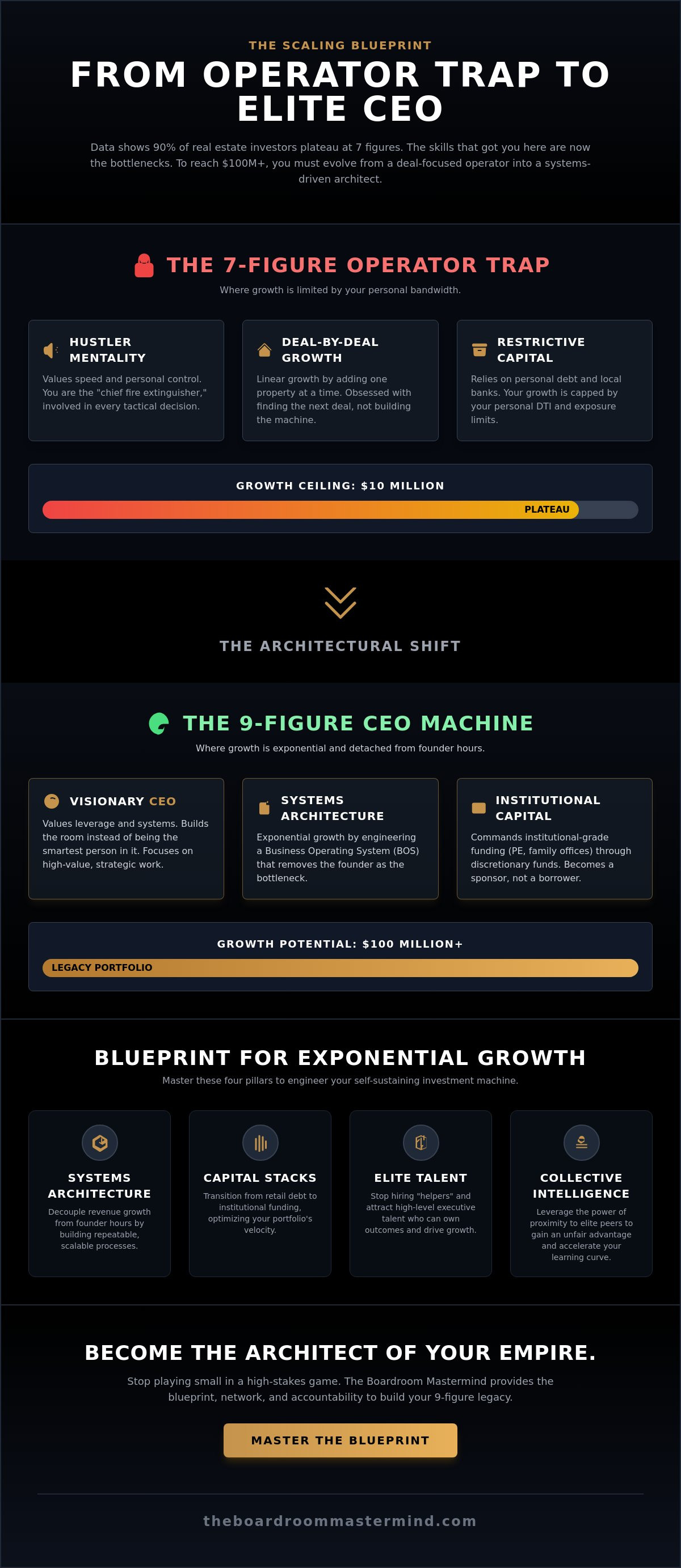
If you're still the person signing every check and vetting every tenant, you don't own a business; you own a high-stress job. This is the Operator Trap. It's the primary reason why 90% of real estate firms plateau before they ever hit the $10 million mark. You've mastered linear growth by adding properties one by one, but that model eventually exhausts your personal bandwidth. True real estate scaling is the systemic decoupling of revenue growth from founder hours.
To understand how to scale a real estate portfolio, you have to stop thinking about the next deal and start thinking about the next system. Most investors fail to make this jump because they hit three specific walls:
- Capital Access: Relying on personal debt or local banks instead of institutional-grade funding.
- Leadership Talent: Hiring "helpers" instead of high-level executives who can own outcomes.
- Operational Friction: Relying on tribal knowledge rather than a documented business operating system.
While traditional real estate investing strategies focus almost exclusively on the individual asset, 8-figure growth focuses on the architecture of the company itself. If the business cannot run without your direct intervention, it isn't an asset; it's a liability.
The Mindset Shift: From Real Estate Hustler to CEO
The "hustler" mentality is your greatest liability at this stage. Hustlers value speed and control; CEOs value leverage and systems. If your daily audit shows you spending 70% of your time on tactical execution, you're effectively blocking your company's path to 9 figures. You must shift from being the smartest person in the room to being the visionary who builds the room. Transitioning to a CEO role requires you to fire yourself from the low-value tasks that keep you busy but stagnant. This transformation is the core of the Boardroom experience, moving you from a frantic operator to a strategic owner who dictates the market's pace.
The Capital Architecture: Transitioning to Institutional-Grade Funding
Conventional financing is a ceiling. Retail banks focus on your debt-to-income ratio and personal exposure limits. Institutional players focus on the asset's performance and your operational infrastructure. If you're wondering how to scale a real estate portfolio beyond the limits of your personal credit, you must stop being a borrower and start being a sponsor. Retail debt is a tool for acquisition; institutional capital is an engine for domination.
Transitioning to real estate private equity allows you to command larger pools of capital without the friction of retail oversight. You'll need to master the architecture of the "Capital Stack." This isn't just about finding the lowest interest rate. It's about optimizing the layers of senior debt, mezzanine financing, and equity to maximize your portfolio's velocity. High-velocity scaling requires a structure where capital is recycled, not trapped in a single asset for decades.
Attracting family offices or institutional funds requires more than a high-yield spreadsheet. These elite entities look for sophisticated reporting, risk mitigation, and a proven "machine." If your financial reporting is manual or inconsistent, you're invisible to the world's largest capital pools. Learning how to scale a real estate portfolio at this level involves positioning your firm as a professional investment vehicle rather than a collection of properties. You can see how elite peers structure these institutional-grade deals in our recent case studies.
Syndication vs. Fund Management
Deal-by-deal syndication is a fundraising treadmill. You're constantly pitching for the next project, which creates a massive bottleneck in your acquisition timeline. Discretionary funds offer the ultimate leverage. With a fund, the capital is committed and ready for deployment. You can strike when the market presents an opportunity, giving you a distinct "unfair advantage" over slower, retail-bound competitors. Fund management is the hallmark of a nine-figure visionary who values speed, control, and certainty of execution.
Engineering the Machine: Building Your Business Operating System
Most investors are obsessed with the next deal. Elite CEOs are obsessed with the machine that finds the deals. If your portfolio growth depends on your personal stamina, you haven't built a business; you've built a cage. To understand how to scale a real estate portfolio to eight figures and beyond, you must implement a business operating system. This framework standardizes every repeatable process, ensuring that the company’s performance is predictable rather than accidental.
You must transition from task-management to KPI-driven management immediately. Stop asking your team "What did you do today?" and start asking "What was the cost per qualified lead this week?" When you manage by metrics, you manage results. This shift requires an "A-Player" hiring framework. Research suggests the cost of a bad executive hire can exceed 15 times their annual salary when you account for lost momentum and cultural damage. You don't need more virtual assistants to handle your inbox; you need a few high-level leaders who own their outcomes without your supervision.
To identify where your machine is breaking, conduct this four-step bottleneck audit:
- Identify the Constraint: Find exactly where the work is piling up. Is it lead generation, capital deployment, or project management?
- Exploit the Constraint: Ensure the current bottleneck is working at 100% capacity before spending more capital.
- Subordinate Everything Else: Align every other department to support the primary bottleneck's output.
- Elevate the Constraint: Invest in the specific systems or talent required to break that ceiling.
If you're ready to stop being the primary bottleneck in your company, apply for a strategic audit with our inner circle.
Constructing an Elite Leadership Team
Scaling requires a specialized C-suite that functions as your surrogate. A COO manages the operational friction. A CFO optimizes the capital stack we discussed previously. A Head of Acquisitions ensures the deal flow remains constant. You must build a leadership team that operates with total autonomy. If your staff needs to call you for permission on a $10,000 decision, you haven't hired a leader; you've hired an expensive secretary. True scale is only possible when your team is empowered to execute the vision without your daily input.
The Force Multiplier: Scaling Through Collective Intelligence
Isolation is the ultimate tax on your growth. While entry-level investors focus on networking with brokers, elite CEOs focus on the Power of Proximity. Your net worth is a lagging indicator of the intelligence within your immediate circle. If you want to master how to scale a real estate portfolio to a nine-figure legacy, you must gain access to the rooms where high-stakes decisions are actually made. In these environments, a single strategic insight can save you 18 months of trial and error.
Collective intelligence acts as an unrivaled business audit. When you join an elite mastermind, you're not just buying a seat; you're acquiring a collective database of battle-tested strategies. This exposure provides the "unfair advantage" of seeing around corners. It prevents "shiny object syndrome," a common trap that derails rapid growth by pulling your focus away from the core machine. Accountability from peers who operate at your level ensures you stay focused on optimizing your capital stack and leadership team rather than chasing every new trend. This is essential for anyone learning how to scale a real estate portfolio without sacrificing their personal freedom.
The Boardroom Mastermind is designed as a critical strategic asset for those who have already achieved significant success. It is a space for the "quiet professional" who dominates their industry without the need for frantic energy. By aligning with a peer group of high-achievers, your ascent to a nine-figure portfolio becomes a narrative of inevitability rather than a game of chance. You're no longer guessing; you're executing a proven blueprint alongside those who have already paved the way.
The ROI of High-Ticket Peer Networks
Quantifying the value of an elite network is simple: one strategic alliance can solve a multi-million dollar capital bottleneck in a single afternoon. Data from industry leadership reports indicates that CEOs who participate in peer advisory groups grow their revenue 2.5 times faster than those who operate in a vacuum. This isn't about casual networking; it's about deep, strategic integration into an inner circle. If you're ready to stop guessing and start executing with precision, experience the Boardroom Mastermind and audit your business for scale.
Architecting Your Eight-Figure Exit
The transition from a high-volume operator to a strategic visionary isn't a matter of effort; it's a matter of architecture. You've seen that mastering how to scale a real estate portfolio requires a fundamental shift from tactical deal-finding to systemic wealth building. By replacing retail debt with institutional-grade capital and swapping personal hustle for a robust business operating system, you clear the path for exponential growth. This is the blueprint for a self-sustaining investment machine that prioritizes your freedom and legacy over daily fires.
Success at this level is rarely achieved in isolation. The Boardroom Mastermind provides the proven framework for transitioning from operator to owner through quarterly in-person business audits with peers currently operating at the eight and nine-figure levels. You gain exclusive access to institutional capital strategies that remain invisible to the general marketplace. Don't let your current success become the ceiling for your future impact. It's time to step out of the engine room and take your seat at the head of the table.
Apply to join the Inner Circle of elite real estate CEOs at The Boardroom Mastermind.
Frequently Asked Questions
How many properties do I need to begin scaling my real estate portfolio?
Scaling is determined by your operational capacity rather than a specific property count. Most investors find that their personal bandwidth reaches a breaking point once they cross the $1 million mark in annual gross revenue or manage approximately 20 units. At this threshold, you must transition from managing individual assets to managing the systems that acquire them. If you wait until you have 50 properties to build your machine, the resulting operational friction will likely collapse your growth.
What is the biggest mistake investors make when trying to scale to 8 figures?
The most frequent error is remaining the primary bottleneck in your own business. Many founders believe that no one can execute as well as they can, which limits the company's growth to the founder's 24-hour day. Data from business audits shows that 85% of scaling failures result from a lack of documented systems rather than a lack of deals. You must stop playing the role of the operator if you want to command an eight-figure enterprise.
Do I need to hire a full leadership team before I start scaling?
You don't need a full C-suite on day one, but you must hire ahead of your next growth phase. Start by identifying your primary bottleneck and hiring an A-player to own that specific outcome. If your capital is trapped, a CFO is your first priority. If your operations are chaotic, a COO is essential. Strategic hiring allows you to learn how to scale a real estate portfolio by delegating execution while you maintain focus on the high-level vision.
What is the difference between an accountability partner and an elite mastermind?
An accountability partner ensures you do the work, but an elite mastermind ensures you're doing the right work. While a partner might help you stay consistent, a high-level peer group provides the unfair advantage of collective intelligence and shared business audits. In the Boardroom, you aren't just checking boxes; you're leveraging the experience of eight and nine-figure visionaries to optimize your entire wealth architecture and avoid costly strategic errors.
How do I find institutional capital for my real estate deals?
Institutional capital flows toward infrastructure and predictability, not just high-yield deals. To attract family offices or private equity, you must present a professional investment vehicle with standardized reporting and risk mitigation systems. Most institutional players require at least 24 months of clean, audited financials and a leadership team that operates independently of the founder. Once your machine is proven, the capital will seek you out as a reliable sponsor for high-velocity growth.


