
How to Lead Leaders: Build Accountability Without Becoming the Bottleneck
If every meaningful decision still lands on your desk, the problem may be how work and authority are designed, not whether your leaders are capable. Adding oversight can make you an even bigger bottleneck. Learning how to lead leaders starts with defining success, naming who owns each outcome, and clarifying which decisions belong at each level.
Experienced leaders need room to lead, along with clear boundaries and shared priorities. Without both, autonomy can turn into conflicting decisions. Your job is to create clarity without stepping into every disagreement.
This article explains how to set measurable outcomes and decision rights, establish a leadership cadence that surfaces issues, and hold accountability conversations focused on commitments. These practices help leaders take ownership while keeping the business aligned.
Key Takeaways
- Learn how to lead leaders by aligning them around shared outcomes while leaving execution in their hands.
- Set decision boundaries before delegating so leaders know what they can decide, when to consult, and what to escalate.
- Use leadership reviews to identify deviations, causes, owners, and next actions.
- Use peer perspectives to pressure-test decisions without replacing clear internal ownership.
How to Lead Leaders Without Becoming the Decision Bottleneck
As the organization grows, your role needs to change. Instead of supervising tasks, align leaders around the outcomes the business needs and let them decide how their teams will deliver. That shift is central to how to lead leaders: set direction, boundaries, and accountability, then leave execution with the person who owns the result.
Leadership oversight sets the destination and decision limits; task-level management dictates each step of the route. Autonomy is not a lack of oversight. Leaders still work within agreed priorities, resource constraints, and escalation rules. You remain responsible for organizational alignment, not every operational choice. For a foundational overview of Leadership, consider how different leadership theories address the practical challenge of coordinating people toward shared aims.
What changes when your direct reports are leaders?
With an individual contributor, you might assign a task, define the method, and check progress. With a leader, agree on the outcome, constraints, and authority. For example, instead of approving each hiring decision, set staffing priorities, a budget boundary, and the conditions that require your involvement. The leader then translates company priorities into choices for their team.
Why capable leaders still escalate routine decisions
Escalation can point to a system problem rather than a capability problem. Vague decision rights encourage leaders to seek approval. Conflicting priorities push trade-offs up to you. And if you reverse decisions after delegating authority, you teach people that asking permission is safer than taking ownership. Set boundaries, honor them consistently, and explain any change in direction. A well-designed leadership team makes accountability clear so decisions stay close to the work and aligned with the business.
Set Outcomes and Decision Rights Before You Delegate
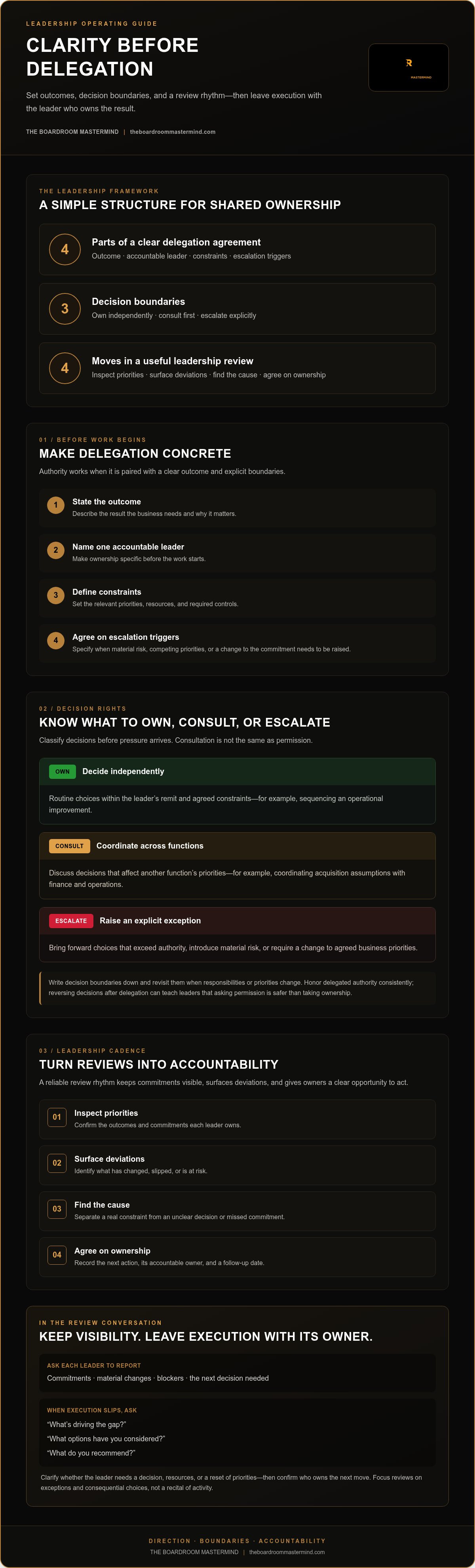
Delegation works when ownership is specific before work begins. Define the result, name one accountable leader, set constraints, and agree on escalation triggers. Without a clear outcome, activity can be mistaken for progress. Without a named owner, decisions drift. Without boundaries, leaders either overstep or keep asking permission. This is how to lead leaders without reclaiming every decision.
How to agree on outcomes without prescribing every move
Describe the result the business needs, the limits that matter, and how progress will be visible. An acquisition leader, for example, might evaluate opportunities against agreed investment priorities and raise material risks without needing you to prescribe each research step. An operations leader might improve a process while meeting existing service commitments. A finance leader might improve reporting while maintaining agreed controls.
Authority works when it is paired with a clear outcome and explicit boundaries. Make the agreement concrete:
- State the outcome and why it matters to the business.
- Name the leader accountable for delivering it.
- Define constraints, such as priorities, resources, or required controls.
- Agree on escalation triggers, including material risk, competing priorities, or a need to change the commitment.
Which decisions should leaders own, share, or escalate?
Classify decisions before pressure arrives. This helps leaders distinguish consultation from permission and raise genuine exceptions promptly.
- Own independently: Routine choices within the leader’s remit and agreed constraints, such as sequencing an operational improvement.
- Consult first: Decisions that affect another function’s priorities, such as coordinating acquisition assumptions with finance and operations.
- Escalate explicitly: Choices that exceed authority, introduce material risk, or require a change to agreed business priorities.
Write these boundaries down and revisit them when responsibilities or priorities change. Experienced real estate operators who value structured peer discussion can also explore The Boardroom Mastermind.
Build a Leadership Cadence That Creates Accountability
Decision rights need a reliable review rhythm. Without one, commitments compete with day-to-day demands and problems may surface late. A useful leadership cadence is not another layer of supervision. It keeps leaders aligned, makes deviations visible, and gives owners a clear opportunity to act.
Keep reviews focused and move through the same sequence:
- Inspect priorities: Confirm the outcomes and commitments each leader owns.
- Surface deviations: Identify what has changed, slipped, or is at risk.
- Find the cause: Separate a real constraint from an unclear decision or missed commitment.
- Agree on ownership: Record the next action, its accountable owner, and a follow-up date.
That is the practical value of business operating system design: priorities, decisions, and follow-through need to work together.
What belongs in a useful leadership review?
Ask each leader to report on commitments, material changes, blockers, and the next decision needed. Record the decision, owner, and follow-up date. A status recital describes activity; an accountability conversation asks whether the agreed outcome is on track and what happens next. Keep routine updates brief so the meeting can focus on exceptions and consequential choices.
How to coach a leader without taking the work back
If execution slips, resist taking over the function. Ask, “What’s driving the gap?”, “What options have you considered?”, and “What do you recommend?” Clarify whether the leader needs a decision, resources, or a reset of priorities, then confirm who owns the next move. This keeps missed commitments visible without turning every review into a permission check. Leading leaders means maintaining visibility, coaching judgment, and leaving execution with its owner.
For experienced operators seeking structured peer accountability alongside internal leadership routines, explore The Boardroom Mastermind.
When Peer Accountability Helps You Lead Leaders Better
Internal reviews clarify ownership, but a recurring bottleneck, a high-stakes decision, or an unchallenged team assumption may benefit from an outside peer perspective. Experienced operators can test the logic, surface trade-offs, and raise questions colleagues inside the business may hesitate to ask.
Peer input does not replace management. Your leaders still own decisions and execution, and you remain responsible for direction and decision boundaries. Use outside perspectives to sharpen the question, not outsource authority. Bring useful insights back to the team, assign the next step, and follow through in your existing cadence.
How to assess whether peer input fits your leadership challenge
Consider whether the issue would benefit from candid discussion with experienced operators outside your company. A recurring handoff failure, consequential strategic choice, or priority interpreted differently across functions may be worth pressure-testing. If the problem is simply an unclear owner or missing decision boundary, fix that internally first. The Boardroom Mastermind’s quarterly hot-seat breakdowns give members an opportunity to examine business challenges and consider different perspectives.
What an experienced peer group can, and cannot, provide
The Boardroom Mastermind is an annual peer-group membership for experienced real estate professionals. Membership includes weekly Zoom calls with live Q&A, bi-weekly progress check-ins, quarterly business hot seats, and team workshops. The annual membership includes 4 quarterly events and 2 additional exclusive events for the invitation-only Billionaire Boardroom Group. These are opportunities for discussion, perspective, and accountability, not promises of specific results. Peers can challenge your assumptions and help you examine options, but they cannot make decisions or own execution for you.
Membership is intended for established operators who are ready to engage openly and contribute to the group. The eligibility requirements are direct:
- “You MUST be THE REAL DEAL and doing significant business revenue.”
- “The Boardroom Mastermind is not for new business owners that are just getting started. EXPERIENCE MATTERS here.”
- “We have a strict ‘NO DOUCHE BAG’ rule.”
- “No scarcity is allowed.”
- “You MUST be willing to connect any and every ‘dot’ possible for your fellow members.”
- “You MUST be willing to be vulnerable and break down your business needs in front of your fellow members.”
- “You MUST be looking to grow and improve your business DRAMATICALLY and QUICKLY.”
Success stories are not typical; results vary based on background, education, experience, and actions taken. No guarantees of success. Mr. Clothier’s results are not typical.
Make Leadership Ownership the Next Standard
The next stage of leadership is not measured by how many decisions reach your desk. It is measured by whether the business can stay aligned and move forward when you are not in every conversation. Give leaders room to exercise judgment, then hold the line on clear ownership. That is how to lead leaders while protecting your time for decisions that require your attention.
The Boardroom Mastermind’s annual membership includes four quarterly events, creating opportunities for experienced real estate operators to connect and learn from one another.
If you are ready to strengthen how you lead and build accountability alongside experienced business owners, explore The Boardroom Mastermind.
Frequently Asked Questions
What does it mean to lead leaders?
It means developing the judgment and capacity of people who lead others, rather than becoming the final authority on every operational choice. A strong leader of leaders helps the team see how decisions affect the wider business, not just one department. The test is whether leaders can resolve trade-offs, communicate direction to their teams, and raise issues that genuinely require executive attention.
How do you lead experienced managers without micromanaging?
Set visibility expectations instead of step-by-step instructions. For example, ask an operations leader to flag decisions that could affect another function or materially disrupt customer commitments, while leaving routine workflow choices in their hands. Review the reasoning and impact, not just the method. If you disagree, explain the principle behind your decision so the leader can apply it next time.
How can a CEO hold senior leaders accountable?
Address commitments directly and separate the result from the explanation. If a deliverable misses its mark, ask what changed, what the leader controlled, and what they recommend now. Agree whether to maintain, adjust, or replace the commitment. Treat repeated avoidable misses as a performance issue, and reassess the plan when business conditions change.
What is the difference between managing managers and leading leaders?
Managing managers often focuses on whether they are executing their responsibilities and supporting their teams. Leading leaders adds an enterprise-wide lens: are leaders making compatible choices, developing sound judgment, and prioritizing the health of the whole business over local wins? The distinction is not about title. It is about whether your attention is on supervising activity or strengthening leadership across the organization.
Can a mastermind help you become a better leader of leaders?
A peer group can help you examine a leadership dilemma from outside your company’s usual assumptions. The Boardroom Mastermind is a peer-group membership for experienced real estate professionals, with opportunities to discuss business challenges and test your thinking with peers. That perspective can inform your next move, but your leadership team still owns its decisions and execution. Peer input supports judgment; it does not guarantee outcomes.

Disclaimer
Mr. Clothier is an expert in real estate investing. As such his experiences are not necessarily typical to the standard real estate investor and whose results may vary. The successes shared on this site are not considered typical. Most individuals who order the educational materials and systems probably do not follow any of the techniques or strategies and consequently make little to no money due to their inaction. The company is in the process of determining the typical success of its clients. Stories shared herein are for example purpose only and should not be construed as "guarantees" of success. Results will vary based on background, education, and experience and actions taken.
This site is not a part of the Google/Facebook website or Google/Facebook Inc. Additionally, this site is NOT endorsed by or affiliated with Google/Facebook in any way. GOOGLE/FACEBOOK is a trademark of GOOGLE/FACEBOOK, Inc.
INCOME DISCLAIMER: This website and the items it distributes contain business strategies, marketing methods and other business advice that, regardless of referenced results and experience, may not produce the same results (or any results) for you. The Boardroom Mastermind makes absolutely no guarantee, expressed or implied, that by following the advice or content available from this web site you will make any money or improve current profits, as there are several factors and variables that come into play regarding any given business. Primarily, results will depend on the nature of the product or business model, the conditions of the marketplace, the experience of the individual, and situations and elements that are beyond your control. As with any business endeavor, you assume all risk related to investment and money based on your own discretion and at your own potential expense.
LIABILITY DISCLAIMER: By reading this website or the documents it offers, you assume all risks associated with using the advice given, with a full understanding that you, solely, are responsible for anything that may occur as a result of putting this information into action in any way, and regardless of your interpretation of the advice. You further agree that The Boardroom Mastermind, its affiliates, subsidiaries, officers and agents, cannot be held responsible in any way for the success or failure of your business as a result of the information provided. It is your responsibility to conduct your own due diligence regarding the safe and successful operation of your business. In summary, you understand that we make absolutely no guarantees regarding income as a result of applying this information, as well as the fact that you are solely responsible for the results of any action taken on your part as a result of any given information. In addition, you agree that our content is to be considered "for entertainment purposes only". Always seek the advice of a professional when making legal, financial, tax, or business decisions.
BUSINESS OPPORTUNITY: All products and services offered by The Boardroom Mastermind are intended to provide prospective purchasers with general business strategies, marketing methods and other general advice for business development and training. At no point is The Boardroom Mastermind soliciting anyone to enter into a new business nor is it representing, either expressly or by implication, that it will provide locations for a business, provide outlets, accounts, or customers, or purchase any of the goods or services made by the purchaser.
The products being offered through this promotion are packages of informational tools to help you learn about business and deal making strategies.


