
How to Attract Private Equity for Real Estate Deals: The CEO’s Playbook
Private equity firms don't actually invest in real estate deals; they invest in institutional-grade CEOs who happen to have them. If you've reached the ceiling of retail syndication, you know the exhaustion of managing hundreds of small investors while capital constraints stall your largest acquisitions. You've built a successful track record. Yet, the leap to institutional backing requires a fundamental shift in your wealth architecture. Mastering how to attract private equity for real estate deals is no longer about the asset itself. It's about the systems, scalability, and calculated confidence you bring to the table.
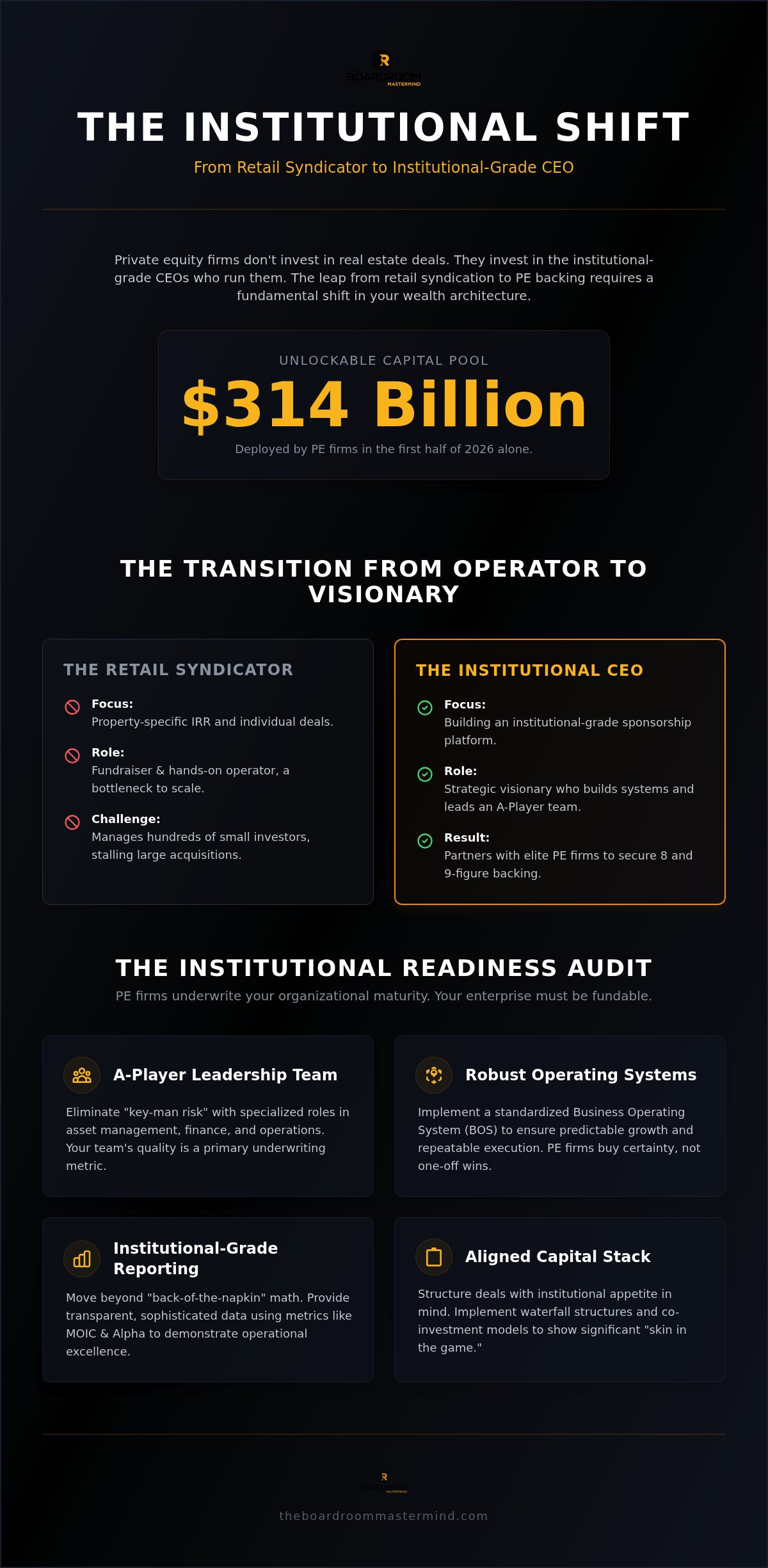
You already know that the transition from operator to visionary leader is the only way to access the $314 billion in capital deployed by PE firms in the first half of 2026. This playbook promises to equip you with the strategic frameworks and positioning required to secure eight and nine-figure backing for your empire. We will examine the institutional-grade infrastructure needed to pass modern due diligence, the impact of the 2026 Warnock-Led Housing Ban, and the operational audits that separate the elite from the merely successful.
Key Takeaways
- Shift your focus from property-specific IRR to building an institutional-grade sponsorship platform that emphasizes team and systems over individual assets.
- Learn how to attract private equity for real estate deals by conducting an operational audit to ensure your leadership team meets the stringent requirements of mid-market funds.
- Align your capital stack with institutional expectations by implementing waterfall structures and co-investment models that demonstrate significant skin in the game.
- Leverage high-level proximity and peer-led business audits to bridge the gap between retail syndication and the elite world of eight-figure institutional partnerships.
The Institutional Shift: Why PE Firms Invest in Sponsors, Not Just Deals
Scaling to institutional capital is about enterprise quality, not just deal size. Retail syndication makes you a fundraiser; partnering with private equity real estate firms makes you a platform. These institutions don't buy properties; they buy the certainty of your execution. They scrutinize the engine driving the acquisition, not just the IRR. If you are learning how to attract private equity for real estate deals, understand that your infrastructure is your most valuable asset.
The relationship between the General Partner (GP) and the Limited Partner (LP) fundamentally changes at this level. Institutional LPs require a "Sponsor-First" mandate. They need to know that your team can handle an eight-figure equity check without buckling. This shift requires moving from tactical management toward strategic oversight. You must position your firm as a strategic asset rather than a service provider. Building this foundation is the first step toward institutional scale.
The Trust Gap: What PE Firms Are Really Buying
Institutions are looking for repeatability. They aren't interested in a single "great deal" that requires your constant personal intervention. They want a system that executes the same strategy 100 times with predictable results. If success depends on your presence at every site visit, you're a bottleneck. Scalability is the primary currency in high-stakes finance.
Transparency is the final pillar. Moving beyond retail capital means leaving "back-of-the-napkin" math behind. You must provide institutional-grade reporting that offers visibility into performance and risk. PE firms expect a shared vernacular of advanced operations. This level of clarity is vital for those determining how to attract private equity for real estate deals at scale. When your data is as sophisticated as your vision, you close the trust gap and secure the backing your empire requires.
The Institutional Readiness Audit: Building a Fundable Real Estate Enterprise
Securing institutional backing requires more than a high-yield asset; it demands a fundable enterprise. If you're solving for how to attract private equity for real estate deals, your first audit must be internal. PE firms aren't just underwriting a property; they're underwriting your organizational maturity. This starts with an A-Player leadership team capable of executing at the highest tiers. Without specialized roles in asset management and finance, your firm remains a high-level hobby, not an institutional platform.
Operational systems provide the transparency needed to pass rigorous due diligence. A standardized Business Operating System ensures your growth is predictable rather than accidental. When understanding the private real estate capital stack, you'll realize that institutional partners prioritize risk-adjusted returns over raw IRR. You must present your track record using metrics like MOIC and Alpha to prove you can generate superior returns through operational excellence, not just market timing.
Delegation as a Capital Attraction Strategy
Solo-operators represent a significant "key-man" risk that most private equity firms won't touch. If you're the primary bottleneck for every decision, your business isn't scalable. Institutional capital seeks CEOs who've successfully transitioned from tactical management to strategic oversight. By delegating the 80% of low-impact activity, you create the capacity to hunt for nine-figure opportunities. This transition is a prerequisite for entry into the high-stakes environments where elite capital flows. You don't attract PE by working harder; you attract it by building a machine that works without you.
Navigating the Capital Stack: Structuring Deals for Institutional Appetite
Attracting institutional capital requires a fundamental shift in how you architect your deal structures. It's no longer enough to present a high-yield asset; you must present a capital stack that aligns perfectly with institutional risk profiles. The waterfall structure is the bedrock of this alignment. By designing tiered hurdles that prioritize Limited Partner security while rewarding General Partner performance, you signal that your firm understands the nuances of sophisticated finance. If you're solving for how to attract private equity for real estate deals, your waterfall must be defensible under the most rigorous scrutiny.
Private equity firms also demand significant co-investment. They aren't looking for a passive sponsor; they're looking for a partner with substantial "skin in the game" to ensure operational discipline. This commitment bridges the trust gap. You must match your deal profile to the specific mandates of the fund, whether Core, Value-Add, or Opportunistic. Understanding how to attract private equity for real estate deals requires knowing that these institutions prioritize the certainty of the exit as much as the entry. Given that PE-backed exits fell to 872 in the first half of 2026, your "Exit Before You Enter" strategy is more critical than ever. Institutional LPs need to see a documented path to liquidity before they commit to an eight-figure check.
From Syndication to Fund Management
Graduating from one-off syndications to discretionary fund structures is the hallmark of a CEO who has mastered institutional scale. This transition allows you to move with the speed and certainty that high-stakes environments demand. You'll need to master the layers of preferred equity and mezzanine debt to optimize your returns while maintaining safety. High-level execution requires high-level proximity. To build the infrastructure needed for this transition, you must audit your capital strategy with peers who are already operating at the nine-figure level. This is where the transition from operator to institutional sponsor becomes permanent.
Elite Proximity: Leveraging Networks to Secure Private Equity Partners
Institutional capital is a game of proximity. While the general public believes the myth that the best deals are found at country clubs, the reality of high-stakes finance is far more exclusive. Global high achievers don't look for partners in public spaces; they look within verified circles of expertise. If you're struggling with how to attract private equity for real estate deals, the bottleneck is likely your network. You can't secure nine-figure backing while surrounded by six-figure thinkers.
The Boardroom Mastermind provides the restricted access required to bridge this gap. By positioning yourself among 8 and 9-figure real estate entrepreneurs, you gain the Power of Proximity that traditional networking lacks. This environment is where fundable CEOs are forged. You must conduct a ruthless network audit: Is your current circle capping your ability to raise capital? Participating in Quarterly Business Intensives allows you to subject your firm to peer-led audits, ensuring your infrastructure is ready for the intense scrutiny of institutional due diligence.
The Boardroom Difference: Engineering Your Exit from the Day-to-Day
Peer accountability is the only antidote to the Operator's Trap. When you're buried in tactical management, you lose the bandwidth to lead at a strategic level. The Boardroom creates the discipline needed to maintain your focus on capital architecture and high-level execution. This community isn't just a service; it's a critical strategic asset for those who've already achieved substantial success but want to scale further. If you're ready to master how to attract private equity for real estate deals, apply for The Boardroom Mastermind today to audit your business for institutional scale.
Architecting Your Institutional Legacy
Transitioning from a successful operator to an institutional-grade sponsor requires a fundamental evolution of your leadership and systems. You've seen that private equity firms prioritize the engine of your business over the IRR of a single property. Mastering how to attract private equity for real estate deals is about proving your firm's repeatability and transparency through a rigorous institutional readiness audit. By optimizing your capital stack and aligning your waterfall structures with fund mandates, you position your empire for permanent, high-level growth.
Access to this tier of capital isn't found in the general marketplace; it's forged within exclusive environments where battle-tested visionaries share the vernacular of wealth architecture. Through quarterly in-person business audits and strategic intensives, you can bridge the trust gap that stops most syndicators. It's time to join an elite network of 8 and 9-figure real estate CEOs dedicated to high-stakes execution. Scale your real estate empire and attract institutional capital with The Boardroom Mastermind. The path to your next milestone is clear for those with the right access.
Frequently Asked Questions
What is the minimum deal size to attract private equity for real estate?
Mid-market private equity firms typically seek a minimum equity check size of $10 million to $25 million per transaction. While smaller boutique funds might consider $5 million, institutional players prioritize efficiency and scale. If your deal doesn't support a significant equity allocation, it likely won't justify their intensive due diligence costs. Mastery of how to attract private equity for real estate deals begins with identifying assets that meet these institutional thresholds.
What are the common due diligence requirements for private equity firms?
Expect an exhaustive review of your firm's operational infrastructure and track record. PE firms require three to five years of audited financial statements, detailed asset management reports, and a comprehensive background check on all key principals. They'll scrutinize your internal controls and risk mitigation strategies to ensure your platform is resilient. This process goes far beyond property-level inspections, it's a full-scale audit of your leadership and systems.
How much 'skin in the game' do private equity firms expect from a sponsor?
Most institutional partners expect a sponsor co-investment between 1% and 5% of the total equity requirement. This ensures that your interests are perfectly aligned with the Limited Partners. For larger deals, firms may accept a lower percentage if it represents a significant portion of the CEO's liquid net worth. Demonstrating this commitment is a prerequisite for any visionary leader looking to secure eight or nine-figure backing for their empire.
What is the difference between a family office and a private equity firm in real estate?
Family offices often provide patient capital with more flexible hold periods and a focus on long-term wealth preservation. In contrast, private equity firms operate with strict fund mandates and defined exit timelines, usually five to seven years. PE firms prioritize high risk-adjusted returns and internal rates of return (IRR) over generational holding. Understanding these nuances is critical when determining how to attract private equity for real estate deals that fit your specific exit strategy.
How do I find private equity investors for my first large-scale deal?
Securing your first institutional partner requires moving beyond retail networks into elite professional circles. You should target mid-market placement agents and institutional brokers who specialize in capital raises. Positioning yourself within exclusive environments where high-growth executives congregate is also essential. By auditing your business architecture among peers who've already achieved nine-figure scale, you gain the credibility and proximity required to attract global high achievers to your platform.

Disclaimer
Mr. Clothier is an expert in real estate investing. As such his experiences are not necessarily typical to the standard real estate investor and whose results may vary. The successes shared on this site are not considered typical. Most individuals who order the educational materials and systems probably do not follow any of the techniques or strategies and consequently make little to no money due to their inaction. The company is in the process of determining the typical success of its clients. Stories shared herein are for example purpose only and should not be construed as "guarantees" of success. Results will vary based on background, education, and experience and actions taken.
This site is not a part of the Google/Facebook website or Google/Facebook Inc. Additionally, this site is NOT endorsed by or affiliated with Google/Facebook in any way. GOOGLE/FACEBOOK is a trademark of GOOGLE/FACEBOOK, Inc.
INCOME DISCLAIMER: This website and the items it distributes contain business strategies, marketing methods and other business advice that, regardless of referenced results and experience, may not produce the same results (or any results) for you. The Boardroom Mastermind makes absolutely no guarantee, expressed or implied, that by following the advice or content available from this web site you will make any money or improve current profits, as there are several factors and variables that come into play regarding any given business. Primarily, results will depend on the nature of the product or business model, the conditions of the marketplace, the experience of the individual, and situations and elements that are beyond your control. As with any business endeavor, you assume all risk related to investment and money based on your own discretion and at your own potential expense.
LIABILITY DISCLAIMER: By reading this website or the documents it offers, you assume all risks associated with using the advice given, with a full understanding that you, solely, are responsible for anything that may occur as a result of putting this information into action in any way, and regardless of your interpretation of the advice. You further agree that The Boardroom Mastermind, its affiliates, subsidiaries, officers and agents, cannot be held responsible in any way for the success or failure of your business as a result of the information provided. It is your responsibility to conduct your own due diligence regarding the safe and successful operation of your business. In summary, you understand that we make absolutely no guarantees regarding income as a result of applying this information, as well as the fact that you are solely responsible for the results of any action taken on your part as a result of any given information. In addition, you agree that our content is to be considered "for entertainment purposes only". Always seek the advice of a professional when making legal, financial, tax, or business decisions.
BUSINESS OPPORTUNITY: All products and services offered by The Boardroom Mastermind are intended to provide prospective purchasers with general business strategies, marketing methods and other general advice for business development and training. At no point is The Boardroom Mastermind soliciting anyone to enter into a new business nor is it representing, either expressly or by implication, that it will provide locations for a business, provide outlets, accounts, or customers, or purchase any of the goods or services made by the purchaser.
The products being offered through this promotion are packages of informational tools to help you learn about business and deal making strategies.


