
Hiring a COO for Your Real Estate Company: The Architect of 8-Figure Scale
What if your real estate firm's primary bottleneck isn't the current market volatility or the new FinCEN reporting requirements, but the person staring back at you in the mirror? You've scaled revenue to impressive heights, yet you remain anchored to the daily grind, managing broken systems and a team that lacks true accountability. The path to the next tier requires a fundamental shift, specifically hiring a COO for real estate company who can transform your visionary energy into a repeatable, scalable business operating system.
You likely agree that working eighty hours a week to prevent deal slippage isn't the freedom you were promised when you started. This article provides the definitive blueprint to identify, vet, and integrate a high-level executive who executes your vision while you focus on capital and architecture. We'll explore how to secure an elite operator capable of navigating 2026's regulatory complexities, allowing you to finally transition from a founder-led bottleneck to a professional enterprise with total operational autonomy. It's time to stop managing the chaos and start architecting your legacy.
Key Takeaways
- Recognize the operational ceiling that prevents 8-figure growth and why a professional architect is required to bridge the gap between vision and execution.
- Master the strategic process of hiring a COO for real estate company to transition from tactical management to high-level strategic oversight.
- Identify the three pillars of a high-performing operator, Systems, Talent, and Accountability, to ensure your acquisition and disposition pipelines run with total autonomy.
- Learn why vetting for systems-thinking and leadership maturity often requires looking beyond the traditional real estate talent pool to find elite operations leaders.
- Implement a 90-day integration framework that establishes clear rules of engagement and synchronizes the Visionary-Integrator relationship for predictable, systemised growth.
The 7-Figure Ceiling: Why Hiring a COO is Mandatory for Real Estate Scale
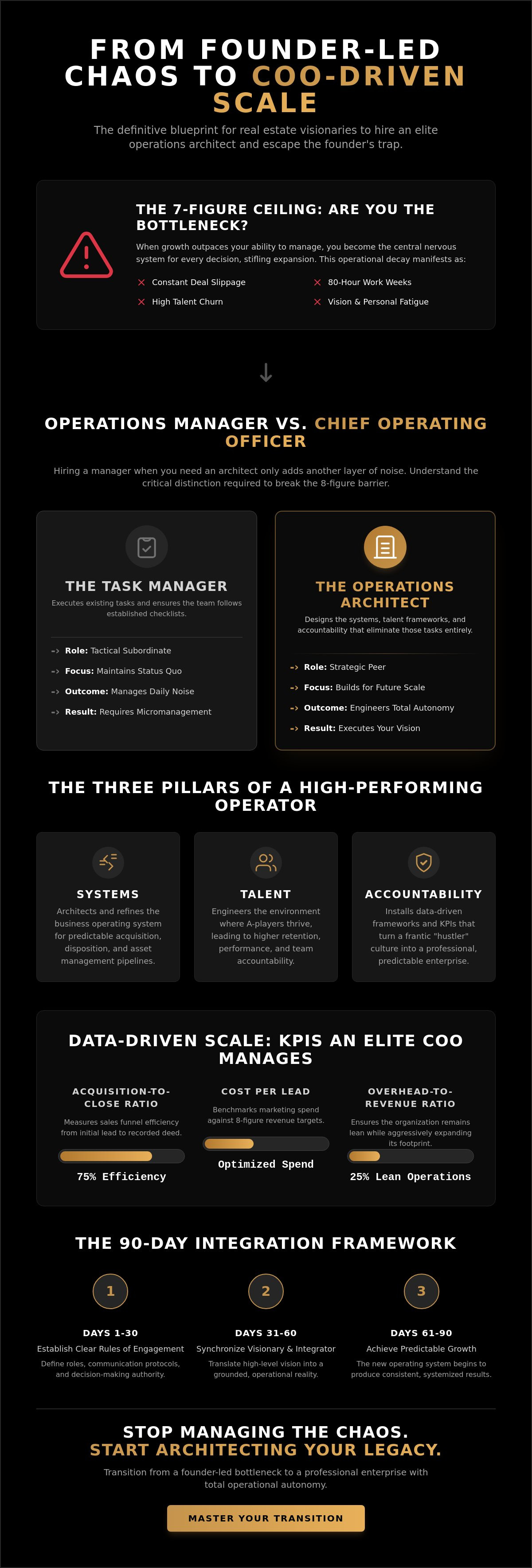
Scaling a real estate investment firm past the $2 million revenue mark reveals a brutal truth. The skills that got you here won't get you to $20 million. Most founders eventually fall into the "Founder's Trap," a state where growth outpaces their ability to manage human capital. You become the central nervous system for every decision. This creates a lethal bottleneck that stifles expansion and erodes your personal freedom. Transitioning to an 8-figure enterprise requires a professional architect. This is why hiring a COO for real estate company isn't a luxury; it's a structural necessity for survival.
Manager vs. COO: The Strategic Distinction
A common mistake is hiring an "Operations Manager" and expecting executive results. Managers are tactical. They execute existing tasks and ensure the team follows established checklists. In contrast, a COO is a strategic peer who designs the systems that eliminate those tasks. While a manager maintains the status quo, the duties of a Chief Operating Officer involve building the infrastructure for future scale. If you hire too low, you'll find yourself micromanaging your manager. That only adds another layer of noise to your day. You need a partner who can translate your high-level vision into a repeatable, institutional-grade machine.
Signs Your Real Estate Empire is Outgrowing Your Leadership
The transition typically becomes non-negotiable once you cross the $2M to $5M revenue threshold. At this stage, operational decay manifests as deal slippage, high talent churn, and a pervasive sense of vision fatigue. You might find yourself asking, Are You the Bottleneck? Signs You've Outgrown Your Role. When the complexity of your acquisition pipelines and asset management exceeds your personal bandwidth, your growth will plateau. A high-level COO stops the bleed. They install the accountability frameworks that turn a frantic "hustler" culture into a predictable enterprise. This hire allows you to step back from the tactical weeds and return to your role as the visionary architect of wealth.
Defining the Real Estate COO: Operations Architect vs. Task Manager
A high-level COO is the architect who installs the business operating system required for institutional-grade scale. While a task manager waits for instructions, the COO builds the machine that renders instructions unnecessary. Their role centers on three non-negotiable pillars: Systems, Talent, and Accountability. They don't just oversee the team. They engineer the environment where A-players thrive and acquisition pipelines flow without friction. When hiring a COO for real estate company, you aren't looking for a subordinate; you're looking for a strategic peer.
In the context of hiring a COO for real estate company, their mandate covers the entire investment lifecycle. They optimize acquisition velocity, refine disposition strategies to maximize liquidity, and ensure asset management protocols protect long-term yields. By acting as the "Integrator," they translate the founder’s erratic visionary sparks into a grounded operational reality. This involves vetting operations leaders for their ability to handle high-stakes complexity while maintaining a composed, strategic posture. Those seeking to master this transition often find the clarity they need through The Boardroom Mastermind Membership.
KPIs and Performance Metrics for Real Estate Operations
Scale demands data, not gut feelings. An elite COO manages by the numbers, focusing on acquisition-to-close ratios to measure the efficiency of the sales funnel from initial lead to recorded deed. They benchmark cost per lead against 8-figure revenue targets and monitor overhead-to-revenue ratios to ensure the organization remains lean while expanding its footprint. This data-driven approach replaces the frantic energy of the "hustle" with the cold precision of a professional enterprise.
The 'Integrator' Profile: Personality Traits of an A-Player COO
The ideal COO is the calm to the founder’s chaos. They possess an innate ability for process-mapping and risk mitigation, seeing the structural flaws that a visionary might overlook. While you chase the next big deal, they're focused on the permanence of the enterprise. They prioritize detail-orientation and rhythmic execution over the excitement of the hunt. This temperament allows them to hold the team accountable to the vision, ensuring that growth is both predictable and sustainable.
The Executive Search: Identifying and Vetting A-Player Operations Leaders
Finding the right operator requires looking beyond the superficial. Many founders mistakenly prioritize industry experience over structural competence. In reality, hiring a COO for real estate company often yields better results when you source talent from systems-intensive sectors like logistics or technology. These candidates bring a level of leadership maturity and process-mapping discipline that is often mandatory for real estate scale. Use a multi-stage vetting process to audit their past scaling successes. You aren't just looking for a resume. You're auditing their ability to build a machine that survives their absence.
Avoid the "Culture Killer" by ensuring deep alignment with your core values and long-term impact goals. An operator who builds a profitable machine but destroys your team's morale is a liability, not an asset. The Boardroom methodology focuses on auditing a candidate's systems-thinking capacity. Can they identify the root cause of a bottleneck, or do they just treat the symptoms? If they can't articulate how they've scaled a previous entity through structured accountability, they won't do it for yours.
Real Estate Executive Compensation Models for 2026
Attracting A-player talent in 2026 requires a sophisticated compensation architecture. Move beyond a simple base salary. High-level COOs expect performance-based equity or "phantom stock" options that align their personal wealth with the firm's long-term impact. Structure bonuses around EBITDA growth and specific portfolio value milestones. This ensures your operator is incentivized to optimize for permanence, not just short-term transaction volume. If the compensation doesn't reflect the high stakes, you'll attract a manager, not an architect.
Where to Find High-Level Operations Talent
The general marketplace is often a graveyard of mediocre talent. To find elite operators, you must look where they congregate. Leveraging elite peer advisory groups provides access to vetted referrals from other 8-figure founders who have already solved these structural puzzles. While executive search firms offer a broad reach, internal networks and exclusive communities often yield candidates with higher cultural alignment. If you're ready to stop the search and start scaling, apply for The Boardroom Elite to connect with the industry's top strategic minds.
Architecture of Integration: Transitioning from Founder-Led to COO-Driven
Successful integration is the final hurdle after hiring a COO for real estate company. The first 90 days are a crucible for your leadership. You must establish rigid "Rules of Engagement" to prevent the team from bypassing the new executive. If you allow employees to continue coming to you for tactical approvals, the COO becomes a hollow figurehead. Conduct a weekly "Visionary-Integrator" same-page meeting to synchronize your high-level ambitions with their operational reality. This ensures that while you remain the source of the vision, they remain the sole source of the execution.
Empowering your COO to hire and fire is the ultimate test of founder trust. If you retain veto power over every personnel decision, you haven't hired an architect; you've hired an expensive assistant. This shift is what facilitates your transition into a true CEO role. By surrendering the tactical weeds, you gain the bandwidth to focus on high-level capital raising and legacy-building. Your business actually grows faster when you stop doing the "work" of management and start doing the work of leadership.
Building the Rhythmic Cadence of Leadership
A professional enterprise runs on a rhythmic cadence, not reactive fire-fighting. Implement weekly L10 meetings to solve operational issues and monthly deep-dives for strategic alignment. Many elite founders use The Boardroom experience and our Quarterly In-Person Intensives to audit their leadership structure. These intensives provide the restricted access and peer feedback necessary to ensure your new architecture remains resilient as you scale toward 8-figure milestones.
The CEO’s New Job Description
Once the COO is integrated, your job description changes fundamentally. You move from the engine room to the bridge. Your primary responsibilities become capital acquisition, building strategic alliances, and designing the long-term market architecture of the firm. This is the paradox of scale. The less you are involved in the daily acquisition pipelines, the more valuable the company becomes. You're no longer the operator; you're the owner of a self-sustaining asset that produces predictable, systemised growth.
Architecting Your 8-Figure Legacy
The transition from a high-revenue operator to a true business architect isn't a matter of effort. It's a matter of infrastructure. You've seen why the 7-figure ceiling exists and how the right integrator effectively dismantles it. By hiring a COO for real estate company, you're not just offloading tasks; you're installing the accountability and systems required for institutional-grade scale. This allows you to step into your highest calling: capital raising and strategic market architecture. You're finally free to focus on the permanence of your enterprise rather than the urgency of the next closing.
True operational autonomy is reserved for those who refuse to remain the bottleneck. If you're ready to audit your leadership structure alongside an exclusive network of 7, 8, and 9-figure investors, the path forward is clear. Gain access to quarterly in-person business audits and the proprietary Boardroom Digital Portal to ensure your expansion is both predictable and permanent. Scale your real estate empire with the Boardroom Mastermind. Your next level of impact starts with the decision to lead, not manage. The architecture of your future is waiting.
Strategic Insights: Frequently Asked Questions
What is the difference between an Operations Manager and a COO in real estate?
An Operations Manager is a tactical role focused on maintaining existing workflows and ensuring daily tasks are completed. A COO is a strategic architect who designs the systems that eliminate the need for manual oversight. While the manager follows the playbook, the COO writes it. In a real estate context, this means the COO optimizes the entire investment lifecycle rather than just managing office logistics or agent paperwork.
How much should I pay a COO for a mid-sized real estate investment company in 2026?
As of May 2026, the average annual salary for a real estate agency COO is approximately $486,702. The typical compensation range falls between $382,998 and $617,428 depending on portfolio complexity and market location. When hiring a COO for real estate company, expect to supplement this base with performance-based equity or phantom stock. This ensures your executive's financial interests are tied directly to the firm's long-term asset value and EBITDA growth.
Should I hire a fractional COO or a full-time executive for my real estate firm?
Fractional COOs are effective for stabilizing broken processes or managing specific projects, but they rarely provide the deep structural integration required for 8-figure scale. If your revenue exceeds $5 million, a full-time executive is non-negotiable. You need a dedicated architect who is fully immersed in your firm's culture and long-term vision. A fractional hire is a temporary patch; a full-time COO is a permanent strategic asset for predictable growth.
How do I know if my real estate company is ready to hire a COO?
Your company is ready when revenue plateaus between $2 million and $5 million despite increased marketing spend. This indicates that your internal infrastructure, not your lead flow, is the primary constraint. If you find yourself personally managing acquisition pipelines or disposition strategies to prevent deal slippage, you've outgrown your current role. Hiring a COO for real estate company becomes mandatory when your visionary bandwidth is consumed by tactical management and broken systems.
What are the common mistakes founders make when hiring their first COO?
The most lethal mistake is hiring "too low" by selecting a glorified administrator instead of a strategic peer. Founders often struggle to relinquish authority, which prevents the new executive from implementing necessary accountability frameworks. Another error is neglecting cultural alignment; an operator who prioritizes efficiency over your core values will eventually trigger talent churn. If you don't empower them to hire and fire, you've hired an expensive assistant, not a COO.


