
Hiring a CFO for Your Real Estate Company: The 8-Figure Scaling Blueprint
Your CPA is keeping you compliant. However, if you are still the primary bottleneck for every capital allocation decision and fund structure, you aren't running an institutional-grade empire; you're managing a high-yield hustle that owns you. Most owners confuse basic accounting with sophisticated financial architecture. Hiring a CFO for real estate company scaling is not about balancing books. It is about engineering a capital stack that survives interest rates as high as 8.81% and leverages the 2026 FASB standards to your competitive advantage. You know the frustration of staring at paper profits while your actual cash flow remains a mystery. It is time to stop playing defense with your balance sheet.
You have likely realized that gut feeling no longer suffices when competing for institutional-grade capital or navigating the compliance requirements of the One Big Beautiful Bill Act. This blueprint provides the exact framework to identify, vet, and integrate a strategic partner who transforms your financial transparency. We will explore current 2026 compensation benchmarks, where top-tier talent often commands base salaries exceeding $400,000, and how to structure a role that secures your exit from daily tactical management. This guide serves as your briefing on transitioning from a frantic operator to a composed visionary with a predictable path to 8-figure growth.
Key Takeaways
- Identify the specific operational signals that indicate your real estate portfolio has breached the seven-figure ceiling and requires sophisticated executive oversight.
- Master the criteria for hiring a CFO for real estate company expansion by vetting for specialized expertise in capital stacks, REIT structures, and institutional-grade syndications.
- Implement a rigorous, two-phase vetting blueprint that uses your current portfolio data to stress-test a candidate’s strategic alignment and financial acumen.
- Learn how a high-level CFO functions as the primary catalyst for your transition from a deal-chasing operator to a visionary architect of an institutional empire.
- Determine the strategic timing for deploying a fractional specialist versus a full-time executive to ensure permanent scalability and capital access.
The Strategic Trigger: When Your Real Estate Empire Outgrows a Controller
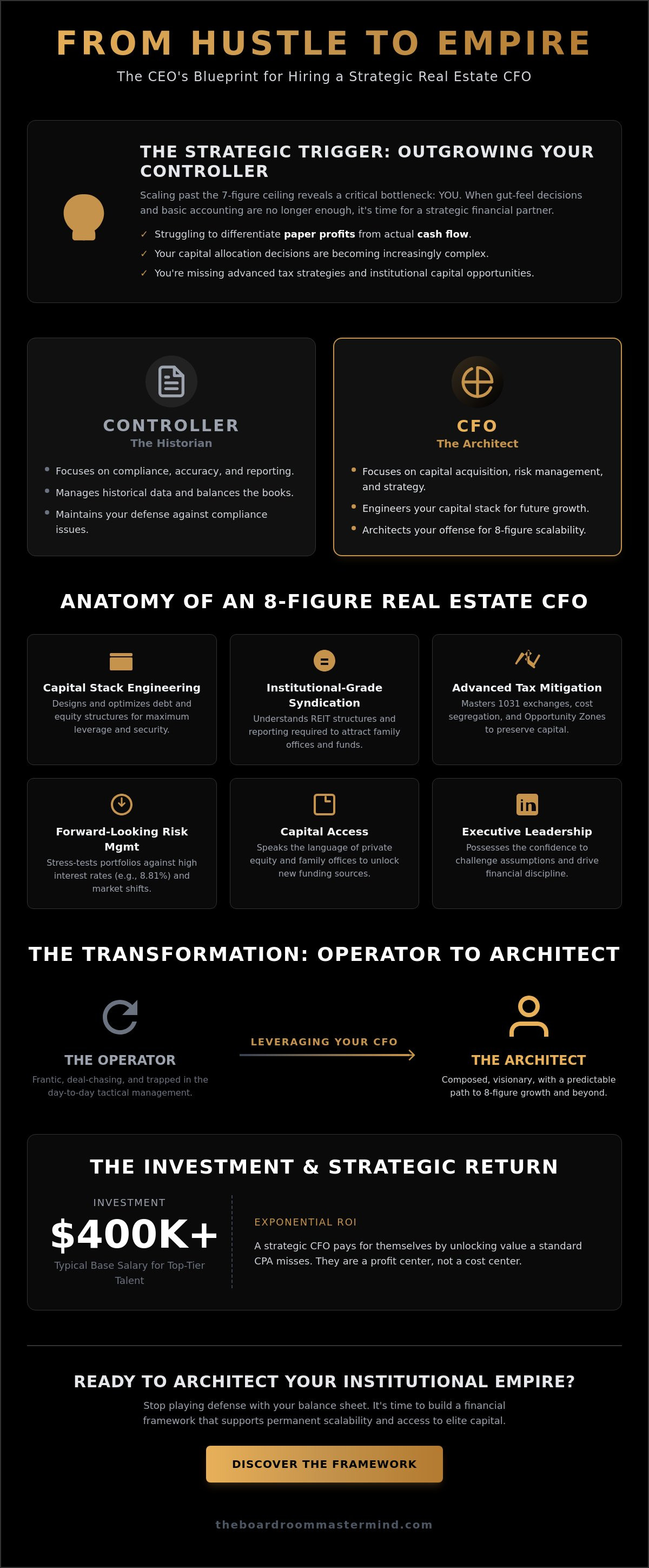
Scaling past the initial growth phase requires a fundamental shift in how you view your balance sheet. Most real estate operators hit a wall when their portfolio reaches a certain complexity. This is the 7-figure ceiling. It's the point where traditional bookkeeping fails to provide the clarity needed for institutional-grade decisions. If you're still the one reviewing every line item on a P&L, you are the bottleneck. Hiring a CFO for real estate company growth is the only way to break through this plateau. A Real Estate CFO is a strategic partner in wealth architecture, not just a compliance officer.
The transition happens when your deals move from simple acquisitions to complex syndications. You might find yourself struggling to articulate true cash flow versus paper profits. Perhaps you are missing out on advanced tax mitigation strategies that could save hundreds of thousands annually. Every hour you spend acting as a part-time CFO is an hour you aren't spending on high-level relationship engineering. That opportunity cost is the silent killer of 8-figure ambitions.
Controller vs. CFO: Knowing the Difference
Confusion between these roles often leads to expensive hiring mistakes. A Controller is your historian. They focus on accuracy, compliance, and reporting historical data. Conversely, a Chief Financial Officer (CFO) is your architect. They focus on capital acquisition, risk management, and forward-looking strategy. Hiring a CFO too early wastes capital on strategy you can't execute; hiring a Controller too late leaves you blind to systemic risks that can collapse a portfolio.
The ROI of Financial Sophistication
A strategic CFO doesn't just cost money; they generate it through precision. They pay for themselves by optimizing debt structures and identifying tax savings that a standard CPA might overlook. This level of oversight is essential for those ready to move from a frantic hustle to a permanent legacy. If you feel stuck at your current level, read our guide on The 7-Figure Ceiling: A CEO Guide to Exclusive Mastermind Groups to understand the ecosystem required for elite scaling.
The Anatomy of an 8-Figure Real Estate CFO: Beyond the Balance Sheet
Generalist CFOs are plentiful. Elite real estate architects are rare. When you are hiring a CFO for real estate company expansion, you aren't looking for a corporate accountant who happens to work in property. You need a strategist who understands the velocity of money within a specific asset class. They must look past the ledger and see the untapped potential in your capital stack. An elite hire doesn't just manage your current wealth; they architect the systems that make future wealth inevitable.
Core Competencies for Real Estate Scale
A high-level hire must navigate the nuances of 1031 exchanges, cost segregation, and Opportunity Zones with surgical precision. They don't just record transactions. They engineer them. This includes structuring private equity funds and maintaining the rigorous reporting standards required by institutional lenders. If they haven't lived in the world of Real Estate Private Equity, they aren't equipped for your next phase of growth. To see how this level of sophistication integrates with a high-performance peer group, explore The Boardroom experience.
The Hiring Blueprint for a CFO emphasizes that the right archetype depends on your current trajectory. For an 8-figure real estate firm, that archetype is the 'Capital Architect.' This individual speaks the language of family offices. They understand that integrated business operating systems must replace manual spreadsheets to maintain institutional-grade transparency. Furthermore, they possess the confidence to challenge your financial assumptions. If your CFO agrees with everything you say, one of you is redundant. This friction creates a resilient, unbreakable business model.
The Strategic Skill Set Table
| Metric | Generalist CFO | Elite Real Estate CFO |
|---|---|---|
| Capital Sourcing | Traditional bank loans | Family offices and Private Equity |
| Tax Strategy | Compliance and Filing | Wealth architecture and 1031s |
| Deal Underwriting | Basic ROI analysis | Multi-layered waterfall structures |
| Risk Mitigation | Insurance and Audits | Market cycle and liquidity hedging |
| Technology | Standard ERPs | Integrated RE operating systems |
The Hiring Blueprint: Vetting for Strategic Alignment and Capital Access
Hiring is an acquisition of intellectual capital. When hiring a CFO for real estate company expansion, the process must mirror the rigor of your most complex deal. You aren't just filling a seat; you're recruiting a partner to safeguard your legacy. Generic interview questions about GAAP compliance, which competitors often suggest, are insufficient for an 8-figure enterprise. You need a framework that isolates strategic brilliance from technical competence.
- Phase 1: Defining the Seat. Determine if your current deal flow requires a full-time executive or if a fractional lead can bridge the gap. Understanding When to Hire a CFO ensures you don't over-leverage your overhead before your capital stack is ready.
- Phase 2: The Stress Test. Hand the candidate a post-mortem of a past deal that underperformed. Ask them to identify the structural flaws and how they would have restructured the debt to preserve equity.
- Phase 3: The Capital Test. Evaluate their existing network. An elite CFO should arrive with established relationships at family offices and institutional lending desks, ready to lower your cost of capital on day one.
Verify their history of navigating market downturns by requiring a detailed post-mortem on how they preserved liquidity and managed debt covenants during previous periods of significant interest rate volatility or economic contraction. This level of scrutiny separates the theorists from the battle-tested veterans.
Interviewing for High-Stakes Decision Making
Your questions must uncover their philosophy on leverage and liquidity. Ask how they balance the pursuit of aggressive growth with the necessity of cash reserves. They must also demonstrate the ability to simplify complex financial data for your Board of Advisors. For more on structuring your executive circle, see our guide on Building a Leadership Team: The CEO’s Blueprint for 8-Figure Scale.
Onboarding for Immediate Impact
The first 90 days are critical for establishing authority. Your new CFO should immediately audit the current capital stack to identify "leaks" in interest payments or tax inefficiencies. This period must establish a permanent feedback loop where your high-level vision is constantly stress-tested against their financial reality. If you are ready to scale with a peer group of high achievers who have already mastered this transition, apply for The Boardroom Mastermind Membership today.
From Operator to Architect: Leveraging Your CFO to Exit the Day-to-Day
Success at the 8-figure level isn't measured by how hard you work; it is measured by how little the business requires your daily presence. Hiring a CFO for real estate company sustainability is the definitive move that transforms you from a deal-chaser into a true architect. While a Controller reports on the past, your CFO builds the future by engineering an unbreakable business operating system. This shift allows you to stop managing transactions and start managing the financial dashboard that dictates your global strategy.
When you have complete financial transparency, you gain more than just data. You gain personal freedom and the ability to focus on legacy building. The CFO becomes the cornerstone of your executive board, providing the calculated confidence needed to pursue high-stakes opportunities. They ensure every expansion is backed by a sophisticated capital stack, allowing you to focus exclusively on high-level vision and relationship engineering with elite partners.
The CEO Mindset Shift
Moving from operator to CEO requires a significant psychological hurdle. You must stop managing bank accounts and start trusting an A-player with the company's financial engine. It is about letting go of the tactical to master the strategic. This transition is essential for implementing a Business Operating System: The Architecture of 8-Figure Real Estate Scaling. Without this trust, you will remain the bottleneck in your own empire.
Engineering Your Exit
An institutional-grade business is an attractive asset. A strategic CFO prepares your company for a potential exit or institutional acquisition by ensuring every record is audit-ready and every fund is structured for maximum valuation. They turn your hustle into a permanent, sellable asset that functions independently of your effort. Ready to stop being the bottleneck? Apply to join The Boardroom Mastermind and scale your empire.
Architecting Your Institutional Empire
The transition from a high-yield hustle to an institutional empire is not a matter of effort; it is a matter of architecture. By hiring a CFO for real estate company expansion, you secure the strategic oversight necessary to navigate complex regulatory environments and sophisticated capital stacks. You stop being the bottleneck. You start being the visionary. This shift ensures your business operates with surgical precision while you focus on high-level relationship engineering and legacy building.
If you're ready to audit your business alongside a network of 7, 8, and 9-figure real estate entrepreneurs, you belong in a different room. Gain exclusive access to institutional-grade scaling strategies and quarterly in-person business audits designed for those at the highest tiers of financial success. Scale your business with elite peers at The Boardroom Mastermind. The path to the next level is clear for those with the right access. Your legacy is waiting.
Frequently Asked Questions
When is the right time for a real estate company to hire a full-time CFO?
The right time arrives when your financial complexity outpaces your ability to manage capital architecture and you need to transition from operator to visionary. If you are managing multiple syndications or preparing to secure institutional-grade capital, you have passed the threshold. This hire is triggered by the need for forward-looking strategy rather than historical bookkeeping.
What is the typical compensation structure for a CFO in an 8-figure real estate firm?
Total compensation for an elite CFO in a high-growth private firm typically ranges from $261,533 to over $400,000 as of May 2026. This package usually includes a base salary, performance-based bonuses, and potentially equity or carried interest. In private equity-backed firms, average cash compensation for CFOs reached $604,000 in 2025, reflecting the high stakes of these roles.
Can a fractional CFO provide the same value as a full-time hire for a growing company?
A fractional CFO provides high-level strategic value for companies that aren't yet ready for a full executive overhead. They are particularly effective for specific projects like fundraising or implementing the 2026 FASB standards. However, a full-time hire becomes essential once the business requires a permanent seat at the executive board for daily capital architecture and long-term wealth building.
What are the biggest mistakes founders make when hiring their first CFO?
The most common mistake is hiring a glorified controller instead of a strategic architect. Founders often focus on historical accuracy and compliance rather than capital sourcing and risk mitigation. Another error is failing to vet for cultural alignment. If your CFO doesn't have the confidence to challenge your financial assumptions, they cannot effectively protect your legacy or your capital.
How much real estate industry experience does a CFO actually need?
Deep industry experience is non-negotiable when hiring a CFO for real estate company growth. They must understand the nuances of 1031 exchanges, cost segregation, and the specific debt covenants associated with commercial lending. A generalist CFO will struggle to navigate the unique tax mitigation strategies and capital stack complexities that define 8-figure real estate empires.


