
Executive Peer Groups for Entrepreneurs: Scaling Beyond the 7-Figure Ceiling in 2026
If you're still the smartest person in your boardroom, you aren't leading a company; you're managing a ceiling. At the seven-figure mark, the isolation of high-stakes leadership becomes a tangible operational bottleneck. You've built a successful engine, but you're still the primary mechanic, and that's exactly why you're stuck. Elite executive peer groups for entrepreneurs aren't about networking or entry-level mentorship. They're about strategic proximity and the transition from tactical management to true executive oversight.
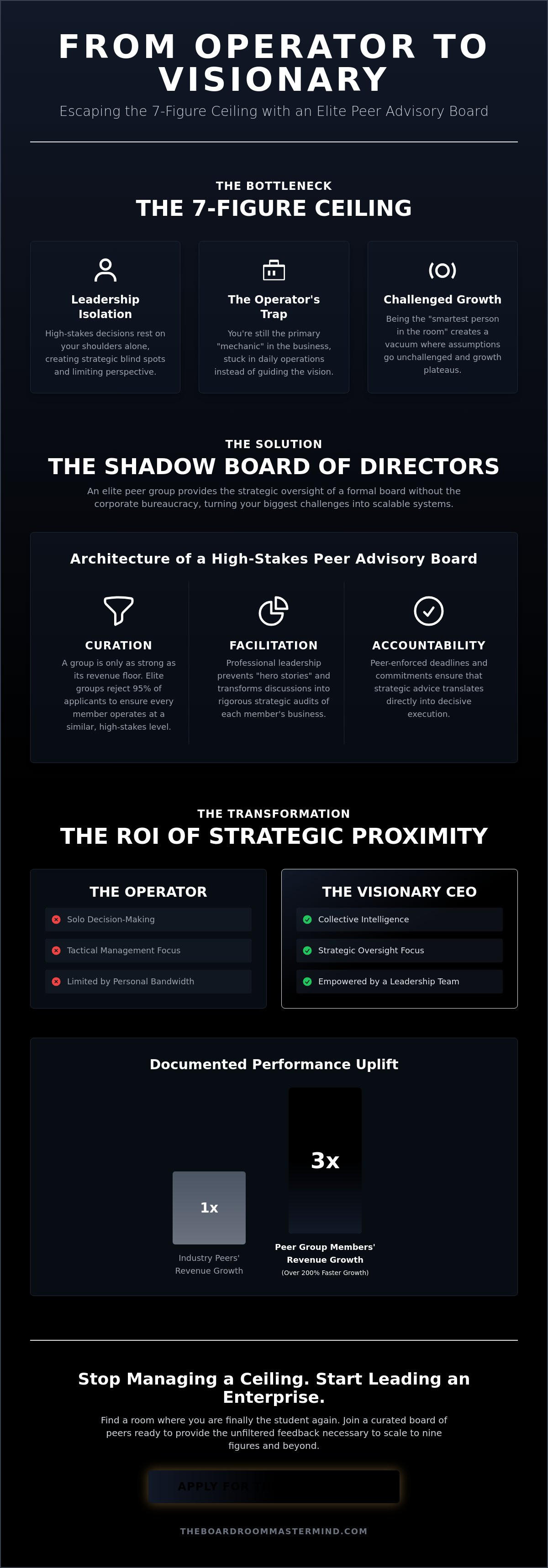
We understand that your time is your most guarded asset. You don't need more general advice; you need a shadow board of directors to provide unfiltered feedback and proven frameworks for scaling to nine figures. This guide reveals how the right advisory board provides the strategic architecture necessary to reclaim your autonomy and maximize your impact. We'll examine the ROI of high-level groups, where members have been found to achieve over 200% faster revenue growth than their industry peers, and show you how to find a room where you're finally the student again.
Key Takeaways
- Learn why solo decision-making becomes a terminal liability at the seven-figure mark and how a "shadow board" provides the objective oversight needed to scale.
- Identify the structural pillars of elite executive peer groups for entrepreneurs, moving beyond casual networking toward a curated environment of strategic accountability.
- Master the vetting process for high-level groups by auditing revenue floors and ensuring the facilitation style mirrors a professional strategic audit.
- Discover the tactical shift required to "fire yourself" from daily operations and build a leadership team that enables true visionary autonomy.
- Understand how the transition from tactical management to strategic oversight protects your personal well-being while accelerating business expansion.
The Strategic Necessity of Executive Peer Groups for Scaling Entrepreneurs
Scaling a business past the seven-figure mark requires a fundamental shift in how you process information. At this level, your primary obstacle isn't a lack of effort; it's the limitation of your own perspective. Most entrepreneurs operate without a formal board of directors, leaving them vulnerable to blind spots that can derail growth. This is where executive peer groups for entrepreneurs become a strategic necessity. Think of these groups as a "shadow board" of directors. They provide the high-level governance and strategic oversight that solo operators lack, but without the red tape of corporate bureaucracy.
Solo decision-making is a liability in a high-growth environment. When every major pivot, hire, and investment rests on your shoulders alone, you become the ultimate bottleneck. High-level proximity is the only cure for this stagnation. Organizations like the Entrepreneurs' Organization (EO) have demonstrated for decades that founders who surround themselves with peers at similar revenue thresholds scale faster and more predictably. Proximity is power. It isn't just a cliché; it's a calculated strategy to engineer eight-figure growth by borrowing the collective experience of those who have already navigated the terrain.
The 7-Figure Ceiling: Why Your Network Must Evolve
If your current circle is still discussing basic marketing tactics or "hustle" culture, you've outgrown the room. Being the smartest person in the room is a dangerous position for a CEO. It creates a vacuum where your assumptions go unchallenged and your mistakes go unnoticed. You need a network that forces you to level up, not one that celebrates your current plateau. For a deeper dive into this transition, read The 7-Figure Ceiling: A CEO Guide to Exclusive Mastermind Groups. If your peers aren't pushing you toward strategic oversight, they're inadvertently keeping you in tactical management.
From Networking to Strategic Collaboration
Forget the cocktail hours and business card exchanges of entry-level networking. True executive peer groups for entrepreneurs function as a rigorous executive briefing environment. The focus shifts from casual "tips" to deep business model auditing. Your peers don't just offer encouragement; they identify operational bottlenecks that your internal team is too close to see. This level of strategic collaboration allows you to stress-test your systems against the reality of eight and nine-figure operations. It ensures your infrastructure is ready for the weight of expansion before you pull the trigger on your next major growth phase.
Beyond Networking: The Architecture of a High-Stakes Peer Advisory Board
A high-stakes peer advisory board is not a social club. It's a precision-engineered environment designed to strip away operational noise and expose the strategic core of your business. Unlike generic networking groups, elite executive peer groups for entrepreneurs rely on a rigorous architecture of curation, facilitation, and accountability. Without these three pillars, you aren't scaling; you're just talking. You need an environment where the stakes are high enough to force a fundamental evolution in your leadership style.
The Power of Curation: Why 95% of Applicants Should Be Rejected
A group is only as strong as its weakest member's revenue floor. If you're managing an eight-figure enterprise, advice from a lifestyle business owner isn't just irrelevant; it's a liability. Elite groups maintain their integrity by rejecting the vast majority of applicants. This stage-matching ensures that every person in the room understands the complexity of high-level scaling. It creates a space where the conversation starts where entry-level masterminds end. An in-depth academic analysis of these environments confirms that the perceived ROI is directly tied to the caliber of the participants and the structure of the sessions.
Facilitated Accountability: The Difference Between Advice and Execution
High-ego rooms require professional facilitation to remain productive. Without a trained lead, discussions often devolve into a series of "hero stories" rather than strategic audits. Peer-enforced accountability is the catalyst for the "Operator to CEO" transition. It's easy to ignore your own deadlines; it's much harder to face a room of your peers and explain why you failed to implement a critical system. To translate these peer-driven insights into reality, you need a robust business operating system. This framework allows you to install the strategic shifts discussed during our Quarterly In-Person Intensives, which function as a business "reset" button. If you're ready to audit your current trajectory, consider exploring The Boardroom Mastermind Membership to see if your business qualifies for this level of proximity.
Vetting for ROI: How to Identify a Group That Matches Your Ambition
Selecting the wrong environment is a costly tactical error. To ensure your investment yields exponential returns, you must look past the marketing and audit the room's actual density. High-level executive peer groups for entrepreneurs should be vetted with the same rigor you'd apply to a corporate merger. If the vetting process feels light, the value will be too. You aren't looking for a social circle; you're looking for a strategic asset that stress-tests your business model.
- Audit the Revenue Floor: Ensure every member operates at or above your current scale. A room full of six-figure founders can't help you navigate eight-figure liquidity events.
- Evaluate Facilitation: Is the session a group therapy hour or a strategic audit? You need a facilitator who acts as a Chief Operating Officer, not a life coach.
- Balance Breadth and Depth: While industry-specific groups offer depth, cross-industry leadership breadth provides the superpowers for leaders required to spot disruptive opportunities outside your niche.
- Measure Access: Does the group provide direct proximity to nine-figure mentors? Proximity to those who have already achieved your ten-year goal is the ultimate shortcut.
Calculating the Financial Impact of Peer Insights
Mastermind ROI is the delta between your current trajectory and your peer-optimized path. It's often found in a single, high-stakes adjustment. One strategic tweak in your capital stack or a single high-level leadership hire can pay for years of membership dues. Forbes identifies these environments as providing superpowers for leaders, specifically through the lens of radical confidentiality and objective feedback. If you aren't seeing a clear path to a 10x return on your time and capital, you're in the wrong room.
The Red Flags of Low-Level Masterminds
Avoid groups that prioritize "motivation" over "mechanics." If the agenda is heavy on inspiration and light on business architecture, it's a social club, not a strategic asset. "Pay-to-play" models without a strict vetting process lead to diluted value and wasted time. You're looking for restricted access, not a high-volume sales funnel. If you're ready to stop guessing and start executing with precision, apply for The Boardroom Mastermind Membership to see if you qualify for our elite tier of strategic oversight.
The Boardroom Shift: Transitioning from Operator to Visionary CEO
The final evolution of a high-growth founder isn't about working harder; it's about shifting your identity. To break through the eight-figure ceiling, you must systematically fire yourself from the daily hustle. High-level executive peer groups for entrepreneurs facilitate this identity shift by exposing the inefficiency of your current operator habits. You can't scale to nine figures while still approving every marketing asset or resolving minor operational disputes. True autonomy is found when you transition from being the engine of the business to becoming its architect.
Achieving this level of scale requires more than just a mindset shift. It requires the strategic execution of building a leadership team that can carry the weight of your ambition. This isn't just about hiring; it's about creating an institutional-level infrastructure that functions independently of your presence. Your peer group acts as the ultimate shortcut, providing the blueprint for peak performance without the standard sacrifice of personal well-being. By observing how your peers have decentralized their decision-making, you gain the confidence to do the same.
The Architect Mindset: Designing a Business That Runs Without You
The Tactical Manager reacts to complexity, while the Strategic Visionary designs systems to prevent it. Peer feedback accelerates this transition by identifying the tasks you're still clinging to out of habit rather than necessity. When you're surrounded by CEOs who have already institutionalized their operations, the path to stepping away from the grind becomes a clear, logical sequence. This proximity allows you to audit your business model through the lens of a buyer or an investor, rather than a tired founder.
Engineering Your Elite Future
Strategic proximity is your unfair advantage. It's the difference between guessing your way through a growth phase and following a battle-tested architecture. The transition to a visionary CEO is inevitable when you're consistently challenged by a room of true peers. If you're ready to audit your current trajectory and claim your seat at the table, it's time to explore the Boardroom Experience. Our community is built for those who value time, privacy, and high-level execution above all else. Whether through The Boardroom Mastermind Membership or our exclusive Boardroom Elite tier, the next level of your leadership starts with the right room.
Claim Your Seat at the Ultimate Strategic Table
Scaling beyond the seven-figure mark is a feat of engineering, not just effort. You've already proven you can build an engine; now you must prove you can lead an organization. By integrating the strategic architecture of elite executive peer groups for entrepreneurs, you move from the chaos of daily operations to the clarity of visionary oversight. This transition is the only way to ensure your business serves your life, rather than consuming it.
The Boardroom Mastermind offers a community built on battle-tested leadership and strategic scale. We focus exclusively on experienced real estate entrepreneurs who are ready to audit their current trajectory and kill their operational bottlenecks. Through our Quarterly In-Person Intensives, you'll gain direct proximity to 7, 8, and 9-figure founders who have already navigated the complexities of institutional growth. Don't let your current success become the ceiling for your future impact.
Apply to Join the Elite: Audit Your Business with The Boardroom Mastermind
The next level of your legacy is waiting for you to step out of the engine room. You've done the hard work of building; now it's time to do the smart work of scaling. The path is clear for those with the right access.
Frequently Asked Questions
What is the difference between an executive peer group and a standard mastermind?
Executive peer groups for entrepreneurs focus on strategic governance and institutional scaling, whereas standard masterminds often prioritize tactical hacks and casual networking. In an elite environment, the group functions as a shadow board that audits your business model. You move beyond simple advice into a structured framework of accountability and high-level operational oversight designed for established leaders.
How do I know if I'm ready for a high-ticket executive peer group?
You're ready when you've reached a revenue plateau where your own expertise has become the primary bottleneck. If you're the smartest person in your current circle and solo decision-making feels like a liability, you've outgrown entry-level mentorship. Readiness is defined by your willingness to subject your business to a rigorous strategic audit and your desire to transition from tactical operator to visionary CEO.
Will joining a peer group actually save me time, or just add more meetings to my calendar?
Joining an elite group saves time by preventing the costly tactical errors that arise from isolated leadership. While it requires a commitment to quarterly intensives, the output is a streamlined business that runs without your constant intervention. You're trading a few days of high-level briefing for hundreds of hours otherwise spent on low-impact management tasks and operational troubleshooting.
What revenue level is typically required for elite executive peer groups?
Elite executive peer groups for entrepreneurs typically require a minimum revenue floor of $1 million to ensure all members face similar scaling challenges. Organizations like YPO often look for founders leading companies with $10 million to $15 million in annual revenue. This strict curation ensures that the strategic advice shared remains relevant to the complexities of high-stakes business operations and institutional growth.
Can a peer group help me transition from a real estate investor to a fund manager?
The transition from investor to fund manager is primarily a shift in business architecture and capital sophistication. High-level peer groups provide proximity to individuals who've already institutionalized their capital raising and management processes. You'll gain the frameworks necessary to move from individual deal-making to the strategic oversight of a scalable investment vehicle, ensuring your infrastructure can handle increased capital velocity.


