
Emotional Intelligence in Leadership: The CEO’s Secret Operating System for 8-Figure Scale
What if the primary bottleneck preventing your transition to 8-figure scale isn't your marketing spend, but your own internal operating system? You've built a powerful engine, yet you still feel like the only mechanic capable of keeping it on the tracks. You're likely exhausted by decision fatigue and the constant churn of a team that refuses to take ownership. It's a common plateau for high-stakes hustlers. However, mastering emotional intelligence in leadership is the differentiator that separates the tactical operator from the strategic CEO.
Refining this psychological architecture is the only way to pass through the Owner Optional gate. This article explores how your EQ allows you to build an unbreakable, self-managing team that owns outcomes. We'll examine the P7 Framework, specifically the People and Purpose pillars, to show you how to audit your leadership using the GWC diagnostic. You'll learn how to replace frantic reactivity with the calculated confidence required for high-stakes negotiations. It's time to stop managing tasks and start architecting a legacy that runs without your daily interference.
Key Takeaways
- Escape the Founder's Trap by reframing your internal operating system to prioritize objective, data-driven decision-making over reactive firefighting.
- Leverage the Builder's Hour and strategic self-regulation to maintain high-level focus even amidst the inevitable chaos of rapid expansion.
- Implement the GWC diagnostic to operationalize emotional intelligence in leadership, ensuring every seat is filled by a high-performer who owns their outcomes.
- Accelerate your evolution through the proximity effect, using elite peer environments to perform radical self-audits and unlock the "Owner Optional" gate.
Beyond the Hustle: Why Emotional Intelligence is the CEO’s Scaling Lever
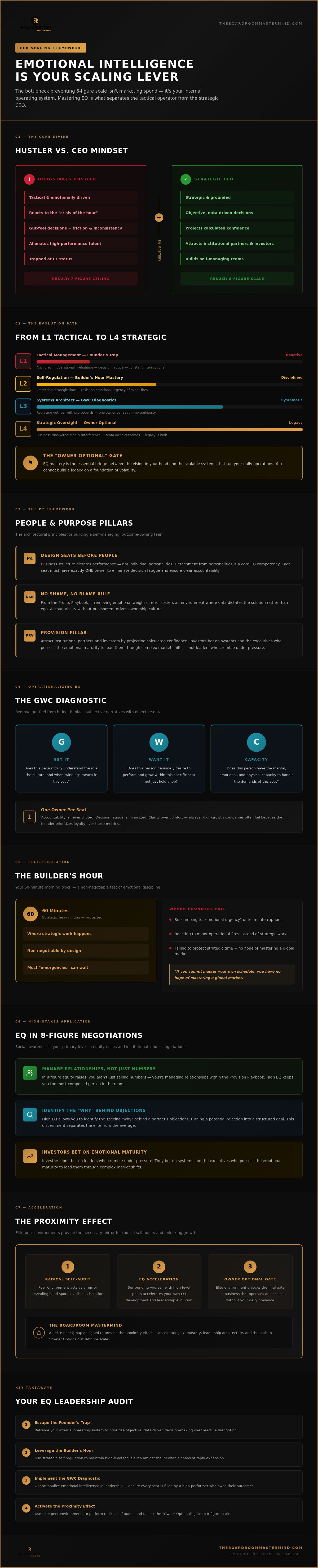
Scaling a business to 8 figures isn't a matter of working harder. It's a matter of thinking better. High-level emotional intelligence is the clinical ability to regulate your internal state to ensure every move is objective and data-driven. Without it, you're just a high-stakes hustler masquerading as a CEO. You're likely trapped in the "Founder's Trap," where reacting to every operational fire keeps you anchored at L1 status. This tactical reactivity is the ultimate growth killer.
The difference between a frantic operator and a strategic visionary lies in composure. A hustler mindset is tactical and emotionally driven, constantly pivoting based on the crisis of the hour. A true CEO mindset is strategic and grounded. To pass through the "Owner Optional" gate, you must master self-regulation. You cannot build a legacy on a foundation of volatility.
The 7-Figure Ceiling and Emotional Reactivity
Relying on "gut" decisions creates friction and inconsistent results. This emotional unpredictability alienates high-performance talent and stalls momentum. If you want to unlock the Provision pillar of the P7 Framework and attract institutional partners, you must project calculated confidence. Investors don't bet on leaders who crumble under pressure. They bet on systems and the executives who possess the emotional maturity to lead them through complex market shifts.
Moving from L1 to L4: The EQ Requirement
Transitioning from a founder-dependent business to a scalable enterprise requires a radical shift in perspective. Emotional intelligence in leadership is the essential bridge between the vision in your head and the scalable systems that run your daily operations. It allows you to step back from the machinery. By mastering your internal state, you empower your team to own their outcomes, effectively moving your organization from L1 tactical management to L4 strategic oversight.
The Architecture of EQ: Strategic Self-Awareness at Scale
High-level scaling requires a shift from intuitive management to architectural precision. You must design "Seats" (roles) before "People" (P4 rule) to ensure the business structure dictates performance, not individual personalities. This detachment is a core component of emotional intelligence in leadership. It allows you to implement the "No Shame, No Blame" rule from the Profits Playbook. By removing the emotional weight of error, you foster an environment where data dictates the solution rather than ego. Each seat must have exactly one owner to eliminate decision-fatigue and ensure clear accountability.
Self-Regulation and the Builder’s Hour
Your 60-minute morning block, known as the Builder's Hour, is a non-negotiable test of emotional discipline. It's the space where strategic work happens. Most founders fail here because they succumb to the "emotional urgency" of team interruptions or minor operational fires. Protecting this hour requires the self-regulation to realize that most "emergencies" can wait until your strategic heavy lifting is complete. If you cannot master your own schedule, you have no hope of mastering a global market.
Reading the Room: EQ in High-Stakes Negotiations
Social awareness is your primary lever during 8-figure equity raises or institutional lender negotiations. You aren't just selling numbers; you're managing relationships within the Provision Playbook. Mastering emotional intelligence in leadership ensures you remain the most composed person in the room during high-stakes negotiations. High EQ allows you to identify the specific "Why" behind a partner's objections, turning a potential rejection into a structured deal. This level of discernment is what separates the elite from the average. If you're ready to audit your own leadership architecture, joining a high-level peer group provides the necessary mirror for growth.
Operationalizing EQ: Using GWC and Scorecards to Lead
Scaling requires you to stop managing by "vibes" and start managing by the numbers on the scoreboard. This shift is the ultimate application of emotional intelligence in leadership. It demands the discipline to replace subjective narratives with objective data. By implementing the rule of "One Owner Per Seat," you eliminate the emotional ambiguity that plagues most org charts. This structure ensures that accountability is never diluted and decision-fatigue is minimized. You aren't just a boss; you're a systems architect who values clarity over comfort.
The GWC Diagnostic: Removing Gut-Feel from Hiring
High-growth companies often fail because the founder prioritizes loyalty over performance. You must use the GWC diagnostic to evaluate every team member. Ask three clinical questions: Do they Get it? Do they Want it? Do they have the Capacity? If the answer is a "No" on any front, the seat remains empty. Loyalty is a powerful emotion, but it shouldn't override the data of a GWC-No. Mastering your emotional response to long-term employees who no longer fit is the hallmark of a CEO ready for 8-figure scale.
Scorecards over Stories: Managing Performance Objectively
Managing performance becomes effortless when you prioritize scorecards over stories. Every seat must have exactly three scorecard numbers. These metrics provide the "truth" of the business, allowing you to lead with composure rather than reactivity. When you are Building a Leadership Team, these numbers act as the guardrails for your culture. Use a 15-minute weekly 1:1 meeting to review these outcomes. This cadence keeps the team aligned without the need for founder intervention. If you're ready to stop guessing and start scaling, apply for The Boardroom Mastermind to secure your seat among the elite.
The Proximity Effect: Mastering EQ within The Boardroom Mastermind
You've operationalized your systems and defined your seats. Now, you must refine the driver. Developing emotional intelligence in leadership isn't a solitary pursuit. It requires proximity to those who've already navigated the 8-figure landscape. In-person quarterly intensives serve as a crucible for radical self-audits. These environments strip away the ego, forcing you to confront the operational bottlenecks you've created. You cannot scale what you cannot see; the right room makes the invisible visible.
The Power of the Elite Peer Group
Most founders confuse an accountability partner with a mastermind. An accountability partner keeps you busy; a mastermind keeps you strategic. The right room filters out the noise of entry-level tactics and demands high-level oversight. If you're struggling to break through The 7-Figure Ceiling, the issue is rarely your talent. It's your environment. You need peers who challenge your emotional defaults and hold you to a CEO standard. This collective intelligence is the ultimate shortcut to behavioral change.
Next Steps: Auditing Your Leadership Capacity
Growth is a recurring 90-day cycle. We utilize the BASE assessment to ensure your leadership capacity expands alongside your profits. This tool provides a clinical check on your progress, moving you from the frantic energy of a hustler to the composed authority of a professional CEO. It's time to stop being the mechanic and start being the architect. If you're ready to solve the People pillar and secure your legacy, apply for membership in The Boardroom Mastermind. High-level execution is the only logical conclusion for those with the right access. Your transition from operator to visionary begins with a single, decisive audit of your emotional intelligence in leadership.
Architecting Your 8-Figure Legacy
Mastering your internal operating system is the final hurdle to achieving owner-optional status. We've explored how emotional intelligence in leadership moves you beyond the "Founder's Trap" by replacing reactive fires with clinical, data-driven systems. By operationalizing the GWC diagnostic and implementing objective scorecards, you ensure that your team owns outcomes while you maintain strategic oversight. This shift isn't just about efficiency; it's about the psychological maturity required to lead a self-managing enterprise.
True transformation happens through proximity to high-growth real estate investors who've already scaled to 8 and 9 figures. Through quarterly in-person intensives, you can audit your business model alongside an elite peer network that understands the stakes. It's time to stop being the bottleneck in your own expansion and start leading with the composure of a battle-tested visionary. Scale your leadership and your business; Apply for The Boardroom Mastermind. The path to the next level is clear for those ready to execute.
Frequently Asked Questions
What is the difference between IQ and EQ in executive leadership?
IQ represents your technical proficiency and cognitive ability to solve complex problems, while EQ is the psychological architecture that allows you to manage yourself and your team. In high-stakes environments, IQ gets you into the room, but emotional intelligence in leadership ensures you stay there. It's the difference between being a brilliant individual contributor and a strategic CEO who can build a self-managing, 8-figure enterprise.
Can emotional intelligence actually be learned by established business owners?
Yes, EQ is a skill developed through radical self-audit and intentional practice rather than a fixed trait. Established owners often refine this capacity by implementing the Builder's Hour, a non-negotiable 60-minute daily block dedicated to strategic work. By consistently applying tools like the GWC diagnostic, you retrain your brain to prioritize objective data over reactive "gut" feelings, effectively upgrading your internal operating system for 8-figure scale. Emotional intelligence in leadership is a practiced discipline.
How does low emotional intelligence impact a company's ability to scale?
Low EQ creates a "Founder's Trap" where the business remains entirely dependent on your daily intervention. This leads to high-stress decision fatigue and team turnover because staff feel no sense of ownership. Without self-regulation, you'll struggle to pass the "Owner Optional" gate. Your inability to detach emotionally from operational fires prevents the organization from moving from tactical L1 management to the scalable L4 systems required for predictable, significant growth.
What are the most important EQ traits for a real estate CEO?
Composure and social awareness are paramount for those operating at the highest tiers of real estate. You must maintain a neutral emotional state to make objective decisions during volatile market shifts. Additionally, the ability to design "Seats" before "People" requires a level of detachment that average operators lack. These traits allow you to lead with calculated confidence, ensuring your leadership team owns outcomes while you focus on wealth architecture.
How do I use EQ to handle high-stress negotiations or deal collapses?
Use EQ to regulate your stress response and identify the specific "Why" behind a partner's or seller's objections. Instead of reacting defensively to a deal collapse, a high-EQ leader uses the "No Shame, No Blame" rule to analyze the failure objectively. This strategic composure allows you to manage institutional lender relationships effectively. It ensures that no deal dies waiting for a leader who is too emotionally volatile to pivot.

Disclaimer
Mr. Clothier is an expert in real estate investing. As such his experiences are not necessarily typical to the standard real estate investor and whose results may vary. The successes shared on this site are not considered typical. Most individuals who order the educational materials and systems probably do not follow any of the techniques or strategies and consequently make little to no money due to their inaction. The company is in the process of determining the typical success of its clients. Stories shared herein are for example purpose only and should not be construed as "guarantees" of success. Results will vary based on background, education, and experience and actions taken.
This site is not a part of the Google/Facebook website or Google/Facebook Inc. Additionally, this site is NOT endorsed by or affiliated with Google/Facebook in any way. GOOGLE/FACEBOOK is a trademark of GOOGLE/FACEBOOK, Inc.
INCOME DISCLAIMER: This website and the items it distributes contain business strategies, marketing methods and other business advice that, regardless of referenced results and experience, may not produce the same results (or any results) for you. The Boardroom Mastermind makes absolutely no guarantee, expressed or implied, that by following the advice or content available from this web site you will make any money or improve current profits, as there are several factors and variables that come into play regarding any given business. Primarily, results will depend on the nature of the product or business model, the conditions of the marketplace, the experience of the individual, and situations and elements that are beyond your control. As with any business endeavor, you assume all risk related to investment and money based on your own discretion and at your own potential expense.
LIABILITY DISCLAIMER: By reading this website or the documents it offers, you assume all risks associated with using the advice given, with a full understanding that you, solely, are responsible for anything that may occur as a result of putting this information into action in any way, and regardless of your interpretation of the advice. You further agree that The Boardroom Mastermind, its affiliates, subsidiaries, officers and agents, cannot be held responsible in any way for the success or failure of your business as a result of the information provided. It is your responsibility to conduct your own due diligence regarding the safe and successful operation of your business. In summary, you understand that we make absolutely no guarantees regarding income as a result of applying this information, as well as the fact that you are solely responsible for the results of any action taken on your part as a result of any given information. In addition, you agree that our content is to be considered "for entertainment purposes only". Always seek the advice of a professional when making legal, financial, tax, or business decisions.
BUSINESS OPPORTUNITY: All products and services offered by The Boardroom Mastermind are intended to provide prospective purchasers with general business strategies, marketing methods and other general advice for business development and training. At no point is The Boardroom Mastermind soliciting anyone to enter into a new business nor is it representing, either expressly or by implication, that it will provide locations for a business, provide outlets, accounts, or customers, or purchase any of the goods or services made by the purchaser.
The products being offered through this promotion are packages of informational tools to help you learn about business and deal making strategies.


