
Developing a Real Estate Investment Philosophy: A Practical Framework
Developing a real estate investment philosophy starts with a useful question: what makes a deal worth pursuing, and what would make you walk away? A compelling opportunity can still be the wrong fit for your capital, risk tolerance, or time horizon.
Experienced investors know markets shift. The harder challenge is keeping decisions consistent when each deal brings a different mix of potential returns, risks, and trade-offs. Without clear criteria, it’s easy to react to the opportunity in front of you and lose sight of what you’re building toward.
A written investment philosophy is a decision filter, not a forecast of what the market will do. It helps you define your objectives, set boundaries, and decide what every opportunity must answer before it earns your attention.
This practical framework will help you connect investment choices to personal priorities, compare strategies by their demands and risks, and assess deals using consistent questions. You’ll also learn how to update your principles when your circumstances change without rewriting them to justify a disappointing outcome.
Key Takeaways
- Developing a real estate investment philosophy means writing down the principles that guide what you pursue, reject, and review, rather than relying on a market forecast or preferred property type.
- Define your purpose, time horizon, liquidity needs, and tolerance for uncertainty before comparing strategies.
- Use a repeatable deal review: test alignment, separate evidence from assumptions, identify risks, and record what could change your decision.
- Review your principles when your circumstances or evidence change, but don’t abandon them because of one disappointing outcome.
What Does Developing a Real Estate Investment Philosophy Actually Mean?
Developing a real estate investment philosophy means putting in writing the principles that guide what you pursue, reject, and review. It turns broad ambitions into a decision framework you can use before a deal starts competing for your attention.
A philosophy isn’t a market forecast or a single acquisition, and it’s more than a preference for one property type. A multifamily focus, for example, describes an asset preference. A philosophy explains whether that investment fits your objectives, risk boundaries, resources, and operating capacity. A broad Principles of Real Estate Investing overview can help you see the range of strategies your criteria may need to assess.
No single philosophy suits every investor. Your capital needs, time horizon, business capabilities, and tolerance for uncertainty shape what makes an opportunity appropriate. Market conditions change; durable decision principles help you choose how to respond.
What belongs in an investment philosophy?
Write down your objectives, acceptable risks, time horizon, liquidity needs, preferred assets, and operating approach. Make each principle specific enough to guide a decision. For example, rather than writing “I want manageable deals,” describe the level of hands-on oversight you can sustain and what kinds of operational demands would exceed that capacity.
Then test how your criteria work together. A strategy may fit your preferred asset type but require more oversight than your business can support, or commit capital longer than your plans allow. These are connected constraints, not isolated preferences. The philosophy should make those trade-offs visible before you evaluate a deal.
Why investors need principles before the next opportunity appears
Urgency can narrow attention. A seller’s deadline or a compelling projection may push you to focus on upside before asking whether the deal serves your larger plan. Pre-set criteria give you a pause point: identify which requirements the opportunity meets, which it misses, and what information is still uncertain.
This won’t guarantee performance or eliminate risk. It does make your reasoning more consistent and your trade-offs easier to see before you commit. If a deal appears to require an exception, write down the reason rather than quietly changing the rule to make the opportunity fit.
Which Principles Should Shape Your Real Estate Investment Philosophy?
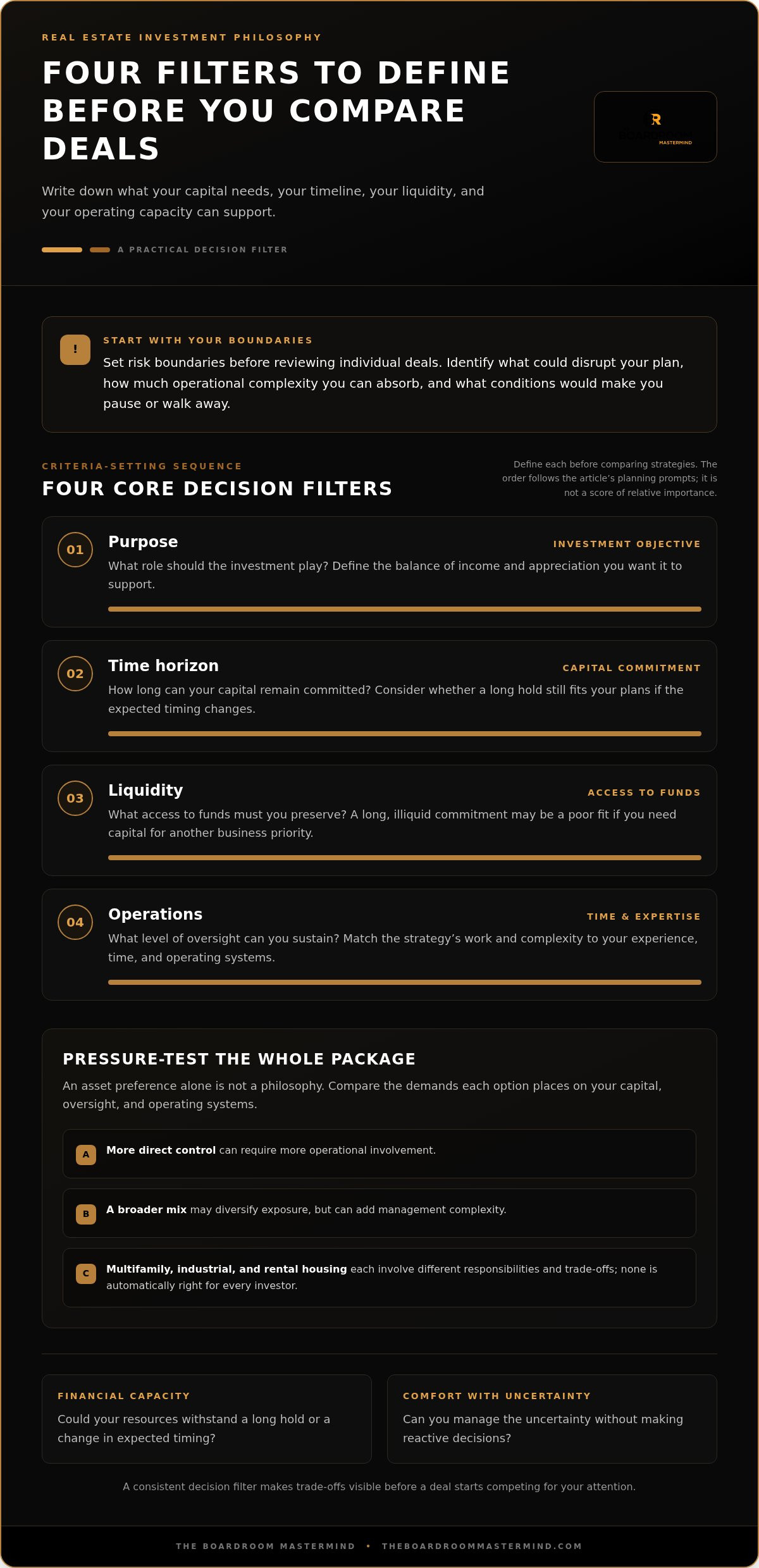
Start by writing down what your capital needs to accomplish, when you may need access to it, and how much uncertainty you can tolerate. Developing a real estate investment philosophy means making those priorities explicit before comparing opportunities. Include your desired balance of income and appreciation, intended holding period, liquidity requirements, and the time and expertise you can commit to operations.
Set your risk boundaries before reviewing individual deals, or an attractive projection may end up defining your tolerance for you. Make the boundaries practical: identify what could disrupt your plan, how much operational complexity you can absorb, and what conditions would make you pause or walk away.
How do risk tolerance and time horizon affect your approach?
Separate your financial capacity for risk from your comfort with uncertainty. You may have the resources to withstand a long hold but still need liquidity for another business priority. A shorter time horizon or limited access to capital may make a long, illiquid commitment a poor fit, even if its projected returns look compelling.
Record both your financial limits and the uncertainty you can manage without making reactive decisions. When reviewing a deal, ask what happens if the expected timing changes or the operating plan demands more of your attention than you anticipated. The purpose is not to predict every outcome, but to understand whether the downside fits your boundaries.
How should asset class and strategy fit your criteria?
Compare options by the demands they place on your capital, oversight, and operating systems. Multifamily, industrial, and rental housing can each involve different responsibilities and trade-offs; none is automatically right for every investor. Greater direct control may require more operational involvement. A broader mix may diversify exposure but can add management complexity.
Evaluate each option as a complete package against your experience, capacity, and objectives. Ask what decisions you would control, what work the strategy requires, and whether you have the systems and time to manage it. Avoid choosing an asset class simply because it is familiar or currently attracting attention.
- Purpose: What role should the investment play?
- Time: How long can capital remain committed?
- Liquidity: What access to funds must you preserve?
- Operations: What level of oversight can you sustain?
Once written, these principles become easier to pressure-test with experienced peers. The real estate peer group at The Boardroom Mastermind offers strategic discussion and accountability for experienced real estate operators.
How Do You Apply Your Philosophy to a Real Estate Deal?
A written philosophy earns its place when it changes how you evaluate an actual opportunity. Use the same sequence each time, whether the deal looks familiar or pushes you into new territory. Developing a real estate investment philosophy is useful only when its principles shape decisions under pressure.
- Restate the objective. What role should this deal play in your investment plan?
- Test the fit. Compare the asset, timeline, operational demands, and risk profile with your written criteria.
- Examine the assumptions. Separate information supported by deal materials from estimates or expectations that still need evidence.
- Identify the risks. Note what could disrupt the plan and which uncertainties remain unresolved.
- Record the decision. Document why you’ll proceed, pause, or pass, including what could change your conclusion.
A practical deal-fit test for investors
For each criterion, record whether the opportunity meets it, fails it, or needs more information. List unresolved assumptions beside the evidence that could address them. For instance, if the plan depends on a particular operating approach, identify what information would show whether that approach is feasible. Don’t turn unanswered questions into convenient certainties.
Structure matters, too. A direct acquisition and a private equity investment can involve different levels of control, responsibilities, and decision rights. Those differences should influence your criteria, not be treated as paperwork after the fact. Before proceeding, make sure you understand which decisions you can make and what obligations come with the structure.
What should make you revisit a decision?
Reconsider when material new evidence emerges or your objectives, resources, or constraints change. Ordinary market noise alone isn’t a reason to reverse course. If you make an exception to your principles, write down why and review its consequences later. A well-reasoned pass is valuable: it shows the opportunity didn’t meet your criteria, not that you failed to act.
Experienced operators can pressure-test written principles through strategic peer discussion. Explore The Boardroom Mastermind to learn about a community built around collaboration and accountability.
How Can You Keep Your Investment Philosophy Relevant as You Grow?
A philosophy should evolve with evidence, not with every change in market sentiment. Review your decisions, assumptions, and personal or business constraints on a regular basis. Ask what proved accurate, what surprised you, and whether your capacity, priorities, or operating model has changed.
Developing a real estate investment philosophy is an ongoing discipline, but revision should be deliberate. One disappointing outcome may point to an execution issue, a faulty assumption, or an unsuitable deal. It does not automatically mean the underlying principle was wrong. Keep a decision record so you can distinguish between those possibilities rather than relying on memory.
How can outside perspectives pressure-test your principles?
Use peer discussion to expose blind spots, test your logic, and consider what you may have overlooked. The purpose of a peer advisory group is to challenge your reasoning, not make the decision for you. The benefits of peer advisory groups include structured accountability and informed discussion, while ownership of the final decision remains yours.
Who is The Boardroom Mastermind designed for?
The Boardroom Mastermind is a peer environment for experienced real estate operators. Its membership expectations are direct:
- “You MUST be THE REAL DEAL and doing significant business revenue.”
- “The Boardroom Mastermind is not for new business owners that are just getting started. EXPERIENCE MATTERS here.”
- “We have a strict ‘NO DOUCHE BAG’ rule.”
- “No scarcity is allowed.”
- “You MUST be willing to connect any and every ‘dot’ possible for your fellow members.”
- “You MUST be willing to be vulnerable and break down your business needs in front of your fellow members.”
- “You MUST be looking to grow and improve your business DRAMATICALLY and QUICKLY.”
Annual membership includes four quarterly events, weekly Zoom calls where members highlight their business models, bi-weekly Zoom check-in calls for 90-day progress updates, and quarterly hot seat breakdowns. These formats give members opportunities to discuss business challenges, share perspectives, and pressure-test their thinking. The quarterly mastermind experience supports focused peer discussion, not a substitute for your own judgment or a promise of results.
Put Your Principles to Work in the Next Decision
The next step in developing a real estate investment philosophy is to make it part of your operating rhythm. Keep your principles visible, revisit them as your business changes, and create space for thoughtful challenge before high-stakes decisions become urgent. Strong judgment develops through deliberate practice and candid discussion.
For experienced real estate operators, The Boardroom Mastermind provides a peer environment for strategic collaboration and accountability. Its annual membership includes four quarterly events, weekly Zoom calls, bi-weekly check-ins, and quarterly hot seat breakdowns.
If you’re an experienced operator ready to engage with peers and sharpen your decision-making, explore The Boardroom Mastermind membership. Bring your experience, your questions, and a commitment to making decisions with intention.
Frequently Asked Questions
What is a real estate investment philosophy?
A real estate investment philosophy is a decision standard you can use across opportunities, not a prediction about the market. Developing a real estate investment philosophy becomes practical when you translate broad aims into choices. For example, an operator who prioritizes predictable oversight might reject a project requiring unfamiliar, intensive operations, even if its projected upside is attractive. A written rationale makes that choice reviewable later.
Is there one best real estate investment philosophy?
No. A suitable approach depends on your goals, experience, available time, capital needs, and operational strengths. One operator may prioritize direct control and accept hands-on demands; another may value a structure that involves less direct oversight. Neither preference is automatically superior. Test your principles against real constraints: could you explain why an opportunity fits, and would the same reasoning still make sense under pressure?
Can your real estate investment philosophy change over time?
Yes, if a meaningful change in evidence or circumstances supports the revision. Keep a brief change log that identifies the principle being reconsidered, what new information emerged, and which future decisions may be affected. For instance, a new operating responsibility could change how much oversight you can provide. That’s different from rewriting your criteria after one disappointing deal simply to justify the outcome.
How do you know if a real estate deal fits your investment philosophy?
Check whether the deal’s requirements align with your stated priorities, then identify what you’re treating as fact versus expectation. If a plan depends on a particular leasing pace, for example, note what evidence supports that assumption and what remains uncertain. Record your rationale for proceeding or passing. This creates a clear decision trail you can compare with what unfolds, without treating fit as a promise of returns.

Disclaimer
Mr. Clothier is an expert in real estate investing. As such his experiences are not necessarily typical to the standard real estate investor and whose results may vary. The successes shared on this site are not considered typical. Most individuals who order the educational materials and systems probably do not follow any of the techniques or strategies and consequently make little to no money due to their inaction. The company is in the process of determining the typical success of its clients. Stories shared herein are for example purpose only and should not be construed as "guarantees" of success. Results will vary based on background, education, and experience and actions taken.
This site is not a part of the Google/Facebook website or Google/Facebook Inc. Additionally, this site is NOT endorsed by or affiliated with Google/Facebook in any way. GOOGLE/FACEBOOK is a trademark of GOOGLE/FACEBOOK, Inc.
INCOME DISCLAIMER: This website and the items it distributes contain business strategies, marketing methods and other business advice that, regardless of referenced results and experience, may not produce the same results (or any results) for you. The Boardroom Mastermind makes absolutely no guarantee, expressed or implied, that by following the advice or content available from this web site you will make any money or improve current profits, as there are several factors and variables that come into play regarding any given business. Primarily, results will depend on the nature of the product or business model, the conditions of the marketplace, the experience of the individual, and situations and elements that are beyond your control. As with any business endeavor, you assume all risk related to investment and money based on your own discretion and at your own potential expense.
LIABILITY DISCLAIMER: By reading this website or the documents it offers, you assume all risks associated with using the advice given, with a full understanding that you, solely, are responsible for anything that may occur as a result of putting this information into action in any way, and regardless of your interpretation of the advice. You further agree that The Boardroom Mastermind, its affiliates, subsidiaries, officers and agents, cannot be held responsible in any way for the success or failure of your business as a result of the information provided. It is your responsibility to conduct your own due diligence regarding the safe and successful operation of your business. In summary, you understand that we make absolutely no guarantees regarding income as a result of applying this information, as well as the fact that you are solely responsible for the results of any action taken on your part as a result of any given information. In addition, you agree that our content is to be considered "for entertainment purposes only". Always seek the advice of a professional when making legal, financial, tax, or business decisions.
BUSINESS OPPORTUNITY: All products and services offered by The Boardroom Mastermind are intended to provide prospective purchasers with general business strategies, marketing methods and other general advice for business development and training. At no point is The Boardroom Mastermind soliciting anyone to enter into a new business nor is it representing, either expressly or by implication, that it will provide locations for a business, provide outlets, accounts, or customers, or purchase any of the goods or services made by the purchaser.
The products being offered through this promotion are packages of informational tools to help you learn about business and deal making strategies.


