
Developing a Leadership Pipeline: The CEO’s Blueprint for 8-Figure Scale
According to the DDI Global Leadership Forecast, 80% of organizations lack confidence in their internal leadership pipeline. For a founder stuck at the seven-figure ceiling, this isn't just a statistic. It's the primary reason you're still making every operational decision at 2:00 AM. You've likely felt the crushing weight of decision fatigue and the burnout that comes from being the only person who truly gets it. It's exhausting to watch high turnover erode your progress while you remain the ultimate bottleneck. We understand that your business shouldn't depend on your constant intervention to survive. This article reveals the exact 90-day framework to transition from a solo operator to a professional CEO by developing leadership pipeline in your company that is self-sustaining. You'll discover how to implement the P4 People Playbook, moving from tactical management to strategic oversight through rigorous seat architecture and objective scorecards. We're moving past the frantic energy of entry-level mentorship into the calculated execution required for eight-figure scale.
Key Takeaways
- Shift from reactive hiring to proactive architecture by designing functional organizational seats based on business needs rather than individual resumes.
- Accelerate the process of developing leadership pipeline in your company using the GWC diagnostic to audit current talent and identify potential high-level successors.
- Establish a high-performance culture by replacing vague feedback with objective scorecards that track exactly three measurable numbers for every leadership role.
- Reach the "Owner Optional" milestone by systematizing every seat to function at Level 4, allowing the business to scale without your daily intervention.
The Architecture of Leadership: Designing "Seats" Before People
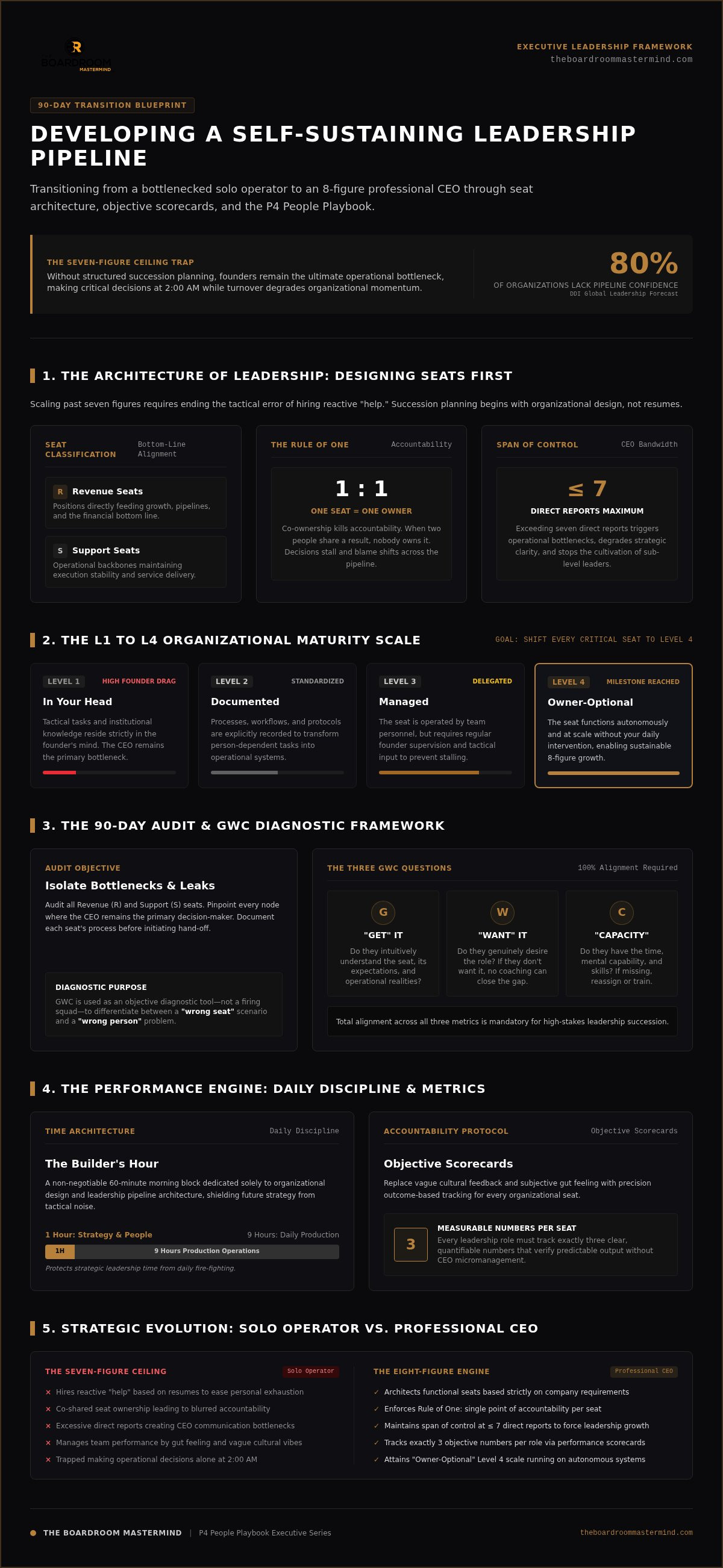
Scaling to eight figures requires a fundamental shift in how you view your organization. Most founders hire "help" to alleviate personal stress, but this is a tactical error that leads to stagnation. True succession planning starts with architecture, not resumes. You must define the leadership pipeline as a systematized flow of talent into pre-defined organizational seats. Before you look for a person, you must design the role based on the specific needs of the business.
Every seat in your company must be categorized as either Revenue (R) or Support (S). This clarity ensures your pipeline feeds the bottom line directly. Progress is measured by the L1 to L4 framework. L1 signifies the process is "in your head," while L4 means it's "scalable and owner-optional." Developing leadership pipeline in your company means moving every critical seat to L4 so the business runs without your intervention.
The Rule of One: Why Co-Ownership Kills Accountability
Ambiguity is the enemy of scale. Every functional seat must have exactly one owner. If two people share ownership of a result, nobody truly owns it. This shared responsibility leads to a pipeline collapse where decisions stall and blame shifts. A single point of accountability ensures that the pipeline remains fluid and high-performing. You can't scale a system where the "who" is as blurry as the "how."
Designing for the Future: The 7 Direct Report Limit
Operational efficiency breaks down when a CEO's span of control is too wide. Limit yourself to seven or fewer direct reports to maintain strategic clarity. Exceeding this number creates a communication bottleneck that halts leadership growth. By maintaining this limit, you force the development of lower-level leaders. It prevents you from becoming the only mechanic in the shop and ensures the organization remains agile enough to pivot at the eight-figure level.
The 90-Day Audit: Identifying and Testing Your Future Leaders
Building an elite team requires more than gut feeling. You need a diagnostic approach that strips away emotion. Start by auditing your current "Revenue" and "Support" seats. Identify every instance where you, the CEO, remain the primary decision-maker. These are your operational bottlenecks. Developing leadership pipeline in your company starts by identifying these tactical leaks and preparing them for hand-off.
Once seats are defined, evaluate your personnel. Apply the three GWC questions to every team member. Do they "Get" the role? Do they "Want" the role? Do they have the "Capacity" to do it? While formal leadership development frameworks often focus on academic traits, GWC focuses on operational reality. This process helps you distinguish between a "wrong seat" scenario and a "wrong person" problem. Before any hand-off occurs, you must document the process for each seat. This documentation transforms a person-dependent task into a scalable machine.
GWC: The Three Questions That Define a Leader
Use GWC as a diagnostic tool, not a firing squad. It's about finding the right alignment for maximum impact. If a team member lacks the "Capacity," they may need training or a different role. If they don't "Want" it, no amount of coaching will fix the performance gap. High-stakes leadership requires total alignment across all three metrics. If you're looking to refine this alignment within your own executive team, The Boardroom Mastermind offers the peer-level perspective needed to make these tough calls.
The Builder’s Hour: Daily Commitment to Pipeline Growth
Scale requires relentless discipline. You must commit to the Builder’s Hour. This is a non-negotiable, 60-minute morning block dedicated solely to people work and organizational architecture. While the other nine hours of your day involve production, this hour belongs to the future. It protects your strategic time from tactical noise and ensures the pipeline never runs dry.
The Performance Engine: Scorecards and the A-Player Pipeline
Managing by "gut feeling" is a liability at the eight-figure level. You need a performance engine built on objective data. Replace vague cultural vibes with scorecards that define exactly three measurable numbers per seat. This structural clarity is non-negotiable for building a leadership team that produces predictable results. Developing leadership pipeline in your company requires moving beyond the ambiguity of job descriptions and into the precision of outcome-based accountability.
Scorecards vs. Job Descriptions
A job description lists duties; a scorecard defines victory. Before you post a vacancy, craft three to five measurable outcomes that the seat must achieve. This ensures you hire for impact rather than activity. Once the seat is filled, implement a weekly 15-minute 1:1 cadence. These meetings aren't for social updates. They are for reviewing those three numbers. If the numbers are off, you coach the seat owner through the dip. If the numbers are green, you stay in your lane.
The 13-Row Scoreboard: Tracking Progress Over 90 Days
The pipeline itself must be proactive. Establish the "Always Be Hiring" rule: maintain at least 5 active A-player conversations logged at all times, even if no seat is currently vacant. This discipline prevents the "panic hiring" that occurs when a key executive departs. Monitor this progress using a 13-row scoreboard that tracks leadership performance over a 90-day sprint. You're reading the instruments, not managing by mood. To master this level of operational oversight, apply for The Boardroom Mastermind and join an elite tier of operators.
Passing the "Owner Optional" Gate: Transitioning to L4 Scale
The transition from a high-earning operator to a professional CEO culminates at the "Owner Optional" gate. This is the precise moment where every leadership seat in your organization operates at Level 4, meaning the system is scalable and runs entirely without your daily intervention. In the P7 Framework, the People pillar acts as the ultimate gate pillar. You simply cannot reach the Amplification stage or achieve eight-figure revenue if you haven't solved the people problem first. Developing leadership pipeline in your company is the only way to ensure this gate remains open and your growth remains permanent.
Successful hand-offs require a shift in your psychological approach to management. When you delegate a functional seat, expect a temporary performance dip as the new owner acclimates. The instinct of a tactical hustler is to take the seat back to "fix" it. Resist this urge. Instead, you must coach the seat owner through the dip using their weekly scorecard numbers. You can see the real-world impact of this discipline by reviewing the Boardroom Case Studies, where founders like Dana reduced their direct reports while increasing revenue through structured hand-offs.
The Final Exam: The 5-Day Vacation Test
To verify your L4 status, you must conduct a stress test. Take five consecutive weekdays off with your phone completely powered down. If your business requires a single decision from you during this window, your pipeline has a leak. This test exposes the remaining bottlenecks that require further documentation or better seat alignment. It's the definitive boundary between owning a job and owning a strategic asset.
Joining the Elite: Strategic Collaboration at the Highest Level
Scaling to nine figures isn't a solo pursuit. It requires proximity to those who have already navigated these waters. The Boardroom Mastermind is the exclusive community for high-achieving leaders ready to move beyond tactical management. Surrounding yourself with peers who have successfully passed the "Owner Optional" gate is the ultimate shortcut to permanent wealth architecture and peak performance without sacrificing your lifestyle.
Architecting Your Eight-Figure Exit
You've moved from the chaos of tactical management to the precision of organizational architecture. By prioritizing functional seats over individual resumes and enforcing objective scorecards, you've built a system that no longer breaks when you step away. Developing leadership pipeline in your company isn't a one-time event; it's a non-negotiable daily commitment to the Builder's Hour. This discipline transforms your business from a person-dependent job into a scalable, strategic asset that generates wealth without your constant intervention.
The path to nine-figure revenue requires more than just a playbook; it requires an elite environment of high achievers. By joining this circle, you gain immediate access to the full P7 Playbook Series and quarterly in-person intensives with battle-tested 8 and 9-figure founders. This is your opportunity to collaborate within an elite peer network of real estate operators who have already passed the "Owner Optional" gate. Apply for The Boardroom Mastermind to scale your leadership team. The stakes are high, but the path to the next level is clear for those with the right access. Your future as a strategic CEO starts now.
Frequently Asked Questions
How do I start a leadership pipeline if I am still a small team?
Start by designing seats based on business needs before you look for people. Even with a small team, you must map out the functional org chart and identify which seats you currently occupy. This architectural clarity ensures that when you hire, you are filling a pre-defined role with specific outcomes rather than just hiring help to solve a temporary bottleneck. Proper seat design is the foundation for all future organizational growth.
What is the difference between a job description and a leadership scorecard?
A job description is a list of duties, while a leadership scorecard defines victory through exactly three measurable numbers reviewed weekly. Developing leadership pipeline in your company requires shifting from vague task lists to outcome-based accountability. Scorecards remove the ambiguity of vibes and replace it with objective data. This ensures every leader knows exactly how their performance is measured against the business's strategic goals and three to five defined outcomes.
How many direct reports should a CEO have when scaling to 8 figures?
You should limit yourself to seven or fewer direct reports to maintain operational efficiency and strategic clarity. Scaling to eight figures requires you to move from a tactical operator to a professional CEO. Managing more than seven people creates a communication bottleneck. This limit forces you to build lower-level leadership layers, ensuring the organization remains agile and that you aren't stuck making every micro-decision during your daily operations.
What should I do if a current leader fails the GWC test?
Use the GWC assessment as a diagnostic tool to identify if they are in the wrong seat or simply the wrong person. If a leader lacks the Capacity, they may need additional training or a different role. However, if they don't Want it or don't Get it, you must reassign them or exit them cleanly. Loyalty shouldn't justify retaining a misfit in a critical seat that requires total alignment.
How much time should I spend on leadership development each day?
You must dedicate a non-negotiable, 60-minute Builder’s Hour every morning solely to people work and developing leadership pipeline in your company. This protected block is for org architecture, scorecard reviews, and maintaining your A-player pipeline. While the rest of your day is for production, this hour ensures you are working on the business rather than just in it, protecting your strategic time for high-level execution and long-term scaling.

Disclaimer
Mr. Clothier is an expert in real estate investing. As such his experiences are not necessarily typical to the standard real estate investor and whose results may vary. The successes shared on this site are not considered typical. Most individuals who order the educational materials and systems probably do not follow any of the techniques or strategies and consequently make little to no money due to their inaction. The company is in the process of determining the typical success of its clients. Stories shared herein are for example purpose only and should not be construed as "guarantees" of success. Results will vary based on background, education, and experience and actions taken.
This site is not a part of the Google/Facebook website or Google/Facebook Inc. Additionally, this site is NOT endorsed by or affiliated with Google/Facebook in any way. GOOGLE/FACEBOOK is a trademark of GOOGLE/FACEBOOK, Inc.
INCOME DISCLAIMER: This website and the items it distributes contain business strategies, marketing methods and other business advice that, regardless of referenced results and experience, may not produce the same results (or any results) for you. The Boardroom Mastermind makes absolutely no guarantee, expressed or implied, that by following the advice or content available from this web site you will make any money or improve current profits, as there are several factors and variables that come into play regarding any given business. Primarily, results will depend on the nature of the product or business model, the conditions of the marketplace, the experience of the individual, and situations and elements that are beyond your control. As with any business endeavor, you assume all risk related to investment and money based on your own discretion and at your own potential expense.
LIABILITY DISCLAIMER: By reading this website or the documents it offers, you assume all risks associated with using the advice given, with a full understanding that you, solely, are responsible for anything that may occur as a result of putting this information into action in any way, and regardless of your interpretation of the advice. You further agree that The Boardroom Mastermind, its affiliates, subsidiaries, officers and agents, cannot be held responsible in any way for the success or failure of your business as a result of the information provided. It is your responsibility to conduct your own due diligence regarding the safe and successful operation of your business. In summary, you understand that we make absolutely no guarantees regarding income as a result of applying this information, as well as the fact that you are solely responsible for the results of any action taken on your part as a result of any given information. In addition, you agree that our content is to be considered "for entertainment purposes only". Always seek the advice of a professional when making legal, financial, tax, or business decisions.
BUSINESS OPPORTUNITY: All products and services offered by The Boardroom Mastermind are intended to provide prospective purchasers with general business strategies, marketing methods and other general advice for business development and training. At no point is The Boardroom Mastermind soliciting anyone to enter into a new business nor is it representing, either expressly or by implication, that it will provide locations for a business, provide outlets, accounts, or customers, or purchase any of the goods or services made by the purchaser.
The products being offered through this promotion are packages of informational tools to help you learn about business and deal making strategies.


