
Delegating High-Stakes Decisions: A CEO’s Framework for 8-Figure Scale
What if your absence from the office wasn't a liability, but the ultimate proof of your company's structural integrity? Most founders reach a plateau where their personal involvement in every transaction becomes a strategic risk rather than an asset. You're likely familiar with decision fatigue, the weight of knowing a single executive error could derail an eight-figure deal. Masterfully delegating high-stakes decisions isn't about blind trust or abdication. It's an architectural installation of clear decision rules and objective scorecards that removes you from the tactical weeds once and for all.
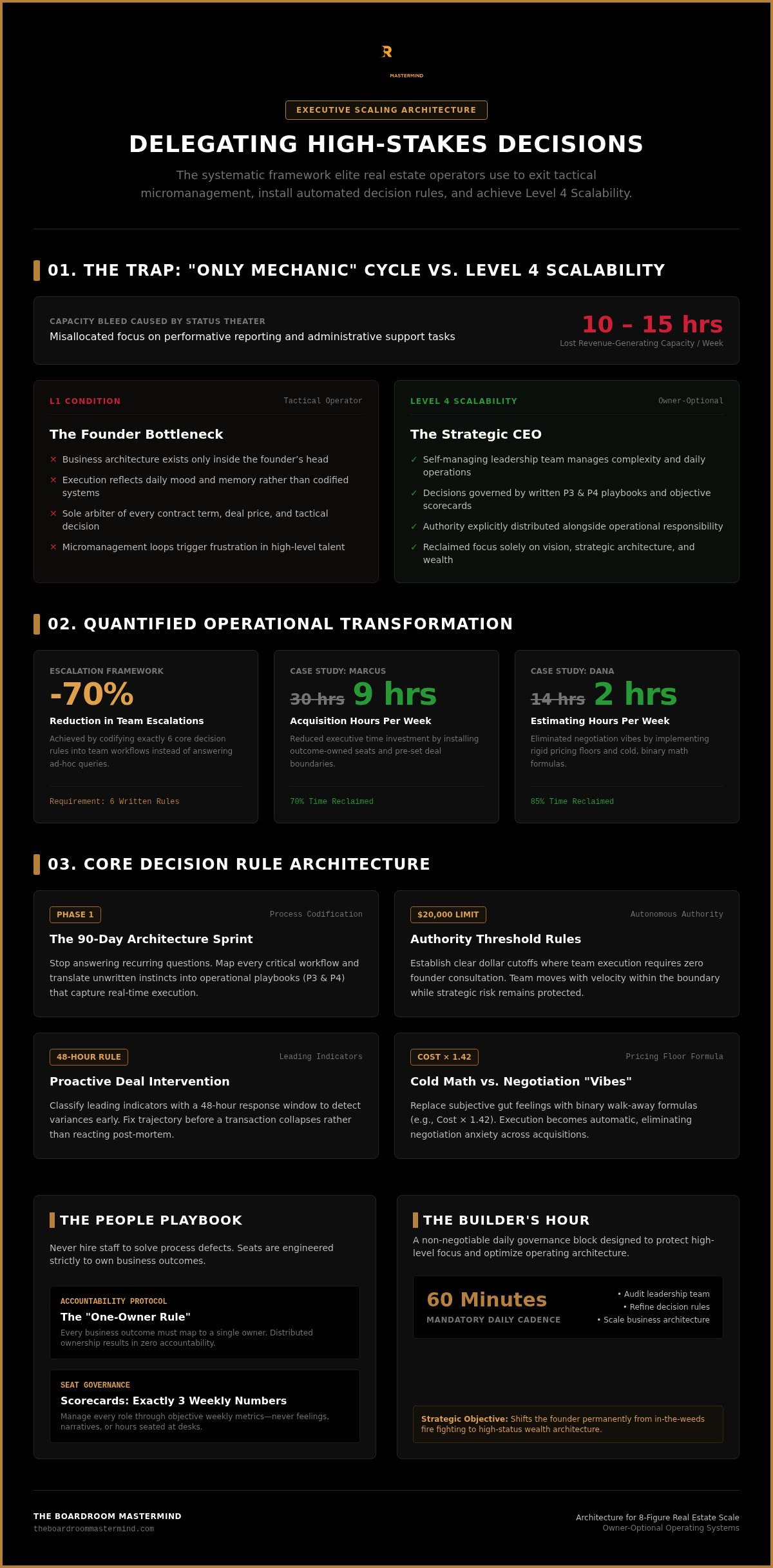
Scaling past your current ceiling requires an organization that doesn't rely on your constant intervention. We're going to bridge that gap by showing you how elite real estate operators use the P3 and P4 playbooks to achieve true "Owner Optional" status. You'll learn to design seats that own outcomes through the same systems that helped leaders like Marcus reduce acquisition hours from 30 down to nine. This briefing breaks down the transition to Level 4 scalability, where a self-managing leadership team handles the complexity while you reclaim your role as a visionary CEO.
Key Takeaways
- Break the "Only Mechanic" cycle by shifting from a tactical operator to a strategic CEO who builds systems that function without your constant intervention.
- Discover the exact architecture for delegating high-stakes decisions using written playbooks and automated decision rules that empower your team to act without your sign-off.
- Implement the "One-Owner Rule" and manage performance through scorecards with exactly three weekly numbers per seat to ensure total accountability across your organization.
- Reclaim your strategic focus by installing the Builder’s Hour, a mandatory 60-minute daily block dedicated to auditing your leadership team and optimizing your operational architecture.
Why Most Founders Fail at Delegating High-Stakes Decisions
Most real estate operators remain trapped in the "Only Mechanic" cycle. They believe being the smartest person in the room is a competitive advantage, yet this is exactly what prevents 8-figure scale. When you're the sole arbiter of every contract term or acquisition price, you aren't leading; you're simply the most expensive employee. This stagnation occurs because your time is consumed by Status Theater, performative reporting that mimics progress, rather than true governance. Industry data reveals that mis-allocating your focus to these support tasks can leak 10 to 15 hours of revenue-generating capacity every single week, effectively capping your company's growth.
The Psychology of the Founder Bottleneck
Operators often confuse being needed with being valuable. This is a dangerous L1 condition where the entire business architecture exists only inside the founder's head. In these environments, the business is a reflection of your mood and memory rather than a scalable asset. To scale beyond this, you must apply the principles of delegation, ensuring that authority is explicitly distributed alongside responsibility. Without this codified structure, delegating high-stakes decisions feels like a reckless abdication of duty. This fear triggers the micromanagement loops that frustrate high-level talent and keep you tethered to the tactical weeds.
Moving from Hustler to Professional CEO
The transition to a founder vs ceo mindset is defined by the pursuit of L4 Scalability. This is the stage where the business functions autonomously, running with precision without your daily involvement. It's a fundamental shift from tactical management to strategic wealth architecture. By designing a system that empowers others to execute with your level of expertise, you move from a job you own to a business that works for you. Mastering the art of delegating high-stakes decisions is the final hurdle in this professional evolution. It's the only path to achieving permanent, sustainable impact.
The Architecture of a Decision Rule: Automating Authority
Every interruption from your team is a symptom. It signals a gap in your business operating system. When a team member asks for your sign-off, they are essentially asking for a decision rule that doesn't exist yet. Scaling requires you to stop answering questions and start installing architectures. This process begins with a 90-day sprint to map your core workflows and convert them into a written playbook. By codifying your logic, you remove yourself as the bottleneck.
Establishing authority thresholds is a critical component of delegating high-stakes decisions. You must set clear dollar amounts where your consultation is no longer required. For example, setting a $20,000 threshold for acquisitions allows your team to move with speed while you maintain strategic oversight. Many founders struggle with the psychological barriers to effective delegation, fearing a loss of control. Yet, by using the 48-Hour Rule to classify leading indicators, you can intervene proactively before a deal fails, rather than reacting after the damage is done. This systematic approach to delegating high-stakes decisions ensures that speed never compromises quality.
Writing the Pricing Floor and Walk-Away Rules
Stop relying on negotiation "vibes." Pricing must be a cold, written formula, such as Cost x 1.42. Dana, an elite operator, reduced her estimating hours from 14 to just two by installing these rigid floor-pricing rules. It's about removing emotion from the equation. When the rules are clear, the execution becomes binary. Logic replaces guesswork.
The Escalation Framework
You can reduce escalations by 70% by writing just six core decision rules. Don't start an SOP from a blank page. Capture the work as it happens in the flow. If you're ready to audit your current systems, consider how a peer-led environment like The Boardroom can accelerate this transition. Designing these rules is the only way to protect your revenue-generating capacity.
The People Playbook: Designing Seats That Own Outcomes
Elite operators don't hire people to solve process problems; they design seats to own outcomes. This is the cornerstone of building a leadership team that scales beyond your personal bandwidth. When delegating high-stakes decisions, you must first define the seat's requirements with surgical precision. If two people share a seat, the seat is effectively unowned. Accountability evaporates in the presence of co-ownership. You need a single point of responsibility for every critical function in your business.
To ensure the right leader is in place, apply the GWC diagnostic. Does the individual Get it, Want it, and have the Capacity to execute at an 8-figure level? This framework establishes clear decision-making roles and accountability across your entire organization. It ensures that delegating high-stakes decisions isn't a gamble on personality, but a calculated bet on competence. When the seat is designed correctly, the person in it doesn't just complete tasks; they own the results.
The Scorecard vs. The Vibes
Management by "vibes" or mood checks is a recipe for failure. Every seat must be anchored by exactly three weekly numbers. No more, no fewer. These metrics feed into a 13-row weekly scoreboard that provides a real-time pulse of the operation. As the CEO, you must never be the reporter for these KPIs. The seat owner must own the data, the cause, and the fix. This objective transparency eliminates the need for micromanagement.
Building an A-Player Pipeline
Recruiting shouldn't be a reactive response to a vacancy. Maintain a target of at least five A-player conversations at all times. This creates a talent bench that allows you to hire for capacity gaps rather than escaping a broken process. If you're ready to stop being the bottleneck, apply to join The Boardroom and start auditing your people architecture with other high-level visionaries today.
Installing the Cadence: Protecting Your High-Level Focus
The final stage of delegating high-stakes decisions isn't about the hand-off itself. It's about the cadence of oversight. You must install a non-negotiable Builder’s Hour every morning. This is sixty minutes dedicated strictly to auditing your systems and people architecture. Without this calendar block, the tactical noise of the day will inevitably drown out your strategic intent. It's the only way to ensure your leadership team remains aligned with the company's trajectory.
Your operational rhythm continues with the Weekly Scoreboard Meeting. This is a strict, fifteen-minute 1:1 cadence with each seat owner. You aren't there to chat. You're there to review the three numbers on their scorecard, identify the root cause of any variance, and agree on exactly one fix. This prevents the "drift" that often occurs when delegating high-stakes decisions to others. To pressure-test your architecture, apply the Vacation Exam. If you can't take a five-day, phone-off vacation without the business stalling, your delegation is a facade rather than a system.
The Quarterly Audit Ritual
Every ninety days, perform a BASE assessment to re-score your business constraints and prevent stagnation. Audit your twelve-quarter roadmap to ensure your current delegation aligns with your ultimate destination. Conduct a Metric Purge during this time. If a KPI hasn't driven a specific decision in thirty days, remove it immediately. Complexity is the enemy of execution, and an overcrowded scoreboard only obscures the truth.
Joining the Room
Scaling toward a nine-figure exit requires more than internal systems. You need an elite peer advisory group to audit your models and challenge your assumptions. High-stakes environments demand high-level perspectives that you simply can't find in the general marketplace. Apply for The Boardroom Mastermind to join a room of battle-tested visionaries who have already mastered the transition from tactical operator to strategic architect.
Architecting Your Exit from the Tactical Weeds
Transitioning from a tactical operator to a professional CEO is the only way to break the eight-figure ceiling. You've seen how written decision rules and outcome-focused seats replace the need for constant founder intervention. By installing a rigorous operational cadence and protecting your daily Builder's Hour, you ensure that delegating high-stakes decisions becomes a predictable system rather than a risky gamble. This is the fundamental difference between owning a job and owning a truly scalable asset.
True scale requires more than internal frameworks. It demands external auditing from peers operating at the highest tiers of financial success. The Boardroom Mastermind provides this through quarterly in-person intensives and exclusive access to the P7 Playbook Series. You'll join an elite network of 7, 8, and 9-figure real estate entrepreneurs who value time and high-level execution above all else. This is your opportunity to optimize your wealth architecture alongside global high achievers who understand the weight of your role.
Your evolution into a battle-tested visionary is the logical conclusion of implementing these systems. The path forward is clear for those with the right access.
Apply for The Boardroom Mastermind and Scale Your Empire
Frequently Asked Questions
How do I know which high-stakes decisions are safe to delegate first?
You should prioritize decisions that follow a repeatable logic or can be bound by a clear numeric threshold. For instance, delegating high-stakes decisions like acquisition offers under $20,000 provides an immediate reduction in founder bottlenecks. Use your Builder's Hour to map these specific rules. If a decision follows a consistent formula, it belongs in a written playbook rather than requiring your personal sign-off every single time.
What happens if a team member makes a costly mistake after I delegate authority?
You must not take the seat back when an error occurs. Re-entering the tactical work invalidates your delegation architecture and signals a lack of trust in your team. Instead, treat the mistake as a diagnostic event. Use it to determine if the decision rule was unclear or if the seat owner lacked the Capacity. Coaching the owner through the fix builds the executive maturity required for scale.
How many direct reports can a real estate CEO effectively manage while delegating?
A functional organization chart should limit the CEO to seven or fewer direct reports. Exceeding this threshold creates management friction and prevents you from focusing on strategic oversight. Each of these reports must own a specific seat with a dedicated scorecard. If your current structure is bloated, use your quarterly audit to consolidate roles and ensure every seat has exactly one owner with clear accountability.
Should I use a complex BI tool to track my delegated KPIs?
You don't need complex BI software until your scoreboard has survived at least four weeks on paper or simple shared sheets. Successful delegation requires clarity, not complexity. Every seat needs exactly three weekly numbers to track performance. Adding heavy technology too early often creates "Status Theater" where data is collected but never used. Stick to the scorecard rules until your operational cadence is permanent.
What is the "Builder’s Hour" and why is it essential for delegation?
The Builder's Hour is a non-negotiable, 60-minute daily block reserved for architecture work. It's essential for delegating high-stakes decisions because delegation is an installation, not just a conversation. You use this morning hour to write playbooks, audit scorecards, and recruit A-players. Production work occupies the rest of your day, but this protected hour ensures the business evolves toward a scalable machine that runs without your daily involvement.

Disclaimer
Mr. Clothier is an expert in real estate investing. As such his experiences are not necessarily typical to the standard real estate investor and whose results may vary. The successes shared on this site are not considered typical. Most individuals who order the educational materials and systems probably do not follow any of the techniques or strategies and consequently make little to no money due to their inaction. The company is in the process of determining the typical success of its clients. Stories shared herein are for example purpose only and should not be construed as "guarantees" of success. Results will vary based on background, education, and experience and actions taken.
This site is not a part of the Google/Facebook website or Google/Facebook Inc. Additionally, this site is NOT endorsed by or affiliated with Google/Facebook in any way. GOOGLE/FACEBOOK is a trademark of GOOGLE/FACEBOOK, Inc.
INCOME DISCLAIMER: This website and the items it distributes contain business strategies, marketing methods and other business advice that, regardless of referenced results and experience, may not produce the same results (or any results) for you. The Boardroom Mastermind makes absolutely no guarantee, expressed or implied, that by following the advice or content available from this web site you will make any money or improve current profits, as there are several factors and variables that come into play regarding any given business. Primarily, results will depend on the nature of the product or business model, the conditions of the marketplace, the experience of the individual, and situations and elements that are beyond your control. As with any business endeavor, you assume all risk related to investment and money based on your own discretion and at your own potential expense.
LIABILITY DISCLAIMER: By reading this website or the documents it offers, you assume all risks associated with using the advice given, with a full understanding that you, solely, are responsible for anything that may occur as a result of putting this information into action in any way, and regardless of your interpretation of the advice. You further agree that The Boardroom Mastermind, its affiliates, subsidiaries, officers and agents, cannot be held responsible in any way for the success or failure of your business as a result of the information provided. It is your responsibility to conduct your own due diligence regarding the safe and successful operation of your business. In summary, you understand that we make absolutely no guarantees regarding income as a result of applying this information, as well as the fact that you are solely responsible for the results of any action taken on your part as a result of any given information. In addition, you agree that our content is to be considered "for entertainment purposes only". Always seek the advice of a professional when making legal, financial, tax, or business decisions.
BUSINESS OPPORTUNITY: All products and services offered by The Boardroom Mastermind are intended to provide prospective purchasers with general business strategies, marketing methods and other general advice for business development and training. At no point is The Boardroom Mastermind soliciting anyone to enter into a new business nor is it representing, either expressly or by implication, that it will provide locations for a business, provide outlets, accounts, or customers, or purchase any of the goods or services made by the purchaser.
The products being offered through this promotion are packages of informational tools to help you learn about business and deal making strategies.


