
Creating an Investor Relations Department: The CEO’s Blueprint for 8-Figure Real Estate Scale
If you're still the one answering every investor text at 9:00 PM, you don't have a real estate business; you have a high-paying job that owns you. Most founders believe their personal touch is the secret sauce to capital raising, but this belief is actually the ceiling on your growth. Transitioning from a founder-led hustle to an 8-figure powerhouse requires creating an investor relations department that functions with or without your direct involvement. This isn't just about hiring an assistant to send emails. It's about architecting a professional, institutional-grade engine that handles the $15 trillion private alternatives market with precision.
You know that the bottleneck isn't the deal flow; it's the exhaustion of being the sole point of contact for every high-net-worth individual and family office in your database. This blueprint will show you how to build that systemized capital raising engine and reclaim your strategic autonomy. We'll explore the essential roles to fill, the high-performance software like Agora or Visible.vc you need to implement, and the critical compliance shifts like the 2026 FinCEN reporting rules that your new team must master to ensure your firm's permanence and credibility.
Key Takeaways
- Transition from founder-led fundraising to a professionalized system that removes you as the primary bottleneck for capital partners.
- Follow a proven blueprint for creating an investor relations department that builds institutional-grade credibility with high-net-worth individuals.
- Identify the exact hiring criteria for an Investor Relations Officer who can manage complex reporting and tax document coordination with precision.
- Deploy advanced CRM and portal technology to automate routine investor management and reclaim your time for high-level deal acquisitions.
The Strategic Architecture of Investor Relations in Private Real Estate
In private real estate, defining what is investor relations requires looking beyond the public market definitions of stock valuation. For the 8-figure sponsor, IR is the strategic bridge connecting capital partners to high-yield deal flow. It's the infrastructure that ensures your firm remains funded even when you aren't on the phone. Most 7-figure founders hit a hard ceiling because they're the sole repository of investor trust. If every capital call or reporting question requires your personal attention, you aren't scaling; you're just working harder.
Creating an investor relations department is the move that separates tactical fundraisers from strategic firm builders. While fundraising is a transactional event, investor relations is a permanent architecture. High-net-worth individuals and family offices don't just invest in your current deal. They invest in your ability to manage their capital professionally over decades. Without a dedicated department, your firm appears amateur to institutional-grade partners who prioritize operational stability as much as IRR.
To better understand this concept, watch this helpful video:
From Hustler to CEO: Professionalizing the Capital Stack
Scaling requires a trust transfer from the founder's personality to the firm's systems. When you commit to creating an investor relations department, you allow the CEO to shift from tactical management to strategic oversight. This transition is vital for those moving toward Real Estate Private Equity: The Architect’s Guide to Institutional Scale. By standardizing communication, you ensure the firm's narrative remains consistent regardless of who handles the inquiry.
The ROI of IR: Beyond Compliance
Stop viewing IR as a cost center; it's a revenue-generating function. A professional department creates referral loops and high retention rates, fueling capital velocity. Consider the opportunity cost of lost deal time. Every hour you spend explaining a K-1 is an hour you aren't finding the next 8-figure acquisition. The ROI of a dedicated team is found in the deals you finally have the bandwidth to close. It's about buying back your time to focus on high-stakes execution.
Core Pillars: Designing the Functions of Your IR Department
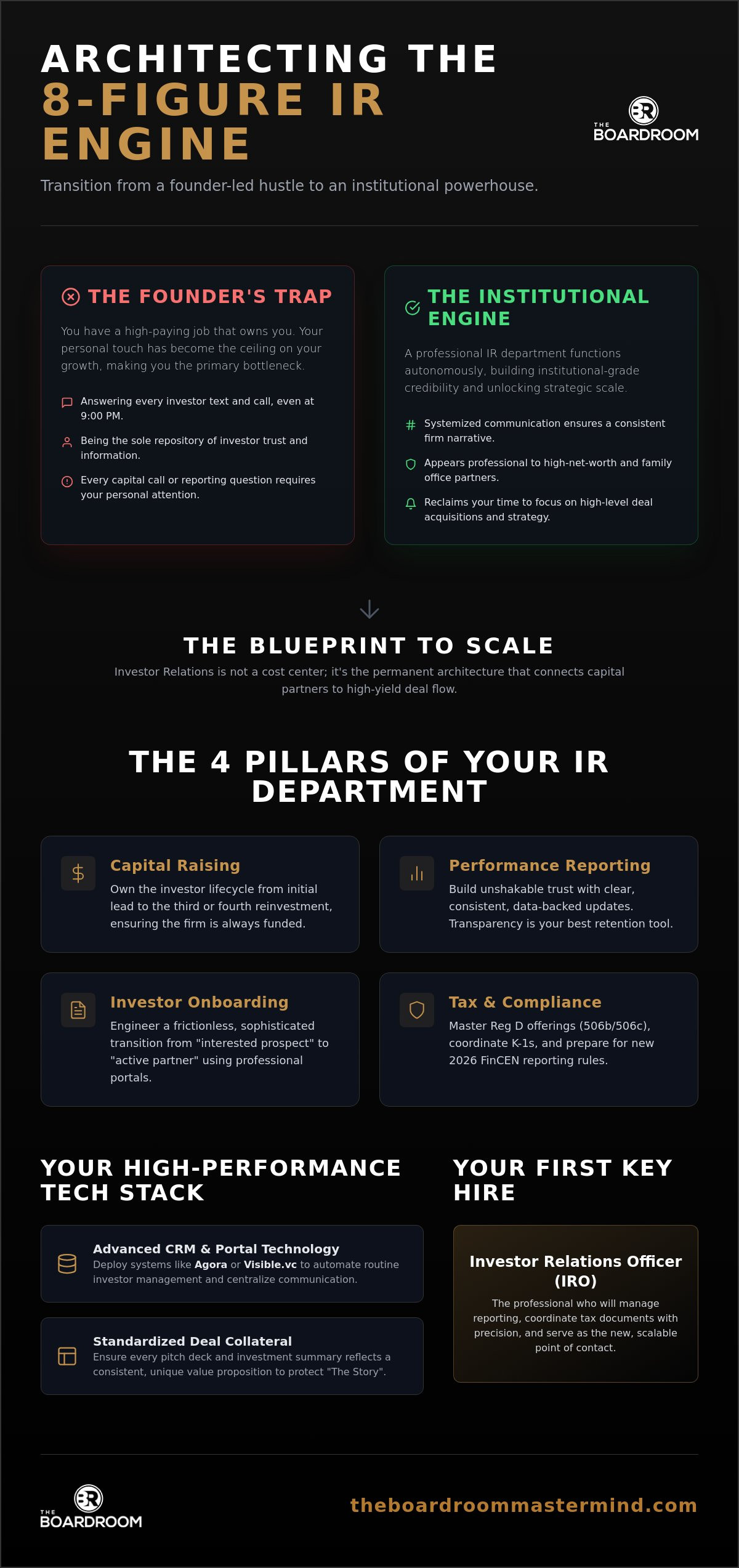
Creating an investor relations department is not about building a customer support desk; it is about architecting a capital engine. This department must own the investor lifecycle from the initial lead to the third or fourth reinvestment. To achieve 8-figure scale, your IR function must manage four non-negotiable responsibilities: capital raising, performance reporting, investor onboarding, and tax document coordination. If your K-1s are late or your reporting is inconsistent, you're signaling to family offices that your firm isn't ready for institutional-grade partnership.
Compliance is the silent foundation of this department. Your team needs absolute mastery over Reg D offerings, specifically the nuances between 506(b) and 506(c) solicitations. As of March 1, 2026, this also includes managing mandatory federal reporting for non-financed residential transfers under the new FinCEN rules. These operational details are often the first things refined when founders undergo a Boardroom-style business audit to prepare for 9-figure growth.
Investor Onboarding and Deal Transparency
Institutional-grade onboarding builds immediate trust. For HNW individuals, the transition from "interested prospect" to "active partner" should be frictionless and sophisticated. Use professional portals to centralize communication and document signing. Transparency in reporting is your best retention tool. When investors see clear, data-backed updates, their anxiety evaporates; they become repeat partners who fuel your capital velocity.
Standardizing the Narrative and Deal Collateral
Your IR team must protect "The Story." Standardizing the narrative ensures that every pitch deck and investment summary reflects your firm’s unique value proposition. This isn't just marketing; it's wealth architecture. Narrative consistency is the foundation of investor confidence in 2026. By removing the founder as the sole storyteller, you create a firm that is bigger than any one individual.
The Hiring Framework: Recruiting Your First Investor Relations Officer (IRO)
Recruiting the right talent is the pivot point in creating an investor relations department that actually scales. You cannot simply delegate this to a mid-level administrator. At the 8-figure level, your investors expect a peer level of sophistication. Your first move is deciding between an IR Coordinator, who handles tactical reporting and data entry, and a true Investor Relations Officer (IRO), who manages the strategic narrative and capital partner relationships. This distinction determines whether you are buying back your time or simply adding another layer of management to your plate.
Once you define the role, integrate the new hire into your Building a Leadership Team framework. This ensures the IR function isn't an island; it must be synchronized with your acquisitions and operations teams. A successful department requires a compensation model that aligns the new hire’s interests with your firm’s long-term AUM goals and investor longevity. If the incentives are purely transactional, the relationship quality will eventually suffer.
The A-Player Profile for Real Estate IR
You need a sophisticated communicator, not just a numbers person. While financial literacy is a prerequisite, the ability to translate complex market cycles into a confident narrative is what secures 7-figure checks. Look for candidates who possess high emotional intelligence and industry-specific knowledge. They must understand the nuances of private equity and the psychological drivers of high-net-worth individuals who value privacy and exclusive access above all else.
Compensation and Incentives for IR Professionals
Top-tier IR professionals expect a structure that reflects their impact on capital velocity. A competitive model typically combines a high base salary with performance-based bonuses tied to capital raised or assets under management. This philosophy ensures an absolute alignment of interests. When your IR team is incentivized by investor retention rather than just the initial close, they focus on the long-term health of the capital stack. This creates the permanence required for 9-figure scale.
To ensure your next executive hire is an A-player who fits your wealth architecture, apply for The Boardroom Mastermind Membership and get your leadership structure audited by peers who have already scaled to 9 figures.
Professionalizing the Experience: IR Systems and Scalability
Scalability in real estate isn't a human problem; it's a systems problem. If your firm still relies on manual data entry and fragmented communication, you're building on sand. Professionalizing your operation requires creating an investor relations department that leverages high-performance technology to centralize data and automate the mundane. By deploying an institutional-grade Investor CRM and Portal, such as Juniper Square or AppFolio, you remove the friction that prevents high-net-worth individuals from reinvesting. This shift allows you to automate low-touch interactions, such as distribution notices and tax document delivery, preserving your executive energy for the high-touch strategic relationships that move the needle on 8-figure acquisitions.
The Tech Stack for Institutional-Grade IR
Centralizing your data is the only way to escape the endless spreadsheets trap that plagues mid-market firms. A professional portal doesn't just look better; it functions as a trust-building asset. When an investor can log in at any time to see their portfolio performance, capital accounts, and historical distributions, their confidence in your leadership increases. This transparency directly impacts your re-up rate, turning one-time participants into lifelong capital partners. Establish a rigid communication cadence, including detailed quarterly reporting and an annual State of the Union webinar, to maintain narrative control and project institutional permanence.
Auditing Your IR Department for 9-Figure Readiness
Building the engine is only half the battle. You must constantly audit its performance to identify the operational bottlenecks that will inevitably appear as you scale. Utilizing The Boardroom Mastermind Membership provides you with a peer-reviewed environment where 8 and 9-figure operators stress-test each other's IR systems. These quarterly intensives are critical for refining the investor experience and ensuring your firm remains a first-choice destination for family office capital. Reviewing Case Studies from members who have successfully professionalized their capital stacks will give you the roadmap to move from tactical management to strategic oversight. Consistency is the hallmark of the elite.
The Architecture of Institutional Permanence
Transitioning from a tactical operator to a strategic visionary requires more than just better deals. It requires a fundamental shift in how you manage the capital that fuels those acquisitions. By creating an investor relations department, you move beyond the bottleneck of personal phone calls and enter the realm of institutional-grade scalability. We've defined the necessity of recruiting an A-player IRO, implementing a frictionless tech stack, and standardizing a narrative that resonates with elite family offices. These aren't just operational updates; they're the pillars of a firm built for permanence.
If you're ready to audit your business model and join an elite network of 8-figure real estate CEOs, the next step is clear. You don't have to navigate this transition in isolation. Through quarterly in-person business auditing intensives and a proven blueprint for transitioning from Operator to CEO, the path to 9-figure scale becomes a matter of precise execution. Apply to join The Boardroom Mastermind and audit your scaling strategy today. The next level of your legacy is waiting for the leader you're becoming.
Frequently Asked Questions
When is the right time for a real estate firm to create an investor relations department?
You should consider this transition the moment your personal involvement in investor communication prevents you from closing the next 8-figure deal. For most firms, this happens when you cross the $10 million AUM threshold or find yourself managing more than 50 individual capital partners. If you're still the primary point of contact for routine reporting questions, you've become a bottleneck to your own capital velocity.
What is the difference between investor relations and a capital raiser?
A capital raiser is tactical and transactional; an investor relations department is strategic and permanent. While a raiser focuses on the "close," IR owns the entire investor lifecycle, including onboarding, reporting, and long-term retention. Creating an investor relations department ensures that your firm builds institutional-grade trust that lasts far beyond a single deal, turning one-time investors into lifelong partners who anchor your capital stack.
How much should I budget for an in-house investor relations department?
Budgeting for an investor relations department requires accounting for both elite talent and institutional-grade technology. 2026 data shows that associate-level IR professionals in commercial real estate earn an average base of $115,000, while C-suite executives can reach over $500,000 in total compensation. Beyond payroll, you must allocate funds for specialized software and compliance infrastructure. View this as a strategic investment in capital velocity rather than a simple overhead expense.
What software is essential for managing real estate investor relations in 2026?
Essential software for 2026 includes specialized investor portals and CRMs like Juniper Square, AppFolio, or Agora, which starts at $749 per month for essential plans. These tools automate the "low-touch" interactions like distribution notices and tax document delivery. By centralizing your data in these platforms, you eliminate the "endless spreadsheet" trap and provide the professional, transparent experience that high-net-worth individuals and family offices demand.
Can I outsource my investor relations function to a third-party firm?
While third-party firms exist, 8-figure sponsors typically find that in-house IR is a prerequisite for institutional-grade credibility. Outsourcing can handle basic administrative tasks, but it often lacks the deep relationship intelligence and narrative consistency required to secure large-scale commitments. To maintain absolute control over your firm's reputation and capital velocity, you must internalize the IR function as a core pillar of your leadership team.


