
Creating an Advisory Board for My Company: The CEO’s Blueprint for 8-Figure Scale
Are you the CEO of an 8-figure powerhouse, or simply the highest-paid employee at a company that cannot survive a week without your direct intervention? Most leaders at this level reach a plateau where their own expertise becomes the primary operational bottleneck. If you are currently considering creating an advisory board for my company, you have likely realized that the tactics that got you to $10 million won't get you to $100 million. You feel the weight of isolation at the top, lacking the high-level strategic oversight needed to navigate complex market shifts and emerging 2026 SEC regulatory changes.
You recognize that true scale requires a shift from tactical management to strategic oversight. This guide provides the architectural blueprint to build a high-level advisory board that eliminates bottlenecks and accelerates your transition to a visionary leader. We will examine the specific frameworks for external accountability, the integration of AI-driven governance, and the specialized knowledge required to bridge the gap between 8-figure success and 9-figure institutional scale. By the end, you'll understand how to transform your business from a solo-driven engine into a sophisticated, self-sustaining asset that no longer relies on your daily presence to thrive.
Key Takeaways
- Identify the specific decision-making bottlenecks that create a "Founder’s Ceiling," preventing your transition from tactical operator to visionary CEO.
- Distinguish between fiduciary and advisory structures to implement a flexible governance model that provides strategic depth without sacrificing corporate control.
- Execute a proven blueprint for creating an advisory board for my company by sourcing A-player advisors who operate several levels above your current financial tier.
- Implement a dynamic "Business Audit" framework to replace stale, static advice with high-stakes accountability and specialized institutional knowledge.
- Bridge the gap between 8-figure operations and 9-figure scale through a structured environment of elite proximity and peer-level strategic oversight.
The Strategic Necessity: Why Scaling to 8 Figures Requires a Formal Brain Trust
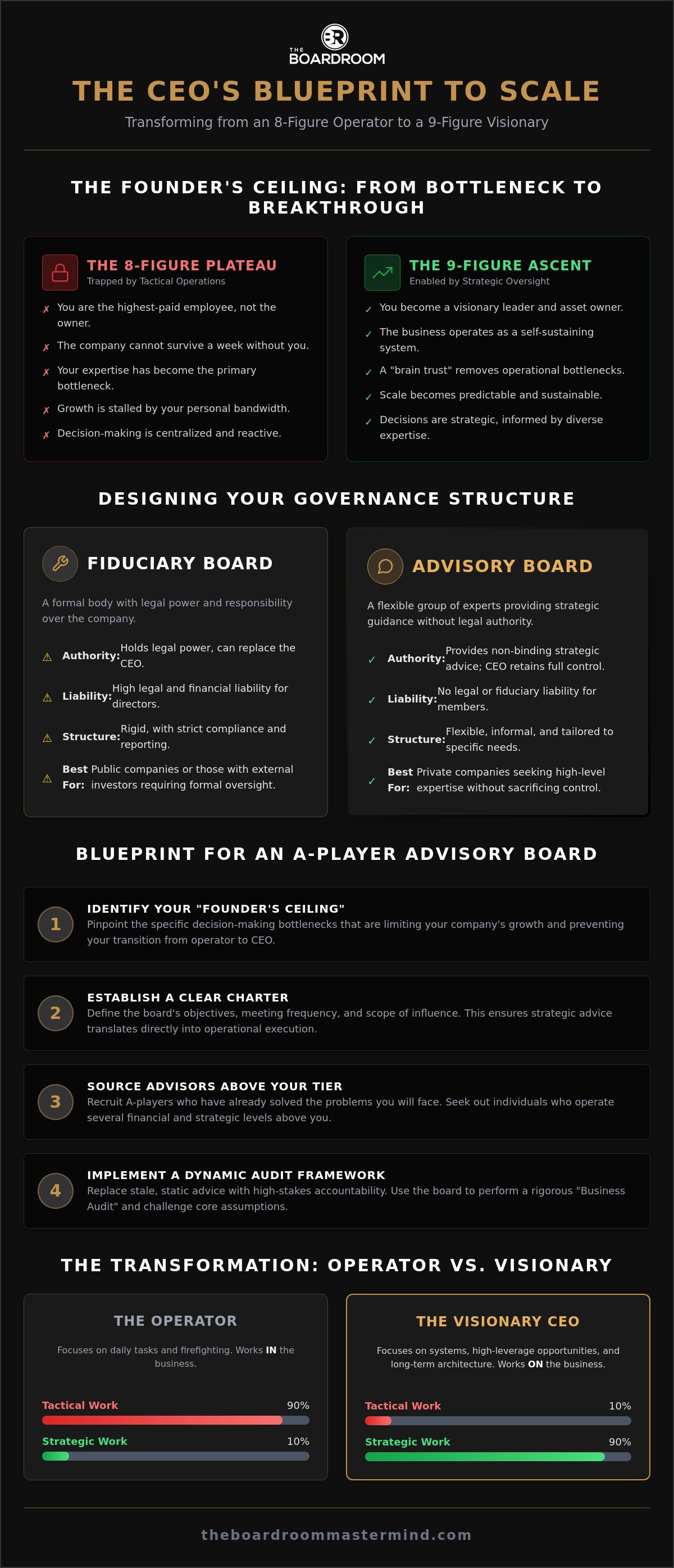
Most CEOs hit a hard ceiling at the mid-7-figure mark. This is the "Founder’s Ceiling," where your current decision-making framework, which was once your greatest asset, becomes your primary liability. Scaling to 8 figures and beyond requires a fundamental shift from tactical doing to strategic directing. If you are currently considering creating an advisory board for my company, you have likely realized that you can no longer be the smartest person in every room. You need a formal brain trust to bridge the gap between where you are and where the market is going.
An Advisory board provides the external expertise needed to audit your business architecture without the legal complexities or liability of a fiduciary board. It functions as a forcing function, professionalizing your business operating system by introducing high-level accountability. To better understand how this structure functions in a high-growth environment, watch this helpful video:
Breaking the Operator Bottleneck
You know you've outgrown your role when every minor operational fire requires your personal approval. If your presence is the only thing keeping the engine running, you don't own a company; you own a high-stress job. An advisory board creates the structural distance necessary for a CEO to observe the business as a system rather than a series of tasks. This detachment is essential for long-term wealth architecture. It is the practical application of The Operator to CEO Mindset Shift, allowing you to focus on high-leverage opportunities instead of low-value fires.
The Role of Independent Voices in Strategic Auditing
Internal staff often suffer from proximity bias. They are often too close to your real estate deal flow or operational workflows to spot systemic risks. Independent advisors bring a battle-tested perspective that challenges your assumptions. They don't offer the comfort of "yes-men." Instead, they provide the objective critique required for institutional scale. The psychological shift of being audited by peers who have already achieved your target milestones is often uncomfortable. However, it's the only way to ensure your growth is both predictable and sustainable.
Fiduciary vs. Advisory: Designing the Right Governance Structure for Your Company
Choosing the wrong structure is a fatal error for a scaling CEO. A fiduciary board holds legal authority over your entity; they have the power to replace you. An advisory board, conversely, provides high-level intelligence without stripping you of control. It is essential to Create Your Advisory Board Or Board Of Directors based on your specific scaling needs. For private real estate firms, the flexibility of a non-fiduciary group is often superior. You gain the brainpower of industry titans without the rigid compliance requirements or liability of a formal board of directors.
Your board needs a clear "Charter." This document defines meeting frequency, core objectives, and the specific scope of their influence. Without this, meetings devolve into social hours. When creating an advisory board for my company, I focus on integrating these insights directly into the business operating system. This ensures that strategic advice translates into operational execution. If you're ready to see how an elite network functions as a dynamic board, explore the Boardroom experience.
Defining Roles and Responsibilities
Conduct a rigorous "Gap Analysis." Don't duplicate your own strengths. If you're a visionary, you don't need another one. You need specialists who fill your blind spots. Consider these three core roles:
- Capital Markets Expert: To optimize debt structures and institutionalize your fundraising.
- Operational Systems Architect: To refine your fulfillment and scale your internal infrastructure.
- Market Strategist: To anticipate economic shifts before they impact your balance sheet.
Liability and Legal Considerations for Private Companies
Structure dictates protection. Use clear non-disclosure and non-fiduciary agreements to protect your intellectual property. These documents should explicitly state that advisors have no voting rights or legal authority. This prevents "shadow directorship," a situation where an advisor's influence is legally interpreted as having director-level liability. Clear boundaries ensure that you maintain autonomy while benefiting from elite proximity. Isolation is a choice; sophisticated governance is a strategy.
Sourcing and Securing A-Player Advisors: A CEO’s Execution Blueprint
Finding talent for your board isn't about browsing LinkedIn; it's about the "Elite Proximity" rule. Your advisors must be individuals who are 2-3 levels ahead of your current scale. If you are operating at $10 million, your board should consist of those who have successfully navigated the $100 million threshold. This ensures you aren't receiving theoretical advice but battle-tested strategies from those who have already survived the trenches. When creating an advisory board for my company, I prioritize the recruitment pitch around strategic impact rather than mere compensation. High-net-worth individuals are often more motivated by the opportunity to architect a legacy than by a standard retainer.
Stanford Graduate School of Business emphasizes that creating an effective advisory board requires a rigorous vetting process that prioritizes cultural alignment over impressive resumes. You need advisors who understand the unique pressures of high-volume real estate and who can complement your building a leadership team efforts by providing the external perspective your internal executives lack. This external layer prevents the groupthink that often plagues internal management teams.
Identifying the Gaps in Your Current Architecture
Before reaching out, conduct a "Strategic Audit." Determine if your primary bottleneck is capital raising, technology integration, or geographic expansion. For high-volume firms, industry-specific real estate expertise is non-negotiable. You don't need generalists; you need specialists who understand the nuances of institutional-grade deal flow and debt structures. If your current advisors haven't personally closed 9-figure deals, they cannot guide you toward them.
Compensation Models: Equity vs. Fees for Elite Talent
Compensation must reflect the company’s stage and the advisor's contribution. While early-stage startups often use equity (typically 0.1% to 1%), growth-stage companies in the $10M–$100M range utilize cash retainers or hybrid models. As of July 2026, the average annual salary for an advisory board member in the U.S. is approximately $112,599. Monthly retainers for growth-stage companies often range between €500 and €3,000, while sales-focused roles may include revenue sharing models of 5-15%.
If you are ready to audit your business model alongside 8 and 9-figure peers, apply for The Boardroom Mastermind Membership today.
The Mastermind as a Dynamic Advisory Board: Achieving Institutional Scale
Traditional models of creating an advisory board for my company often suffer from a lack of velocity. Static boards meet infrequently and often provide advice rooted in past successes rather than current market realities. In the high-stakes world of 8-figure real estate, stale intelligence is a precursor to failure. You don't just need a board; you need a dynamic engine of accountability that functions at the speed of institutional scale. This isn't mentorship. It's a high-stakes business audit conducted by peers who have as much to lose as you do.
The Boardroom Mastermind Membership redefines the advisory function by leveraging a network of hundreds of 8-figure peers. This "Distributed Advisory Board" provides real-time market data that no single hired advisor could possibly possess. By operating within this elite ecosystem, you signal to institutional capital that your firm is governed by the highest standards of strategic oversight. Credibility is not bought; it is built through proximity to those already operating at the 9-figure level.
Quarterly Intensives: The Rhythm of High-Level Oversight
Success at scale is a matter of rhythm. Quarterly in-person intensives serve as the ultimate forcing function for your business model. These meetings are designed to audit your current architecture, identify operational leaks, and optimize your systems for the next phase of growth. This structured accountability provides The Unfair Advantage needed to stay ahead of market shifts and regulatory changes. You aren't just getting advice; you're getting a stress-test for your entire organization.
Proximity to Peers: Why Your Network is Your True Board
There is a fundamental difference between a hired advisor and a peer who is currently closing the same size deals as you. Hired advisors offer perspective, but peers offer proof. When you sit at a table with other 8 and 9-figure founders, the level of transparency and accountability is unparalleled. You gain access to specialized knowledge that isn't available in any textbook or consulting deck. If you are ready to stop being the sole bottleneck and start building for institutional scale, Apply for The Boardroom Mastermind to secure your seat at the table.
Architecting Your 9-Figure Future
Scaling beyond the 8-figure mark isn't a matter of working harder; it's a matter of architecting a more sophisticated decision-making engine. You've seen that the transition from operator to visionary CEO requires more than just internal management. It demands the objective, battle-tested scrutiny that only an elite brain trust can provide. By creating an advisory board for my company, you effectively remove yourself as the primary bottleneck and install a system designed for institutional scale. This shift from reactive management to proactive strategic oversight is the hallmark of a true industry leader.
The path to the next level is clear for those with the right access. You don't have to navigate this complexity in isolation. Join an elite network of investors auditing business models for institutional scale and access quarterly in-person strategy intensives led by battle-tested visionaries. It's time to transition from Operator to CEO through high-level peer accountability. Scale your business to 8 and 9 figures with The Boardroom Mastermind membership. Your business is ready for its next evolution. Ensure you have the board to lead it there.
Frequently Asked Questions
What is the primary difference between a board of directors and an advisory board?
The primary difference lies in the nature of legal authority and fiduciary responsibility. A board of directors has a legal obligation to shareholders and possesses the power to hire or fire the CEO. An advisory board exists solely to provide non-binding strategic guidance. This distinction is critical when creating an advisory board for my company because it allows you to maintain total control of your firm while still accessing the brainpower of industry titans.
How much should I compensate an advisory board member for my company?
Compensation varies based on the advisor's experience and your company's revenue stage. As of July 2026, the average annual salary for an advisory board member in the United States is approximately $112,599, with top earners exceeding $151,847. For growth-stage companies, monthly cash retainers typically range from €500 to €3,000. You should structure these fees to reflect the high-level strategic impact you expect from your brain trust.
Is it necessary to give equity to advisory board members in a private real estate firm?
Equity is not a requirement for established private real estate firms, although it is common in the startup sector. While early-stage companies often grant 0.1% to 1% equity, growth-stage entities frequently opt for cash retainers or phantom equity models. This approach keeps your cap table clean while providing necessary incentives for elite advisors. The goal is to align interests without diluting your ownership in a high-value asset class.
How many members should be on a small business advisory board?
An effective advisory board typically consists of three to five members to maintain strategic agility. This size is large enough to cover critical gaps in your architecture, such as capital markets or operational systems, without creating decision paralysis. When creating an advisory board for my company, you should prioritize the quality of expertise over the number of seats. A lean group of high-level strategists ensures that every meeting results in actionable institutional progress.
How often should an advisory board meet to be effective?
Quarterly meetings are the standard for high-level strategic oversight, though monthly touchpoints are useful during rapid-growth phases. A quarterly rhythm allows for deep-dive business audits that align with your long-term scaling objectives. Between these intensives, ad-hoc communication ensures that specific operational bottlenecks are addressed in real-time. This cadence balances the need for rigorous accountability with the time required for your leadership team to execute on the board's directives.


