
Company Culture for Real Estate Teams: The Operational Code for 8-Figure Scale
If you are still the primary engine of your business, you don't own a real estate team; you own a high-stakes job that relies on your constant presence to survive. Most high-producers believe that culture is a soft skill or a collection of office perks. They're wrong. In reality, company culture for real estate teams is the invisible operating system that dictates how your organization scales when you aren't looking. You likely feel the weight of being the permanent bottleneck; managing every detail while watching talented agents churn because your systems lack the gravity to hold them.
It's time to stop chasing activity and start architecting impact. This guide will transform your perception of culture from a vague sentiment into a strategic business system designed for 8-figure scale. You'll learn how to build a self-governing team of A-players who execute with precision without your intervention. We are moving beyond the frantic energy of entry-level mentorship toward a sophisticated framework of predictable growth; giving you the clarity to finally step back into a true CEO role while your business continues its inevitable expansion.
Key Takeaways
- Move beyond the superficiality of team happy hours to treat culture as the foundational code that dictates every operational decision.
- Discover how to use company culture for real estate teams as a strategic filter to maintain high standards and predictable performance during rapid expansion.
- Master the cultural interviewing process to identify true A-Players who align with your vision before you ever assess their technical capabilities.
- Establish the operational rituals and rhythms necessary to sustain excellence; turning your core values into active filters for daily execution.
- Learn the two-step governance framework to relinquish tactical control and empower a leadership team that functions with total autonomy.
Redefining Company Culture for Real Estate Teams as a Strategic Asset
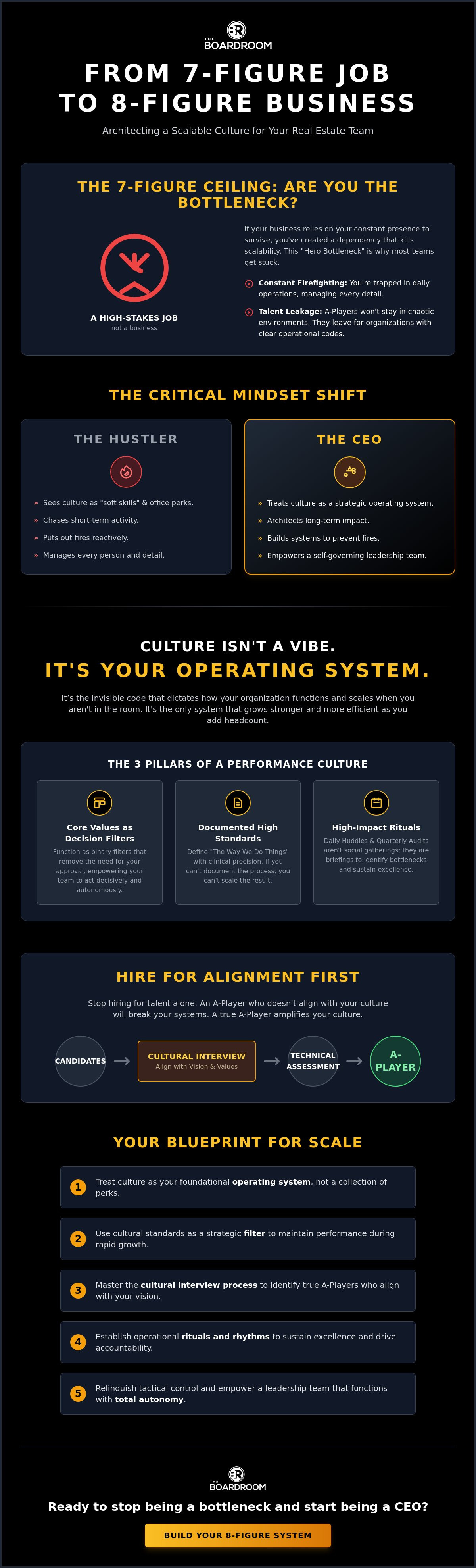
Most real estate founders mistake culture for a vibe. They think Friday drinks and branded swag build a business. They're wrong. Culture isn't about how people feel; it's about how they function when you're not in the room. It is the foundational code of your organization. While lead gen and CRM systems provide the tracks, Organizational culture is the engine that determines how fast you can actually move. High-performance culture is the set of invisible systems that drive autonomous decision-making.
To better understand how roles and culture intersect to drive team success, watch this high-level briefing:
The primary reason company culture for real estate teams is a strategic asset is simple: it's the only system that scales linearly with headcount. You can buy more leads, but without a culture of accountability, you're just throwing fuel on a damp fire. A "Hustler" sees team dynamics as a series of fires to put out. A "CEO" sees them as a structural architecture to be optimized. If your growth feels heavy, it's likely because your culture hasn't been coded for scale.
Why 7-Figure Teams Fail to Reach 8 Figures
Many teams hit a wall at the seven-figure mark. This is the "Hero" bottleneck. The founder's individual talent is so high that it masks a broken culture. You're working 80 hours a week to keep the wheels on, but you've created a dependency that kills scalability. When there are no cultural standards, you suffer from "talent leakage." High-performers don't stay in chaotic environments; they leave for organizations with clearer operational codes. Breaking through this requires shifting from tactical management to strategic oversight. You can explore how elite leaders navigate this transition in our guide on The 7-Figure Ceiling.
The 8-Figure Cultural Operating System: Pillars of Performance
Core values are not aesthetic choices. In an elite environment, they function as binary decision filters that remove the need for constant executive approval. If your team has to ask for permission on every deal adjustment or lead assignment, you haven't built a culture; you've built a bureaucracy. True company culture for real estate teams acts as the logic layer that governs behavior in your absence. It ensures that every producer is aligned with the high-stakes goals of the organization without requiring you to micromanage the minutiae.
Understanding What Is Company Culture? is the first step toward moving from a chaotic group of producers to a structured entity. However, scale requires more than just a definition. It requires a robust Business Operating System that integrates these values into the daily workflow. When your cultural standards are clear, accountability becomes a byproduct of the system rather than a personal confrontation. Visibility into leading and lagging indicators ensures that performance is never a matter of opinion; it's a matter of data.
Designing Your Cultural Standards
Scalable growth relies on institutionalizing your "Unfair Advantage." This means defining "The Way We Do Things" with clinical precision. Whether it's a mandatory five-minute lead follow-up or a specific criteria for deal analysis, these standards must be documented. You aren't just hiring agents; you're recruiting operators into a proven framework. This clarity reduces friction and ensures that your brand's reputation for excellence remains consistent as you add headcount. If you can't document the process, you can't scale the result.
Rituals That Drive Results
Sustaining excellence requires rhythm. Operational rituals like the Daily Huddle and the Quarterly Business Audit keep the team focused on leading indicators rather than just reacting to lagging ones. These aren't social gatherings. They are high-level briefings designed to identify bottlenecks and recalibrate strategy. When you foster peer-to-peer accountability within these rituals, the team begins to self-correct. This shift allows you to step back from tactical management and focus on the high-level wealth architecture that characterizes The Boardroom experience.
Hiring for Alignment: Building an Unbreakable Leadership Team
Scaling to eight figures requires you to stop hiring workers and start recruiting architects. Workers follow instructions; architects build the systems that remove you from the daily grind. Many founders make the mistake of hiring for technical skill first, only to realize later that a high-producer with a misaligned ego is a liability, not an asset. Maintaining a high-performance company culture for real estate teams requires a shift in how you identify talent. You are looking for A-Players who don't just fit the culture but actively reinforce it through every decision they make.
Cultural interviewing is the mechanism that protects your organization's integrity. Technical proficiency is merely the baseline for entry. The real assessment begins when you screen for values-alignment and the psychological resilience required for high-stakes environments. Ask yourself: does this person possess the maturity to lead without constant oversight? If you are still the one holding people accountable, you haven't hired a leadership team; you've hired a group of expensive assistants. You can master this transition by following our Building a Leadership Team: The CEO’s Blueprint for 8-Figure Scale.
The Cost of Cultural Misalignment
In an elite organization, the "Hire Slow, Fire Fast" mantra is a survival strategy. Research indicates that global employee engagement dipped to 21% in 2024, a trend that typically signals a lack of clear purpose and leadership. One B-Player in a leadership role can dismantle years of cultural development by tolerating mediocrity and creating friction for your A-Players. When a hire doesn't align with your "Operational Code," they must be removed immediately. Protecting the standards of the group is more important than the production of any single individual. If you are ready to surround yourself with peers who prioritize this level of execution, apply for The Boardroom Mastermind Membership to gain access to our battle-tested scaling frameworks.
Leadership Governance: Maintaining Culture at Scale
Governance at the eight-figure level isn't about inspection; it's about architecture. You must relinquish tactical control to empower leadership autonomy. If you are still reviewing individual contracts or mediating minor internal disputes, you aren't leading a team. You're a high-paid clerk. Maintaining company culture for real estate teams requires a systematic approach to governance that survives your absence. This begins with implementing an external "Board of Advisors" or an elite peer group. These external audits provide the objective clarity needed to identify cultural decay before it impacts your bottom line.
Scalability is a byproduct of cultural health. You need rigorous feedback loops to audit the organization's alignment. Research indicates that work-life balance is the leading retention driver for professionals at 65 percent, surpassing even salary. If your business expansion comes at the cost of your A-Players' personal well-being, your culture is predatory, not high-performance. Predictable growth occurs when the team's professional success is inextricably linked to their personal advancement. You aren't just building a business; you're engineering a vehicle for long-term impact.
The CEO as the Cultural Architect
Your role has shifted fundamentally. You are no longer the primary producer; you are the protector of the environment. You design the standards, and you enforce the boundaries. This transition from tactical management to strategic oversight is the hallmark of the industry's elite. Refining this leadership philosophy doesn't happen in a vacuum. It requires proximity to other battle-tested visionaries who have already navigated these complexities. Elite networks like The Boardroom Mastermind provide the restricted access and shared expertise necessary to sharpen your executive edge. By focusing on the environment rather than the activity, you ensure that your organization remains a self-governing, high-performance machine that scales without your constant intervention.
Architecting Your Exit from the Tactical Trenches
True scale is not found in the volume of your leads, but in the strength of your standards. You have learned that company culture for real estate teams is the invisible infrastructure that allows your business to function autonomously. By codifying your values into decision filters and recruiting architects instead of workers, you move from being the bottleneck to becoming the visionary. This transition requires more than just internal focus; it demands the objective perspective of those who have already breached the 8-figure barrier.
Success at this level is a game of precision and proximity. You cannot audit your own blind spots. You need a room of peers who operate at the highest tiers of wealth architecture to challenge your leadership philosophy. The Boardroom Mastermind offers an elite peer network for 7, 8, and 9-figure founders, providing access to the REWW ecosystem led by Kent Clothier. It's time to stop managing activity and start governing impact. Audit your business model and optimize your leadership at the next Boardroom Intensive through quarterly in-person business audits designed for elite execution. Your path to the next level is clear; it's time to take your seat at the table.
Frequently Asked Questions
How do I change a toxic culture in an existing real estate team?
Changing a toxic culture begins with the immediate removal of individuals who refuse to adhere to your operational standards. You can't build a high-performance machine on a foundation of compromise. Once the misaligned elements are purged, you must redefine the "Operational Code" and enforce it without exception. This shift often results in short-term production dips; however, it's the only way to clear the path for 8-figure scalability.
What are the most important core values for a high-growth real estate company?
The most effective core values for 8-figure teams function as binary decision filters rather than generic slogans. Values like "Extreme Ownership," "Speed to Lead," and "Data-Driven Execution" are essential because they dictate behavior in high-stakes environments. When you prioritize these standards, you remove the ambiguity that leads to chaos. High-performance company culture for real estate teams relies on values that empower agents to act autonomously while remaining aligned with the organization's financial goals.
How does company culture affect agent retention in a competitive market?
Culture acts as the strategic gravity that prevents your most talented agents from being recruited by competitors. In a market where 32 percent of real estate professionals anticipate an increase in agent attrition, a robust culture is your primary defense. While salary is a factor, 65 percent of professionals cite work-life balance as their leading retention driver. A culture that harmonizes high-level execution with personal well-being ensures your A-players have no reason to look elsewhere.
Can a small real estate team have a 'corporate' culture?
A small team can and should adopt a sophisticated executive framework to prepare for rapid expansion. Size is irrelevant; what matters is the discipline of your systems and the clarity of your leadership governance. By institutionalizing your "Unfair Advantage" early, you ensure that your culture remains consistent as you scale from five agents to fifty. Treating your small team as a high-level environment from day one is the fastest way to bridge the gap between seven and eight figures.
How do I measure the ROI of investing in company culture?
The ROI of company culture for real estate teams is measured by the reduction in founder-dependency and the increase in per-agent productivity. You should track quantitative metrics like the decrease in agent turnover and the percentage of deals closed without CEO intervention. When your culture is optimized, your time is freed for high-level wealth architecture rather than tactical management. This shift directly impacts your bottom line by allowing for predictable growth that doesn't rely on your personal presence.


