
Capital Raising Strategies for Real Estate Funds: Scaling to Institutional Grade
Most real estate operators are running a marathon on a treadmill, perpetually exhausted by the grind of deal-by-deal fundraising while their institutional peers operate with a quiet, systemic certainty. If you're tired of the frantic hustle for individual checks, it's because you haven't yet transitioned from being a deal-finder to a fund-architect. Scaling requires more than just better assets; it demands a total overhaul of your capital raising strategies for real estate funds. You've likely realized that the same tactics that got you to your first few millions won't bridge the gap to an 8-figure management firm.
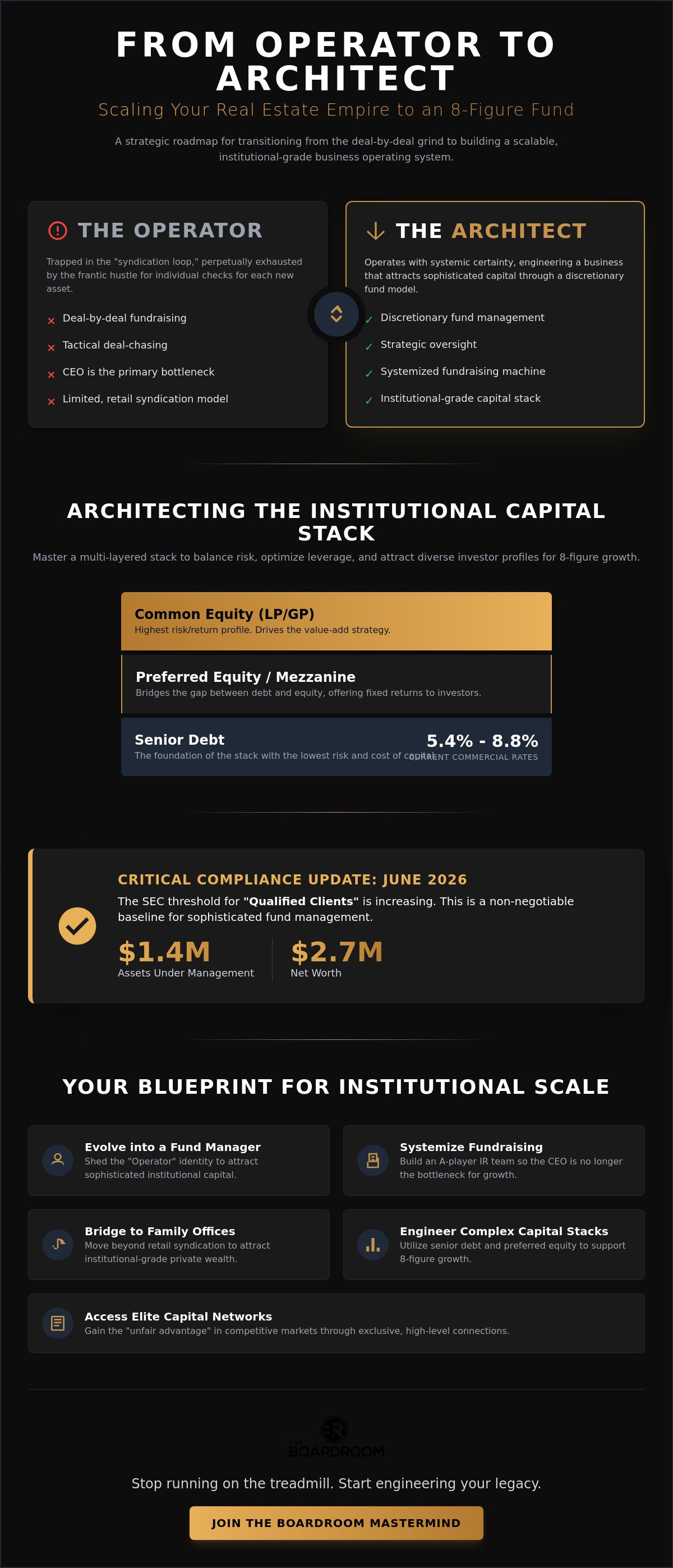
The path to institutional grade isn't about working harder, it's about engineering a business operating system that institutionalizes trust and predictability. In this briefing, you'll master the sophisticated capital architectures and systemic frameworks necessary to move beyond the limitations of retail syndication. We'll analyze critical shifts, including the June 2026 SEC threshold increases for qualified clients to $1.4 million in assets under management, and provide a high-level roadmap for eliminating operational bottlenecks. This is the blueprint for moving from tactical management to strategic oversight while commanding the respect of global high achievers.
Key Takeaways
- Learn to shed the limited "Operator" identity and evolve into a discretionary fund manager to attract sophisticated institutional capital.
- Master the engineering of a complex capital stack, utilizing senior debt and preferred equity layers to support 8-figure growth.
- Discover how to implement capital raising strategies for real estate funds that bridge the gap between retail syndication and institutional-grade family offices.
- Systemize your fundraising operations with an A-player investor relations team, ensuring the CEO is no longer the primary bottleneck for growth.
- Shift from tactical deal-chasing to strategic oversight by accessing elite networks that provide the "unfair advantage" in competitive markets.
From Syndication to Fund Management: The Structural Evolution
Scaling a real estate enterprise requires a fundamental departure from the deal-by-deal hustle. Most operators remain trapped in a "syndication loop" where every new asset demands a fresh, frantic round of fundraising. This isn't a scalable business; it's a series of high-stakes jobs. Transitioning to a discretionary fund model allows you to secure capital before the deal is even under contract. This provides the speed and certainty that institutional-grade partners demand. To truly master capital raising strategies for real estate funds, you must stop selling individual properties and start selling your infrastructure.
To better understand this concept, watch this helpful video:
The Institutional Mindset Shift
Sophisticated investors don't just care about the projected IRR of a single multifamily complex. They're investing in your "Business Operating System." They want to see that your acquisition, management, and reporting processes are repeatable and resilient. If you're still the one answering every technical question on an LP call, you're an operator, not a CEO. This transition is often the hardest hurdle for founders who have built their success on being the "smartest person in the room." Moving beyond tactical management is the only way to break through The 7-Figure Ceiling: A CEO Guide to Exclusive Mastermind Groups. You must architect a firm where the systems, not your personal activity, drive the results.
GP/LP Dynamics at the 8-Figure Level
At this tier, the structure of your General Partner (GP) entity is vital for liability protection and tax efficiency. You're no longer just managing money; you're building a Private equity real estate firm. This requires designing Limited Partner (LP) terms that balance attractive yields with the flexibility the fund needs to pivot in shifting markets. Trust is established through institutional-grade reporting and strict SEC compliance. For instance, following the June 2026 updates, ensuring your LPs meet the new "qualified client" thresholds ($1.4 million AUM or $2.7 million net worth) is a non-negotiable baseline for sophisticated fund management. Success is no longer about the deal; it's about the framework that secures the deal.
Architecting the Capital Stack: Strategies for Institutional Scale
Institutional scale isn't just about the volume of capital; it's about the architecture of that capital. To move beyond the limitations of retail syndication, you must master a multi-layered capital stack that balances risk and reward across diverse investor profiles. This typically involves a sophisticated blend of senior debt, mezzanine financing, and preferred equity. Senior debt remains the foundation, with conventional commercial rates currently ranging between 5.4% and 8.8% as of June 2026. By layering mezzanine debt or preferred equity above this, you can optimize your leverage without over-extending the fund's risk profile. These structures provide the flexibility required to execute complex value-add strategies that simple equity splits cannot support.
The most effective capital raising strategies for real estate funds often utilize Joint Ventures (JVs) to secure anchor investors. A single, large commitment from a JV partner provides the social proof necessary to attract a broader pool of Limited Partners. Before you even file with the SEC, use "soft reservations" to gauge market appetite and refine your terms. This allows you to enter the formal fundraising period with momentum and verified interest. For those seeking to refine these high-level architectures, the peer-led environment at The Boardroom Mastermind provides the strategic clarity needed to execute these frameworks with precision.
Attracting Family Office Investment
Private wealth is rapidly becoming the primary bridge between retail investors and massive institutional pension funds. Family offices are not just looking for yield; they are seeking strategic assets for multi-generational wealth preservation. They value discretion, transparency, and a shared vision of long-term impact. Positioning your fund as a strategic partner rather than a mere investment vehicle is essential. You aren't chasing their money. You are inviting them into an exclusive ecosystem of high-performing assets. To dive deeper into these high-stakes relationships, consult our Real Estate Private Equity: The Architect’s Guide to Institutional Scale. Understanding Strategies to Maximize Performance is the baseline for these sophisticated conversations.
Sophisticated Debt Strategies
Agile fund managers use bridge financing and warehouse lines to maintain deal flow. These tools allow you to close on high-quality assets before capital is fully called from your LPs. This speed is a competitive advantage in a market where investment activity is projected to increase by 16% in 2026. However, you must maintain a disciplined approach to leverage. Balancing your debt-to-equity ratios ensures fund stability during periods of market volatility. It transforms debt from a liability into a strategic tool for accelerated growth.
The Capital Machine: Systemizing Your Fundraising Operations
To scale to institutional grade, you must stop viewing capital raising as a series of tactical pitches and start treating it as a high-performance business system. Most founders remain the primary bottleneck because they insist on being the face of every technical call. This approach is fundamentally unscalable. A true capital machine operates independently of the CEO’s daily activity, utilizing a repeatable "Investor Journey" that institutionalizes trust from the first touchpoint to the final quarterly distribution. By systemizing your outreach and reporting, you create a predictable environment where capital flows as a result of your infrastructure rather than your personal charisma.
Your elite network determines the ceiling of your success. Proximity to global high achievers isn't just about social status; it's about the shared vernacular and strategic frameworks that move 8-figure deals forward. Implementing a "Business Operating System" ensures that your deal flow is recurring and your investor communication is flawless. This shift allows you to focus on the high-level architecture of your firm while your team executes the capital raising strategies for real estate funds that you've engineered. If you're ready to step out of the tactical weeds, apply for The Boardroom Mastermind Membership to access the frameworks used by industry leaders.
Building Your Leadership Team
Scaling requires an executive team capable of managing the complexity of institutional capital deployment. You need specialists who can oversee asset management while you focus on strategic oversight. The Investor Relations Officer (IRO) is the most critical hire in this phase, acting as the primary conduit for capital velocity by maintaining high-touch relationships without CEO intervention. For a deeper dive into structuring your C-suite, consult Building a Leadership Team: The CEO’s Blueprint for 8-Figure Scale. This transition is what separates the battle-tested visionary from the mere operator.
Quarterly Audits and Strategy Correction
Predictable growth is the result of constant refinement. You must implement quarterly business audits to identify specific operational bottlenecks in your fundraising funnel. Are your digital deal rooms underperforming? Is your reporting lacking the transparency required by family offices? These audits provide the data necessary for strategy correction. Peer advisory plays a vital role here, offering the objective validation required to ensure your fund remains competitive in a market where global capital raising exceeded €117 billion in 2025. Accessing a room of peers who have already solved these bottlenecks is the ultimate shortcut to permanent success.
The Boardroom Advantage: Access to Elite Capital Networks
Networking at the institutional level isn't about social pleasantries; it's about the strategic acquisition of proximity. For the fund manager aiming for 9-figure growth, high-ticket masterminds provide an "unfair advantage" that retail operators simply cannot access. It's the difference between cold-calling family offices and being introduced as a trusted peer within a restricted ecosystem. In this environment, your capital raising strategies for real estate funds are no longer tested in isolation. They're stress-tested and refined by a collective of battle-tested visionaries who have already navigated the complexities of institutional scale.
The Boardroom Mastermind Membership serves as a critical strategic asset for those ready to move from tactical management to strategic oversight. By auditing your business model against the benchmarks of global high achievers, you identify the structural weaknesses that prevent you from attracting the largest sources of capital. Success at this level requires more than just a strong IRR. It demands a level of leadership development and accountability that ensures your firm can handle the projected 16% increase in commercial real estate investment activity expected in 2026. This isn't mentorship; it's peer-level collaboration designed to institutionalize your success.
Engineering Your Elite Network
The "Power of Proximity" is a tangible force that manifests in Co-GP opportunities and strategic alliances that would be impossible to secure elsewhere. When you operate within an elite network, you gain access to the shared vernacular and capital architectures required for massive deployment. These relationships transform your business from a solo venture into a connected empire. To see the real-world results of this collaborative environment, see how elite investors are scaling their empires through these high-stakes partnerships.
Next Steps: Auditing Your Fund for Scale
You must determine if your current network is a catalyst for your growth or the very ceiling holding you back. If you aren't regularly in rooms where 8-figure deals are the baseline, your fund will never reach institutional grade. The transition to a 9-figure firm requires a ruthless audit of your systems, your team, and your associations. If you're ready to stop chasing deals and start architecting a permanent legacy, apply for The Boardroom Mastermind and scale your real estate business today. The path to the next level is clear for those with the right access.
Mastering the Shift to Institutional Dominance
The transition from deal-by-deal syndication to a discretionary 8-figure fund is not a matter of luck; it's a matter of architecture. You've seen that scaling requires a departure from the "Operator" identity and the implementation of a rigorous "Capital Machine" that functions without your constant intervention. By architecting a sophisticated capital stack and systemizing your investor journey, you institutionalize trust and predictability. Refining your capital raising strategies for real estate funds is the critical first step toward permanent industry leadership and strategic autonomy.
True acceleration happens in the rooms you choose to enter. Accessing an elite peer network of 7, 8, and 9-figure investors provides the objective validation and strategic foresight necessary to navigate high-stakes market shifts. It's time to move beyond tactical management and embrace the role of the visionary CEO. Our proven framework and quarterly in-person strategic intensives are designed for those who refuse to settle for the status quo. Apply for The Boardroom Mastermind to Audit Your Business for 8-Figure Growth and secure your place among global high achievers. The path to institutional scale is open. Step into the boardroom.
Frequently Asked Questions
What is the most effective capital raising strategy for a new real estate fund?
The most effective capital raising strategies for real estate funds involve securing a "cornerstone" or anchor investor through a Joint Venture structure. This provides the immediate social proof required to catalyze subsequent commitments from Limited Partners. You should utilize soft reservations to verify market appetite before committing to formal SEC filings. This approach ensures you launch with momentum rather than starting from zero, which is essential for maintaining fund velocity.
How do real estate funds attract institutional investors like family offices?
Family offices are attracted to fund managers who position their offerings as strategic vehicles for multi-generational wealth preservation rather than high-turnover tactical plays. You must demonstrate institutional-grade infrastructure and absolute transparency in your reporting. These partners prioritize discretion and long-term alignment. They aren't just looking for yield; they're looking for a peer-level relationship with an operator who understands the weight of legacy capital and values strategic oversight.
What is the difference between real estate syndication and a discretionary fund?
Real estate syndication is a deal-by-deal model where capital is raised for a specific, identified asset. In contrast, a discretionary fund is a "blind pool" where capital is committed upfront. This gives the manager the autonomy to execute on deals as they arise. This fund model is the hallmark of institutional-grade operations. It provides the speed and certainty of execution that high-stakes sellers demand in competitive markets.
How much capital do I need to raise to be considered institutional grade?
While there is no rigid SEC definition, the industry generally considers a manager "institutional grade" when they move beyond the $50 million to $100 million AUM threshold. However, the volume of capital matters less than the systemic framework supporting it. True institutional status is defined by your ability to execute capital raising strategies for real estate funds that attract pension funds. This requires a robust back-office and institutional-grade reporting systems.
What are the common legal structures for real estate private equity funds?
Most real estate private equity funds utilize a Limited Partnership or a Delaware Limited Liability Company structure to provide pass-through tax treatment and liability protection. Within these structures, managers typically operate under SEC Regulation D, specifically Rule 506(b) or 506(c). These frameworks allow you to raise unlimited capital from accredited investors. They maintain the necessary legal boundaries between the General Partner's strategic management and the Limited Partners' passive capital contributions.


