
Calculating Investor ROI in Real Estate Funds: The CEO’s Guide to Sophisticated Return Architecture
A standard ROI formula is a blunt instrument in a world that demands a scalpel. If you're still relying on basic entry-level math to pitch sophisticated limited partners, you're signaling a lack of institutional readiness. Calculating investor ROI in real estate fund environments requires more than a simple percentage; it demands an understanding of how 2026 commercial mortgage rates, currently ranging from 5.45% to 8.75%, intersect with complex waterfall tiers. You understand that your investors aren't just looking for a number. They're looking for the structural integrity of the deal.
It's frustrating when a high-performing asset's value is obscured by a poorly communicated fee structure or an unclear hurdle rate. You deserve a reporting framework that reflects the 8-figure reality of your investment vehicle. This guide will master the advanced metrics and waterfall structures required to evaluate and communicate institutional-grade returns with absolute precision. We'll examine the specific mechanics of IRR and Equity Multiples, the strategic use of catch-ups, and how the OBBBA permanent 100% bonus depreciation transforms your net return profile in the current fiscal landscape.
Key Takeaways
- Adopt Internal Rate of Return (IRR) as the definitive standard for measuring time-weighted performance in complex multi-asset environments.
- Architect sophisticated waterfall structures that balance investor priority with GP performance incentives to build long-term institutional trust.
- Master the precision of calculating investor ROI in real estate fund by integrating current leverage costs and the nuances of the 2026 tax landscape.
- Shift your trajectory from tactical management to strategic oversight by leveraging the collaborative power of elite peer advisory networks.
Beyond Simple Math: Why Real Estate Fund ROI Demands Sophisticated Metrics
Standard accounting methods are designed for stability, not the velocity of an 8-figure fund. When you're calculating investor ROI in real estate fund portfolios, a static percentage fails to account for the irregular timing of capital calls and distributions. Sophisticated limited partners demand a time-weighted perspective. They look to Real estate benchmarking to compare your performance against institutional standards. IRR is the discount rate that makes the net present value of all cash flows equal to zero.
To better understand the mechanics of these calculations in a practical environment, watch this technical breakdown:
IRR: The Time-Value Component
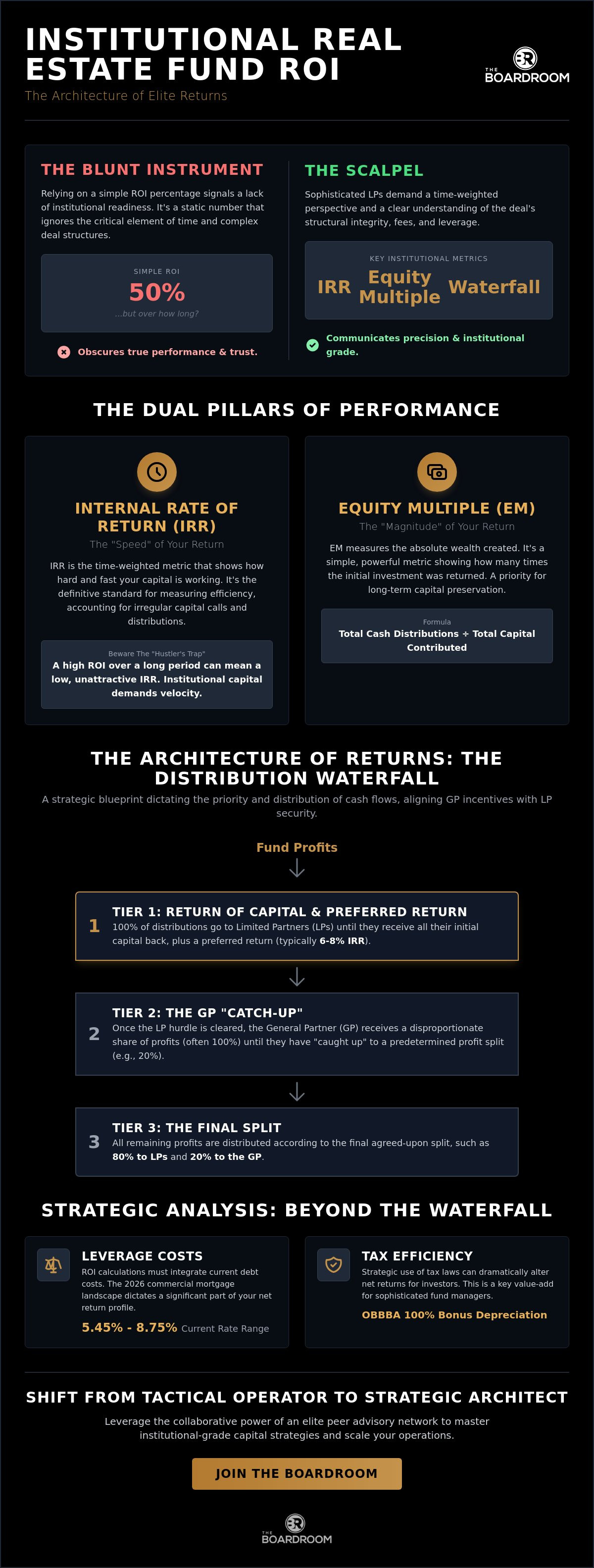
Timing is the silent arbiter of your reputation. A 50% ROI sounds impressive until the investor realizes it took seven years to achieve. This is the 'Hustler's Trap'. It's a return that looks high on paper but destroys trust because the capital was stagnant for too long. Institutional investors prioritize IRR because it measures efficiency. It reveals how hard the capital is working every single day it remains deployed in your fund.
Equity Multiple: The Wealth Creation Anchor
If IRR is about speed, the Equity Multiple (EM) is about magnitude. Calculating EM is straightforward: Total Cash Distributions divided by Total Capital Contributed. It provides a clear picture of how much absolute wealth was created. Family offices often prioritize this metric because their focus is on long-term capital preservation and multi-generational growth. Balancing a high IRR with a strong EM is the hallmark of sophisticated capital architecture. It ensures that when you are calculating investor ROI in real estate fund models, you are presenting a complete picture of performance that satisfies both the need for liquidity and the requirement for absolute wealth creation.
The Architecture of Returns: Hurdle Rates, Waterfalls, and Preferred Equity
Sophisticated return architecture is what separates a localized operator from a national fund manager. While basic ROI calculations look at the finish line, the return waterfall describes the journey. It is a strategic blueprint that dictates the priority and distribution of cash flows. You aren't just managing money; you're managing expectations through structure. Mastering the nuances of calculating investor ROI in real estate fund structures requires a deep dive into the hierarchy of payments, starting with the preferred return.
The preferred return, or "pref," is your primary tool for building institutional credibility. It functions as a hurdle that must be cleared before you, the General Partner (GP), receive performance-based compensation. In the 2026 market, a common preferred return for limited partners sits between 6% and 8% IRR. By prioritizing your investors' capital and a baseline return, you signal a commitment to capital preservation that resonates with family offices and high-net-worth individuals.
Understanding the Preferred Return & Catch-up
The catch-up clause is the bridge between investor priority and your own performance incentives. Once the initial hurdle is cleared, the catch-up allows the GP to receive a disproportionate share of the remaining profits until they reach parity with the agreed-upon split. This mechanism ensures that if the fund performs exceptionally well, your compensation reflects that success. It aligns your drive for growth with the investor's desire for safety. If you want to refine your approach to these high-stakes structures, joining an exclusive peer community can provide the clarity needed to execute at scale.
Waterfall Tiers and Performance Incentives
A professional 8-figure fund often utilizes a three-tier waterfall structure to incentivize the GP while protecting the LP. This typically includes:
- Tier 1: 100% of distributions to LPs until they receive their initial capital and the preferred return.
- Tier 2: The GP catch-up, where the GP receives a higher percentage of available funds.
- Tier 3: The final split, often 70/30 or 80/20, representing the "Promote" or carried interest.
Managing these tiers with precision is impossible without robust business operating systems. As your fund scales, the complexity of calculating investor ROI in real estate fund environments grows exponentially. You must move away from manual spreadsheets toward automated, systematic reporting that can handle higher IRR hurdles and shifting profit splits with total accuracy.
Strategic ROI Analysis: Factoring in Leverage, Fees, and Tax Efficiency
True wealth architecture requires more than high-level deal flow. It demands a granular understanding of the capital stack. When calculating investor ROI in real estate fund models, the interplay between senior debt and mezzanine financing dictates the risk-adjusted return. With conventional commercial mortgage rates currently hovering between 5.45% and 8.75%, your choice of leverage is no longer a secondary consideration. It's the primary lever for yield enhancement. If the cost of debt exceeds your cap rate, you're looking at negative leverage, a trap that destroys institutional credibility faster than any market downturn.
Accounting for fund-level fees is where many emerging managers stumble. Acquisition fees typically range from 0.5% to 3% of the purchase price. Asset management fees generally fall between 0.5% and 2% of committed capital. These aren't just line items; they're the fuel for your operational engine. Transparency is the mark of a seasoned CEO. Reporting Gross IRR might look impressive on a pitch deck, but sophisticated LPs only care about Net IRR. They want to see the return after all fees and promotes have been stripped away.
The Fee Drag: Balancing GP Revenue and LP Returns
How do you structure fees so they cover your overhead without cannibalizing investor ROI? It's a delicate equilibrium. Over-loading fees prevents you from scaling to 9-figures because it signals a short-term hustler mindset rather than a long-term architect approach. You must ensure your incentives are tied to performance rather than mere activity. High-level operators use The Boardroom Mastermind network to audit their fee structures against institutional peers, ensuring they remain competitive while maintaining healthy margins.
Tax-Adjusted ROI: The Silent Multiplier
Real estate offers an unfair advantage that other asset classes simply can't match. Under the One Big Beautiful Bill Act (OBBBA) of 2025, 100% bonus depreciation is now a permanent fixture for qualifying properties. When you communicate ROI, are you factoring in the tax-equivalent yield? For an investor in the highest tax bracket, a 10% net IRR in a fund can be the equivalent of a 15% return in the stock market due to K-1 distributions and cost segregation. For the 2026 tax year, the increased $40,000 SALT deduction cap further enhances this profile. To optimize your fund's tax architecture, apply to join our community of elite founders today.
From Passive Investor to Fund Architect: Scaling Your Capital Strategy
Transitioning from a deal-by-deal operator to a professional fund manager is a fundamental psychological evolution. It requires abandoning the frantic energy of the hustler for the composed precision of a wealth architect. When you're calculating investor ROI in real estate fund models at an 8-figure level, the math is only half the battle. The other half is the structural integrity of your organization. Your ROI projections are a direct reflection of your leadership team's ability to execute on a complex mandate without your constant intervention.
The CEO’s Role in Fund Performance
Scale demands you move from tactical management to strategic oversight. You can't be the one auditing every line item on a spreadsheet; you must be the one setting the standards for the audit. Use quarterly intensives to pressure-test your assumptions against current market volatility. If your projected IRR is 18% but your operational team is struggling with asset-level NOI growth, your credibility is at risk. Building a culture of radical accountability ensures that your spreadsheets don't just look good in a pitch deck. They must manifest as realized, institutional-grade returns in your investors' bank accounts.
Leveraging Proximity for Global High Achievement
Successful 9-figure fund managers don't operate in isolation. They understand that calculating investor ROI in real estate fund environments is a shared vernacular among elite wealth architects. Access to elite peer groups provides the external perspective needed to identify operational bottlenecks before they impact your yield. It's about proximity to those who have already solved the problems you currently face; it's about the shortcut to high-level execution.
Audit your current fund model today. Is it built for 7-figure survival or 8-figure institutional investment? The path to the next level is clear for those with the right access. Apply to join The Boardroom Mastermind and refine your scaling strategy alongside the world's most successful real estate CEOs.
Architecting Your Institutional Future
Mastering the intricacies of calculating investor ROI in real estate fund structures is the definitive boundary between a local operator and a global architect. You've seen how sophisticated metrics like IRR and Equity Multiples provide the clarity that institutional capital demands. You understand that the strength of your fund lies in the precision of your waterfall tiers and the strategic use of tax-advantaged structures like cost segregation. These aren't just technical details; they are the pillars of a professional investment vehicle designed for permanence and significant impact.
Scaling to 9-figures requires more than just isolated effort; it requires a battle-tested framework and proximity to peers who have already conquered the bottlenecks you're currently facing. Through quarterly in-person business strategy sessions and access to an exclusive network of 7, 8, and 9-figure real estate CEOs, you can stop managing deals and start leading an empire. The path to the next level is clear for those who value time and high-level execution above all else.
Scale your real estate fund to 8-figures with The Boardroom Mastermind.
Your transition from tactical management to strategic oversight starts now. The tools for institutional-grade success are within reach.
Frequently Asked Questions
What is a 'good' IRR for a real estate fund in 2026?
A target net IRR of 12% to 18% is generally considered strong for value-add funds in 2026, while core-plus strategies typically target 8% to 12%. These benchmarks signal competitive superiority when compared to the 25-year private market average of 5.2%. Your projections must account for the current 5.45% to 8.75% commercial mortgage rates to ensure the risk-adjusted return justifies the capital commitment in this environment.
How does the 'hurdle rate' differ from the 'preferred return'?
The preferred return is a distribution priority that ensures limited partners receive a specific yield before the general partner receives any profit. In contrast, a hurdle rate is a performance benchmark that triggers a specific tier in the waterfall split. While often used synonymously in calculating investor ROI in real estate fund structures, the hurdle is the gatekeeper of your carried interest, whereas the pref is the investor's safety net.
What is the difference between Gross IRR and Net IRR?
Gross IRR reflects the total performance of the fund's assets before accounting for management fees, acquisition costs, and the general partner's promote. Net IRR is the actual realized return delivered to the limited partner's pocket. Institutional investors focus exclusively on Net IRR because it incorporates the fee drag, which often includes acquisition fees ranging from 0.5% to 3% and annual asset management fees up to 2%.
Why is the Equity Multiple sometimes more important than the IRR?
The Equity Multiple measures total wealth creation, whereas IRR measures the speed of that return. A high IRR can be deceptive if it's achieved over a very short duration with low total capital gain. Sophisticated family offices often prioritize the multiple because it demonstrates absolute capital growth and long-term preservation, ensuring that the total cash distributions significantly outweigh the initial capital contributed over the fund's life.
How do acquisition fees affect the total investor ROI?
Acquisition fees, typically between 0.5% and 3% of the purchase price, act as an immediate reduction in the fund's initial equity position. When calculating investor ROI in real estate fund models, these front-end costs must be offset by rapid operational efficiency or value-add execution to avoid dragging down the early-year IRR. Managing these fees with total transparency is critical for maintaining alignment between your operational needs and the investor's net return expectations.


