
Business Partner Dispute Resolution: A CEO’s Guide to Protecting the Empire
Your partnership isn't failing; it's evolving. For the high-tier real estate executive, a rift in the boardroom is rarely about personality and almost always about a structure that can no longer support your current scale. You've reached a level where the stakes involve more than just profit; they involve your legacy and your absolute control. Effective business partner dispute resolution isn't about compromise. It's about a calculated realignment that protects your equity while shedding the operational bottlenecks that threaten your momentum.
You likely feel the weight of potential litigation or the fear that a public fallout could trigger a pilot scheme disclosure of your private court documents. It's a valid concern for anyone operating at the top. This article outlines how to navigate these high-stakes conflicts with the precision of a seasoned strategist. You'll discover how to determine whether to restructure or exit, alongside frameworks designed to prevent future paralysis. We're moving beyond tactical fires toward a permanent, strategic resolution that keeps your empire's growth inevitable.
Key Takeaways
- Reframe partnership conflict as a structural symptom of business growth rather than a personal failure of leadership.
- Adopt an "Empire First" framework for business partner dispute resolution that prioritizes company valuation and creditworthiness above all else.
- Audit your current Operating Agreement to identify strategic leverage points and determine if your valuation formulas still align with an 8-figure scale.
- Understand the implications of the "Shotgun Clause" and how liquidity determines your power during a forced buyout or restructuring.
- Utilize elite peer accountability as a proactive insurance policy to ensure your leadership team evolves at the same pace as your portfolio.
The Anatomy of High-Stakes Partnership Conflict
A business partner dispute is rarely a simple personality clash. It is a strategic misalignment that threatens your company's core operating system. When you launched, a "handshake deal" and shared grit were enough to drive the machine. Now, as your portfolio expands, those original agreements are likely cracking under the weight of institutional scale. Effective business partner dispute resolution starts with recognizing that your business has outgrown its original leadership architecture. It's a system failure, not just a human one.
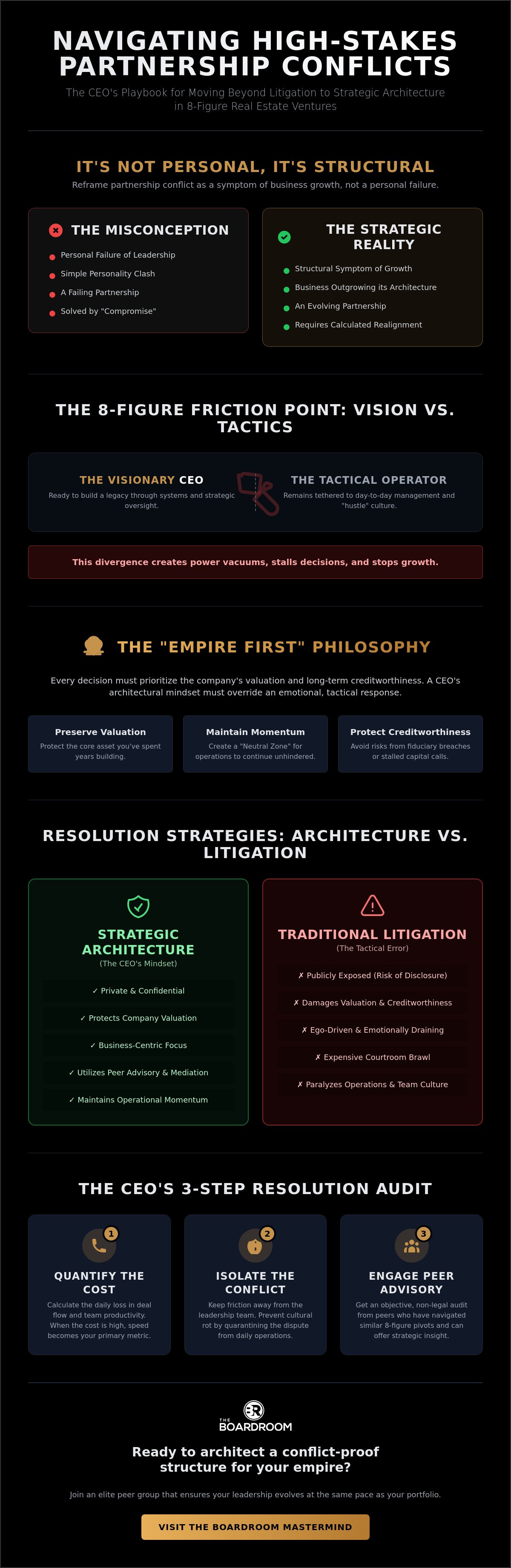
The transition from "hustler" to "CEO" is the primary friction point where partners often diverge. One may be ready to build a legacy through systems and oversight, while the other remains tethered to tactical management. While traditional dispute resolution methods like litigation provide a legal exit, they often ignore the architectural needs of a scaling real estate empire. You need a solution that preserves your company's valuation while addressing the divergence in vision.
To better understand this concept, watch this helpful video:
The 8-Figure Friction Point
Scaling to 8 figures reveals a harsh truth. One partner is usually a natural operator, while the other is a visionary. Without a clear business operating system, power vacuums emerge. Decisions stall. Growth stops. This is where tactical disagreements about daily tasks turn into structural rifts. If you don't have a framework for decision-making, the partner with the loudest voice wins, rather than the partner with the right data.
Common Triggers in Elite Real Estate Ventures
In elite real estate, friction often stems from capital calls, fund management, or complex institutional debt structures. These aren't just arguments; they're risks to your creditworthiness. A fiduciary breach in real estate private equity occurs when a partner prioritizes personal gain or outside interests over their legal obligation to act in the best interest of the entity and its stakeholders. When this happens, the conflict is no longer about "getting along." It's about protecting the empire from internal collapse.
Strategic Resolution: Moving Beyond Litigation to Architecture
When a rift occurs, your first instinct might be to call a litigator. That's a tactical error. High-stakes business partner dispute resolution requires a CEO's architectural mindset, not a courtroom brawl. You must adopt an "Empire First" philosophy. Every move you make should prioritize the company's valuation and long-term creditworthiness. If you let ego drive the process, you risk the very asset you've spent years building.
Before engaging external counsel, audit your existing Operating Agreement. Identify the specific leverage points that protect the entity's cash flow. Treating the friction as a business model audit rather than a personal betrayal keeps your head clear. This shift is essential for effective business partner dispute resolution. You need a "Neutral Zone" where operations continue without the "bottleneck effect" while you negotiate behind closed doors. This maintains momentum while you work through the architecture of the split.
The 5-Step CEO Resolution Framework
- Quantify the Cost: Calculate the daily loss in deal flow and team productivity. If the dispute costs you five figures a day in missed opportunities, speed becomes your primary metric.
- Isolate the Conflict: Keep the friction away from the leadership team to prevent cultural rot.
- Engage Peer Advisory: Get an objective, non-legal audit from those who have navigated similar 8-figure pivots.
Mediation as a Strategic Tool
Privacy is your greatest asset. With the 2026 UK pilot scheme providing wider public access to court documents, litigation is more exposed than ever. Utilizing private strategies for resolving partnership disputes ensures your sensitive financial data remains off the public record. A "Fractional CEO" or advisor can facilitate a business-centric resolution that focuses on the bottom line rather than personal grievances. For those seeking this level of strategic oversight, the Boardroom Mastermind experience provides the elite proximity needed to navigate these high-stakes pivots with composure.
The Pivot: Restructuring, Buyouts, and Strategic Exits
When structural alignment fails, the path forward requires a surgical pivot. You must stop negotiating and start executing the exit. Most legacy agreements were drafted when the company was a fraction of its current size, meaning the valuation formulas are often obsolete for an 8-figure portfolio. If your buy-sell agreement doesn't reflect your current institutional scale, you're either overpaying or inviting a lawsuit. Effective business partner dispute resolution at this level demands a valuation that accounts for future cash flows, not just past performance.
The "Shotgun Clause" is the ultimate liquidity test in these scenarios. If you trigger it, you must be prepared to buy out your partner at the price they set, or sell your own shares to them at that same valuation. It's a high-stakes game where the partner with higher liquidity and stronger banking relationships usually wins. If a total break isn't feasible, consider a "Restructured Role." Transitioning an active operator to a passive equity holder can preserve the cap table while removing the operational friction that stalls growth.
Don't let the tax man gut your buyout. Capital gains can destroy the value of an exit if not handled with precision. In the real estate sector, you must analyze the implications for 1031 exchanges and potential clawbacks. A poorly structured exit can trigger massive liabilities that negate the benefit of the split.
Structuring the Clean Break
You must engineer a buyout that doesn't cripple your company's cash flow. Utilizing real estate private equity structures or mezzanine debt can provide the necessary liquidity without draining your operating capital. A seamless handoff of institutional relationships is vital. Lenders and joint venture partners hate uncertainty; they need to know the empire's creditworthiness remains unchanged despite the leadership shift.
Rebuilding the Leadership Team
Once the exit is finalized, you must stabilize your leadership team immediately. Cultural rot spreads quickly if the remaining staff feels the void of a departing founder. Communicate the change to your A-players and investors with absolute transparency. Frame the departure as a strategic evolution rather than a crisis. If you're currently facing a complex buyout or restructuring, apply for the Boardroom Mastermind to access the strategic frameworks used by elite operators to navigate these transitions without losing momentum.
Engineering Proximity: Preventing Conflict Through Peer Accountability
Prevention is the ultimate form of leverage. While most leaders wait for a crisis to seek business partner dispute resolution, the elite engineer their environment to make conflict obsolete. This is the essence of "Elite Proximity." It's a strategic insurance policy against the stagnation and misalignment that inevitably occur when two founders grow at different speeds. By placing your partnership within a high-stakes peer group, you create a layer of accountability that your internal team simply cannot provide.
Think of The Boardroom Mastermind Membership as your external Board of Directors. It provides the objective, cold-eyed "Audit" your business needs to survive the transition to institutional scale. Our "Quarterly Intensives" are designed to force partners to align on vision and strategy long before rifts form. These sessions act as a pressure valve. They ensure that every decision serves the empire's growth rather than a partner's ego. It's about maintaining a shared vernacular of success.
The Power of the Peer Audit
Having your business model critiqued by 8 and 9-figure peers identifies partnership cracks early. These operators have seen every permutation of failure and success. They can spot the "hustler" who's becoming a bottleneck in your 8-figure enterprise before that individual causes operational paralysis. The ROI of joining an elite network is measured in the millions of dollars saved by avoiding the legal fees and reputational damage of a failed partnership.
Building an Unbreakable Foundation
You must transition from a "Two-Man Show" to a professional, CEO-led organization. This shift requires a level of discipline that few can maintain in isolation. Peer accountability ensures you remain focused on strategic oversight rather than tactical management. It's time to move beyond reactive business partner dispute resolution and toward proactive empire building. If you're ready to secure your company's legacy, apply to join the elite network and audit your business model today.
Secure Your Legacy Through Strategic Alignment
High-stakes partnerships don't fail because of personality. They fail because the business outgrows its original structure. You've seen that effective business partner dispute resolution requires moving beyond tactical litigation toward a CEO-led architectural realignment. By auditing your operating agreements and quantifying the cost of friction, you protect your empire's valuation and creditworthiness. Most importantly, you now understand that elite proximity is your best defense against future stagnation.
Scaling to 8 and 9 figures is a lonely pursuit without a board of peers to audit your trajectory. You don't have to navigate these transitions in isolation. We provide the proven frameworks to move you from Operator to CEO. This is supported by quarterly in-person intensive strategy sessions that force alignment and clarity. Surrounding yourself with an elite peer network of 8 and 9-figure real estate investors ensures your leadership evolves as fast as your portfolio. It's time to build a foundation that is truly unbreakable.
Apply to join The Boardroom Mastermind and scale with the right proximity. Your next level of impact is waiting for the leader you're becoming.
Frequently Asked Questions
What are the first steps in a business partner dispute resolution?
The first steps in business partner dispute resolution involve a cold-eyed audit of your Operating Agreement and an immediate quantification of the "Cost of Conflict." You must determine the daily loss in deal flow and team productivity to establish a baseline for negotiation. This prevents ego-driven delays and focuses the conversation on protecting the entity's valuation rather than personal grievances.
Can a partnership dispute be resolved without going to court?
Yes, most high-stakes conflicts are resolved through private mediation, structured buyouts, or internal restructuring rather than public litigation. With current trends favoring privacy, maintaining confidentiality is a strategic necessity for elite real estate brands. Alternative methods allow you to keep sensitive financial data off the public record while engineering a business-centric solution that preserves your institutional reputation.
How do I protect my personal assets during a business partner dispute?
Protecting personal assets requires strict adherence to corporate formalities and a thorough review of all personal guarantees tied to institutional debt. Ensure your business remains a distinct legal entity by avoiding any commingling of funds while the dispute is active. You should also evaluate your "Shotgun Clause" to understand your liquidity requirements if a forced buyout becomes the only path forward.
What should I do if my business partner is breaching their fiduciary duty?
If a partner breaches their fiduciary duty, you must document every instance of self-dealing or negligence while immediately isolating them from critical decision-making. A breach in a real estate private equity context is a direct threat to your investors and your long-term creditworthiness. You need to secure the company's core operating system and engage counsel to determine if the breach triggers a "for cause" removal or buyout.
How does a mastermind group help with business partnership issues?
A mastermind group acts as an external Board of Directors, providing the objective "Peer Audit" that your internal leadership team often lacks. It helps you identify partnership cracks before they become catastrophic rifts through business partner dispute resolution frameworks shared by peers. By surrounding yourself with 8 and 9-figure operators, you gain the clarity needed to navigate complex transitions without losing your company's momentum.
When is it time to legally dissolve a business partnership?
You should legally dissolve the partnership when strategic misalignment creates permanent operational paralysis that threatens the company's solvency. If your partner is no longer an asset to the "Empire First" mission and restructuring has failed to produce a viable path forward, a clean break is the only way to salvage your legacy. Don't wait for a total collapse; execute the exit while the valuation still holds.


