
Building Systems in Real Estate Business: The Architecture of 8-Figure Scale
If your business stops moving the moment you stop grinding, you don't own an enterprise. You own a high-pressure job that happens to pay well. Most real estate founders are trapped in a exhausting cycle of tactical management while their potential for 8-figure scale remains locked behind operational bottlenecks. The reality is that building systems in real estate business isn't about adding administrative layers; it's about architecting an institutional-grade machine that produces predictable results without your constant intervention.
You've likely spent years perfecting the art of the deal, only to find yourself acting as a glorified administrator for your own success. It's a common plateau where deal flow feels inconsistent and the fear of a total collapse keeps you from taking even a week of rest. You will learn how to transition from a high-stakes operator to a strategic CEO by implementing frameworks that ensure growth is both inevitable and sellable. We will examine the specific architecture required to reclaim your personal freedom and transform your daily hustle into a legitimate, scalable asset that thrives on its own.
Key Takeaways
- Identify the "Hustler’s Ceiling" where manual effort plateaus and learn why systems are the only bridge to institutional equity.
- Discover the architectural requirements for building systems in real estate business through a centralized Business Operating System (BOS) focused on leadership, data, and process.
- Learn how to engineer a resilient "Deal Machine" that ensures consistent acquisition and capital flow through every market cycle.
- Master the "Eliminate, Automate, Delegate" framework to reclaim your personal freedom while maintaining high-level strategic oversight.
- Shift your perspective from managing daily operations to architecting a sellable asset that functions with or without your direct involvement.
The Operator Trap: Why Your Real Estate Business Hits a Seven-Figure Ceiling
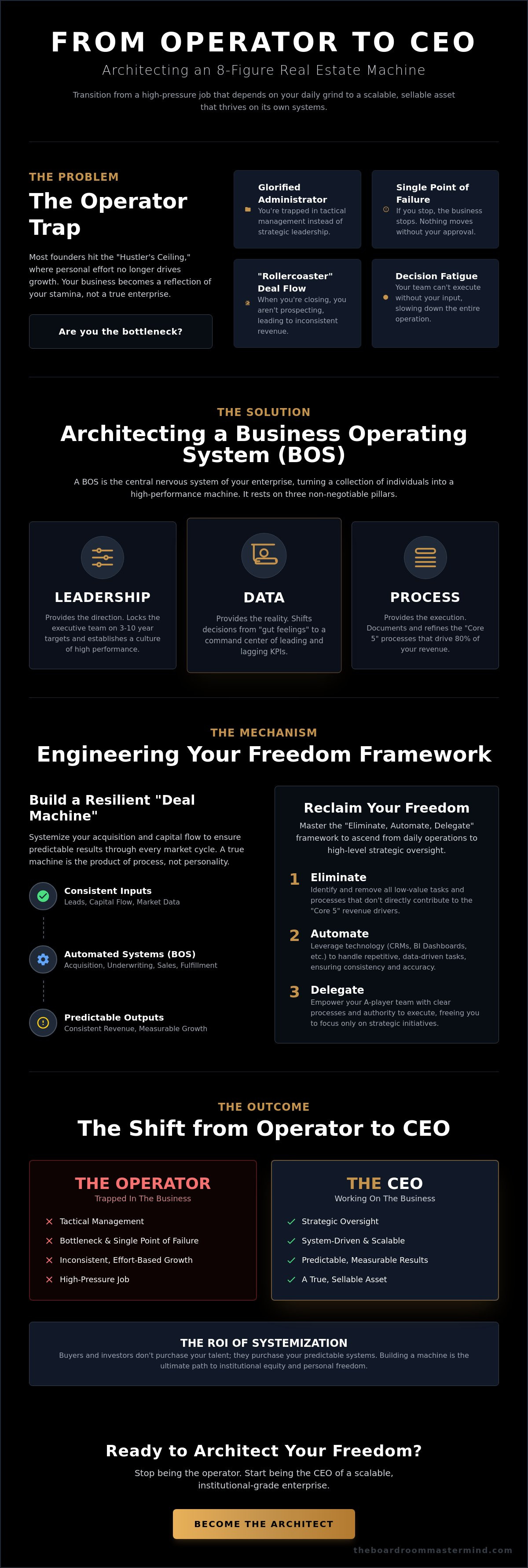
You've built something impressive, but you're likely exhausted. This is the "Hustler’s Ceiling." It's the point where your personal output can no longer drive incremental growth. At this stage, your business isn't an asset; it's a reflection of your stamina. If you stop, it stops. Building systems in real estate business is the only way to bridge the gap between exhausting tactical activity and true institutional equity. Without these structures, you're just trading high-level problems for high-level stress.
The most dangerous bottleneck in your firm is your own expertise. Being the "smartest person in the room" feels rewarding until you realize it makes you the single point of failure. Every major decision requires your sign-off, which means your company can only move as fast as your calendar allows. A real estate business system is a repeatable, measurable framework for value creation. Without these frameworks, you aren't a CEO; you're an operator who happens to own the company.
Signs You Are the Bottleneck in Your Firm
Decision fatigue is the first indicator. If your team can't execute an acquisition or resolve a complex operational hurdle without your input, you haven't architected a self-governing machine. This leads to the "rollercoaster" effect in your deal flow. When you're closing, you aren't prospecting. When you're prospecting, you aren't closing. You need a higher level of perspective to break this cycle. Understanding The 7-Figure Ceiling: A CEO Guide to Exclusive Mastermind Groups is essential for founders ready to stop being the operational bottleneck and start leading.
The ROI of Systemization: Beyond Just 'Saving Time'
Systems do more than reclaim your schedule. They increase your enterprise value. When you eventually look for an exit, a buyer isn't purchasing your talent; they're purchasing your Business Process Management protocols. Predictability is the currency of high finance. If you want to attract institutional-grade capital or private equity, you must prove that your results are the product of a machine, not a miracle. Building systems in real estate business ensures that your revenue is consistent, your growth is measurable, and your business is a sellable asset rather than a high-paying job.
Architecting Your Business Operating System (BOS) for Institutional Scale
A Business Operating System (BOS) is the central nervous system of your enterprise. It's the difference between a collection of talented individuals and a high-performance machine. To achieve true scale, you must move beyond static SOPs. You are building a dynamic ecosystem that connects every department. This is the foundational logic behind Business Operating System: The Architecture of 8-Figure Real Estate Scaling.
An elite BOS rests on three pillars: Leadership, Data, and Process. If one is weak, the entire structure collapses. Leadership provides the direction, Data provides the reality, and Process provides the execution. Building systems in real estate business isn't just about efficiency; it's about culture. Your BOS must be culture-driven to ensure long-term adoption by A-players. High achievers don't want to be micromanaged by rules. They want to be empowered by a framework that allows them to win consistently.
The Core Components of an 8-Figure Real Estate BOS
Success at this level requires alignment across three critical areas. First, the Vision Component ensures your executive team is locked in on 3-year and 10-year targets. Second, the Data Component shifts your decision-making from "gut feelings" to leading and lagging indicators. Finally, the Process Component involves documenting the "Core 5" processes that drive 80% of your revenue. This includes building a great real estate sales system to maintain a predictable acquisition pipeline.
Data Integrity: Establishing Your Command Center
Stop confusing your CRM with a true Business Intelligence (BI) dashboard. A CRM tracks activity; a BI dashboard tracks efficiency and ROI. Your command center must prioritize KPIs that predict future revenue, such as new lead velocity or debt-to-equity ratios. If you're looking for a battle-tested framework to implement these structures, the Boardroom Mastermind Membership provides the specific blueprint for this transition.
Engineering Predictability: Key Systems Every Elite Real Estate Firm Requires
Predictability isn't a luxury; it's a requirement for institutional growth. Building systems in real estate business requires moving beyond basic lead generation into sophisticated engineering. You need a "Deal Machine" that operates independently of market sentiment. If your acquisitions depend on your personal network or daily effort, you haven't built a system. You've simply built a more complex way to stay busy. True scale demands a framework where deal flow is a mathematical certainty rather than a hope.
Acquisition and Disposition Systems
Automating the "Top of Funnel" ensures a constant stream of off-market opportunities without your direct involvement. This requires a multi-channel approach where lead velocity is tracked with surgical precision. Once leads enter the funnel, your "Underwriting System" must take over. By standardizing deal analysis, you remove the emotional bias that leads to overpayment. You're no longer "feeling" a deal; you're verifying its performance against institutional-grade benchmarks.
Strategic growth also requires a sophisticated capital stack. You must build systems to attract, manage, and deploy private equity and debt with confidence. For a deeper dive into these structures, see Real Estate Private Equity: The Architect’s Guide to Institutional Scale. Accountability is the heartbeat of this high-performance culture. Weekly "L10" style meetings ensure every team member is aligned on their primary "rocks" and measurable outcomes.
Talent and Leadership Systems
Your scale is limited by the quality of your leadership. You don't need more employees; you need executives who think like owners. Implement an "A-Player" hiring system that filters for high-agency individuals who thrive on accountability. Refer to Building a Leadership Team: The CEO’s Blueprint for 8-Figure Scale for a complete recruitment framework. To audit your current operations against these elite standards, apply for Boardroom Elite today.
From Architect to CEO: Implementing Systems That Buy Back Your Freedom
The final transition from operator to CEO is less about adding new skills and more about shedding old habits. You must apply the "Eliminate, Automate, Delegate" framework with clinical detachment. If a task doesn't require your specific vision, it shouldn't be on your desk. Building systems in real estate business allows you to move from tactical management, where you solve daily fires, to strategic oversight, where you design the future of the firm. This is how you stop being a prisoner of your own success.
This evolution requires a profound psychological shift. You've likely relied on your intuition to reach the seven-figure mark, but that same intuition becomes a liability at eight figures. You must learn to trust the system more than your gut. Successful system implementation requires a 90-day commitment to auditing, refining, and enforcing new protocols before they become the cultural norm. Without this period of rigorous enforcement, your team will inevitably revert to the path of least resistance.
The 5-Step System Implementation Framework
Systemization fails when it's rushed or disorganized. Start with a comprehensive Audit to identify the highest-leverage bottleneck in your next 90 days. Focus only on the systems that move the needle. Once identified, Document the current "mess" exactly as it exists. You can't optimize a process you haven't mapped. Finally, Test the new framework with a small, high-agency team before a firm-wide rollout. This ensures the protocol works in the field, not just on a whiteboard.
Maintaining the Machine: The CEO’s Audit Role
Your role as CEO shifts to that of a high-level inspector. You must perform a quarterly business audit to ensure your operations haven't suffered from "operational drift," where team members slowly bypass established protocols. Maintaining an elite edge requires constant external perspective. Using the Boardroom Mastermind Experience to pressure-test your systems against elite peers ensures your architecture remains institutional-grade. Building systems in real estate business is not a one-time event; it's a continuous pursuit of operational excellence that secures your freedom and your legacy.
Architecting Your Exit from the Daily Grind
Scaling to eight figures and beyond requires more than just harder work. It demands a fundamental shift in how you view your role. You've seen how the Operator Trap limits your growth and how a culture-driven Business Operating System provides the necessary foundation for institutional scale. Building systems in real estate business isn't a secondary task; it's the primary responsibility of a CEO who values long-term impact and personal autonomy. By engineering predictability into your acquisitions and leadership, you transform a high-pressure job into a sellable, sovereign asset.
Success at the highest levels is never a solo pursuit. It requires access to the right frameworks and a peer group that has already solved the bottlenecks you're currently facing. Trusted by 7, 8, and 9-figure real estate entrepreneurs, our community offers exclusive quarterly intensives focused on business architecture. You'll gain access to a battle-tested network of high-level operators who speak the language of scale. Apply to join The Boardroom Mastermind and audit your business systems with elite 8-figure founders. The path to your next milestone is clear once the right architecture is in place.
Frequently Asked Questions
What are the first systems I should build in my real estate business?
Start with your acquisition and capital deployment frameworks. These are the high-leverage engines of your firm. Without a predictable way to find deals and secure funding, you're merely reacting to market fluctuations. Building systems in real estate business begins with the "Core 5" processes that generate the majority of your revenue. Focus on standardizing lead intake and underwriting before you attempt to optimize secondary administrative tasks.
How do I know if my real estate systems are actually working?
Your systems are working when your physical presence is no longer required for high-level execution. Monitor your leading indicators like lead velocity and debt-to-equity ratios through a centralized dashboard. If the business maintains its growth trajectory while you are away for two weeks, your architecture is sound. If deal flow stalls or decision-making halts without your input, your systems haven't yet reached institutional maturity.
Can I scale a real estate business without a complex operating system?
You can reach high six figures through sheer force of will, but you can't achieve 8-figure scale without a robust operating system. Manual effort doesn't scale; it only compounds fatigue. A professional Business Operating System acts as the central nervous system of your firm. It ensures that as you add complexity, you don't sacrifice clarity or profitability. Without this structure, your business will eventually collapse under its own weight.
How much does it cost to implement a professional business operating system?
The cost of implementing a professional operating system is measured primarily in executive time and strategic focus. While you'll invest in high-level BI dashboards and specialized management platforms, the real expense is the 90-day commitment to auditing and refining your protocols. This is a critical investment in your enterprise value. It's the price of transitioning from a high-paying job to a legitimate, sellable asset.
How do I get my team to actually follow the systems I build?
Adoption starts with hiring A-players who thrive within structured environments. If your team resists your protocols, you likely have a leadership or a talent mismatch. Building systems in real estate business requires a culture-driven approach where the system itself is the authority. Use weekly accountability meetings to enforce these standards. When the system becomes the "single source of truth," compliance becomes a natural byproduct of your high-performance culture.


