
Building a Vertically Integrated Real Estate Company: The CEO’s Blueprint for Enterprise Scale
Your greatest operational risk isn't the current 3.62 percent federal funds rate; it's the third-party contractor holding your margins hostage. If you're tired of losing control over your construction timelines and watching external managers erode your profits, you've reached a critical inflection point. Building a vertically integrated real estate company is no longer a luxury for the elite. It's the necessary evolution for any leader who wants to transition from a deal-hunter to a true platform owner. You understand that every external hand in your pocket is a leak in your wealth architecture. This isn't about saving on minor fees. It's about total command over the investment lifecycle.
We agree that the current environment demands more than just tactical management. It requires a strategic overhaul of how you deploy capital and manage assets. You'll learn how to master the architecture of vertical integration to eliminate friction and capture every dollar of value from acquisition to disposition. We'll examine the systems needed for enterprise scale, including how to leverage permanent 100% bonus depreciation and the increased $40,000 SALT deduction cap to maximize your internal returns. This briefing outlines the transition from managing projects to presiding over an unbreakable real estate empire.
Key Takeaways
- Internalize your entire value chain to shift your identity from a tactical operator to a sophisticated enterprise architect.
- Eliminate the "contractor tax" and recapture lost margins by building a vertically integrated real estate company that controls the construction lifecycle.
- Deploy a standardized business operating system to manage the critical transition points between acquisition, underwriting, and development.
- Consolidate your operational data into a single source of truth to maintain total visibility over your portfolio's performance.
- Elevate your leadership from tactical troubleshooting to strategic oversight by surrounding yourself with high-level peers who understand enterprise complexity.
The Strategic Architecture: Why Vertical Integration is the Final Frontier of Scale
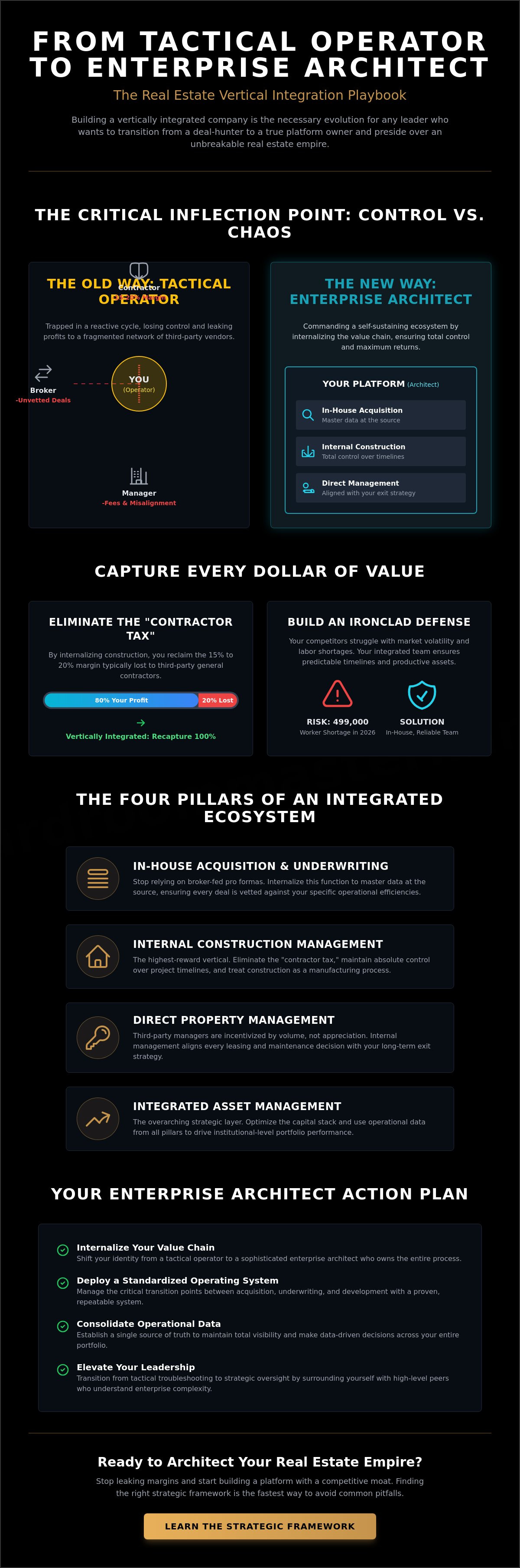
Most real estate professionals stay trapped in the cycle of the Tactical Operator. They chase a lead, secure financing, and then immediately hand over their hard-earned equity to a fragmented network of third-party vendors. This approach is fundamentally reactive. By contrast, the Enterprise Architect understands that true scale requires a shift in the very DNA of the business. Building a vertically integrated real estate company is the process of internalizing every critical node of the value chain. It transforms your business from a collection of projects into a self-sustaining ecosystem.
At its strategic core, Vertical Integration involves consolidating multiple stages of production or distribution under a single corporate banner. Why pay for a general contractor's profit margin when you can build the infrastructure to manage it yourself? This isn't just about saving pennies on a renovation. It's about capturing the "Lost Margin" that typically leaks out to external partners. When you own the construction and management arms, you aren't just an investor. You are the supply chain. This level of control provides an ironclad defense against market volatility. While your competitors struggle with the projected 499,000-worker construction workforce shortage in 2026, your integrated team ensures that your timelines remain predictable and your assets remain productive.
The Shift from Deal-Flow to Platform Ownership
Scaling to 8 figures and beyond requires more than just a high volume of deals. It demands a platform. A platform is a competitive moat. If you rely on the same third-party managers as every other investor in your market, you have no structural advantage. You're competing on price alone. When you own the vertical, you dictate the terms of the game. You move faster. You operate leaner. You build with a level of quality that external partners simply cannot replicate. This transition from deal-hunter to platform owner is the hallmark of the industry's elite. It's how you move from merely participating in the market to dominating it.
The Pillars of an Integrated Real Estate Ecosystem
A closed-loop system is the only way to ensure that your strategic vision isn't diluted by external incompetence. Building a vertically integrated real estate company requires a relentless focus on the interconnectedness of four core operational pillars. When these pillars work in harmony, they create a feedback loop that compounds your returns and de-risks your entire portfolio. You stop being a passive recipient of market data and start becoming the primary source of it.
- In-House Acquisition and Underwriting: Stop relying on broker-fed pro formas that ignore reality. Internalizing this function allows you to master data at the source, ensuring that every deal is vetted against your specific operational efficiencies.
- Internal Construction Management: This is where you eliminate the "contractor tax." By bringing this in-house, you reclaim the 15 to 20 percent margin typically lost to third-party general contractors while maintaining absolute control over your project timelines.
- Direct Property Management: Third-party managers are often incentivized by volume, not asset appreciation. Internal management aligns every leasing and maintenance decision with your long-term exit strategy.
- Integrated Asset Management: This is the overarching layer. It optimizes the capital stack and ensures that the operational data from the other three pillars is used to drive institutional-level performance.
If you're ready to architect this system, finding the right strategic framework through peer proximity is often the fastest way to avoid common pitfalls.
Internalizing Construction: The High-Risk, High-Reward Vertical
Construction is undoubtedly the most difficult vertical to internalize, yet it offers the highest reward for those who execute it correctly. With the industry projected to need an additional 499,000 workers in 2026, relying on external labor is a recipe for stalled projects. Success here requires hiring a dedicated Head of Construction who understands enterprise scale, not just job-site management. This leader must build systems that treat construction as a manufacturing process rather than a series of one-off events.
Management as a Strategic Asset
Direct management provides an invaluable real-time feedback loop. When your management team identifies a recurring maintenance issue, that data should immediately inform your future underwriting and acquisition criteria. This level of economic performance and control is a central theme in the NBER working paper on vertical integration, which examines how internalizing these functions can drive superior outcomes. By transitioning management from a cost center to a value-driver, you position your portfolio for more lucrative institutional exits.
Implementing the Business Operating System for Integration
Complexity is the silent killer of scale. If you're building a vertically integrated real estate company without a unified business operating system, you're simply creating more fires to fight. Integration demands precision. It requires a framework that connects every department into a single, high-performance machine. You aren't just managing properties anymore. You're managing a complex supply chain of capital, labor, and data.
You must standardize the "Vertical Hand-off." This is the precise protocol for when a deal moves from the acquisition desk to the construction team. Without clear documentation and checklists, information dies in the transition. This leads to operational bottlenecks and expensive rework. Centralizing your data is equally vital. You need a single source of truth for project tracking and financial reporting. If your teams are working from siloed spreadsheets, your enterprise lacks the transparency required for high-level decision-making.
Effective CEOs focus on leading versus lagging indicators. Leading indicators, like your weekly acquisition pipeline depth or construction bid velocity, predict future performance. Lagging indicators, such as your final project yield or quarterly NOI, tell you what happened in the past. To maintain control, you need A-Players leading each department. If you're still the one making every tactical decision, you haven't built a company; you've built a job. If you want to see how elite owners structure their firms, explore the Boardroom experience.
The Real Estate CEO’s Dashboard
The most critical KPI for an integrated firm is the Internal Yield Spread, which measures the delta between your internal cost of execution and the market rate for those services. You must use a business operating system to audit this performance quarterly. This ensures your internal verticals remain more efficient than the third-party alternatives you replaced.
Avoiding the Complexity Trap
Don't internalize every vertical simultaneously. Use the "Step-Up" method. Internalize one function, such as property management, and stabilize it before moving to construction. Your leadership team must be incentivized by the performance of the entire enterprise. If a department head is only focused on their own silo, they'll make decisions that harm the total value of the asset. Alignment is the only path to predictable growth.
The CEO’s Role: Transitioning to Strategic Oversight
The greatest threat to a scaling enterprise isn't market volatility; it's a CEO who refuses to stop being a "Hustler." When you're building a vertically integrated real estate company, your primary objective shifts from hunting for the next deal to engineering a high-performance platform. You must evolve from a tactical firefighter, constantly solving operational bottlenecks, into a strategic visionary who designs the systems that prevent those fires from starting. This transition is non-negotiable for those aiming for 8 and 9-figure scale.
An integrated firm is a sophisticated machine that attracts institutional attention. With global real estate investment volumes rising 14 percent to $888.6 billion in 2025, the appetite for high-quality, predictable assets has never been higher. Institutional capital and private equity firms don't just buy your portfolio; they buy your infrastructure. They're looking for the total control and predictable timelines that only a vertically integrated model can provide. To maintain this level of excellence, you must audit your business model during quarterly intensives. These sessions ensure your verticals remain aligned and your internal yield spread stays competitive.
The Power of Proximity in Scaling
You cannot navigate the complexities of enterprise-level integration in a vacuum. Joining an exclusive mastermind group provides the essential blueprint for 9-figure success. It places you in the room with battle-tested founders who've already mastered the "Vertical Hand-off" and centralized their data systems. Leveraging this collective intelligence allows you to avoid the expensive pitfalls that stall most ambitious owners. Proximity to peers who operate at the highest tiers of financial success isn't just a luxury. It's a critical strategic asset.
The Logical Conclusion: Achieving Peak Performance
Vertical integration is the ultimate shortcut to long-term impact and personal autonomy. It removes the friction of external partners and puts the full value of the real estate lifecycle directly into your hands. You've seen the pillars and the operating systems required to win. Now, it's time to execute with precision. If you're ready to audit your current integration strategy with a group of elite peers, apply for The Boardroom Mastermind. This is where tactical operators become enterprise architects.
Architecting Your Unbreakable Empire
You've identified the operational leaks and recognized that the path to true autonomy requires a structural evolution. Building a vertically integrated real estate company isn't just a strategy for higher margins; it's the final frontier of enterprise scale. By internalizing your acquisition, construction, and management verticals, you move beyond the limitations of third-party friction. You've learned that success at this level depends on a robust business operating system and a CEO who prioritizes strategic vision over tactical firefighting.
Scaling to 8 or 9 figures doesn't happen in isolation. It requires proximity to those who have already solved the complexities of integration. Our community offers access to an elite network of 7, 8, and 9-figure founders and quarterly in-person business intensives designed to audit your growth architecture. Use our proven frameworks to transition from a deal-hunter to a platform owner. Apply to join The Boardroom Mastermind and scale your integrated empire. The next level of your legacy is waiting for you to claim it. Your vision deserves a platform that can sustain it.
Frequently Asked Questions
Is vertical integration right for every real estate investor?
Vertical integration is reserved for high-growth leaders aiming for enterprise scale. It isn't a fit for passive investors or those content with a small, manageable portfolio. The model requires significant operational overhead and a sophisticated leadership team to manage successfully. If you don't have the capital or the desire to oversee a large internal workforce, staying lean through strategic outsourcing remains the more efficient path for your current stage.
How much deal volume do I need to justify bringing construction in-house?
You generally need enough consistent deal flow to keep a full-time crew and management team active twelve months a year. While specific numbers vary by market, many firms find the break-even point occurs when they have at least five to seven active projects running simultaneously. Without this volume, the fixed costs of salaries and equipment will erode the margins you're trying to capture by building a vertically integrated real estate company.
What are the biggest risks of building a vertically integrated company?
The primary risk is the massive increase in fixed overhead and the potential for a "Complexity Trap." When you internalize a vertical like construction, you're effectively launching a separate business with its own unique liabilities and labor challenges. A downturn in deal volume can leave you with high payroll costs and no revenue to cover them. This is why a robust business operating system is required to maintain total visibility over every department.
How does vertical integration affect my ability to attract institutional capital?
It significantly enhances your attractiveness to institutional partners by providing total control over the investment lifecycle. Institutions value the predictability and speed that an integrated model offers. When you own the data and the supply chain, you minimize the third-party friction that often leads to budget overruns and missed deadlines. This operational maturity signals that your firm is ready for 9-figure capital deployments and institutional-level exits.
What is the first vertical most real estate companies should internalize?
Property management is typically the most logical starting point for internalization. It requires less initial capital expenditure than construction and provides an immediate, high-value feedback loop for your underwriting team. By controlling the tenant experience and maintenance costs, you gain real-time insights into asset performance. This stability allows you to master one internal system before taking on the higher risks and complexities of an in-house construction arm.


