
Building a Family Office for Real Estate: The Architect’s Blueprint for Institutional Scale
Most real estate operators aren't building a legacy; they're merely managing a high-stakes job that happens to own property. You've reached the ceiling of what manual oversight and sheer willpower can achieve. If you're still the primary bottleneck for every capital allocation decision, you don't have an enterprise. You have a collection of assets. Building a family office for real estate is the strategic pivot required to transition from a high-volume operator to a sophisticated principal who commands an institutional-grade machine.
It's frustrating to watch your operational efficiency erode as your portfolio expands. You understand that the current pace of managing a growing list of moving parts is unsustainable if you want your wealth to survive for generations. This guide provides the architect's blueprint for creating a structured, autonomous entity that leverages the latest OBBBA tax advantages, such as the permanent 20% QBI deduction and restored 100% bonus depreciation. You'll learn how to implement the systems required to secure your legacy while regaining total operational autonomy.
We'll examine the regulatory framework of the SEC Family Office Rule, the integration of AI-driven investment research, and the specific governance structures that separate global high achievers from the general marketplace.
Key Takeaways
- Identify the "Founder’s Trap" and why transitioning to a private entity is the only way to scale your portfolio beyond 8-figure operational caps.
- Understand the structural requirements for building a family office for real estate, including how to audit and formalize your existing "embedded" office functions.
- Define the critical differences between a Chief Investment Officer and a Chief Operating Officer to ensure your human capital stack supports institutional growth.
- Establish a robust Investment Policy Statement (IPS) to create a disciplined, multi-generational framework for capital allocation and acquisitions.
- Discover why elite founders prioritize peer-to-peer collaboration over generic advice to audit performance and maintain a competitive edge.
What is a Real Estate Family Office and Why the Transition is Mandatory
A real estate family office is a private entity designed to manage the complexity of hard asset portfolios. Unlike a generic family office that focuses on passive manager selection, this structure is an operational vehicle for active principals. It provides the legal and financial framework to move beyond simple property management into the sphere of institutional-grade wealth architecture.
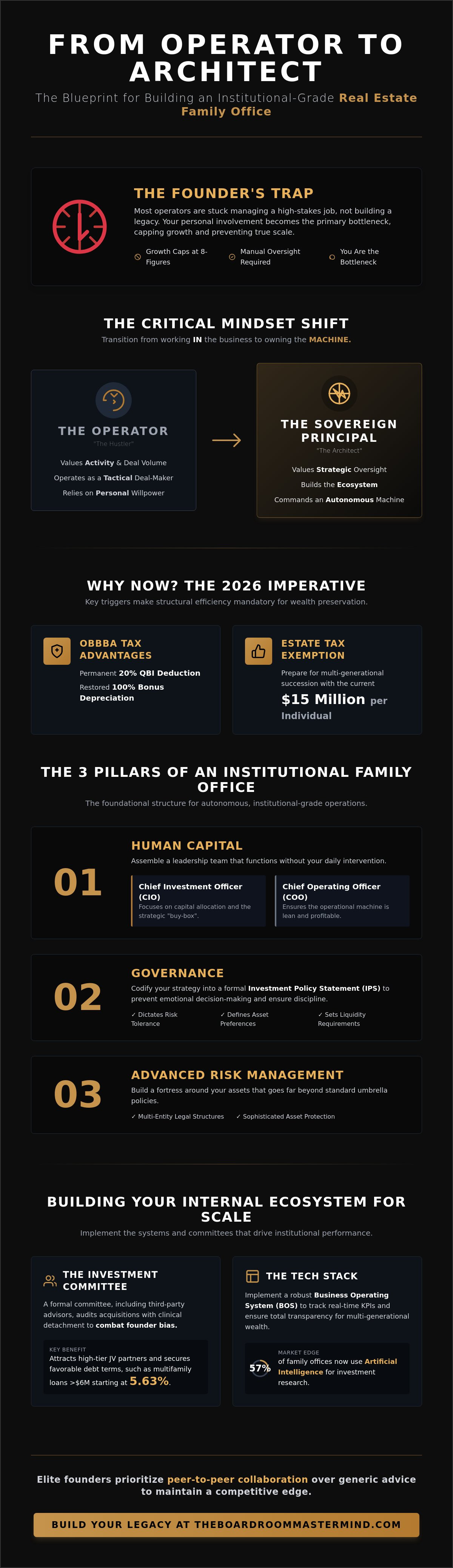
Most founders fall into the "Founder’s Trap." They operate as tactical deal-makers, personally reviewing every T-12 and signing every closing document. This hustle works at the start, but it inevitably caps growth at the 8-figure mark. You become the primary bottleneck. If your physical presence is required for the machine to run, you haven't built a legacy; you've built a high-paying job. Building a family office for real estate is the only way to break this ceiling.
Several 2026 triggers make this transition mandatory right now. With the estate tax exemption at $15 million per individual and 100% bonus depreciation restored under the OBBBA, the cost of structural inefficiency has never been higher. Whether you're facing a massive liquidity event or preparing for multi-generational succession, your current "Embedded Family Office" (EFO) within your operating company is likely overstretched. A true Single Family Office (SFO) provides the clean separation required for institutional-scale deal flow.
The Operator vs. Principal Mindset Shift
The transition requires a psychological evolution. The "hustler" mentality values activity and deal volume. The "sovereign principal" values strategic oversight and system integrity. Success in building a family office for real estate depends on your ability to stop hunting for the next deal and start building the ecosystem that finds and funds them for you. It's the difference between working in the business and owning the machine.
Signs You Have Outgrown Your Current Structure
Analyze your operational bottlenecks. If your personal involvement is the primary constraint on your deal volume, your structure is failing you. The family office is the ultimate business operating system for wealth preservation.
Structuring the Pillars of an Institutional Real Estate Family Office
Scaling a portfolio requires a shift from managing properties to managing systems. When building a family office for real estate, your primary objective is the assembly of a human capital stack that functions without your daily intervention. This starts with the distinction between your Chief Investment Officer (CIO) and Chief Operating Officer (COO). While the CIO focuses on capital allocation and the strategic buy-box, the COO ensures the operational machine remains lean and profitable. Success at this level depends on building a leadership team that specializes in institutional-grade hard assets rather than generic wealth management.
Governance is the second pillar. You must codify your strategy into a formal Investment Policy Statement (IPS). This document dictates your risk tolerance, asset class preferences, and liquidity requirements. It prevents emotional decision-making during market volatility. Parallel to this is a sophisticated approach to risk management. True institutional scale demands multi-entity legal structures and advanced asset protection that go far beyond standard umbrella insurance policies.
The Real Estate Investment Committee
Founder bias is a silent killer of 9-figure portfolios. You need a formal investment committee to audit your acquisitions with clinical detachment. By including third-party advisors, you ensure every deal is vetted against institutional benchmarks rather than your personal intuition. This level of rigor is what attracts high-tier joint venture partners and secures favorable debt terms in a 2026 market where multifamily rates for loans over $6 million start at 5.63%.
Operational Infrastructure and Tech Stacks
Transparency is non-negotiable for multi-generational wealth. Implementing a robust business operating system allows you to track real-time KPIs across diverse asset classes. With 57% of family offices now utilizing artificial intelligence for investment research, your tech stack must integrate automated forecasting and portfolio modeling. This infrastructure ensures your reporting is ready for the complex tax requirements of the OBBBA, maintaining the permanence of your 20% QBI deduction. For those ready to refine these systems among peers, the Boardroom Elite provides the necessary strategic proximity.
The Strategic Roadmap: Building Your Internal Ecosystem
The journey to institutional scale is a sequence of deliberate transitions. You cannot simply flip a switch and become a family office; you must engineer it. This begins with a rigorous audit of your current "Embedded" office functions. Most high-volume operators already have the components of a family office hidden within their property management or acquisitions teams. You must untangle these roles to ensure your personal wealth management isn't subsidized or compromised by your daily operations. Building a family office for real estate requires this clean break to achieve true sovereign oversight.
Once your functions are isolated, you must formalize your governance. This isn't a mere mission statement. It is a set of investment mandates that align your family’s multi-generational values with specific, clinical investment goals. With this framework in place, your next move is to recruit "A-Player" leadership. You need executives who have navigated institutional waters and understand the nuances of managing high-stakes capital. Finally, you must graduate from the constant treadmill of syndication-based deal flow. Transitioning into real estate private equity structures allows you to command your capital rather than constantly chasing it.
Optimizing the Capital Stack
Your family office must manage debt and equity with surgical precision to maximize your internal rate of return (IRR). In a 2026 environment where multifamily rates for institutional assets start at 5.63%, the ability to recycle capital from stabilized assets into opportunistic developments is your greatest lever. This strategic recycling ensures your capital is never stagnant. It keeps your portfolio in a state of constant, tax-efficient expansion.
Legacy and Succession Planning
Succession is a strategic risk that most founders ignore until it's too late. With the current estate tax exemption at $15 million per individual, you have a unique window to structure your legacy. Preparing the "Next Gen" isn't about handing over a check; it's about structured education and governance. If you are ready to architect a machine that survives your involvement, apply for The Boardroom Mastermind Membership to align with peers who have already secured their sovereign future.
Beyond Capital: Proximity as a Strategic Asset
High-stakes wealth architecture isn't built in a vacuum. While institutional banks provide proprietary management, they often lack the battle-tested perspective of someone who has actually liquidated a 9-figure portfolio. Elite founders understand that 95% of generic financial advice is designed for the masses. When building a family office for real estate, you don't need a consultant; you need a peer who has already solved your specific operational bottlenecks. Proximity is your most valuable non-liquid asset.
Building a family office for real estate is as much about who you know as what you own. The Boardroom Mastermind functions as a "Mastermind for Principals" rather than a training ground for operators. It's a space where leaders benchmark their infrastructure against global high achievers. Leveraging a peer advisory group allows you to audit your office performance with clinical objectivity. It's the difference between guessing your internal systems are scalable and knowing they are through collective validation.
The Power of the Quarterly Intensive
Operational blindness is a byproduct of success. Stepping out of the daily grind for Quarterly In-Person Intensives prevents stagnation. These sessions are designed to pressure-test your business model. You gain access to collective intelligence that is vital for navigating complex institutional-scale deals. In a market where 1 in 3 family offices report experiencing a cyberattack, this shared vernacular is a critical strategic asset for protecting your permanence.
Joining the Elite 1%
The transition from operator to sovereign leader is the final milestone in your professional evolution. Stop chasing the next deal and start leading the entity that owns them. If you're ready to secure a legacy that survives your involvement, it's time to align with those operating at the highest tiers of financial success. Apply for The Boardroom Mastermind to join an elite circle of real estate principals and finalize your blueprint for institutional scale.
Architecting Your Sovereign Future
The transition from a high-volume operator to a sovereign principal is the ultimate evolution for a real estate leader. You've seen how auditing your embedded functions and formalizing governance structures creates the permanence required for multi-generational wealth. Success in building a family office for real estate isn't just about the assets you acquire; it's about the institutional machine you build to manage them without your constant intervention.
True scale requires more than capital; it requires the proximity of peers who have already navigated the complexities of 9-figure portfolios. Through our Quarterly In-Person Intensives and an elite network of battle-tested visionaries, you can audit your business model against the highest industry standards. You don't have to navigate this transition in isolation. The path to total operational autonomy and a sustainable legacy is clear for those with the right access.
Apply for The Boardroom Mastermind to scale your real estate empire to institutional levels and join the ranks of 8 and 9-figure principals who are leading the industry from the top. Your legacy starts with the decision to lead, not just operate. We look forward to seeing you at the next level.
Frequently Asked Questions
What is the minimum net worth required to start a family office for real estate?
Traditionally, a Single Family Office requires $250 million to $500 million in investable assets to justify the operational overhead. However, the emerging "micro family office" model serves principals with a net worth between $1 million and $30 million. This model utilizes fractional advisors and advanced technology to provide the strategic benefits of a formal structure without the institutional price tag associated with a full-scale SFO.
How does a family office differ from a standard real estate investment company?
A standard investment company is a tactical vehicle focused on deal flow and property management. In contrast, building a family office for real estate creates a strategic entity dedicated to multi-generational wealth preservation and sovereign oversight. While the investment company handles the "how" of the deals, the family office manages the "why" of the entire portfolio, including tax efficiency under the OBBBA and legacy planning.
What are the primary costs associated with running a single-family office?
Personnel is the most significant expense, often accounting for 50% to 60% of the total operating budget. You must also account for sophisticated technology stacks for portfolio modeling and cybersecurity. This is critical since 1 in 3 family offices have reported cyberattacks with a major impact on assets. Other costs include specialized legal counsel for multi-entity structures and the overhead of maintaining independent governance and reporting systems.
Can I use my existing real estate staff to form an embedded family office?
You can utilize existing staff to form an Embedded Family Office, but you must clearly define their roles to avoid operational overlap. The danger lies in "operational blindness" where property managers attempt to act as wealth architects. To succeed in building a family office for real estate, you must eventually untangle these functions. This ensures your personal legacy isn't compromised by the daily friction of property operations.
What is the most critical first hire when building a real estate family office?
The Chief Operating Officer (COO) is typically the most critical first hire for an active real estate principal. While a CIO manages capital allocation, the COO builds the institutional-grade infrastructure required to remove the founder as the primary bottleneck. You need a battle-tested leader who can implement systems that survive your involvement. This allows you to transition effectively from tactical management to strategic oversight.


