
Breaking Through a Real Estate Business Plateau: The CEO’s Blueprint for 8-Figure Growth
What if the very grit that built your empire is now the primary obstacle to its expansion? Most high-performing principals eventually reach a ceiling where increased effort no longer yields proportional returns. You've hit the wall. Breaking through a real estate business plateau requires more than just longer hours. It demands a fundamental overhaul of your internal operating system.
You've likely realized that being the primary decision-maker for every minor operational issue is a recipe for stagnation, not scale. It's a common trap for the ambitious. We'll identify the structural bottlenecks stalling your growth and implement the executive frameworks required to scale from a tactical operator to a visionary CEO. This blueprint outlines the transition toward predictable, systemized growth and the acquisition of a peer group operating at the highest tiers of financial success.
Key Takeaways
- Identify the critical distinctions between production-based ceilings and operational bottlenecks that stall 7-figure firms.
- Transition from a reactive operator to a strategic visionary by adopting the specific mindset shifts required for high-level executive oversight.
- Implement a ruthless audit framework to expose the single points of failure within your current deal flow and capital stack.
- Learn why breaking through a real estate business plateau depends on the proximity of an elite peer network that challenges your current operational standards.
The Anatomy of the High-Level Real Estate Plateau
Most real estate principals view a plateau as a market signal or a temporary dip in energy. It's rarely either. In reality, a plateau is the logical conclusion of an outdated architecture. You've likely reached the limit of what "heroic effort" can sustain. Breaking through a real estate business plateau requires a shift from managing transactions to managing systems. It's about moving beyond the frantic energy of the initial climb toward a more grounded, strategic oversight.
There is a critical distinction between a Production Ceiling and an Operational Ceiling. A Production Ceiling is reached when your sales team hits a volume limit. An Operational Ceiling, however, occurs when your internal infrastructure cannot support more growth without the founder's direct intervention. This is where most 7-figure firms stall. They've mastered the art of the deal but haven't mastered strategic growth planning at an institutional level. Hustle is the very thing preventing you from reaching 8 or 9 figures, as it locks you into a reactive, tactical loop.
The Founder Bottleneck is the primary inhibitor of institutional scale, representing the point where the CEO remains the single point of failure for all critical operational and strategic decisions.
The 7-Figure Ceiling: Why Your Current Systems Are Failing
If your business relies on your personal presence to function, you don't own a business; you own a high-paying job. A fragile business operating system is the most common symptom of a plateau. When growth depends on your 24/7 oversight, you've built a structure that collapses the moment you step away. Predictable processes must replace your individual brilliance to ensure long-term stability.
Signs You Have Outgrown Your Current Role
Are you still reviewing minor expense reports or mediating staff disputes? If so, you're operating tactically, not strategically. The transition to 8-figure growth requires you to stop "doing the deals" and start owning the system that does the deals. It’s the difference between being the lead actor and being the studio head. True scale isn't about working harder. It's about building an organization that performs with surgical precision in your absence, allowing you to focus on high-level wealth architecture.
The Operator to CEO Mindset Shift
The psychological evolution from operator to executive is the most difficult hurdle in breaking through a real estate business plateau. Most founders remain stuck in a "Hustler" mindset, characterized by reactive decision-making and a tactical focus on daily fires. This frantic energy is the hallmark of early-stage growth, but it is toxic to 8-figure scaling. A true CEO operates with calculated confidence, moving from the center of every transaction to the architect of the entire organization.
Elite founders understand that growth is often a result of what you stop doing. You must develop the discipline to reject 95% of incoming opportunities to protect the 5% that drive exponential returns. This requires a sophisticated approach to developing business growth strategies that prioritize long-term value over short-term commission checks. You are no longer managing people; you are leading leaders. If your presence is required for the business to function, you haven't built a company; you've built a cage.
Leadership Development: Building an Unbreakable A-Player Team
Scaling an empire is impossible with B-players or "yes men" who require constant supervision. To achieve institutional scale, you must attract executive talent that challenges your thinking and owns their departments with autonomy. Implementing a CEO’s blueprint for building a leadership team ensures your organization remains resilient during market shifts. If you find yourself still making tactical decisions, your team isn't yet operating at the level required for 8-figure growth.
Accountability and Execution at the Highest Level
High-stakes professionalism requires a ruthless commitment to accountability. This isn't about micromanaging; it's about developing the discipline to audit your own leadership and systems quarterly. When you move away from the noise of the general marketplace, you find that peak performance is a result of quiet, strategic execution. For those ready to institutionalize their success, joining The Boardroom Mastermind provides the framework to audit your operations alongside peers at the same level.
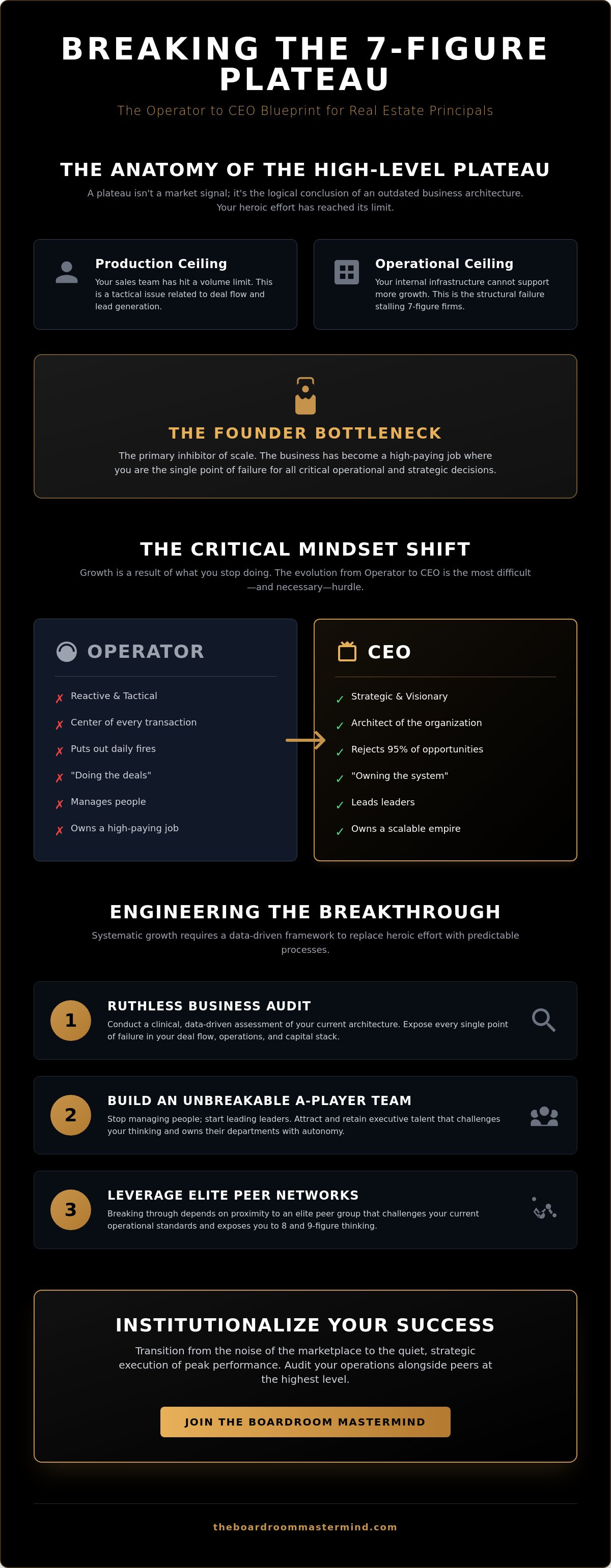
Engineering the Breakthrough: The Business Audit Framework
Breaking through a real estate business plateau requires a clinical, data-driven assessment of your current architecture. You cannot fix what you haven't diagnosed with surgical precision. A ruthless audit of your deal flow and capital stack is the first step in identifying where your growth has stalled. Often, the barrier isn't a lack of opportunity but a single point of failure in your operations. By applying a CEO's strategic checklist, you can isolate these bottlenecks and reallocate resources toward high-impact activities. This transition requires implementing a business operating system designed for 8-figure predictability, moving you from tactical management to strategic oversight.
Auditing Your Business Model for 2026
The market of 2026 demands more than just basic lead generation. You must evaluate your lead generation ROI and deal flow consistency against institutional benchmarks. Many successful principals find that their current model is too reliant on individual effort. To scale, you must move beyond simple syndication toward sophisticated real estate private equity structures. This evolution allows for greater capital efficiency and the ability to compete for larger, more profitable assets that smaller operators simply cannot touch.
The Quarterly Intensive: Auditing Growth in Real Time
It is nearly impossible to see the flaws in a system when you are the one running it. An outside perspective is essential to uncovering the blind spots in your business architecture. This is why quarterly in-person intensives are a non-negotiable for elite founders. These sessions provide the "hard reset" required to break plateaus and align your team with a clear, 8-figure vision. If you are ready to audit your business alongside a peer group of high-achievers, apply to join The Boardroom Mastermind and secure your seat at our next intensive.
The Proximity Factor: Leveraging Elite Peer Networks
You've heard that you are the average of the five people you spend the most time with. For most, this is a platitude; for the 8-figure CEO, it's a strategic reality. If your current circle is impressed by your 7-figure revenue, they've become your ceiling. They won't challenge the architecture of your business because they don't understand the complexity of your next level. Breaking through a real estate business plateau requires a room where your current peak is the baseline for everyone else.
Proximity to 8 and 9-figure earners doesn't just provide new ideas; it collapses timeframes. When you see someone else managing a $100M portfolio with less stress than you manage a $10M one, your internal standards shift. There are profound strategic benefits of a peer advisory group that general networking cannot replicate. It's about radical transparency and "iron-sharpens-iron" accountability. In these rooms, ego is discarded in favor of surgical feedback and shared expertise.
Exclusive Mastermind Groups vs. General Networking
General networking is a marketplace of noise. Exclusive masterminds are sanctuaries of execution. Restricted access creates a higher caliber of collaboration because every member has skin in the game. You aren't just swapping business cards; you're sharing wealth architecture and operational blueprints. Consult the CEO guide to exclusive mastermind groups to evaluate the ROI of high-ticket proximity. The cost of entry is often the cheapest part of the investment when compared to the cost of staying stagnant.
Transitioning to the Boardroom: Your Next Level
Moving from a tactical operator to a visionary CEO isn't a solo journey. The Boardroom Mastermind serves as the ultimate strategic asset for those ready to institutionalize their success. It's a community designed to facilitate peak performance without sacrificing personal well-being. Review our Boardroom case studies to see how other principals have navigated the 8-figure transition. Your next level of growth is inevitable when you change the room you're in.
Institutional Scale Awaits
The path to 8-figure growth is rarely paved with more hustle. It requires a clinical transition from tactical operator to visionary CEO. You've seen that the structural bottlenecks stalling your progress are often the result of outdated operating systems and a network that no longer challenges your baseline. Breaking through a real estate business plateau is a matter of engineering; you must audit your operations, lead leaders, and position yourself in rooms where 9-figure success is the standard.
Success at this level is a choice of proximity and precision. By implementing a proven "Operator to CEO" scaling framework, you can reclaim your time while ensuring your business performs with surgical accuracy. It's time to move beyond the noise of the general marketplace and secure your place among the industry's elite. Access to our quarterly in-person business intensives and an elite network of 7, 8, and 9-figure real estate entrepreneurs will ensure your trajectory remains fixed on institutional scale.
Apply to join The Boardroom Mastermind and audit your path to 8-figures.
Your vision for a self-sustaining empire is within reach. With the right systems and the right peers, the breakthrough you've been chasing becomes the logical next step in your professional evolution.
Frequently Asked Questions
What are the first signs that my real estate business has hit a structural plateau?
The first signs of a structural plateau include stagnant revenue despite increased operational effort and a growing reliance on your personal intervention to close deals. You might notice that your team's total output has flattened even as you increase headcount. This indicates that your current systems have reached their maximum capacity. If you're working harder but seeing diminishing returns, you're likely facing the limits of your current business architecture.
How do I know if I am the bottleneck in my own company growth?
You are the bottleneck if every minor operational decision requires your final approval or if the business grinds to a halt during your absence. A company that can't function for thirty days without the founder's input is a high-paying job, not a scalable asset. Breaking through a real estate business plateau requires identifying where your personal "heroic effort" is actually preventing your team from taking ownership of their specific departments.
Why is a mastermind more effective than one-on-one coaching for scaling to 8 figures?
A mastermind is more effective for 8-figure scaling because it provides proximity to a diverse peer group operating at or above your level. While one-on-one coaching offers individual focus, it often lacks the collective intelligence and competitive accountability found in an elite network. In a mastermind, you aren't just learning from a mentor; you're witnessing real-time strategic execution from multiple high-performers who are navigating similar institutional challenges.
What is the difference between a real estate "operator" and a "CEO"?
The difference between a real estate operator and a CEO lies in their focus: the operator works in the business, while the CEO works on it. An operator is reactive, managing daily fires and tactical deal flow. A CEO is proactive, designing the systems, capital stacks, and leadership teams that drive growth. Transitioning to a CEO role means prioritizing long-term wealth architecture and institutional stability over short-term transactional wins.
How much time should a real estate CEO spend on high-level strategy vs. daily operations?
A real estate CEO aiming for 8-figure growth should ideally spend 80% of their time on high-level strategy and only 20% on operational oversight. In the early stages of growth, this ratio is often reversed. However, breaking through a real estate business plateau requires a disciplined shift toward strategic planning, talent acquisition, and market positioning. Your primary value to the organization is no longer found in tactical execution but in the quality of your high-stakes decision-making.


