
Best CRM for Scaling Real Estate Business: The CEO’s Architecture for 8-Figure Growth
Is your real estate business a self-sustaining asset, or is it a high-priced job that requires your constant intervention to survive? Most high-achieving founders eventually hit a ceiling where their legacy tech stack becomes a liability rather than a lever. You've likely felt the friction of data silos and the exhaustion of manual oversight. Identifying the best crm for scaling real estate business is no longer a tactical choice for agent productivity; it's a strategic necessity for institutional-grade growth. By 2026, 89% of elite professionals will rely on AI-powered systems to maintain their competitive edge. If you're still using a basic lead tracker, you aren't just falling behind; you're building on a foundation that cannot support 8-figure volume.
You deserve a business that offers predictable deal flow and total executive visibility without requiring you to bridge every operational gap yourself. This guide will show you how to transition from a chaotic lead environment to a sophisticated business operating system that supports 8 and 9-figure scale. We'll explore the architecture required to automate high-level KPIs, ensure TCPA compliance before the January 2026 deadline, and eliminate the bottlenecks that keep you tethered to daily operations. It's time to build the wealth architecture that turns your company into a permanent, scalable asset.
Key Takeaways
- Identify why your current lead tracker is an invisible ceiling and how to escape the "Hustler’s Trap" by shifting focus from activity to high-level outcomes.
- Implement the three non-negotiable pillars of institutional-grade architecture to ensure data integrity and remove human error from your daily deal flow.
- Apply the CEO’s selection framework to identify the best crm for scaling real estate business, moving beyond basic tools toward custom solutions that support 8 and 9-figure growth.
- Master the "Integration Litmus Test" to ensure your core systems communicate seamlessly across marketing, finance, and operations for real-time visibility.
- Transform your software from a mere tool into a high-value business operating asset that provides predictable revenue without requiring your constant intervention.
Beyond Lead Tracking: Why Your Current CRM is the Invisible Ceiling on Your Growth
Most real estate founders are trapped. They believe they own a business, but they actually own a high-stress job. This is the "Hustler’s Trap." It happens when you use Customer Relationship Management (CRM) software simply to manage activity rather than outcomes. If your team uses a CRM to remember who to call, you have a digital Rolodex. If you use it to predict your revenue for next quarter, you have an asset. Searching for the best crm for scaling real estate business is a strategic audit of your entire growth engine, not just a software upgrade.
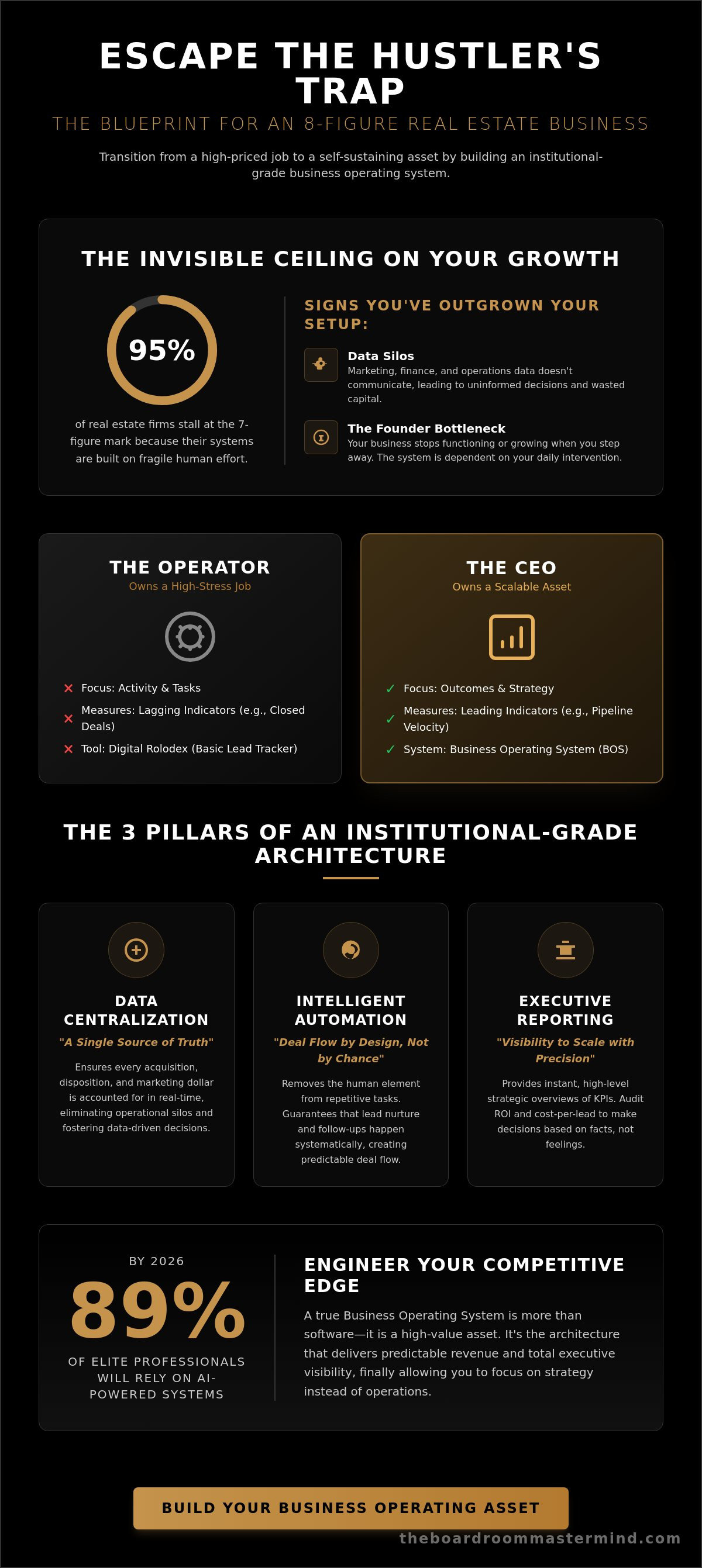
Scaling to 8 figures requires moving beyond manual data entry. Manual processes are fragile. They break under the weight of real volume. When you search for the best crm for scaling real estate business, you aren't looking for a better way to track leads; you are looking for a Business Operating System (BOS). 95% of real estate firms stall at the 7-figure mark because their systems are built on human effort. True scale requires a system built on institutional architecture that functions independently of the owner’s daily input.
The Shift from Operator to CEO
An operator looks at a task list; a CEO looks at a dashboard. To lead effectively, you must prioritize leading indicators over lagging indicators. While closed deals tell you where you've been, metrics like lead-to-appointment ratios and pipeline velocity tell you where you're going. You need a platform that exposes these numbers in real time. A scaling CRM is the central nervous system for institutional growth, coordinating every department from marketing to disposition.
Signs You Have Outgrown Your Current Setup
Growth stops when data silos emerge. If your marketing team doesn't know which lead sources are producing the highest ROI for acquisitions, you're wasting capital. The ultimate red flag is the "Founder Bottleneck." If the system stops when you stop, it isn't a system. True enterprise value is found in a "set it and forget it" operating asset that maintains deal flow while you focus on high-level strategy.
The 3 Non-Negotiable Pillars of an Institutional-Grade CRM Architecture
Scaling a high-growth firm requires more than just software; it requires a strategic blueprint. The best crm for scaling real estate business is built on three non-negotiable pillars: data centralization, intelligent automation, and executive reporting. Without a single source of truth, your departments will inevitably drift into operational silos. Centralization ensures that every acquisition, disposition, and marketing dollar is accounted for in real time. This level of transparency is foundational to the rigorous business auditing we champion within The Boardroom Mastermind Membership.
Automation is the only mechanism to remove the human element from repetitive deal-flow tasks. If your team relies on memory for follow-ups, they'll fail. Intelligent automation ensures that lead nurture happens by design, not by chance. Finally, executive reporting provides the visibility required to audit ROI and cost per lead instantly. You can't scale what you don't measure with surgical precision.
Engineering Predictable Deal Flow
Predictability is the hallmark of an 8-figure enterprise. By automating the nurture phase, you mitigate the 15 to 20 percent increase in operational costs that unoptimized firms faced in 2025. Advanced systems integrate your CRM directly with your capital stack. This allows for immediate fund allocation and faster deal closing, moving your business from a series of sporadic wins to a consistent assembly line of profitable exits.
Building for Executive Oversight
Your tech stack must serve different masters. While an acquisitions manager needs a granular view of daily tasks, a CEO requires a high-level strategic overview of pipeline velocity. Customizing these views creates a culture of accountability. When data is transparent, you foster an unbreakable leadership team that makes decisions based on facts rather than feelings. This structural clarity is what separates a chaotic office from a dominant market leader.
The CEO’s Selection Framework: Auditing CRM Platforms for 9-Figure Potential
Selecting the best crm for scaling real estate business requires a fundamental shift in perspective. While entry-level tools like Follow Up Boss or LionDesk are excellent for individual agents, they often buckle under the operational weight of an 8-figure enterprise. You aren't just buying software; you're investing in the infrastructure of your future company. High-level operators eventually graduate to robust platforms like Salesforce or monday.com, or they build bespoke Business Operating Systems (BOS) tailored to their specific workflows. The goal isn't just to track a lead; it's to manage a portfolio of opportunities with surgical precision.
The "Integration Litmus Test" is your first hurdle. Does the platform communicate seamlessly with your marketing engine and your financial reporting tools? If you have to manually move data between systems, you have a bottleneck, not a solution. Your scalability audit must ask a simple question: Will this platform handle 1,000 or more transactions a year without performance degradation? If the answer is uncertain, it's a liability. Vetting these decisions within an elite peer network is the only way to bypass the expensive trial and error that plagues most founders.
Evaluating the Tech Stack for Long-Term Wealth
Stop looking at monthly subscription fees and start calculating the Total Cost of Ownership (TCO). A cheap CRM that lacks an "API First" architecture will eventually cost you hundreds of thousands in lost efficiency and custom workarounds. Sophisticated enterprises require open APIs to ensure their data remains liquid and accessible across the entire tech stack. If you can't push and pull data programmatically, you don't own your system; the software provider does.
The Power of Proximity in Tech Decisions
Proximity is the ultimate shortcut to operational excellence. Following the lead of top producers who have already surpassed your current volume saves years of wasted capital and frustration. However, you must audit your business model before you audit your software. A CRM cannot fix a broken process; it only accelerates it. Refine your architecture first, then select the tool that amplifies your results. If you are ready to stop guessing and start engineering your growth, apply to join a community of high-level achievers who have already solved these complex puzzles.
From Software to Systems: Engineering Your Business Operating Asset
Software is often mistaken for a total solution. In reality, it is merely a tool. True enterprise value is built only when you integrate that tool into a comprehensive Business Operating System. This system becomes a permanent asset of the firm. It functions without your constant oversight and generates revenue regardless of your personal activity. Identifying the best crm for scaling real estate business is the first step toward this institutional maturity. However, the system is only as effective as the discipline behind it. As CEO, your role shifts from managing people to maintaining the integrity of the system itself. If a deal isn't documented in the BOS, it does not exist.
This transition requires moving from tactical management to strategic oversight. You no longer spend your day putting out fires or chasing individual leads. Instead, you use CRM data to identify operational friction before it impacts your bottom line. You are architecting a machine that produces predictable results. This clarity allows you to focus on high-level capital allocation and market expansion. Your tech stack should provide the "Single Source of Truth" that makes these decisions inevitable rather than speculative.
Transitioning to an 8-Figure CEO Role
You will eventually reach a point where your current network can no longer offer the answers you need. Your CRM data will reveal this ceiling. It shows when lead costs rise and conversion rates plateau despite increased effort. This is the moment you must stop hustling and start architecting. The best crm for scaling real estate business provides the transparency needed to make these high-stakes pivots. It allows you to move from the frantic energy of a startup to the composed precision of a market leader.
Next Steps for Elite Founders
Scaling to 8 figures is a solitary pursuit without the right peers. By joining The Boardroom Mastermind, you gain access to an elite community focused on auditing these very systems. Our Quarterly In-Person Intensives provide a dedicated space to refine your tech stack and leadership strategy away from the noise of daily operations. You will collaborate with founders who have already navigated the complexities of 9-figure scale. Stop managing a job. Start engineering an empire.
Secure Your Strategic Advantage
You've now seen the architecture required to escape the hustler's trap and move toward institutional-grade growth. A CRM is not merely a tool for agent productivity; it's the vital dashboard for your entire enterprise. By implementing the three pillars of institutional architecture, you remove the systemic fragility that causes many real estate firms to stall at the seven-figure mark. Identifying the best crm for scaling real estate business is ultimately about building a permanent asset that produces predictable wealth without demanding your constant presence.
The transition from operator to CEO is a calculated shift in focus. It requires the right systems, the right data, and the right proximity to those who have already scaled the mountain. If you're ready to audit your operations and join an elite network of 7, 8, and 9-figure real estate investors, it's time to step into the room. We provide the battle-tested frameworks and quarterly business audits necessary to refine your leadership and tech strategy. Apply for The Boardroom Mastermind to Audit Your Scaling Systems and start architecting your legacy today. Your next level of expansion is a matter of design, not luck.
Frequently Asked Questions
What is the best CRM for a real estate team doing over 100 deals a year?
The best crm for scaling real estate business at this volume is one that prioritizes institutional-grade visibility over basic contact management. High-growth teams often graduate to platforms like the Follow Up Boss Platform plan or Lofty because they provide the robust automation required to prevent lead leakage. However, software is only the tool; the true solution is how well that tool integrates with your broader capital stack and reporting systems to provide a single source of truth for the CEO.
Can a generic CRM like Salesforce work for a scaling real estate investment business?
Salesforce is the gold standard for enterprise-level customization and is highly effective for sophisticated investment firms. It offers an "API First" architecture that allows you to build a bespoke Business Operating System tailored to complex departmental needs. While it requires a more significant initial investment in setup compared to industry-specific tools, it provides the long-term flexibility needed to manage 8 and 9-figure deal flow without outgrowing your infrastructure.
How much should an 8-figure real estate company spend on its CRM and tech stack?
An 8-figure enterprise should view tech spending as a strategic investment in automation rather than a simple monthly expense. While basic software costs can range from $400 to over $1,500 monthly depending on user count and AI add-ons, the Total Cost of Ownership often includes custom integrations and data security. You're paying to remove the human element from repetitive tasks. Budget for the system that ensures your revenue is predictable and your data is secure.
What is the difference between a real estate CRM and a Business Operating System (BOS)?
A CRM is a tactical tool designed to track lead activity, while a Business Operating System is the strategic architecture that runs your entire company. Your CRM becomes a component of your BOS when it's integrated with marketing, finance, and acquisitions to provide real-time executive visibility. A BOS allows you to transition from tactical management to strategic oversight. It turns your business into a self-sustaining asset that functions independently of the founder's daily intervention.
How do I ensure my leadership team actually uses the CRM to its full potential?
Adoption is a matter of culture and leadership discipline rather than software training. You must establish a rule that if a deal or interaction isn't documented in the system, it doesn't exist. Stop accepting verbal updates and start conducting your business audits directly from the dashboard data. When you tie KPIs and compensation to the metrics within the system, your leadership team will naturally maintain the data integrity required to scale effectively.


