
Avoiding the Entrepreneur’s Trap: Architecting Your Exit from the 7-Figure Ceiling
Your highest level of competence is currently your greatest operational liability. You've built a seven-figure machine through sheer force of will, yet you're finding that the harder you push, the more the gears grind to a halt. It's a frustrating paradox where increased effort yields stagnant revenue and chronic burnout. Successfully avoiding the entrepreneur's trap requires a fundamental shift in how you view your role. You aren't just hitting a market ceiling; you're hitting a structural one that you built yourself.
We recognize that the frantic energy of a startup cannot survive the sophisticated demands of an elite enterprise. You'll discover how to transition from a high-performance operator to a strategic CEO by identifying and dismantling the specific bottlenecks that cap your growth. This article provides the blueprint to replace manual intervention with a self-sustaining business asset. We'll explore the architecture of 8-figure scale, focusing on how to regain your personal freedom while your enterprise continues to expand. It's time to stop working in the business and start architecting its exit from your daily oversight.
Key Takeaways
- Identify the critical transition from high-performance operator to strategic CEO to overcome the structural limits of your own competence.
- Learn the specific methodology for avoiding the entrepreneur's trap by transforming your role from the primary engine of growth to its chief architect.
- Establish a sophisticated Business Operating System built on five core pillars to ensure institutional scale and predictable 8-figure performance.
- Document and institutionalize "tribal knowledge" to create a self-sustaining asset that functions with elite precision in your absence.
- Utilize external auditing and the power of proximity to uncover the operational bottlenecks that remain hidden to those inside the daily grind.
What is the Entrepreneur’s Trap in High-Stakes Business?
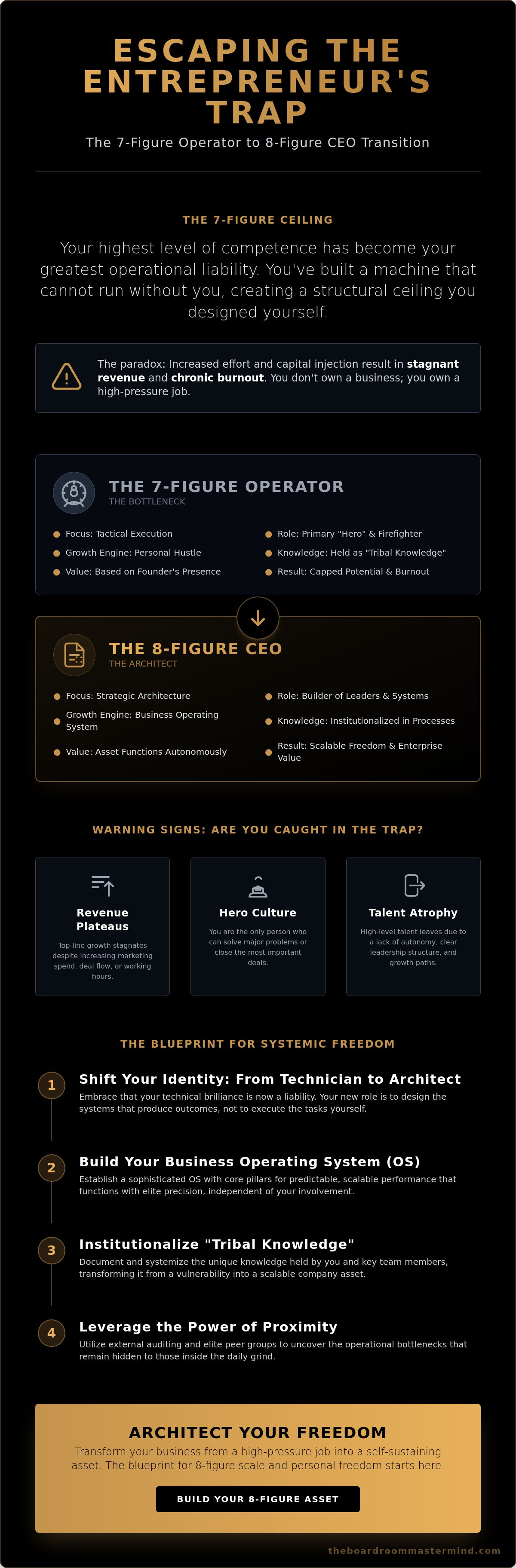
Success in the seven-figure range is often built on the founder's relentless drive and tactical brilliance. However, this same competence eventually transforms into a structural liability. The entrepreneur’s trap is the precise point where the founder becomes the primary bottleneck for all growth. You've reached a stage where your business cannot breathe without your permission; every decision, deal, and operational pivot requires your direct oversight. Successfully avoiding the entrepreneur's trap requires a fundamental shift from the "Hustler" mindset to that of a "Strategic CEO."
The Hustler lives in the world of tactical execution, priding themselves on being the most capable person in the room. In contrast, the CEO focuses on strategic architecture, building systems that function with elite precision regardless of their personal presence. When you remain the "Center of the Wheel," every department depends on your individual bandwidth. This often manifests as a sophisticated form of Founder's Syndrome, where the very control that sparked your initial success now prevents institutional scale. To reach eight figures, you must dismantle the silo of your own ego and replace it with a scalable Business Operating System.
The 7-Figure Ceiling: Why Success Becomes a Silo
Seven-figure success is frequently the result of personal effort. You've pushed through the noise, but you've hit an invisible cap. In a scaling real estate or high-stakes enterprise, personal bandwidth is a finite resource. Once your time is fully exhausted, growth stops. You aren't lacking market opportunity; you're lacking the structural integrity to support more deal flow without breaking yourself in the process.
Symptoms of the Trap in 2026
Identifying the trap is the first step toward escaping it. In the current high-growth environment, these symptoms are unmistakable:
- Revenue Plateaus: Your top-line revenue remains stagnant even as you increase marketing spend or deal volume.
- Hero Culture: You are the only person capable of closing complex deals or solving high-level operational crises.
- Talent Atrophy: High-level executives leave because there is no clear leadership structure or autonomy.
If the business stops moving the moment you stop working, you don't own an asset. You own a high-pressure job that you cannot leave.
The CEO Transition: Why Your Current Hustle is Your Greatest Liability
The belief that you are the most capable person in your organization is your most expensive delusion. While tactical brilliance may have secured your first seven figures, it's the exact barrier preventing you from reaching eight. Avoiding the entrepreneur's trap requires a brutal audit of where your ego is masquerading as "quality control." Many leaders face the classic rich versus king trade-offs; they choose the "king" role by maintaining total authority, but they sacrifice the "rich" outcome of a truly scalable enterprise. In 2026, the CEO mindset is about architecting outcomes, not executing tasks.
From Technician to Architect: The Identity Shift
Your unfair advantage as a technician, perhaps your ability to navigate complex capital stacks or negotiate fund management terms, eventually becomes your fatal flaw. If you're the only person who can solve a high-level problem, you've built a business that is inherently unscalable. You must transition from being the engine of the business to its chief architect. This shift is explored deeply in our guide on The 7-Figure Ceiling: A CEO Guide to Exclusive Mastermind Groups, which outlines how elite peers help you see your own blind spots.
The True Cost of the Bottleneck
Tactical management is a low-yield activity for a high-stakes leader. Every hour you spend on $50 tasks is an hour stolen from $10,000 strategic moves that drive long-term wealth. Beyond your daily schedule, founder-dependency actively devalues your business as a saleable asset. Investors and buyers look for systems, not heroes. If the business collapses the moment you step away, it isn't an asset; it's a liability. To begin building a self-sustaining machine, consider the strategic framework offered by The Boardroom Mastermind Membership, which focuses on high-level execution and autonomous growth.
Systemic Freedom: Building a Business Operating System for 8-Figure Scale
Systemic freedom isn't found in a better calendar; it's built into the architecture of your enterprise. To bridge the gap between seven and eight figures, you must implement a robust Business Operating System (BOS). This framework rests on five non-negotiable pillars: Strategy, Team, Workflow, Data, and Culture. Without these, your business remains a collection of high-stress tasks rather than a self-regulating asset. Avoiding the entrepreneur's trap requires you to stop managing people and start managing the systems that manage the people.
The transition from leading by activity to leading by indicators is the hallmark of a sophisticated CEO. You cannot scale what you cannot measure. This shift directly addresses the paradox of entrepreneurial success, where the specific skills that launched the company eventually hinder its expansion. You must capture "Tribal Knowledge" and convert it into repeatable, scalable workflows. When your intellectual property is documented, the business no longer relies on your daily presence to maintain deal flow or operational excellence.
Designing the Machine: The 4-Step Exit Plan
Architecting your exit from the tactical loop requires a disciplined approach to delegation and oversight. Follow this sequence to regain your autonomy:
- Step 1: Audit your current role to identify low-value tasks that drain your strategic bandwidth.
- Step 2: Recruit a leadership team that excels in the operational areas where you are weak.
- Step 3: Implement a cadence of accountability through weekly KPI reporting and quarterly objectives.
- Step 4: Gradually remove yourself from the tactical deal-flow loop to focus exclusively on high-level strategy.
The Role of an Unbreakable Leadership Team
An elite enterprise is only as strong as its secondary layer of leadership. As you scale, you'll find that A-Players require a different management style than the "Hustlers" of your early days; they demand autonomy and clear metrics. For a detailed breakdown on sourcing this talent, see our guide on Building a Leadership Team: The CEO’s Blueprint for 8-Figure Scale. To install these systems with the guidance of battle-tested peers, apply for The Boardroom Mastermind Membership and start architecting your 8-figure exit today.
The Power of Proximity: Escaping the Trap Through Elite Collaboration
You cannot read the label from inside the jar. When you're immersed in the daily mechanics of fund management or navigating complex capital stacks, you lose the objectivity required for high-level auditing. The most dangerous phase of scaling is when you've become the smartest person in your immediate circle. Avoiding the entrepreneur's trap is nearly impossible without the external pressure and perspective of those who have already breached the eight-figure threshold. Proximity isn't just about networking; it's about strategic alignment with peers who challenge your operational status quo.
The Boardroom Mastermind Membership provides the specific, high-stakes accountability that a solo founder simply cannot replicate. It moves you away from the echo chamber of your own management team and into a space of restricted access where the only currency is results. If your current network doesn't force you to evolve your leadership structure, it's actually anchoring you to your current ceiling. True growth requires a peer group that identifies your blind spots before they become systemic failures.
Why a Peer Advisory Group is the Ultimate Shortcut
Attempting to solve structural bottlenecks through trial and error is a waste of your most valuable asset: time. Engaging with peer advisory groups offers a significant strategic advantage by allowing you to learn from the multi-million dollar mistakes of others. Our Quarterly In-Person Intensives are designed to force this perspective, providing a dedicated environment to work on the business rather than in it. These sessions are not mere meetings; they are high-level briefings where the architecture of your exit is stress-tested by industry leaders.
Auditing Your Exit: The Boardroom Experience
The path to autonomy begins with a brutal assessment of your current operational bottlenecks. Through the Boardroom Experience, we provide the framework to deconstruct your role and identify the exact points where your presence is hindering scale. It's time to stop being the hero of your own story and start being the architect of a self-sustaining empire. If you're ready to join the top 5% of real estate investors and secure your personal freedom, apply for The Boardroom Mastermind today. Your eight-figure future is the logical conclusion of the right proximity.
Architect Your 8-Figure Future
Transitioning from a high-performance operator to a strategic architect is the only path to breaching your current revenue ceiling. You've seen how seven-figure success often creates a silo where your personal bandwidth becomes the ultimate bottleneck. Successfully avoiding the entrepreneur's trap requires more than just better time management; it demands a total deconstruction of your operational role. By implementing a robust Business Operating System and shifting to leadership by indicators, you transform your business into a self-sustaining asset rather than a high-pressure job.
The journey to 8-figure scale is paved with elite collaboration and proven frameworks. You don't have to navigate this complex transition in isolation. Our exclusive network of 7, 8, and 9-figure real estate investors provides the peer-level auditing and quarterly in-person intensives necessary to stress-test your strategy and ensure long-term permanence. It's time to reclaim your personal freedom and elevate your global impact. Your next level of success is a logical conclusion of the right systems and the right proximity.
Join the Elite: Apply for The Boardroom Mastermind Today
Frequently Asked Questions
Is the entrepreneur’s trap inevitable for every successful founder?
The entrepreneur's trap is a structural milestone for nearly every founder who achieves significant seven-figure success. It occurs because the specific skills used to launch the business are rarely the same ones required to scale it. Avoiding the entrepreneur's trap is a deliberate strategic choice to replace manual effort with institutional systems. Without this transition, your growth will naturally plateau at the limits of your personal bandwidth.
How do I know if I am the bottleneck in my own business?
You are the bottleneck if your business cannot function for thirty days without your direct intervention. Conduct a decision audit by counting how many operational choices require your final approval each week. If deal flow, capital raising, or team management grinds to a halt during your absence, you've built a job rather than a self-sustaining asset. A true CEO manages indicators, not individual tasks.
Can I escape the entrepreneur’s trap without hiring a full executive team?
Initial escape is possible through hyperautomation and sophisticated workflows, but long-term eight-figure scale eventually requires elite human capital. In 2026, many founders utilize agentic automation to handle complex workflows before bringing on full-time executives. However, the transition from operator to architect is ultimately about leadership. You can automate the "what," but you must eventually hire A-players to lead the "who."
What is the difference between a business coach and a mastermind group for avoiding the trap?
A business coach offers a singular perspective, whereas a mastermind group provides the power of proximity to multiple high achievers. While a coach might help you with personal productivity, a peer advisory group offers a strategic briefing from those who have already breached the eight-figure ceiling. This collective intelligence allows you to audit your business against battle-tested frameworks rather than generic advice.
How long does it typically take to transition from Operator to CEO?
The transition is a strategic process that typically takes twelve to twenty-four months of disciplined implementation. This timeline allows for the documentation of tribal knowledge, the recruitment of a leadership team, and the stabilization of a Business Operating System. It's not an overnight shift but a phased withdrawal from tactical deal flow. The speed of your exit depends entirely on your willingness to relinquish control in favor of scale.


