
Attracting Institutional Capital for Real Estate: The CEO’s Blueprint for 9-Figure Scale
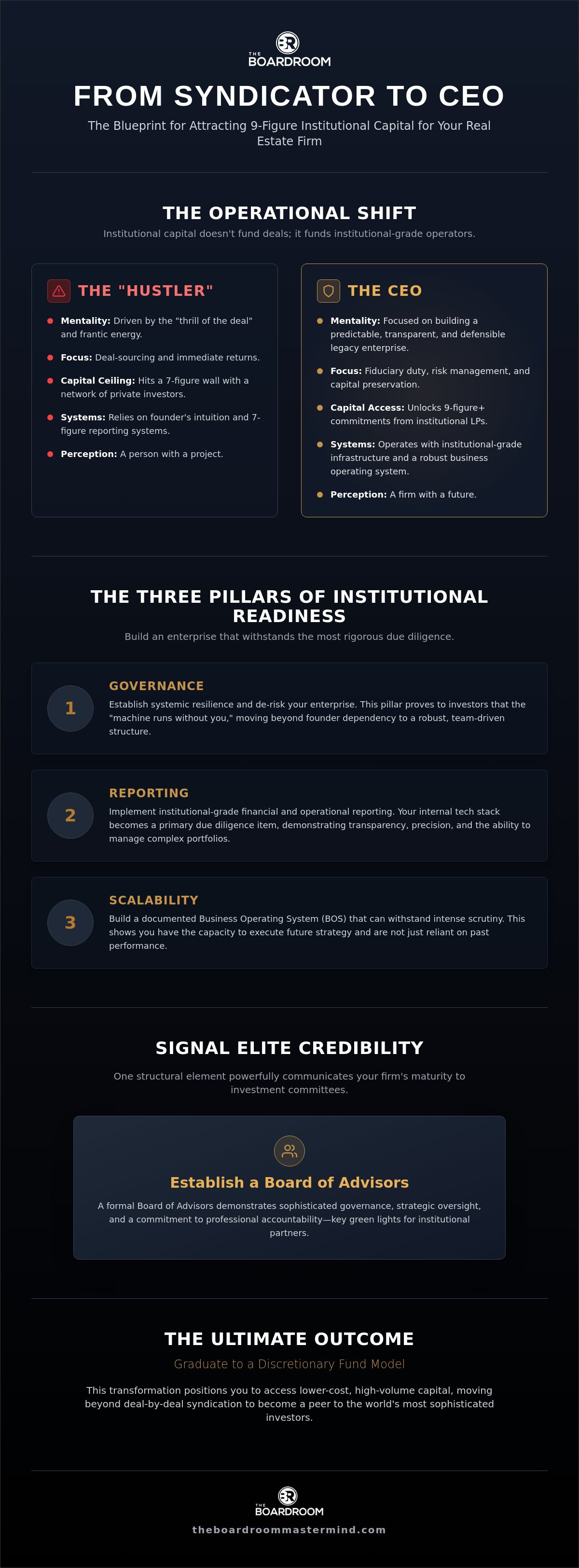
Institutional capital doesn't fund real estate deals; it funds institutional-grade operators who happen to hold real estate. If you've hit a capital ceiling with your current network of private investors, the obstacle isn't the asset class or the current 3.50% federal funds rate. It's the infrastructure of your firm. Attracting institutional capital for real estate requires a calculated transition from being a deal-driven syndicator to becoming a systems-driven CEO. You cannot expect 9-figure commitments while operating with 7-figure reporting systems and a "hustler" mentality.
You likely feel the friction of outgrowing your current capital sources while competing against firms that have mastered the language of global high achievers. It's a common bottleneck for ambitious leaders who have the vision but lack the institutional-grade reporting to back it up. This article reveals the exact operational shifts and structural requirements needed to graduate from deal-by-deal syndication to a discretionary fund model. We will preview the roadmap to building a legacy-scale enterprise that accesses lower-cost, high-volume capital and positions you as a peer to the world's most sophisticated investors.
Key Takeaways
- Master the transition from retail syndication to high-volume funding by aligning your firm with the professionalized expectations of the 2026 market.
- Implement the "Three Pillars of Institutional Readiness" to ensure your reporting and governance systems meet the rigorous demands of global capital partners.
- Refine your strategic positioning by moving away from a generalist model to a specialized narrative that highlights your firm's unique operational edge.
- Identify the structural requirements for attracting institutional capital for real estate and learn how a Board of Advisors signals elite credibility to investment committees.
- Conduct a comprehensive enterprise audit to remove the operational bottlenecks that prevent you from scaling toward a discretionary fund model.
The Evolution of Capital: Graduating to Institutional Real Estate Partnerships
Institutional capital represents the definitive transition from the fragmented world of retail syndication to the high-volume, professionalized funding sources of the global elite. For most operators, the leap into Private Equity Real Estate requires more than just a larger balance sheet. It demands a fundamental re-engineering of how you perceive your role. While the 2026 market dynamics, characterized by a steady 3.50% federal funds rate, have stabilized values, they've also narrowed the field for generalists. Institutional capital is the alignment of fiduciary duty with scalable operational systems.
To better understand the structural shifts necessary for your portfolio, watch this helpful video:
The "Hustler" mindset is built on the thrill of the deal, hunting for the next acquisition with the frantic energy of a newcomer. In contrast, the "CEO" mindset focuses on building a legacy-scale enterprise that attracts capital because it's predictable, transparent, and defensible. Attracting institutional capital for real estate is impossible if you're still managing your firm like a high-stakes hobby. When you focus on attracting institutional capital for real estate, you're essentially marketing your operational maturity rather than just your deal flow.
The Threshold of Scale: When to Seek Institutional Funding
Most operators hit a 7-figure capital ceiling where private money becomes a bottleneck rather than a fuel. At this stage, your track record alone is no longer the primary currency. Institutional LPs aren't just buying your past performance; they're buying your future capacity to execute. This requires a robust business operating system that can withstand the intense scrutiny of a professional investment committee. Without these systems, you're merely a person with a project, not a firm with a future.
Fiduciary Duty vs. Deal Sourcing
Managing institutional capital requires a psychological shift from being a deal-sourcer to being a fiduciary. Private investors often prioritize immediate returns and personal relationships; conversely, institutional LPs view risk management through the lens of capital preservation and systemic stability. Your enterprise must prove it can protect 9-figure allocations with the same precision you used to find your first deal. This means moving beyond the tactical and embracing the strategic oversight that defines true executive leadership.
Building Institutional-Grade Infrastructure: Systems and Governance
Institutional partners don't just audit your assets; they audit your operational integrity. If your firm still relies on the founder's intuition for every decision, you aren't ready for 9-figure scale. Attracting institutional capital for real estate is a process of de-risking your enterprise for the world's most discerning LPs. They seek systemic resilience, not individual heroics. This requires establishing the three pillars of institutional readiness: Governance, Reporting, and Scalability. Your internal tech stack is now a primary due diligence item, serving as the central nervous system that proves your ability to manage complex portfolios with precision.
To move beyond the "hustler" stage, you must prioritize building a leadership team that removes you as the single point of failure. Institutional investors need to know the machine runs without you. Citing research on the attractiveness for institutional real estate investments, it's clear that regulatory compliance and internal controls are non-negotiable for global capital entry. Third-party audits and transparent financial controls aren't just administrative burdens; they're the language of trust in high-stakes finance.
Reporting and Transparency Requirements
Standardized KPIs are the baseline for professional credibility. You must move beyond simple cash-on-cash ROI to more sophisticated metrics that institutional committees demand. This includes:
- Internal Rate of Return (IRR): Calculated with precision over the hold period.
- Equity Multiple: Proving the total value created relative to invested capital.
- Time-Weighted Returns: Eliminating the distortions of cash flow timing to show true manager performance.
Utilizing institutional-grade property management and accounting software is essential. If you're still using basic spreadsheets for 8-figure portfolios, you're signaling a lack of scalability.
Governance and Risk Mitigation
Governance is about creating a predictable environment for capital. Implementing an Investment Committee (IC) de-risks your decision-making by introducing formal checks and balances. Furthermore, by July 2026, formal Environmental, Social, and Governance (ESG) frameworks have become a mandate for most pension funds and endowments. These LPs require documented proof of your firm's impact and sustainability efforts before they commit to a discretionary fund model. If you are ready to audit your current systems against these elite standards, consider exploring the strategic frameworks used by industry leaders.
Strategic Positioning: Specialization and the Family Office Narrative
Institutional investment committees don't fund generalists. In the high-stakes world of 9-figure allocations, being a "jack of all trades" is a strategic liability. It signals a lack of deep operational focus and suggests your firm hasn't yet mastered a specific domain. Attracting institutional capital for real estate requires you to define a sharp, defensible "Edge." Whether it is proprietary deal flow in secondary markets, industry-leading operational efficiency, or niche dominance in a specific asset class, your positioning must be unmistakable. You are no longer just a deal-maker; you are a specialized fiduciary.
The transition to global capital often requires a mid-tier bridge. Family offices serve as this essential gateway. Unlike larger pension funds that demand massive scale immediately, family offices prioritize long-term wealth preservation and alignment of values. By mastering real estate private equity structures now, you prove your readiness for the more rigid requirements of the institutional world. This is where you refine your narrative from "chasing returns" to "architecting legacy."
The Family Office Advantage
Family offices are the ultimate proving ground for aspiring institutional operators. They offer more flexible capital but require a sophisticated touch that balances performance with privacy. Your pitch must pivot away from short-term gains toward systemic stability. When you can demonstrate that your enterprise protects their capital across market cycles, you build the track record necessary for the largest endowments in the world.
Niche Dominance as a Capital Magnet
Capital flows where expertise is concentrated. Consider the current institutional appetite for specialized sectors like Industrial or Build-to-Rent (BTR). Operators who focus exclusively on BTR, for example, can leverage the exceptions in recent legislation like the "21st Century ROAD to Housing Act" to gain a competitive advantage. Deep market knowledge is proven through data-driven reporting, not anecdotes. If you can show a 13-17% CAGR in PropTech adoption within your portfolio, you aren't just an operator; you're a market leader. If you are ready to command this level of market presence, apply to join our elite circle of high-growth executives.
The CEO’s Audit: Preparing Your Enterprise for 9-Figure Capital
Before you step into the boardroom of a pension fund or a global endowment, you must survive your own internal scrutiny. Attracting institutional capital for real estate isn't a pitch; it's the presentation of a finished, high-performance machine. You cannot expect a capital partner to trust your systems if those systems still reside in your head. A "Pre-Flight" audit identifies the operational friction points that will inevitably be exposed during institutional due diligence. This audit isn't just about financial health; it's about verifying that your enterprise can withstand the weight of 9-figure scale.
One of the most effective ways to add immediate institutional gravity is by building a formal Board of Advisors. This isn't a group of friends; it's a strategic assembly of industry veterans who have already navigated the waters you're entering. Their presence signals to LPs that your firm values diverse oversight and professional governance. It's a calculated move that shifts the focus from your individual talent to the collective intelligence of your organization.
Removing the Founder Bottleneck
The greatest risk to any scaling enterprise is a founder who refuses to let go of tactical management. You must test your systems with ruthless honesty. Can your business run for 30 days without your direct involvement? If the answer is no, you aren't a CEO; you're a high-paid manager of a fragile entity. Transitioning from the "Chief Everything Officer" to a strategic visionary is the only path to institutional readiness. This evolution allows you to focus on high-level capital architecture while your leadership team handles the operational execution.
Engineering the Elite Network
High-level networking is a strategic asset, not a professional luxury. Proximity to other 8 and 9-figure founders is the fastest way to level up your enterprise. When you surround yourself with peers who have already secured institutional-grade commitments, their "normal" becomes your baseline. This is why the benefits of a peer advisory group are so critical for elite founders. You gain access to the unspoken rules of the institutional world and the specific architectural shifts required to compete at the highest tier.
The path to 9-figure scale is reserved for those who value systems over deals and strategy over activity. If you are ready to audit your business model alongside a community of battle-tested visionaries, the next level of your enterprise is within reach. To begin this transition and secure your seat among the industry elite, apply for The Boardroom Mastermind today.
Architecting Your Institutional Future
Attracting institutional capital for real estate is more than a fundraising exercise. It's the deliberate transformation of your firm from a deal-driven shop into a professionalized enterprise. By implementing rigorous governance, mastering specialized market niches, and removing yourself as the operational bottleneck, you position your firm as a peer to global high achievers. The path to 9-figure scale requires a level of precision that most generalists simply cannot maintain. It's about moving from the frantic energy of the chase to the calculated confidence of a legacy-scale leader.
You don't need to build this infrastructure in a vacuum. Proximity to battle-tested visionaries who have already crossed these thresholds is your greatest strategic asset. Our community offers quarterly in-person business intensives and an exclusive peer network of 7, 8, and 9-figure investors who share the technical vernacular of success. You can see the tangible impact of this environment in our Case Studies. If you're ready to stop being a "hustler" and start leading as a CEO, the next level of growth is waiting for you. Join the elite 5% of real estate founders scaling to 9-figures at The Boardroom Mastermind.
Frequently Asked Questions
What is the minimum AUM required to attract institutional capital?
Most institutional LPs look for a minimum of $100 million to $250 million in Assets Under Management (AUM) to ensure the sponsor has the infrastructure to handle significant allocations. While some specialized funds may look at smaller operators with a unique niche, the $100 million mark is generally the threshold where your firm is perceived as having the necessary operational maturity. Smaller firms often bridge this gap by starting with Family Offices to build the track record required for larger pension fund commitments.
How do institutional real estate investors evaluate a sponsor’s track record?
Institutional investors evaluate a sponsor’s track record by looking for consistency across multiple market cycles and specific asset classes. They prioritize risk-adjusted returns, focusing heavily on realized Internal Rate of Return (IRR) and Equity Multiples rather than just pro-forma projections. Committees will scrutinize your ability to execute on your stated strategy, looking for evidence that your "Edge" is a repeatable system and not merely the result of favorable market timing.
What is the difference between a Family Office and an Institutional Investor?
The primary difference lies in the source of capital and the rigidity of the investment mandate. Family Offices manage the wealth of specific families, often offering more flexible terms and a focus on long-term wealth preservation and legacy. Institutional Investors, such as pension funds or insurance companies, manage public or corporate capital and operate under strict fiduciary mandates with standardized reporting requirements. Attracting institutional capital for real estate requires meeting these higher regulatory and compliance hurdles that Family Offices might overlook.
Do I need a discretionary fund to attract institutional LPs?
You don't strictly need a discretionary fund for your first institutional partnership, but it is the gold standard for achieving 9-figure scale. Many operators begin with a Joint Venture (JV) structure for a single asset to prove their capabilities to a specific partner. However, graduating to a discretionary model signals to the market that you have the systems and investor trust to move rapidly on opportunities without deal-by-deal approval. It’s the ultimate mark of an institutional-grade CEO.
How long does the due diligence process take for institutional capital?
The due diligence process typically takes six to twelve months from the initial introduction to the first capital call. This timeline accounts for an exhaustive deep dive into your firm's governance, third-party audits, and background checks on your leadership team. It is a marathon of transparency that tests every system you've built. Preparing your enterprise for this level of scrutiny is a core requirement for attracting institutional capital for real estate at the highest tiers of success.


