
Asset Protection Strategies for Real Estate Investors: Building an 8-Figure Fortress
What if the very equity you've spent a decade building is actually the largest liability in your portfolio? Most high-performing owners believe they're safe because they have a few scattered LLCs and a standard insurance policy. However, as your net worth climbs toward the eight-figure mark, you aren't just an investor anymore; you're a primary target for predatory litigation. You recognize that the simple structures that served you at five properties will inevitably crumble under the weight of fifty. Mastering advanced asset protection strategies for real estate investors is no longer optional. It's the critical difference between owning a business and being owned by your risks.
You've worked too hard to let a single legal challenge dismantle your legacy. We're going to bridge the gap between tactical management and strategic oversight. This briefing outlines the sophisticated legal frameworks required to shield your assets and transition from a vulnerable operator to an untouchable real estate CEO. We will analyze how to leverage the 2026 lifetime estate tax exemption of $15 million, the nuances of charging order protection, and the structural systems needed to attract institutional-level capital. It's time to build a fortress that ensures your wealth is preserved for generations to come.
Key Takeaways
- Shift your mindset from tactical insurance coverage to structural separation, ensuring your personal identity is entirely decoupled from commercial liability.
- Implement sophisticated asset protection strategies for real estate investors by utilizing Wyoming or Delaware holding companies to establish ironclad anonymity and superior charging order protection.
- Master the art of equity stripping to make high-value assets unattractive to creditors by strategically encumbering properties with legitimate liens.
- Deploy Land Trusts to maintain complete privacy of ownership while streamlining the ease of asset transfer within your growing portfolio.
- Standardize your legal architecture to meet the rigorous due diligence requirements of private equity and family offices, paving the way for institutional-level capital attraction.
The CEO Perspective on Asset Protection: Moving Beyond Insurance
True asset protection is the strategic separation of your personal identity from your commercial liability. It is a fundamental architectural requirement for any portfolio scaling toward institutional levels. Many operators mistake high-limit umbrella insurance for a comprehensive shield; it isn't. While insurance is a necessary tactical tool for liquidity after a loss, it does not prevent the loss of control or the public exposure of your wealth. Relying solely on a policy is a reactive posture that leaves your foundation vulnerable to exclusions, policy limits, and the whims of an adjuster. Advanced asset protection strategies focus on the legal ownership of the asset itself, ensuring that even if a judgment exceeds your coverage, your core holdings remain untouched.
To better understand the structural necessity of these systems, watch this high-level briefing on legal frameworks:
The Fortress Mindset is the non-negotiable psychological prerequisite for achieving and sustaining 8-figure real estate growth. This mindset demands that you distinguish between internal and external liabilities. Internal liability arises from incidents on the property, such as a tenant injury, while external liability stems from personal legal issues, such as a car accident or a private dispute. Without a robust structure, a personal lawsuit can pierce through to your properties, and a property lawsuit can drain your personal bank accounts. Sophisticated asset protection strategies for real estate investors create a "one-way valve" that isolates these risks into distinct, manageable silos.
The Vulnerability of the 7-Figure Hustler
Most investors reach the seven-figure mark through sheer grit, but they often leave a trail of "liability bottlenecks" behind them. If your personal name appears on a deed or a mortgage, you've painted a target on your back for any litigious predator with access to public records. Scaling requires a psychological shift from "owning properties" to "governing an enterprise." You must stop thinking like a landlord and start operating like a CEO who manages a complex web of legal entities designed for maximum privacy and minimum exposure.
Why Your Current Systems Are Your Greatest Risk
Fragmented entity management is the silent killer of established portfolios. When you have three LLCs in three different states with no cohesive holding structure, you create "cracks" that creditors can exploit through a process known as "piercing the corporate veil." A rigorous business audit is the only way to identify these structural weaknesses before they're tested in court. If your entities aren't properly capitalized or if you're commingling funds, your protection is nothing more than a paper thin illusion.
The Architecture of an Empire: Advanced Entity Structuring
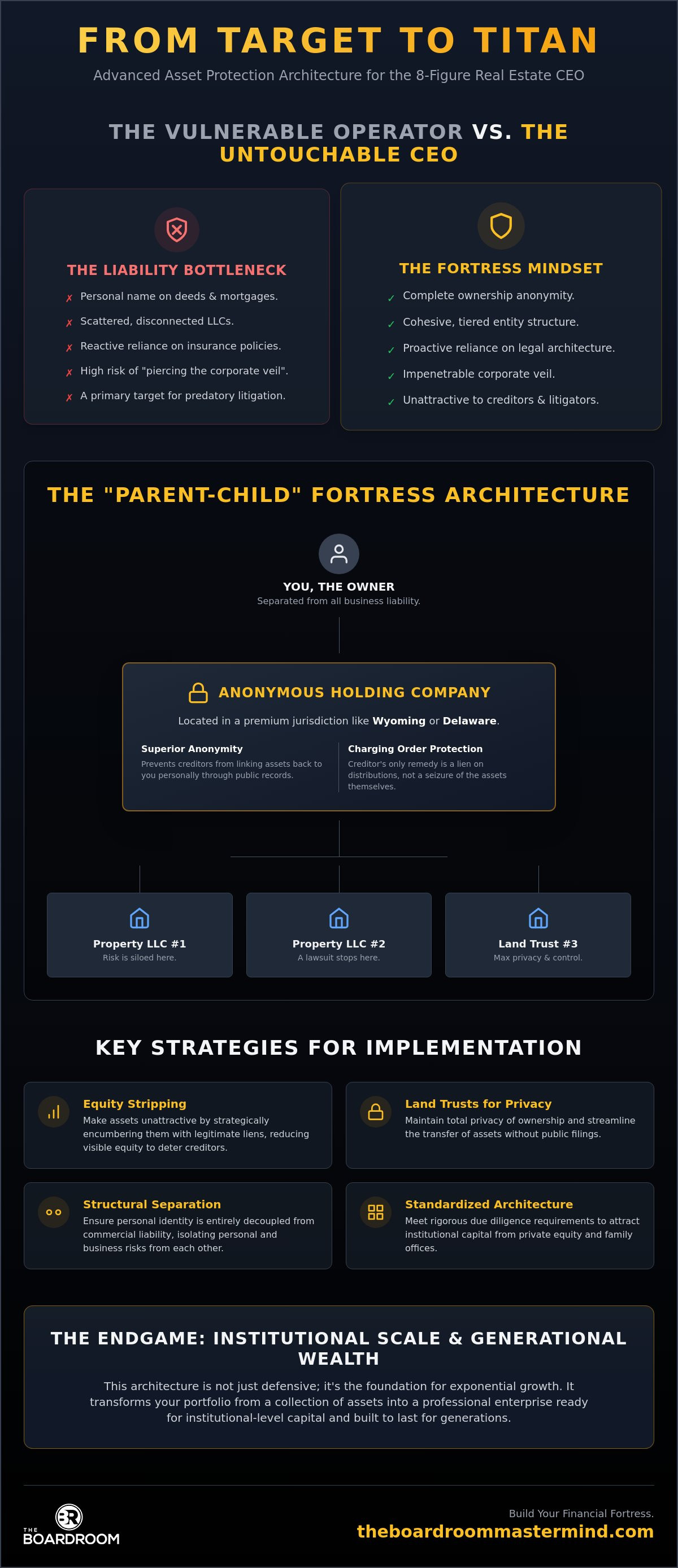
The transition from a high-net-worth individual to a sophisticated enterprise owner begins with architectural integrity. While the novice investor relies on a single LLC, the eight-figure CEO utilizes a "Parent-Child" hierarchy to isolate risk and maximize privacy. This structure utilizes an anonymous holding company, typically established in Wyoming or Delaware, to serve as the sole member of individual sub-entities that hold specific assets. When you implement these advanced asset protection strategies for real estate investors, you ensure that a legal event at one property cannot migrate upward to the holding company or laterally to other holdings in your portfolio.
Jurisdictional arbitrage is your greatest ally in this process. Wyoming remains a premier choice for holding companies because it offers robust charging order protection. This legal barrier ensures that even if a creditor wins a judgment against you personally, their only remedy is a lien on distributions, which you control, rather than the forced liquidation or seizure of the underlying real estate. Strict adherence to corporate formalities is the only way to ensure your legal entities remain separate in the eyes of the court; without them, your fortress is merely a collection of unsecured rooms. Utilizing these asset protection strategies allows you to maintain control while shedding the risks associated with individual ownership.
The Role of the Anonymous Holding Company
Privacy is your ultimate deterrent. An anonymous holding company acts as the "Manager" of all your sub-entities, effectively removing your personal name from public records and state registries. This layer of obscurity prevents predatory litigants from easily mapping your total net worth through simple search tools. In jurisdictions like Wyoming, member and manager information is not a matter of public record, allowing you to maintain a position of "silent control" over your entire empire. Executing this level of structural precision is a core focus for leaders within The Boardroom Mastermind who are scaling toward institutional exits.
Operating Entities vs. Asset Holding Entities
You must never house activity and equity in the same legal bucket. High-risk functions like property management, construction, and tenant relations should be isolated within a dedicated "Operating LLC" that owns zero assets. This entity signs the leases and hires the contractors, while your high-equity properties remain safely tucked away in separate "Asset Holding LLCs" or Series LLCs. As your operations grow, you will need a sophisticated leadership team to manage these distinct divisions, ensuring that your strategic focus remains on expansion rather than tactical firefighting. Refining these asset protection strategies for real estate investors ensures that if a management dispute arises, the underlying real estate remains shielded from the fallout.
Advanced Strategies for Equity Stripping and Privacy
Building an 8-figure fortress requires more than just legal walls; it requires making your assets invisible or entirely unappetizing to creditors. While entity structuring provides the skeleton of your defense, equity stripping and privacy protocols provide the muscle. Mastering advanced asset protection strategies for real estate investors involves a shift toward offensive defense. You don't just wait for a lawsuit to arrive. You ensure that when a predator performs a preliminary asset search, they find nothing worth the cost of a legal battle. This level of sophistication is exactly what separates the high-growth CEO from those who hit a 7-figure ceiling and remain stuck in tactical vulnerability.
Equity Stripping: The Invisible Shield
Equity stripping is the art of making a property "poisonous" to a potential litigant. By encumbering your high-equity assets with "friendly liens" or utilizing cross-collateralization strategies, you effectively reduce the "predatory value" of the asset. If a creditor realizes that a $2 million property is encumbered by $1.9 million in senior debt, the incentive to sue evaporates. These liens must be substantiated by legitimate promissory notes and security agreements to remain defensible in court. When executed correctly, you maintain the utility and cash flow of the asset while leaving zero meat on the bone for a judgment creditor.
Privacy as a Primary Defense Layer
Privacy is your ultimate deterrent. Your name should never appear on a public deed, a mortgage, or a state registry. Utilizing Land Trusts allows you to maintain the privacy of ownership while providing for the seamless transfer of beneficial interest. By appointing a Nominee Trustee and using professional registered agents, you effectively break the digital paper trail that links your personal identity to your commercial empire. A CEO's personal residence is their most vulnerable emotional asset; it should always be held within a specialized trust or LLC to ensure it remains invisible to the public eye. If you are ready to implement these institutional-grade frameworks, you should explore the Boardroom experience to align with peers operating at this tier.
For catastrophic "doomsday" scenarios, the integration of a Bridge Trust or an Asset Protection Trust (APT) provides the final fail-safe. These structures allow you to maintain domestic control of your assets during peace time while retaining the ability to move the trust's jurisdiction offshore if a legal threat becomes imminent. This hybrid approach offers the convenience of a domestic entity with the untouchable strength of a foreign jurisdiction.
Institutional Scale: Preparing for Private Equity and Beyond
Scaling to an eight-figure empire requires a fundamental shift from individual deal-making to institutional fund management. Institutional partners and family offices don't just look for high yields; they demand absolute clarity in your legal architecture. They won't deploy capital into a portfolio where personal and commercial liabilities are blurred or where ownership trails are messy. Implementing advanced asset protection strategies for real estate investors is the only way to satisfy the rigorous due diligence of high-level capital providers who prioritize risk mitigation as much as profit.
Structural Integrity for Capital Attraction
Institutional partners require "clean" entities with clear indemnification and protection layers. They need to see that your assets are isolated and that your operating entities are properly capitalized. A robust Business Operating System is essential for maintaining these legal frameworks at scale. This structural discipline facilitates the transition from individual syndications to a more scalable Real Estate Private Equity model. When your architecture is institutional-grade, you aren't just selling a property; you're selling a governed enterprise that is ready for a massive exit.
The Boardroom Audit: Engineering Your Exit
At this level, your greatest risk is the "single point of failure" you haven't identified yet. A structure that worked for ten properties will often buckle under the weight of fifty. Within The Boardroom Mastermind, elite investors audit these structures during quarterly intensives to identify vulnerabilities before they become liabilities. These high-level peer reviews ensure your wealth architecture is not just a theoretical plan but a battle-tested reality. You can view our Member Spotlights to see how peers have systemized their wealth protection to prepare for institutional scale.
Your portfolio's ultimate value is directly tied to its structural integrity. If you are ready to move beyond tactical management and build an untouchable real estate empire, visit our Experience page to see how 8-figure founders optimize their empires. It is time to stop operating as a target and start leading as a CEO.
Securing Your Legacy: From Operator to Architect
You've moved beyond the frantic energy of the early hustle. Now, your focus must shift toward permanence. By transitioning from simple LLCs to sophisticated holding structures and utilizing advanced tools like equity stripping, you ensure your portfolio remains a fortress rather than a target. Implementing these asset protection strategies for real estate investors is the bedrock upon which institutional-grade empires are built. Without them, your growth is limited by the very risks you haven't yet mitigated.
True scale isn't achieved in isolation. It requires a peer group that has already navigated the complexities of eight and nine-figure exits. The Boardroom Mastermind offers exclusive access to a community of high-achieving founders and quarterly in-person intensives designed to audit and optimize your business architecture. This is where strategic collaboration with elite CEOs turns structural vulnerability into competitive superiority. You gain the weight of collective experience to ensure your systems are bulletproof.
Don't wait for a legal event to test your foundation. It's time to refine your systems and secure your wealth for future generations. Apply to Join The Boardroom Mastermind and Audit Your Empire to begin your transition to an untouchable real estate CEO. Your next level of impact is waiting for those ready to lead.
Strategic Briefing: Frequently Asked Questions
What is the best state for real estate asset protection?
Wyoming and Delaware remain the premier jurisdictions for sophisticated owners seeking to shield their portfolios. Wyoming is often preferred for its superior charging order protection and member anonymity, while Delaware offers the most robust and predictable body of corporate case law in the United States. Choosing between them is a matter of architectural alignment with your specific scaling goals and the requirements of your future institutional partners.
Can a single LLC protect multiple properties effectively?
Housing multiple properties in a single LLC creates a catastrophic "single point of failure" where a legal event at one property can jeopardize the equity of every other asset in that entity. You must isolate high-equity assets into individual silos, such as Series LLCs or separate Statutory Trusts, to ensure that liability remains contained. This granular approach is a fundamental component of advanced asset protection strategies for real estate investors who prioritize portfolio permanence.
How does a Land Trust differ from an LLC for privacy?
A Land Trust is primarily a privacy tool designed to keep your personal name off public records, whereas an LLC is a legal shield designed to limit commercial liability. Land Trusts do not provide asset protection on their own; they function as a defensive layer that masks ownership from predatory searches. For maximum impact, you should use a Land Trust to hold title while an anonymous LLC serves as the beneficiary.
Is equity stripping legal for real estate investors?
Equity stripping is a legal and highly effective deterrent when it is substantiated by legitimate promissory notes and security agreements. It involves encumbering an asset with debt to make it unattractive to creditors who perform preliminary asset searches. If there's no accessible equity for a judgment creditor to seize, the incentive for a predatory litigant to pursue the asset evaporates entirely. It's a strategic move that turns your equity into an invisible target.
What happens to my asset protection plan if I want to sell to a Private Equity firm?
A sophisticated asset protection plan actually increases your portfolio's value by providing the clean, siloed structure that Private Equity firms require during due diligence. These firms prioritize "buyable" assets with clear indemnification and zero commingling of funds. Your structural integrity ensures a smoother transition to institutional capital and a more profitable exit because the buyer can easily audit and integrate your holdings into their own enterprise.


