
Advanced Real Estate Investment Portfolio Management Strategies: The CEO’s Blueprint for 8-Figure Scale
Most real estate investors are merely high-paid property managers disguised as owners, trapped in a loop of tactical fire-fighting that prevents them from ever reaching true institutional scale. You likely feel the weight of this operational bottleneck every time you dive into a spreadsheet or struggle to give a high-net-worth partner a definitive 2026 projection. To scale effectively, you must move beyond basic tracking and adopt advanced real estate investment portfolio management strategies that favor systems over sweat equity. You know that to hit an 8-figure valuation, you cannot be the person manually analyzing every single deal.
This guide will show you how to implement the institutional-grade frameworks required to move you from the engine room to the captain's chair. You'll learn to build a wealth architecture that remains resilient even as the 30-year fixed mortgage rate sits at 6.53 percent and the commercial market continues its complex recovery. We are breaking down the financial frameworks, data-driven systems, and executive oversight protocols required to stress-test your assets and secure your position as a visionary CEO. It's time to stop managing properties and start leading an empire.
Key Takeaways
- Shift your focus from individual asset underwriting to wealth architecture, transforming your portfolio into a predictive engine for 8-figure growth.
- Master advanced real estate investment portfolio management strategies that leverage complex capital stacks and waterfall distributions to satisfy high-net-worth partners.
- Build a standardized financial operating system that ensures data integrity and allows for hands-off executive oversight of every transaction.
- Understand the necessity of elite peer proximity to stress-test your portfolio against market volatility and eliminate the founder’s echo chamber.
Beyond the Spreadsheet: Why Advanced Portfolio Management is a CEO Asset
Real estate is not a hobby. It's high-stakes financial architecture. If you're still viewing individual properties in isolation, you aren't a CEO; you're a technician. Advanced real estate investment portfolio management strategies act as a predictive lens. They transform a collection of fragmented assets into a unified, scalable empire. This shift moves you from the frantic energy of a deal-hunter to the calculated confidence of a visionary leader. You aren't just buying buildings anymore. You're architecting a multi-asset business model where every acquisition serves a specific purpose within your broader wealth structure.
A robust portfolio strategy becomes the ultimate source of truth for your firm. It eliminates the emotional, gut-based decision-making that often leads to over-leveraged disasters. While many operators master real estate investing fundamentals, few ever bridge the gap to institutional-grade oversight. This strategy dictates when to hold, when to liquidate, and how to pivot before the market forces your hand. It's the difference between owning a job and owning a legacy.
The 7-Figure Ceiling: Why Your Current Systems are Stalling
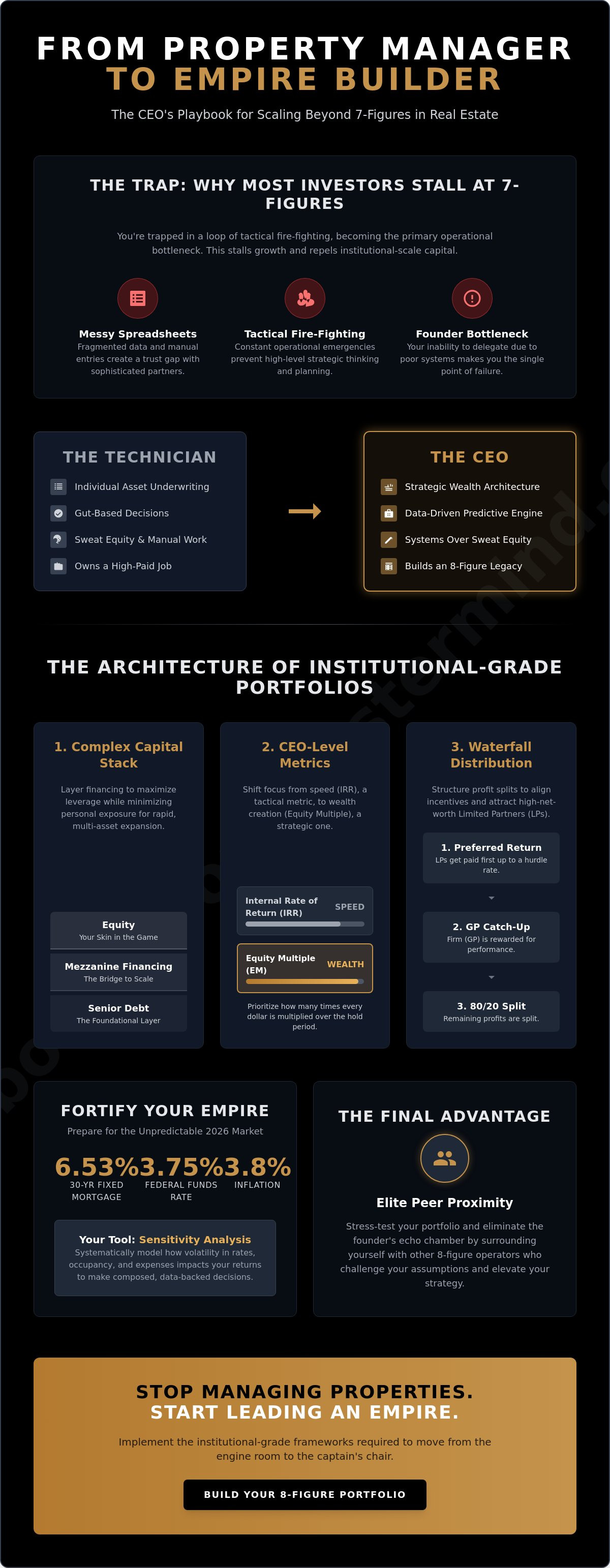
Messy spreadsheets are the silent killer of 8-figure dreams. When your data lives in fragmented tabs and manual entries, you become the primary operational bottleneck. You can't scale what you can't see with clarity. This creates a significant trust gap when you're presenting to institutional-scale capital. Sophisticated partners won't back a vision built on amateur data. If your systems can't survive a rigorous audit, you'll remain capped at the 7-figure level, regardless of your work ethic.
Modeling as a Tool for Strategic Autonomy
A sophisticated portfolio model allows you to exit the engine room and step onto the bridge. By standardizing how your firm analyzes risk and returns, you empower your team to execute without your constant intervention. Strategic oversight means maintaining a composed, high-level view of the portfolio's health while navigating the 3.8 percent inflation and interest rate shifts of the 2026 market. This autonomy is the only path to achieving peak performance without sacrificing your lifestyle or your sanity.
The Architecture of Institutional-Grade Portfolios: Waterfalls and Sensitivity
Building an 8-figure empire requires more than just capital. It requires a sophisticated understanding of how that capital is layered and protected. At this level, your real estate investment portfolio management strategies must evolve to incorporate a complex capital stack. You aren't just looking at a simple loan-to-value ratio. You're balancing senior debt, mezzanine financing, and equity to maximize leverage while minimizing personal exposure. Senior debt provides your foundation, but the mezzanine layer often acts as the bridge that allows for rapid, multi-asset expansion without diluting your core ownership too early.
A visionary CEO also understands the tension between Internal Rate of Return (IRR) and the Equity Multiple. While many operators chase high IRR to signal speed, the true architect of wealth prioritizes the Equity Multiple. Speed is a tactical metric; wealth is a strategic one. You want to know how many times every dollar is being multiplied over the hold period. This shift in perspective ensures you're building for permanence and long-term impact, rather than just flipping for a quick exit.
Mastering the Waterfall: GP/LP Structures That Attract Capital
To attract institutional-grade partners, your distribution models must be impeccable. Waterfall distributions define the hierarchy of profit, utilizing hurdle rates to ensure your Limited Partners (LPs) receive a preferred return before the General Partner (GP) participates in the upside. Incorporating catch-up provisions allows the firm to be rewarded for its performance once those investor benchmarks are met. This structure aligns incentives and provides the transparency required to leverage real estate private equity as your primary scaling vehicle. If you want to play at the highest levels, your financial transparency must be your greatest competitive advantage.
Sensitivity Analysis: Preparing for the Unpredictable in 2026
The 2026 market demands a composed approach to risk. With the federal funds rate at 3.75 percent and 30-year fixed mortgage rates averaging 6.53 percent, your models must account for volatility. Sensitivity analysis is your shield. It allows you to stress-test your portfolio against cap rate expansion and fluctuating vacancy rates. By modeling "black swan" events, you gain the data-backed confidence to remain aggressive while your competitors freeze in uncertainty. This level of high-level financial oversight ensures that your downside is protected, leaving the upside as a mathematical inevitability. You don't guess the future. You architect it.
Scaling from Tactical Underwriting to Strategic Wealth Architecture
Scaling an empire requires you to fire yourself from the day-to-day math. If you're still the primary person auditing every cell in a deal model, you've become the ultimate operational bottleneck. Advanced real estate investment portfolio management strategies aren't just about better spreadsheets; they're about building a Business Operating System that ensures data integrity without your constant presence. The transition from "Excel Jockey" to "Strategic Portfolio Reviewer" is the definitive hurdle for any leader moving toward an 8-figure valuation. It requires a shift from doing the work to auditing the system that does the work.
You must standardize your underwriting process so that every deal is viewed through the same institutional lens. This consistency allows you to integrate complex modeling into your quarterly business audit, ensuring that your portfolio remains optimized for 2026 market conditions. When your financial department operates with this level of precision, you stop reacting to the market and start dictating your firm's growth trajectory. Systems provide the clarity that gut feelings never can.
Building an A-Player Financial Team
You cannot reach institutional scale with a generalist assistant. To protect an 8-figure portfolio, you need a specialized hierarchy. Analysts handle the high-volume data crunching. Controllers ensure the accuracy of the books and capital calls. A CFO architects the long-term financial strategy. This structure is essential for building a leadership team that can manage the math while you manage the vision. You're hiring for expertise that exceeds your own in specific technical domains.
Leading vs. Lagging Indicators in Portfolio Management
Most operators focus on lagging indicators, such as last month's cash flow or historical occupancy. A CEO looks forward. Your portfolio model must utilize leading indicators to predict capital needs and cash flow requirements 12 to 24 months in advance. By identifying these trends early, you can secure financing or pivot your acquisition strategy before a liquidity crunch occurs. This forward-looking stance is what separates the masters of wealth architecture from the victims of market cycles. To see how your current systems measure up against elite standards, explore the Boardroom Digital Portal for high-level strategic frameworks.
Auditing Your Empire: The Power of Elite Peer Proximity
Isolation is the greatest liability for an 8-figure CEO. Even the most sophisticated financial models are susceptible to the "echo chamber" effect, where a solo leader stops questioning their own assumptions about risk and market direction. To maintain unbreakable real estate investment portfolio management strategies, you must subject your architecture to the scrutiny of a Board of Advisors. This isn't about mentorship for beginners. It's about peer-level auditing where high-stakes professionals stress-test your capital stack and identify the blind spots that could derail a 9-figure vision.
The ROI of proximity is measured in the catastrophic errors you avoid. By engaging with those who have already achieved institutional scale, you gain access to a shared vernacular of success. The Boardroom Mastermind facilitates this level of radical transparency, allowing you to refine your systems alongside global high achievers. When you stop operating in a vacuum, your decision-making moves from calculated guesses to strategic certainties. High-level execution requires high-level feedback.
The Boardroom Intensive: A Quarterly Audit for Your Business
Our Quarterly In-Person Intensives serve as a rigorous health check for your firm. During these sessions, you present your portfolio strategy to a room of elite peers who understand the nuances of the 2026 market. This process forces you to justify your allocations and risk management protocols in the face of current 3.8 percent inflation and shifting cap rates. Peer feedback prevents the kind of structural decay that happens when a founder is too close to the data to see the flaws. You leave with a refined blueprint and the confidence to deploy capital aggressively.
Transitioning to the CEO Role with Absolute Confidence
Mastering advanced portfolio strategy is the final step in your evolution from operator to visionary. It provides the financial clarity needed for professional expansion and the systems required for personal freedom. You've built the architecture; now you must lead the empire. If you're ready to exit the operational bottleneck and step into a space of restricted access and elite performance, it's time to act. Apply for The Boardroom Mastermind and Audit Your Path to 9-Figures. Your legacy depends on the strength of your oversight.
Architecting Your 9-Figure Legacy
The transition from a high-stakes operator to a visionary real estate CEO isn't a matter of effort. It's a matter of architecture. You've seen how institutional-grade waterfalls, sensitivity analysis, and robust leadership teams form the bedrock of an unbreakable empire. By implementing advanced real estate investment portfolio management strategies, you move beyond the limitations of manual deal-tracking and into a space of predictable, scalable growth. The systems you build today are the only assets that will survive the market volatility of 2026 and beyond.
Scaling to 8 and 9 figures requires a level of scrutiny that you cannot provide in isolation. You need access to battle-tested scaling frameworks and a peer network of 7, 8, and 9-figure investors who will challenge your assumptions. Through our quarterly in-person intensives, you'll subject your business to the rigorous auditing required for elite performance. Don't let your current operational bottlenecks define your future impact. It's time to step onto the bridge and lead with absolute clarity. Apply for The Boardroom Mastermind and Audit Your Path to 9-Figures. Your path to the next level is clear for those with the right access.
Frequently Asked Questions
What is the difference between basic underwriting and advanced real estate portfolio management?
Basic underwriting is a tactical exercise focused on the viability of a single asset while advanced real estate investment portfolio management strategies focus on the health of the entire multi-asset business model. You're moving from asking if a building will cash flow to asking how that asset impacts your firm's total weighted average cost of capital. This holistic view allows you to identify cross-collateralization opportunities and tax efficiencies that remain invisible when you're looking at deals in isolation.
How much detail should a CEO personally know about their financial models?
A CEO must master the underlying logic and stress-test parameters without getting lost in the individual spreadsheet cells. You don't need to write every formula, but you must know exactly which levers, such as a 50-basis point shift in the 6.53 percent average mortgage rate, will break your debt service coverage ratio. Your role is to define the risk thresholds and audit the outputs of your financial team to ensure every data point supports your 8-figure vision.
Which software is best for institutional-grade real estate modeling in 2026?
Institutional leaders in 2026 typically rely on a combination of Argus for complex valuation and AppFolio Investment Management for GP/LP reporting and capital calls. For custom wealth architecture, many elite firms utilize proprietary Excel frameworks integrated with Power BI to visualize real-time portfolio health across different sectors. The goal isn't just data storage; it's predictive analytics that turn raw numbers into high-level strategic executive briefings that drive 2026 decision-making.
How do I structure a waterfall model to attract high-net-worth investors?
Sophisticated investors expect a tiered waterfall structure that prioritizes their capital preservation and a preferred return before your firm participates in the performance upside. This structure typically includes a preferred return hurdle followed by a GP catch-up and a final carried interest split. Using these advanced real estate investment portfolio management strategies proves to high-net-worth partners that your incentives are aligned and that your firm is built for institutional-grade transparency and performance.
Can advanced portfolio management help predict and mitigate market downturns?
Advanced management acts as an early warning system by utilizing sensitivity analysis to model "black swan" scenarios and liquidity crunches. By stress-testing your assets against the current 3.8 percent inflation rate and potential cap rate expansion, you can identify which properties are vulnerable before the market shifts. This foresight allows you to build defensive cash reserves or restructure debt while the market is still liquid, ensuring your empire remains unbreakable during volatility.


